
 LV
 EN
 RU
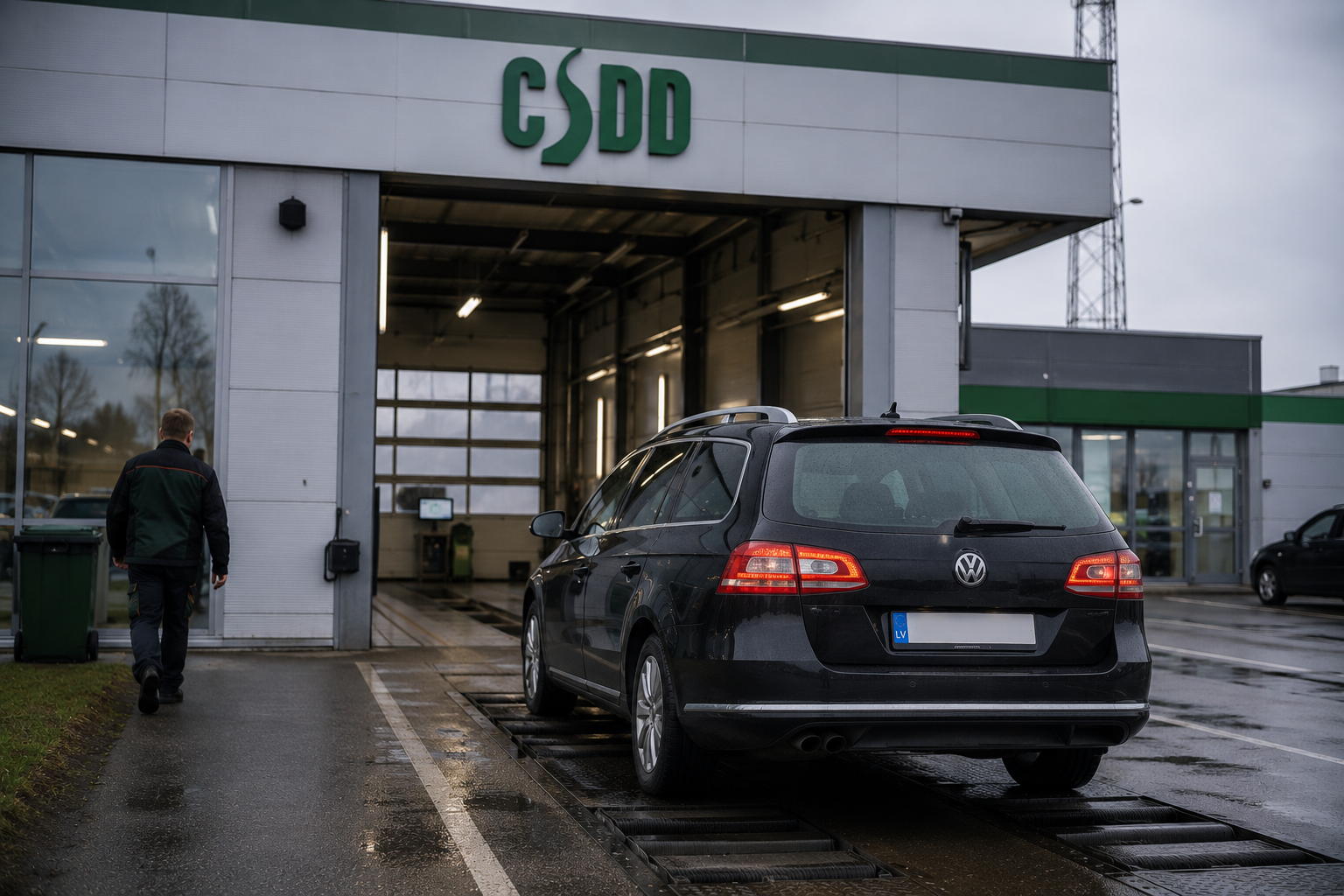
Information checked on 30 July 2026. The EU roadworthiness-testing reform has not yet been finally adopted. The European Commission has submitted a proposal, while the European Parliament and the Council of the EU have approved their negotiating positions and are continuing discussions on the final text. This article therefore clearly distinguishes between the rules currently in force in Latvia, the Commission’s original proposal and possible future requirements.
The news that the European Union wanted cars over ten years old to undergo a roadworthiness inspection every year caused considerable concern in many countries.
Some drivers saw it as yet another additional cost for owners of older vehicles. Others began calculating whether it would remain worthwhile to maintain a car that was ten or fifteen years old.
In Latvia, however, the situation is much more interesting than the dramatic headlines suggest.
Passenger cars in Latvia already undergo a roadworthiness inspection every 12 months after their ninth year.
The Commission’s original proposal for annual inspections after ten years would therefore not have created a new inspection frequency for a large proportion of Latvian drivers.
Moreover, the situation at EU level had changed by summer 2026. Both national governments in the Council of the EU and the European Parliament rejected a mandatory change from biennial inspections to annual inspections after a vehicle’s tenth birthday in their negotiating positions.
This does not mean that the entire reform has been abandoned.
On the contrary, roadworthiness testing may become more digital, more precise and much more closely connected with a vehicle’s electronic data, mileage, emissions and safety software.


The short conclusion: the EU has not adopted a rule requiring every car over ten years old to undergo an annual inspection. Both Parliament and the Council currently oppose this part of the Commission’s proposal. In Latvia, the dispute would make little difference in any case because older passenger cars are already inspected every year.
What did the European Commission originally propose?
In April 2025, the European Commission published a broad reform of roadworthiness testing and vehicle-registration rules.
The Commission’s original proposal stated that M1-category passenger cars and N1-category light commercial vehicles should be inspected:
• for the first time four years after their first registration;
• every two years after that until the vehicle reached ten years of age;
• every year after the vehicle reached ten years of age.
This would have been an EU minimum standard. Member states would still have been allowed to use a stricter inspection schedule.
The Commission justified the proposal by pointing out that Europe’s vehicle fleet is ageing and that older vehicles present an increased risk of technical defects, excessive emissions and mileage manipulation.
However, the proposal covered much more than inspection frequency alone.
| Change proposed by the Commission | Practical significance |
|---|---|
| Annual inspection for vehicles over ten years old | In countries where older vehicles are inspected every two years, owners would have to undergo inspections twice as often |
| New NOx and ultrafine-particle tests | Damaged or deliberately modified diesel and petrol emissions systems would be easier to detect |
| Inspection of electric and hybrid high-voltage systems | Greater attention to batteries, high-voltage cables and electrical safety during roadworthiness inspections |
| Testing electronic safety systems | The condition of ADAS and other safety functions could be checked through the vehicle’s electronic interface |
| Broader recording of mileage data | It would become more difficult to reduce odometer readings before selling a used vehicle |
| Digital registration and inspection documents | Fewer paper documents and faster checks in another EU country |
What had happened by summer 2026?
The European Commission submits a proposal, but the final legislation is adopted jointly by the European Parliament and the Council of the EU, which represents the governments of the member states.
Both legislative institutions had approved their negotiating positions by summer 2026.
| Institution | Position on annual inspections after ten years | Status |
|---|---|---|
| European Commission | Proposed mandatory annual inspections for passenger cars and light commercial vehicles after ten years | Original proposal from April 2025 |
| Council of the EU | Rejected the Commission’s proposed increase in inspection frequency and wanted to retain the current minimum requirements | Negotiating position approved on 4 December 2025 |
| European Parliament | Also rejected the transition from biennial inspections to annual inspections after ten years | Negotiating mandate approved on 21 May 2026 |
| Final legislation | Not yet adopted | Negotiations are continuing between Parliament, the Council and the Commission |
What does this mean in practice? Because neither the Council’s nor Parliament’s initial position includes the ten-year annual-inspection requirement, its inclusion in the final text currently appears less likely. However, negotiations have not concluded, so it is legally accurate to say that the requirement has not been adopted, rather than that it has been permanently abandoned.
Older vehicles in Latvia are already inspected every year
Latvia’s inspection schedule for passenger cars differs from the EU minimum used in the Commission’s proposal.
| Inspection | Time after first registration | Interval until the next inspection |
|---|---|---|
| First roadworthiness inspection | After 3 years | 24 months |
| Second roadworthiness inspection | Approximately after 5 years | 24 months |
| Third roadworthiness inspection | Approximately after 7 years | 24 months |
| Fourth roadworthiness inspection | Approximately after 9 years | 12 months |
| All subsequent inspections | For an older vehicle | Every year |
For example, a car first registered in 2016 is already subject to annual roadworthiness testing in Latvia in 2026.
The headline “The EU will require ten-year-old vehicles to be inspected every year” therefore gives Latvian drivers the incorrect impression that an entirely new obligation is being planned.
Even if the Commission’s original version were adopted, Latvia would most likely be able to retain its existing stricter schedule.
How many Latvian vehicles are affected?
Latvia has one of the vehicle fleets in which older cars represent a particularly large share.
Official statistics for the end of 2025 show the following distribution of registered passenger cars:
| Vehicle age | Number of registered cars | Approximate share |
|---|---|---|
| Under 2 years | 37,751 | 4.7% |
| 2–5 years | 51,975 | 6.5% |
| 5–10 years | 108,199 | 13.5% |
| 10–20 years | 376,970 | 47.0% |
| Over 20 years | 227,889 | 28.4% |
In total, Latvia had 604,859 passenger cars more than ten years old.
That represented approximately 75.3% of the entire registered passenger-car fleet.
Any change to roadworthiness-testing procedures in Latvia therefore affects not a small group of old vehicles but the majority of car owners.
How much does a roadworthiness inspection cost?
According to the price list published by the Latvian Road Traffic Safety Directorate, or CSDD, the total cost of the basic inspection for an M1-category passenger car is EUR 36.95.
| Service | Price stated by CSDD |
|---|---|
| Basic M1-category inspection | EUR 34.10 |
| Granting permission to participate in road traffic | EUR 2.85 |
| Total basic inspection cost | EUR 36.95 |
| Total repeat-inspection cost | EUR 21.39 |
This amount does not include the vehicle operation tax, insurance, repairs or other payments that the owner may need to make before the inspection.
If a vehicle passes the basic inspection on its first attempt for five consecutive years and the price remains unchanged, the total cost of five annual inspections would be EUR 184.75.
However, owners of older vehicles in Latvia already face these costs. The EU reform does not currently create a second inspection within the same year or propose inspections every six months.
Inspection frequency may not be the most important part of the reform
For Latvian drivers, the parts of the reform that received less attention in public headlines may prove much more significant.
If the common directions supported by Parliament, the Council and the Commission remain in the final legislation, the roadworthiness-testing system could become more closely connected with:
• digital vehicle documents;
• vehicle registers in other EU countries;
• odometer readings recorded by repair shops;
• electronic data from connected vehicles;
• remote roadside emissions measurement;
• diagnostics of ADAS and electronic safety systems;
• inspection of electric and hybrid high-voltage systems.
Could a Latvian-registered vehicle be inspected in another EU country?
One of the most practically interesting proposals is the possibility of obtaining a temporary roadworthiness certificate in another EU member state.
This could help a person who lives, studies or works outside Latvia for an extended period while the vehicle remains registered in Latvia.
The Council’s position provides that a temporary roadworthiness certificate issued in another member state could allow the vehicle to remain in traffic for another six months.
During that period, the vehicle would have to undergo the full inspection in the country where it is registered.
| Example | Possible future procedure |
|---|---|
| A Latvian-registered car remains in Germany for an extended period | The driver could undergo an inspection in Germany and receive a temporary certificate valid for six months |
| The driver returns to Latvia after three months | The full inspection would have to be completed in Latvia before the temporary certificate expired |
| The driver wants to continue using only the foreign certificate | A temporary certificate would not be sufficient for an unlimited period |
The final legislation still needs to determine the technical data, inspection quality, fees and the process through which a foreign inspection station will receive information about the vehicle.
A vehicle registration certificate on your phone
Another part of the reform concerns vehicle-registration documents.
The European Parliament’s negotiating position would gradually make the digital registration certificate the primary document format within three years after the new rules enter into force.
The document could be stored in the European Digital Identity Wallet and verified electronically.
At the same time, Parliament wants drivers to retain the option of requesting a physical registration certificate.
Possible benefits:
• the document would not have to be found in the glove compartment;
• the police could check the vehicle’s status more quickly;
• there would be a lower risk of forged documents;
• data could be checked more quickly when registering a vehicle in another country;
• a QR code could provide fast access to authorised vehicle information.
A digital document does not mean that anyone who scans the QR code will see the owner’s personal data.
Access rights will have to be divided according to whether the information is being checked by the owner, police, an inspection station, a registration authority or another authorised person.
Repair shops could record vehicle mileage
Reducing odometer readings remains one of the most difficult forms of fraud to detect in the used-car market.
At present, mileage is generally recorded during roadworthiness inspections and in certain repair documents.
A year or even several years may pass between inspections when the vehicle is newer.
The European Parliament’s position provides that repair shops should submit a vehicle’s odometer reading to a national database when a repair takes longer than one hour.
Manufacturers could also be required to submit regular mileage data from connected vehicles.
| Date | Data source | Recorded mileage |
|---|---|---|
| January 2027 | Roadworthiness inspection | 184,200 km |
| April 2027 | Repair shop | 189,700 km |
| September 2027 | Connected-vehicle data | 198,100 km |
| January 2028 | Roadworthiness inspection | 204,300 km |
If a sales advertisement suddenly stated 149,000 kilometres in March 2028, the inconsistency would be much easier to prove.
The more independent data points that are stored, the more difficult it becomes for a dishonest seller to create a credible but false mileage history.
Cross-border data exchange will be particularly important because manipulation often occurs before a vehicle is exported and registered in another country.
Will a used-car buyer be able to see the complete mileage history?
The reform is intended to improve data availability for authorities and reduce fraud, but this does not automatically mean that the complete database will be publicly accessible.
The final rules will have to determine:
• which data will be visible to every potential buyer;
• which data will be accessible only to the owner or an authorised repair shop;
• how mileage recorded in another country can be checked;
• how long the information will be retained;
• how an incorrectly entered odometer reading can be corrected;
• how the data will be protected against unauthorised use.
Buyers will still need to evaluate the vehicle’s complete history rather than relying on a single number.
The mileage record may be genuine while the vehicle has still suffered a serious collision, received inadequate maintenance or been used under particularly demanding conditions.
More accurate emissions tests
A modern vehicle may appear technically sound and show no dashboard warnings while still emitting considerably more harmful substances than permitted.
The cause may be a damaged or removed DPF, an improperly modified engine-control programme, a defective SCR system, a non-functioning catalytic converter or another emissions-system problem.
The Commission’s proposal provides for newer methods of measuring ultrafine particles and nitrogen oxides, or NOx.
| Problem | Why might the current inspection fail to detect it? | Possible new method |
|---|---|---|
| Damaged or removed DPF | Under certain conditions, an opacity test may not reveal the complete particle count | Particle-number measurement |
| Ineffective SCR and AdBlue system | A stationary test does not always reflect the actual NOx level under load | NOx measurements and remote emissions sensing |
| Reprogrammed control system | An error code may have been deleted or the function disabled in software | Electronic-data and software-integrity checks |
| Temporary or variable excessive emissions | The vehicle may operate differently during the inspection than it does in everyday traffic | Remote roadside emissions measurement |
The European Parliament’s position supports the possibility of using remote roadside measurements to identify vehicles with potentially excessive emissions and refer them for an additional inspection.
This does not mean that every vehicle would automatically receive a penalty after passing a roadside sensor.
A remote measurement would instead serve as a risk-selection instrument, after which a more precise inspection would be required.
What would be inspected in electric vehicles and hybrids?
A conventional vehicle inspection traditionally focuses on the brakes, suspension, lighting, steering, tyres, corrosion and exhaust emissions.
An electric vehicle has no exhaust system, but it contains other potentially dangerous components.
• the high-voltage battery;
• high-voltage cables and connections;
• electrical insulation;
• battery mountings and protective casing;
• the charging port;
• thermal-management and cooling systems;
• warning and isolation systems after a collision.
The technical annex to the Commission’s proposal includes specific inspection points for the high-voltage systems of battery-electric vehicles and hybrids.
This does not mean that the inspection would determine the battery’s precise remaining-capacity percentage or guarantee its future service life.
The primary purpose would be to detect visible and electronically identifiable safety risks rather than perform a complete battery-health assessment.
ADAS and vehicle software could become part of the inspection
In newer vehicles, safety is increasingly provided not only by mechanical parts but also by software, cameras, radar sensors and electronic control units.
These systems include:
• automatic emergency braking;
• lane-keeping assistance;
• adaptive cruise control;
• blind-spot monitoring;
• electronic stability control;
• airbag and seat-belt control systems;
• emergency communication and other electronic safety functions.
A camera may be incorrectly calibrated after a windscreen replacement. A radar sensor may be misaligned after a collision involving the front of the vehicle. A function may have been disabled in software in a used car to conceal a fault.
The new system could allow an inspection station to use the vehicle’s electronic interface to check whether certain safety systems are present, operational and free from unauthorised modification.
The final regulation will need to determine which information manufacturers must provide to inspection stations and how to prevent testing from becoming dependent exclusively on expensive brand-specific equipment.
Five practical examples for Latvian drivers
| Situation | What changes now? | What could change in the future? |
|---|---|---|
| The owner has a 14-year-old petrol car | The vehicle is already inspected annually in Latvia | Emissions and electronic safety-system testing may become more precise |
| The owner has an 11-year-old diesel with a removed DPF | The car may already fail the current inspection if it does not meet the requirements | Particle-number and remote measurements may make the modification easier to detect |
| A Latvian resident lives in France with a Latvian-registered vehicle | The current Latvian and French rules must be followed | A six-month temporary inspection certificate could potentially be obtained in France |
| A buyer examines a car imported from another EU country | CSDD, repair-shop, foreign and seller documents should be compared | A broader cross-border mileage and inspection history may become available |
| An electric vehicle has been repaired after a collision and offered for sale | The buyer should order a professional high-voltage-system diagnostic check | More high-voltage safety components could be checked during the official inspection |
In none of these examples would the proposed reform remove the owner’s responsibility to keep the vehicle in a safe condition between inspections.
A roadworthiness certificate confirms the vehicle’s condition at the time of the inspection. It does not guarantee that the tyres, brakes or suspension will still be in proper condition six months later.
What is not changing yet?
• No new requirement has been adopted requiring every ten-year-old vehicle to undergo an immediate additional inspection.
• The inspection interval for older passenger cars in Latvia remains 12 months.
• There is no requirement for older cars to be inspected every six months.
• No automatic additional fee has been imposed solely because of a vehicle’s age.
• The digital registration certificate has not yet become the mandatory primary document.
• Repair shops are not yet subject to an EU-wide requirement to report mileage after every longer repair.
• The precise date on which the final reform would have to be implemented in Latvia is not yet known.
Even after a political agreement, the text of the directive will still have to be formally approved and published.
Member states will then receive an implementation period whose length will be determined by the final legislation.
Drivers therefore do not need to change their behaviour merely because an online headline mentions an EU proposal.
Myths and reality
| Myth | Reality |
|---|---|
| The EU has already adopted annual inspections for every car over ten years old | This was a Commission proposal that neither the Council nor Parliament supports in its current negotiating position |
| Ten-year-old cars in Latvia were previously inspected only once every two years | After the fourth inspection, subsequent inspections in Latvia already take place every 12 months |
| Older vehicles will now require two inspections per year | No such general requirement appears in the Commission proposal or the positions of Parliament and the Council |
| The reform applies only to older diesel cars | It also covers petrol cars, electric vehicles, hybrids, light commercial vehicles, digital documents and data exchange |
| A digital registration certificate means paper documents will be completely prohibited | Parliament wants drivers to retain the option of receiving a physical document upon request |
| A repair shop will be able to show all vehicle data publicly to anyone | Data submission and access will have to comply with legally defined purposes, access rights and data-protection requirements |
| An EV inspection will measure the exact battery state of health and remaining-value percentage | The main direction of the reform is high-voltage-system safety, not a complete commercial battery-health assessment |
| If a car passes the inspection, it is guaranteed to remain completely safe for one year | The inspection evaluates the vehicle at a specific moment; a fault may arise even the following day |
The biggest mistake is to read only the headline without checking whether it refers to a Commission proposal, Parliament’s position, the Council’s position or legislation that has already been adopted.
In the EU legislative process, there may be substantial differences between the first proposal and the final requirement.
In this case, the most controversial requirement for annual inspections after ten years has already been removed from the initial negotiating positions of both legislative institutions.
Mini test: have you understood the proposed rules correctly?
Answer yes or no:
1. Did the Commission propose annual inspections for passenger cars after ten years?
2. Has this requirement already been finally adopted?
3. Does the Council of the EU currently support mandatory annual inspections after ten years?
4. Does the European Parliament currently support this requirement?
5. Are older passenger cars in Latvia already inspected every year?
6. Are more than 75% of registered passenger cars in Latvia over ten years old?
7. Could the reform expand the exchange of odometer data?
8. Could an inspection in another EU country provide a temporary certificate?
9. Could an EV’s high-voltage system receive greater attention during roadworthiness inspections?
10. Is the exact date on which the new rules will take effect in Latvia already known?
Correct answers: 1 — yes; 2 — no; 3 — no; 4 — no; 5 — yes; 6 — yes; 7 — yes; 8 — yes; 9 — yes; 10 — no.
If you answered the second, third or fourth question incorrectly, a dramatic headline may have caused you to confuse the Commission’s original proposal with the current legislative status.
What should drivers do now?
1. Check the current expiry date of your vehicle’s roadworthiness inspection in e-CSDD.
2. Do not postpone repairs until the final day before the inspection.
3. Keep repair invoices and documents that include odometer readings.
4. When buying an imported car, compare mileage using several independent sources.
5. Do not remove the DPF, catalytic converter or other emissions-control systems.
6. Check ADAS calibration after windscreen or body repairs.
7. After an impact to the underside of an EV, have the high-voltage system checked by a professional repair shop.
8. When living abroad, continue to rely on the current rules rather than the proposed six-month system.
9. Before taking action, check whether a report concerns legislation already in force or merely a political proposal.
The best way to prepare for a new roadworthiness-testing system is not to wait until the final moment but to maintain a transparent vehicle history.
Repair invoices, regular mileage records, completed manufacturer recalls and properly performed repairs may also increase the vehicle’s resale value in the future.
Does my 12-year-old car now need to be inspected more frequently?
No. Older passenger cars in Latvia are already inspected annually. The new EU reform has not yet been adopted, and the current positions of Parliament and the Council do not provide for a more frequent general inspection.
Will a ten-year-old vehicle require an inspection twice a year?
No. Neither the Commission’s original proposal nor the positions of Parliament and the Council require every ten-year-old passenger car to be inspected every six months.
Has the European Parliament already cancelled the annual-inspection requirement?
Parliament does not support the requirement in its negotiating mandate. The Council does not support it either. However, the final legislation has not yet been adopted, so it is more accurate to say that the requirement is not included in the negotiating positions of the two legislators.
Will roadworthiness inspections become more expensive?
The EU proposal itself does not establish a uniform inspection price. New measuring equipment, data systems and testing methods could affect service costs, but any changes to Latvian prices would require separate decisions.
Will it be possible to complete the full inspection in another EU country?
The Council’s position provides for a temporary certificate issued in another member state and valid for six months. The full inspection would then have to be completed in the country of registration. The final procedure may still change.
Will the repair shop report every oil change to the government?
In the European Parliament’s position, the obligation to submit the odometer reading would apply when a repair lasts more than one hour. The final threshold and practical reporting procedure have not yet been adopted.
Will a connected car automatically send mileage data to the government?
Parliament’s position supports requiring manufacturers to regularly submit mileage data from connected vehicles to a national database. However, the technical system, data-protection requirements, applicable vehicle scope and implementation deadlines still need to be determined.
Could an older car with low annual mileage be inspected less frequently?
The current Latvian system determines inspection frequency mainly according to vehicle category and age rather than annual mileage. The final EU reform has not proposed a general low-mileage exemption for Latvia.
Will the vehicle’s software version be checked during the inspection?
The proposal provides for checking the integrity of electronic safety and emissions systems. This does not mean a complete audit of all software, but it may allow inspectors to detect a disabled function, unauthorised modification or system fault.
When will the new rules enter into force in Latvia?
The precise date is not yet known. Parliament and the Council must first reach an agreement, after which the legislation must be formally adopted and implemented by the member states within the specified deadline.
Conclusion: the most dramatic proposal would be the smallest change for Latvia
The European Commission’s proposal for annual inspections of vehicles over ten years old received the greatest public attention, but for Latvian drivers it would be the least surprising part of the reform.
Passenger cars in Latvia are already inspected annually after their ninth year.
In addition, both the European Parliament and the Council of the EU entered the negotiations in summer 2026 from positions that did not support the Commission’s requirement for mandatory annual inspections after ten years.
Much more significant changes may help detect manipulated mileage, defective emissions systems, unsafe electric-vehicle high-voltage components and unlawfully disabled electronic safety functions.
A digital registration certificate and closer data exchange between EU countries could simplify the use of a vehicle abroad and make the used-car market more transparent.
However, several legal and technical stages remain before a final political agreement is reached and the requirements are implemented in Latvia.
Drivers should therefore continue to follow their current CSDD inspection deadlines and do not need to take any emergency action merely because of an EU proposal that has not yet been adopted.
The main conclusion for drivers: in Latvia, an annual roadworthiness inspection for a ten-year-old vehicle is not a new surprise from Brussels — it is already the current procedure. Drivers should focus not on the alarming phrase “ten years”, but on how the reform may change mileage histories, emissions testing, digital documents, EV safety and transparency in the used-car market.
Official and image sources
European Commission: proposal on safer roads, emissions testing and digital documents
EUR-Lex: proposal on periodic roadworthiness tests and roadside inspections
Council of the EU negotiating position of 4 December 2025
European Parliament negotiating mandate of 21 May 2026
European Parliament information on digital vehicle-registration documents
CSDD: roadworthiness-testing intervals in Latvia
CSDD: inspection fees for M1-category passenger cars
Official statistics: passenger cars registered in Latvia by age
Wikimedia Commons: Vehicle inspection – brake test