
 LV
 EN
 RU
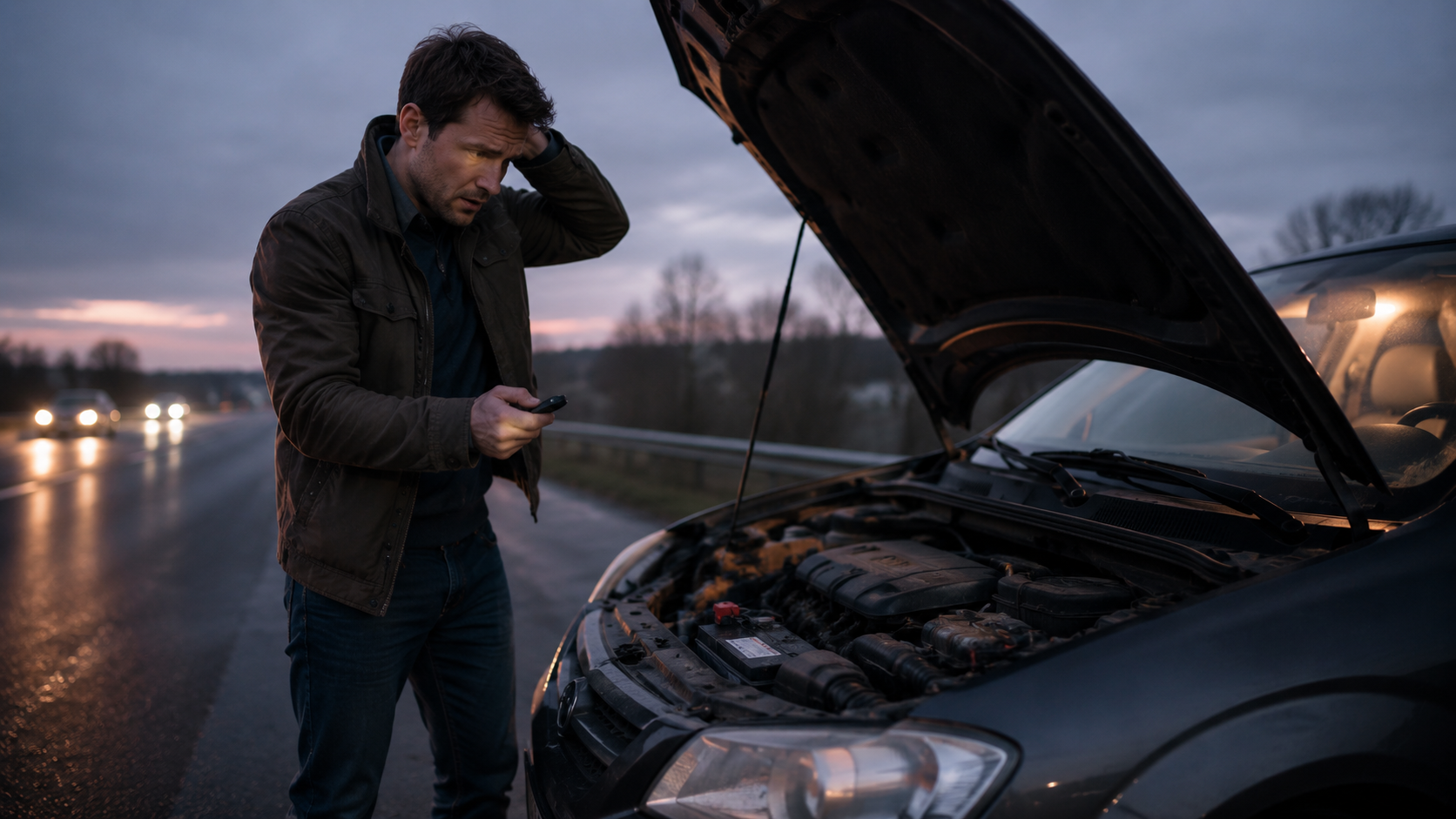
In the morning, a driver gets into the car, presses the brake pedal and pushes the start button. The instrument panel lights up, but only a single click comes from the engine bay. On the second attempt, the starter turns the engine very slowly. On the third, the dashboard begins flashing and all displays briefly go dark.
In this situation, the first assumption is usually a flat battery. That is often correct, but not always. Similar symptoms may be caused by corroded battery terminals, a damaged earth cable, a faulty starter solenoid, a worn starter motor or even an engine that is mechanically locked.
In another vehicle, the starter turns the engine quickly and apparently normally, but the engine does not start. The driver keeps cranking until the battery becomes weak. A workshop later finds a failed crankshaft-position sensor, which prevents the control unit from detecting engine speed and controlling ignition or injection.
In another case, the engine starts for one second and immediately stalls. The fuel pump works, the battery is new, but a key symbol flashes on the dashboard. The problem lies in the immobiliser or key recognition rather than the starter or fuel quality.
The question “Why will the car not start?” is therefore too broad. First, you must determine exactly what happens after the key is turned or the start button is pressed.
The main principle: before replacing the battery, starter or fuel pump, identify which main situation applies — the starter does not crank, cranks slowly, cranks normally but the engine does not fire, or the engine starts and immediately stalls.
Four situations that must not be confused
There is no sound, only one click is heard or the starting command is not accepted. The power supply, starter-control circuit, selector position, pedal switches and immobiliser must be checked.
The most common causes are a weak battery, poor connections, a damaged earth connection, starter wear, excessively thick oil or increased mechanical resistance.
The fuel supply, ignition, sensors, injection system, valve timing or compression must be investigated.
Possible causes include immobiliser intervention, loss of fuel pressure, incorrect air supply, an EVAP-valve fault or an electronic-control problem.
This classification immediately eliminates some incorrect assumptions. For example, if the starter turns the engine quickly and evenly, the battery normally has enough energy to operate the starter at that moment. This does not prove that the battery is in perfect condition, but the main no-start cause is more likely to be elsewhere.
If the engine stalled while driving
An engine that stalls while the vehicle is moving presents a more dangerous situation than a car that will not start while parked. Once the engine stops, steering and brake assistance may change, although mechanical steering and braking do not normally disappear completely.
- Maintain control of the vehicle and do not remove the key from the ignition while moving.
- Switch on the hazard warning lights.
- Use the vehicle’s remaining momentum to reach a safe location.
- Expect the steering and brake pedal to become heavier.
- After stopping, assess warning lights, smells, smoke and fluid leaks.
- If there is a fuel smell, oil-pressure warning, overheating or mechanical noise, do not restart the engine.
If the engine starts again after cooling, that does not mean the problem has disappeared. A crankshaft sensor, fuel pump, relay, control unit or electrical connection may fail only when hot.
What should you observe before trying again?
The first failed starting attempt provides a great deal of information. If the driver immediately tries ten more times, the original symptom may disappear, the battery becomes discharged and diagnosis becomes more difficult.
- whether the instrument panel lights normally;
- whether the lights dim sharply while starting;
- whether there is one click, repeated clicking or complete silence;
- how quickly and evenly the starter turns the engine;
- whether the engine attempts to fire even briefly;
- whether a key or immobiliser symbol is flashing;
- whether the fuel pump can be heard;
- whether there is a fuel or burning smell;
- whether the problem occurred with a cold or hot engine;
- whether repairs, battery replacement or refuelling took place shortly beforehand.
Complete silence after turning the key
If no starter or click is heard after the start command, the fault may be in either the power or control circuit. In a modern vehicle, the starter is not necessarily switched directly by the key or button — the command may pass through several control units, safety switches and relays.
Common causes of complete silence
- a completely discharged or internally damaged battery;
- a disconnected or loose battery terminal;
- a failed main fuse or power cable;
- an ignition-switch or start-button fault;
- the automatic-transmission selector is not recognised in P or N;
- the clutch or brake-pedal switch does not confirm that the pedal is pressed;
- the immobiliser does not recognise the key;
- a failed starter relay or control circuit;
- a faulty starter solenoid or starter motor;
- starting has been disabled after a collision or security-system activation.
The dashboard does not light up either
If the instrument panel, central locking and cabin electrics do not work, the main power supply must be checked first. The battery may be completely flat, a terminal may have become disconnected or a main fuse may have failed.
If battery voltage appears normal but the vehicle remains completely dead, voltage loss must be traced between the battery, body, fuse box and control systems.
A visually clean terminal does not always provide a good electrical connection. Corrosion may be present between the inside of the terminal clamp and the battery post or beneath the cable insulation.
One strong click, but the starter does not turn
A single click often means that the starter solenoid is receiving the command, but the starter motor is not turning. This may result from insufficient current supply, worn contacts or a mechanical starter fault.
Possible causes
- a weak battery;
- high resistance at the battery terminals;
- a damaged earth cable between the engine and body;
- a damaged starter positive cable;
- worn starter brushes or commutator;
- burnt solenoid contacts;
- a jammed starter gear or mechanism;
- the engine or one of its accessories is mechanically locked.
Hitting the starter with a tool is not a reliable repair method. Vibration may occasionally move worn brushes temporarily, but it may also damage the starter, magnets, housing or nearby components.
Rapid clicking and a flashing dashboard
Repeated clicking normally occurs when the starter relay engages, voltage drops sharply under load, the relay releases and voltage recovers slightly. The process repeats several times per second.
The most common cause is a discharged or damaged battery, although a very poor terminal or earth connection can produce the same effect.
The starter cranks too slowly
For an engine to start, the starter must turn it fast enough. If cranking is slow, the control system may not receive sufficient voltage, a diesel may not develop the required compression temperature and the fuel system may not achieve the necessary pressure.
Why does the starter crank slowly?
- the battery is discharged or has lost cranking capacity;
- cold weather has reduced the battery’s ability to deliver current;
- the battery terminals are loose or corroded;
- the engine earth cable is damaged;
- the starter has internal electrical or mechanical resistance;
- the engine oil is unsuitable for the temperature or excessively thick;
- the alternator, air-conditioning compressor or another accessory is seized;
- liquid has entered a cylinder and the engine cannot turn freely;
- the engine itself has suffered mechanical damage.
A battery may power the dashboard but not the starter
The instrument panel, radio and cabin lighting require relatively little current. The starter briefly requires far more power. The fact that the dashboard lights up therefore does not prove that the battery can start the engine.
A battery may show acceptable voltage without load but collapse sharply while the starter operates. This can be identified with a load or conductance test combined with voltage monitoring during cranking.
If the vehicle starts after an external power source is connected, this points toward a power-supply problem but does not prove that the battery itself must be replaced. Alternator charging, cables and possible parasitic drain must also be checked.
Battery terminals and the earth cable
Even a small amount of resistance in the starter circuit creates a significant voltage drop under high current. A connection may appear tight while remaining electrically poor.
Signs of a poor connection may include
- white, greenish or bluish deposits near the battery;
- a terminal clamp can be rotated by hand;
- the dashboard goes completely dark while starting;
- the symptom changes after moving a cable;
- a cable or connection becomes hot while cranking;
- an external power source works when connected to a different earth point;
- a voltage-drop test shows excessive loss.
The earth cable connects the battery’s negative terminal to the body and engine. If the connection between the engine and body is damaged, cabin electrics may still work while starter current cannot return properly to the battery.
Can jump leads be used?
An external power source may help if the battery lacks sufficient energy. The connection must, however, be made according to the specific vehicle’s instructions and using the designated connection points.
In modern vehicles, hybrids and cars with battery-management sensors, incorrect connection may cause voltage spikes, damage electronics or bypass the intended current-measurement point.
- the battery is frozen, swollen, cracked or leaking;
- there is a strong acid or burning smell;
- melted cables or fuses are visible;
- the correct connection point is unknown;
- the vehicle has been involved in a collision or flooded;
- the manufacturer’s instructions prohibit the method.
Starter motor and solenoid
The starter solenoid moves the gear into engagement with the flywheel and closes the high-current contacts. The starter motor then turns the engine.
Worn brushes, a damaged commutator, bearings, windings or solenoid contacts may cause intermittent operation. The starter may work normally once and produce only a click the next time.
If the starter continues running after the engine has started or a metallic gear noise is heard, switch off the ignition. Prolonged starter operation may damage the starter, flywheel teeth and wiring.
Automatic-transmission selector in P and N
A vehicle with an automatic transmission normally permits engine starting only in P or N. If the selector-position sensor, wiring or mechanism is faulty, the control system may believe that a driving range is selected.
If the vehicle will not start in P but starts in N, this is an important diagnostic observation. It does not mean the problem should be ignored — the selector or range sensor must be checked.
Brake and clutch-pedal switches
Many vehicles require the brake or clutch pedal to be pressed. If the pedal switch does not send the correct signal, the dashboard may instruct the driver to press the pedal even though it is already depressed.
A brake-switch fault may also be indicated by brake lights that do not work, remain on constantly or problems releasing the transmission selector.
Key, keyless system and immobiliser
The immobiliser permits starting only when the correct key code is recognised. Depending on the vehicle, an unrecognised key may completely disable the starter or allow the engine to start and then shut it down after one or two seconds.
Signs of a key or immobiliser problem may include
- a flashing key, padlock or vehicle symbol;
- a “key not detected” message;
- the engine starts and immediately stalls;
- the spare key works while the main key does not;
- the problem began after key-housing work or battery disconnection;
- the keyless system fails in a particular location;
- diagnostics shows that starting is not authorised.
The remote-control battery and immobiliser-transponder function are not exactly the same. In many vehicles, the engine can still be started with a flat remote battery if the key is placed at the manufacturer’s designated emergency-reading position.
Aftermarket alarm or hidden immobilising switch
Additional alarms, remote-start systems and hidden immobilisers often interrupt the starter, fuel-pump or ignition circuit.
An aged relay, poor-quality connection or remote-control problem may cause intermittent no-start faults. Diagnosis requires knowing which additional system is fitted and which circuit it interrupts.
The starter cranks normally, but the engine does not fire
An internal-combustion engine requires the correct quantity of air and fuel, ignition at the correct moment in a petrol engine, sufficient compression and precise valve-timing synchronisation.
The control unit must also receive valid sensor signals and authorise injection. If even one essential condition is missing, the starter may turn the engine completely normally while it still refuses to start.
Is there really fuel in the tank?
The fuel gauge may be incorrect because of a stuck float, failed sender, wiring fault or dashboard problem. The reading should not be trusted blindly, especially after work on the tank, pump or level sender.
A vehicle may also be parked on a slope with very little fuel, preventing the pump from drawing it in. Before adding fuel, however, confirm that the correct type will be used.
Fuel pump, fuse and relay
In some vehicles, the electric fuel pump can be heard for a few seconds after the ignition is switched on. The absence of this sound may be a useful clue, but it is not a final diagnosis.
Some systems activate the pump only while cranking, and its sound may be inaudible from inside the cabin. The pump may also make a noise while being unable to generate sufficient pressure.
Fuel-supply problems may be caused by
- a failed pump fuse or relay;
- a worn electric pump inside the tank;
- a faulty pump-control module;
- a poor connection at the tank module;
- a blocked fuel filter;
- a failed high-pressure pump;
- a major leak or air entering the system;
- an impact cut-off switch or software lockout;
- the control unit not activating the pump because of another fault.
Crankshaft-position sensor
The crankshaft sensor allows the control unit to determine engine speed and piston position. Without a reliable signal, the system may not control ignition or injection.
A faulty sensor sometimes stops working only when hot. The engine stalls, the starter then cranks normally, but the engine does not restart. After cooling, it starts again.
Diagnosis may include checking
- whether the control unit sees engine speed while cranking;
- whether a crankshaft-sensor fault code is stored;
- the sensor waveform with an oscilloscope;
- the condition of the wiring and connector;
- the sensor gap to the trigger wheel;
- whether the trigger wheel is damaged or displaced.
The absence of a fault code does not completely rule out a sensor defect. The signal may disappear so abruptly or become so incorrect that the control unit does not store a clear fault.
Camshaft-position sensor
The camshaft signal helps identify the operating cycle of a particular cylinder. Some engines take longer to start or operate in emergency mode with a failed camshaft sensor, while others may not start at all.
If there is a correlation fault between crankshaft and camshaft signals, the sensors are not the only possible cause. A stretched chain, jumped belt or damaged trigger wheel must also be considered.
The timing belt or chain has jumped or broken
The timing system synchronises the crankshaft and camshafts. If the timing belt breaks or the chain jumps, the valves no longer open at the correct time.
The starter may begin turning the engine unusually quickly and evenly because normal compression is no longer being produced in the cylinders. The cranking sound may become noticeably lighter.
If the starter suddenly sounds unusually light
Do not keep cranking. If the timing system has failed, repeated attempts may increase damage to valves, pistons and the cylinder head.
No ignition spark in a petrol engine
A petrol mixture requires an ignition spark at the correct time. The fault may involve an ignition coil, spark plugs, power-supply relay, wiring, control unit or crankshaft signal.
One failed coil does not normally stop the entire engine, but a shared power, earth or control fault may eliminate spark from every cylinder.
Checking for spark by placing a loose spark plug against the engine is unsafe, especially near fuel vapours or a direct-injection system. A workshop uses a suitable tester and controls the fuel-delivery risks.
Flooded petrol engine
After repeated failed starting attempts, excessive fuel may collect inside the cylinders. The spark plugs become wet, the mixture no longer ignites and a petrol smell may be noticeable near the exhaust.
Some vehicles have a special clear-flood mode, but its activation differs by model. Incorrect accelerator use may worsen the situation, so the manufacturer’s procedure should be followed.
If a significant amount of fuel has entered the oil, the engine oil may need to be inspected or replaced after the original fault is repaired.
Leaking petrol injector
An injector may drip into a cylinder after the engine is switched off. A hot engine may then be difficult to restart after a short stop because one cylinder contains an excessively rich mixture.
Other possible signs include loss of residual fuel pressure, longer cranking, black smoke after starting, a fuel smell or a rising engine-oil level.
A diesel engine cranks but does not start
In addition to adequate cranking speed and compression, a diesel engine must develop sufficient fuel pressure. In cold weather, the glow-plug system may also be important.
Common diesel no-start causes
- a weak battery and insufficient cranking speed;
- failed glow plugs or glow-plug control unit;
- air has entered the fuel system;
- a blocked or incorrectly installed filter;
- the low-pressure pump is not delivering fuel;
- the Common Rail system does not reach the pressure required for starting;
- excessive injector return flow;
- a failed pressure regulator or sensor;
- a crankshaft or camshaft-sensor fault;
- insufficient compression.
Glow plugs and cold starting
Glow plugs help warm the combustion chamber for cold starting. One failed glow plug may cause uneven running and smoke after start-up, while several failed plugs or a control-system fault may prevent starting in cold weather.
The glow-plug warning light going out does not always mean heating has completely ended, and the absence of the light does not always prove a fault. In a modern engine, operation is controlled according to temperature and other conditions.
Air inside a diesel fuel system
After fuel-filter replacement, running the tank empty or a leaking connection, air may enter the system. The fuel pump cannot establish a stable supply, so the engine cranks but does not start.
The priming procedure differs by vehicle. Some have an electric supply pump, others a hand primer, while certain systems require a diagnostic-tool command.
Prolonged cranking does not always prime the system correctly and may overheat the starter or discharge the battery.
The engine starts and immediately stalls
If the engine begins running but stops after one or several seconds, observe whether it always stalls after exactly the same period and whether a security-system warning is shown on the dashboard.
Possible causes
- the immobiliser interrupts fuel delivery;
- the fuel pump creates pressure only during initial priming;
- a failed pump relay or control unit;
- a stuck EVAP purge valve floods the intake with vapours;
- a very large vacuum or intake-air leak;
- the throttle body is heavily contaminated or has lost adaptation;
- the control unit loses the crankshaft signal;
- air enters the fuel system;
- the engine lacks sufficient idle air or fuel supply.
The car will not restart when hot
A hot-start problem is a valuable diagnostic clue. A component may change electrical resistance when heated, a connection may expand or fuel pressure may become incorrect.
Common hot-start suspects
- the crankshaft or camshaft-position sensor;
- a hot starter cranking too slowly;
- resistance in the starter or earth connection;
- a leaking petrol injector;
- fuel pressure disappears too quickly after shutdown;
- excessive diesel-injector return flow;
- the fuel pump loses output when hot;
- a temperature-related control-unit or relay fault.
The car will not start only in severe cold
In cold weather, the battery’s ability to deliver current decreases, engine oil becomes more viscous, fuel evaporates differently and a diesel requires an effective glow-plug system.
Diesel-fuel properties must suit the season. Waxing fuel or frozen water inside the filter may restrict supply. Adding random petrol, additives or external heat sources is not a safe solution.
If the starter cranks very slowly in cold weather, first check the battery, cables, starter and correct engine oil rather than immediately replacing the glow plugs.
Incorrect or contaminated fuel
If the problem began immediately after refuelling, incorrect or contaminated fuel must be considered. Petrol in a diesel vehicle, diesel in a petrol engine, water or other contamination may prevent starting and damage the system.
If incorrect fuel is suspected, do not continue making starting attempts. Every attempt may spread the wrong fuel farther through pumps, the rail, injectors and return system.
AdBlue warning and blocked restart
In some diesel vehicles, a critically low AdBlue level or unresolved SCR-system fault may disable the next engine start after a warning and remaining-distance countdown.
Simply adding fluid may not immediately restore starting if there is a sensor, pump, heater or quality fault. Follow the dashboard instructions and the procedure for the specific model.
Insufficient compression
Compression may be reduced by worn cylinders, piston rings, valves, a failed head gasket, incorrect valve timing or the oil film being washed from the cylinder walls after repeated failed starts.
Low compression may appear as very long cranking, attempts to fire on only some cylinders, smoke, an uneven cranking sound or complete failure to start.
Compression measurements must be interpreted together with engine design, temperature, cranking speed and valve-timing condition. There is no single universal value for every engine.
Can the engine be bump-started?
Certain vehicles with manual transmissions may theoretically be started using wheel movement, but this is not a universal or risk-free solution.
If the cause of the no-start condition is unknown, bump-starting may worsen timing-system damage, spread incorrect fuel or create uncontrolled vehicle movement. The method is unsuitable for automatic transmissions, hybrids and many modern vehicles.
Why should starting fluid not be used?
Ether or another highly flammable starting spray may cause premature and uncontrolled combustion. It can be especially dangerous in a diesel equipped with glow plugs or an intake heater.
Damage to the intake system, pistons, rings and connecting rods is possible. Temporary starting with a spray also does not repair a fuel-pressure or sensor fault.
How long may the starter be operated?
The exact maximum cranking time and cooling pause depend on the vehicle. Follow the manufacturer’s instructions.
Prolonged continuous cranking overheats the starter, solenoid and cables, discharges the battery and may fill the catalytic converter with unburned fuel.
If the engine shows no sign of starting after several reasonable attempts, repeating the process without diagnosis rarely helps.
What can the driver check safely?
- Make sure an automatic transmission is in P or N.
- Press the brake or clutch pedal fully.
- Observe the dashboard and immobiliser symbols.
- Listen for silence, clicking or normal cranking.
- Check whether the battery terminals are visibly loose or heavily corroded.
- If a spare key is available, try it according to the instructions.
- Confirm that the tank contains the correct fuel.
- Note whether the problem began after refuelling or repairs.
- Check for fuel, oil or coolant beneath the vehicle.
- Check for a burning or strong fuel smell.
- Record all dashboard messages.
- Stop cranking after several failed attempts.
What must not be done?
This overheats the starter, discharges the battery and may send a large amount of unburned fuel into the exhaust.
A new battery will not repair a failed starter, while a new fuel pump will not help if the control unit cannot see a crankshaft signal.
This may damage control units, wiring and the vehicle’s security systems.
In direct-injection and Common Rail systems, fuel may be under dangerously high pressure.
Uncontrolled ignition may cause serious engine and intake-system damage.
Incorrect towing may damage an automatic, all-wheel-drive, hybrid or electric drivetrain.
A hybrid will not start or READY does not appear
In a hybrid, the petrol engine does not necessarily begin running immediately after the start button is pressed. The key indication is READY mode, which confirms that the vehicle is prepared to move.
If READY does not appear, common causes include a weak 12-volt battery, brake-pedal signal, key-recognition problem, high-voltage-system lockout or another control fault.
The driver must not open the high-voltage battery, disconnect orange cables or attempt to bridge the high-voltage system.
An electric vehicle will not enter drive mode
An electric vehicle has no traditional starter or internal-combustion-engine starting process. It still requires a functioning 12-volt system to activate control units and close the high-voltage contactors.
A weak 12-volt battery may create a situation in which the traction battery is charged but the vehicle will not enter READY or drive mode.
Other causes include a charging connector that is not fully disconnected, a selector-signal fault, brake-switch fault, high-voltage isolation error or crash-safety lockout.
How does a workshop diagnose a no-start condition?
- confirming the exact original symptom;
- checking battery condition and state of charge;
- monitoring voltage while the starter operates;
- measuring voltage drop in the positive and earth circuits;
- assessing starter current draw;
- checking the starter relay and control signal;
- reading pedal and selector statuses;
- checking immobiliser authorisation;
- reading faults from all control units;
- checking the engine-speed signal while cranking;
- comparing crankshaft and camshaft signals;
- measuring low-pressure and high-pressure fuel systems;
- testing injector control and return flow;
- checking ignition spark on a petrol engine;
- checking glow plugs and their control on a diesel;
- performing a compression or cylinder-leakage test;
- checking valve-timing synchronisation;
- checking fuel quality and correct fuel type;
- testing wiring under load;
- repeating cold-start and hot-start tests after repair.
Why is a fault code alone not enough?
A fault code identifies a system or observed deviation, not necessarily the failed component. Low fuel pressure, for example, may be caused by the pump, filter, regulator, excessive injector return flow or insufficient cranking speed.
A crankshaft-to-camshaft correlation code may be caused by a sensor, wiring, chain stretch, jumped timing system or mechanically damaged trigger wheel.
The absence of fault codes does not confirm that the system is healthy. A completely discharged battery, mechanical starter fault or low compression may leave no clear electronic fault.
Illustrative cost example
Assume that the starter cranks normally, but the hot engine will not start. In the first scenario, the workshop checks the engine-speed signal and finds a crankshaft sensor that fails when hot. In the second scenario, the battery, starter and fuel pump are replaced without testing, but the problem remains.
The amounts are illustrative and are not a quotation from a specific workshop. Costs depend on the vehicle, component prices, availability, diagnostic time and the actual fault.
What should be checked when buying a used vehicle?
A seller may warm the vehicle beforehand, charge the battery or position it so that it starts on the first attempt. Both cold-start and fully warmed-up starting behaviour therefore matter.
- whether the engine is genuinely cold before inspection;
- how quickly the starter turns the engine;
- whether the dashboard dims sharply during cranking;
- whether there is timing-chain, starter or flywheel noise;
- how quickly the engine begins running;
- whether there is smoke or a strong fuel smell after starting;
- whether idle becomes smooth immediately;
- whether the hot engine restarts equally well after a short stop;
- whether both keys work;
- whether there are immobiliser or battery warnings;
- the battery production date and test result;
- the control-unit fault history;
- whether diagnostic readiness monitors were recently reset;
- an independent cold-start and hot-start inspection at a workshop.
Driver’s checklist
☐ It has been determined whether the starter cranks at all
☐ The number and sound of clicks have been recorded
☐ Dashboard brightness was observed while starting
☐ An automatic transmission was checked in P and N
☐ The brake or clutch pedal was pressed fully
☐ Immobiliser symbols were checked
☐ The spare key was tried, if available
☐ The battery terminals are not loose
☐ The battery was tested under load
☐ Positive and earth voltage drops were checked
☐ It is known whether the problem occurs cold or hot
☐ The correct fuel is in the tank
☐ There are no visible fuel or fluid leaks
☐ The starter is not overheated by prolonged cranking
☐ Parts are not being replaced one after another by guesswork
☐ Both cold and hot starts were checked after repair
A short self-check
The dashboard lights up and one click is heard, but the starter does not turn. Is the starter definitely faulty?
No. First check the battery under load, terminals, positive cable and engine earth connection. Only then can the starter be assessed reliably.
The starter turns the engine normally. Does that prove the battery is good?
Not necessarily, although it is providing enough power for cranking at that moment. The main no-start cause should then more often be sought in the fuel, ignition, sensor, timing or compression systems.
The engine starts for one second and stalls. Is the fuel pump responsible?
It is possible, but first check the immobiliser symbol and starting-authorisation status. Stalling after the same short period is often associated with the security system.
The hot engine will not start but works again after half an hour. What should be checked?
Check the crankshaft and camshaft sensors, hot cranking speed, fuel pressure, injector leakage, relays and electrical connections that fail with temperature.
Frequently asked questions
Does a new battery guarantee that the car will start?
No. There may still be poor connections, a starter fault, an immobiliser problem, missing fuel or ignition and mechanical engine damage.
Why does the car start after a jump-start but fail again the next day?
The battery may be worn, the alternator may not charge it sufficiently or a system may continue consuming current while parked. A complete charging and parasitic-drain test is required.
Does the absence of fuel-pump noise prove that the pump has failed?
No. The pump may operate only while cranking, may be inaudible or may not be activated by the control unit because of another fault. Power supply and fuel pressure must be checked.
Does a failed crankshaft sensor always switch on the Check Engine light?
No. The signal may disappear intermittently or the control unit may not store a clear fault. It is important to check the engine-speed signal during the actual no-start condition.
Why does the starter sometimes work and sometimes only click?
Possible causes include worn starter brushes, solenoid contacts, poor cable connections or an internal battery defect. The fault must be captured during testing.
Can failed glow plugs prevent a diesel from starting in summer?
Depending on the engine and temperature, a diesel may start in warm weather with some failed glow plugs. If it will not start in summer, cranking speed, fuel pressure, sensors and compression must also be checked.
Can the battery be disconnected to reset the fault?
This may erase valuable diagnostic information, disturb adaptations and create additional programming requirements in some vehicles. Faults and live data should preferably be read first.
Can the vehicle be towed to a workshop with a rope?
This depends on the transmission, drivetrain and manufacturer’s requirements. An automatic, all-wheel-drive, hybrid or electric vehicle often requires a recovery truck or a specific wheel-lifting method.
Can repeated starting attempts damage the catalytic converter?
Yes. If fuel is injected but does not burn, it may enter the exhaust and overheat the catalytic converter after the engine eventually starts.
Correctly identifying the sound and symptom saves the most time
A no-start condition is not one specific fault. Complete silence, rapid clicking, slow cranking and normal starter operation are four different diagnostic starting points.
If the starter does not crank or turns slowly, first check the battery, connections, starter circuit and starting authorisation. If it cranks normally, check the engine-speed signal, fuel pressure, ignition, injection, timing synchronisation and compression.
Repeatedly replacing parts by guesswork can be expensive and ineffective. Voltage-drop, starter-current, fuel-pressure, engine-speed-signal and compression measurements made while the fault is present are far more valuable.
The main takeaway: when a car will not start, listen to the starter first. Silence or a click points toward power supply, control or the starter itself; slow cranking points toward the battery, connections or mechanical resistance; normal cranking without starting points toward fuel, ignition, sensors, valve timing or compression. A few precise measurements are more valuable than replacing several parts by guesswork.