
 LV
 EN
 RU
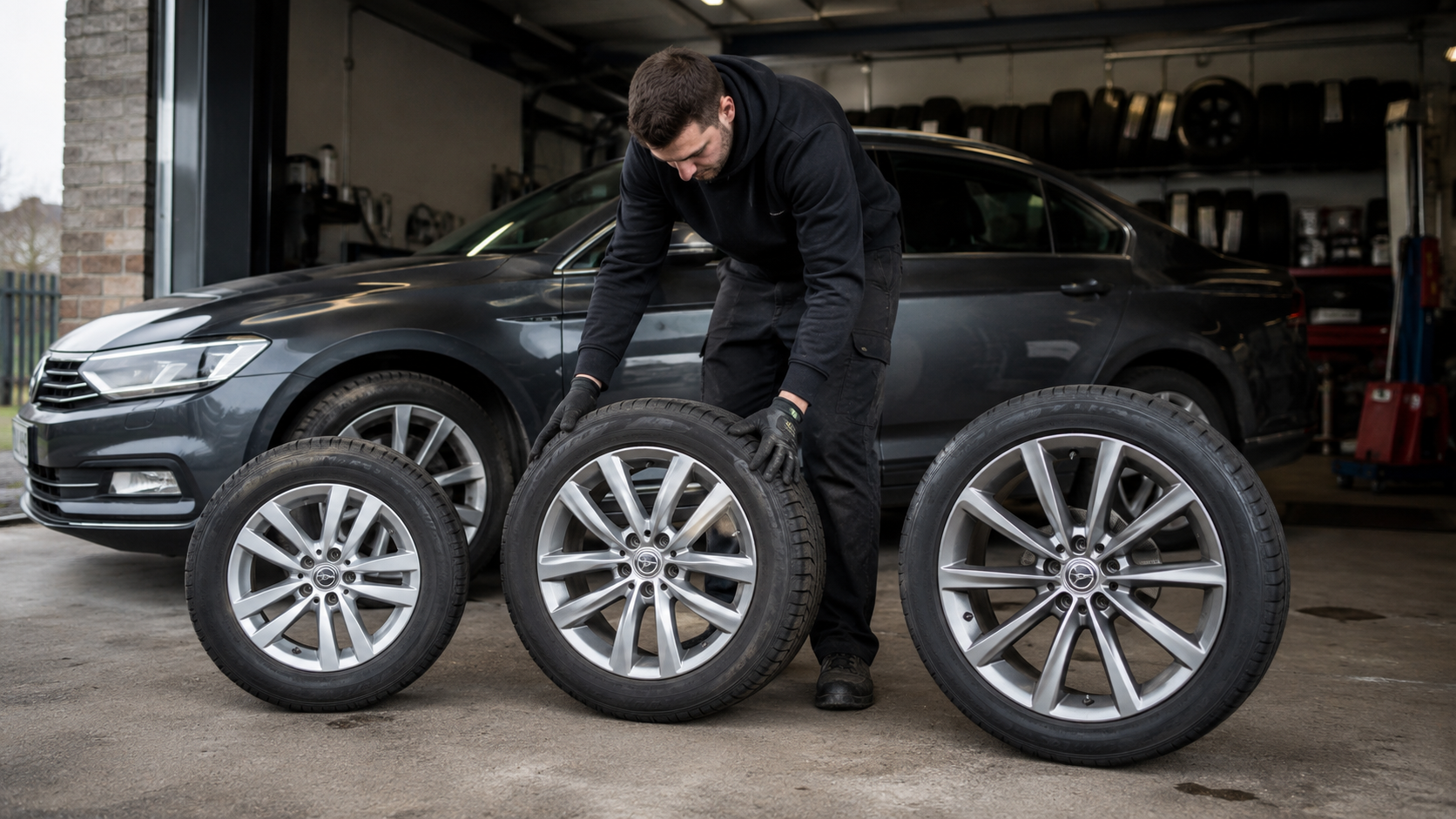
Larger wheels are one of the most noticeable visual changes that can be made to a car. Moving from 16-inch to 17- or 18-inch wheels can give the vehicle a sportier appearance, fill the wheel arches and make the steering feel more responsive. This is why larger wheels are frequently included in more expensive and sportier trim levels.
After changing wheels, however, drivers sometimes notice less welcome differences: a firmer ride, more tyre noise, slower acceleration and slightly higher fuel consumption. Other drivers notice no difference in consumption at all.
The reason is simple — fuel consumption is not determined by wheel diameter alone. Two 18-inch wheel-and-tyre packages can differ completely in weight, tyre width, rubber compound, aerodynamics and rolling resistance. Under certain conditions, a lightweight 18-inch forged wheel with an efficient tyre may perform better than a heavy 17-inch package fitted with inefficient tyres.
A professional comparison must therefore consider more than the question, “How many inches?” The entire wheel package must be evaluated: the wheel, tyre, overall diameter, weight, width, tyre efficiency and suitability for the particular vehicle.
The driver’s short takeaway right at the start: larger wheels often increase consumption, but not because of the diameter alone. The main causes are usually greater weight, wider tyres and higher rolling and aerodynamic resistance.
Quick answer: do 18-inch wheels use more fuel than 16-inch wheels?
Often yes, but not necessarily.
A larger wheel is normally combined with a wider, lower-profile tyre. This package may be heavier and may create greater rolling and aerodynamic resistance.
However, a lightweight 18-inch wheel with an energy-efficient tyre may use less fuel than a heavy 17-inch wheel fitted with a wide performance tyre.
The actual wheel weight, tyre dimensions and European tyre label should therefore be compared rather than the number of inches alone.
Manufacturer-approved 16-, 17- and 18-inch versions normally retain a similar overall wheel diameter. As the wheel becomes larger, the tyre sidewall becomes lower. This principle is known as plus sizing.
Wheel diameter and overall tyre diameter are not the same thing
When talking about 16- or 18-inch wheels, we usually mention only the diameter of the metal wheel. The car, however, rolls on the complete assembly: the wheel together with the tyre.
When the wheel diameter is increased, the tyre profile is normally reduced to maintain a similar overall diameter. This is necessary to avoid significantly changing the gearing, ground clearance, speedometer reading and available space inside the wheel arch.
| Tyre size | Wheel diameter | Tyre sidewall height | Approximate overall diameter |
|---|---|---|---|
| 205/55 R16 | 406.4 mm | 112.8 mm | 631.9 mm |
| 225/45 R17 | 431.8 mm | 101.3 mm | 634.3 mm |
| 225/40 R18 | 457.2 mm | 90.0 mm | 637.2 mm |
These sizes are only illustrative examples. A specific vehicle should use only manufacturer-approved or technically suitable sizes.
How is the overall wheel diameter calculated?
Tyre sidewall height = tyre width × profile percentage.
Wheel diameter in millimetres = number of inches × 25.4.
Overall diameter = wheel diameter + two tyre sidewalls.
What does 205/55 R16 mean?
A tyre-size marking may initially appear complicated, but every part has a specific meaning.
| Marking | Meaning | Example |
|---|---|---|
| 205 | Nominal tyre width in millimetres | 205 mm |
| 55 | Sidewall height as a percentage of the tyre width | 55% of 205 mm |
| R | Radial tyre construction | The modern passenger-car standard |
| 16 | Wheel diameter in inches | 16-inch wheel |
It is important to understand that the number 55 does not mean 55 millimetres. It is a percentage of the tyre’s width. A 225/45 tyre therefore does not have the same sidewall height as a 205/45 tyre.
General comparison of 16-, 17- and 18-inch wheels
| Characteristic | 16 inches | 17 inches | 18 inches |
|---|---|---|---|
| Fuel economy | Often the best | Usually a compromise | Often slightly worse |
| Ride comfort | Softer | Moderate | Firmer |
| Steering response | More relaxed | More precise | Usually the quickest |
| Tyre price | Often lower | Moderate | Often higher |
| Protection against potholes | Greater tyre sidewall | Moderate | Less impact protection |
| Appearance | More practical | Balanced | Sportier |
The table shows typical tendencies rather than absolute rules. A particular lightweight 18-inch package may be more comfortable and economical than a heavy, poor-quality 17-inch package.
1. Wheel weight: an important but often misunderstood factor
A larger-diameter wheel often weighs more because more material is required. A wider tyre may also be heavier. As a result, the weight of one complete wheel-and-tyre assembly can increase by several kilograms.
Four additional kilograms per wheel mean an extra 16 kilograms for the whole vehicle. This weight is not simply ordinary luggage — much of it is part of the rotating and unsprung mass.
Additional mass has the greatest effect during driving that involves frequent acceleration and braking. The difference in wheel weight can therefore be more noticeable in the city than during steady motorway driving.
Important detail: wheel diameter does not determine its weight. A high-quality lightweight alloy or forged wheel may weigh less than a smaller wheel with a heavier construction.
2. Rotating mass and moment of inertia
For the car to accelerate, the engine must not only move the vehicle forward but also spin the wheels. The greater the wheel weight and the further that weight is positioned from the centre of rotation, the more energy is required to accelerate it.
Two wheels with the same total weight can therefore behave differently. If a greater proportion of one wheel’s mass is concentrated near its outer edge, its rotational inertia may be higher.
This effect is sometimes exaggerated online. At a constant speed, the wheels do not need to be continually accelerated, so tyre rolling resistance and wheel aerodynamics may matter more on the motorway. Rotating mass becomes especially important in city and dynamic driving.
3. Unsprung weight and ride comfort
The wheel, tyre, brake components and part of the suspension are positioned below the vehicle’s springs. This is known as unsprung mass.
The heavier the wheel, the more difficult it is for the suspension to control it on an uneven road. The wheel must be able to move up and down quickly while maintaining contact with the surface.
A heavy, low-profile wheel-and-tyre package can make the ride firmer and increase the load on bushes, ball joints, dampers and other suspension components. This does not always directly increase fuel consumption, but it can affect the vehicle’s overall maintenance costs.
4. Tyre width and rolling resistance
Moving to a larger wheel often also means fitting a wider tyre. For example, a 205 mm tyre may be replaced with a 225 or 235 mm tyre.
A wider tyre can increase aerodynamic resistance and is often designed with a sportier rubber compound, a stiffer structure and a greater emphasis on grip. These characteristics can increase rolling resistance.
However, saying that a wider tyre always uses more fuel would be an oversimplification. Rolling resistance depends on tyre construction, materials, tread pattern, pressure, temperature and load. Two tyres of the same size can differ significantly in efficiency.
The professional approach:
Do not judge consumption from tyre width alone.
Compare the tyre’s rolling-resistance rating.
Also check its wet-grip rating.
Fuel economy must not be achieved at the expense of safety.
5. The European tyre label matters more than wheel size alone
One of the main categories on the European tyre label is fuel or energy efficiency, which is determined by the tyre’s rolling resistance. It is displayed in classes from A to E.
The label also separately lists wet braking grip and external rolling noise. Winter tyres may additionally carry snow- or ice-suitability symbols.
This means that two 225/45 R17 tyres can produce different fuel consumption. One may be designed for low rolling resistance, while the other prioritises maximum performance grip.
When buying tyres, the letter on the energy-efficiency label often reveals more about possible fuel consumption than the wheel diameter alone.
6. Wheel aerodynamics
Wheels are exposed to the airflow and rotate at high speed. Their spokes, openings and shape influence how air moves around the wheel arches and brakes.
A very open performance wheel may cool the brakes effectively but create different aerodynamic resistance from a nearly closed aerodynamic wheel. This is why many electric cars use partially enclosed wheels or aerodynamic covers.
The effect of wheel design is most noticeable at higher speeds. In the city, weight and repeated acceleration are usually more important, while aerodynamic resistance becomes increasingly significant on the motorway.
Not every lightweight performance wheel is aerodynamically efficient, and not every enclosed wheel is heavy. Weight and aerodynamics should be evaluated as two separate factors.
7. Overall diameter, gearing and the speedometer
If the overall tyre diameter remains almost unchanged after fitting larger wheels, the effective gearing does not change significantly. This is the principle behind correctly selected plus sizing.
If the overall tyre diameter is also increased considerably, the engine may run at slightly lower revolutions at the same actual road speed. In theory, this can help efficiency in certain conditions, but acceleration becomes more difficult and the engine may operate under unsuitable load more frequently.
An excessive change in overall diameter can make the speedometer and odometer inaccurate, reduce clearance inside the wheel arches and affect the operation of ABS, stability control, all-wheel drive and driver-assistance systems.
Important: do not choose an overall tyre diameter using only an online calculator. Check the vehicle manufacturer’s approved dimensions, wheel specifications, load index and brake-system requirements.
8. Tyre pressure may matter more than wheel size
Even an efficient tyre deforms more and creates greater rolling resistance when its pressure is too low. An incorrectly inflated 16-inch package can therefore use more fuel than a correctly inflated 18-inch package.
Tyre pressure should be checked when the tyres are cold and adjusted according to the vehicle manufacturer’s recommendations. Different values may be specified for the front and rear axles, particularly when the vehicle is fully loaded.
Wheel alignment and suspension condition also affect rolling resistance and tyre wear. If the car pulls to one side or the tyres wear unevenly, fitting a new wheel package will not solve the underlying problem.
Where is the effect of larger wheels more noticeable — in the city or on the motorway?
| Driving environment | Main wheel-related factors | What may the driver notice? |
|---|---|---|
| City | Weight, rotational inertia and frequent acceleration | Slower response and slightly higher consumption |
| Steady motorway driving | Rolling resistance and aerodynamics | A difference in long-term average consumption |
| Hilly road | Weight, width and engine load on climbs | More frequent gear changes and greater engine load |
| Performance driving | Grip, tyre construction and weight | More precise handling but higher consumption |
A practical fuel-cost example
Consider a hypothetical example. With 16-inch wheels, the car averages 6.6 l/100 km. After changing to a heavier and wider 18-inch package, consumption rises to 6.9 l/100 km.
The difference is 0.3 litres per 100 kilometres. Over an annual distance of 15,000 km, this amounts to 45 additional litres.
| Wheel package | Consumption | Fuel over 15,000 km | Cost at €1.70/l |
|---|---|---|---|
| 16-inch package | 6.6 l/100 km | 990 litres | €1,683.00 |
| 18-inch package | 6.9 l/100 km | 1,035 litres | €1,759.50 |
| Difference | +0.3 l/100 km | +45 litres | +€76.50 per year |
This is only a hypothetical calculation, not a guaranteed difference between every 16- and 18-inch wheel package. In real use, consumption may change less, more or not at all.
The simple formula:
Additional litres per year = annual distance × consumption difference / 100.
Additional cost = additional litres × fuel price.
Fuel is not the only additional cost
The financial effect of larger wheels does not end at the filling station. Tyre prices, damage risk and suspension costs must also be considered.
| Cost category | Why can a larger size cost more? |
|---|---|
| Tyre purchase | 18-inch tyres are often more expensive than comparable 16-inch tyres |
| Wheel repair | A lower-profile tyre absorbs less of a pothole impact |
| Tyre damage | A smaller sidewall may be more vulnerable to a severe impact |
| Suspension | A heavier wheel and sharper impacts can increase component loads |
| Seasonal wheel set | A second set of larger wheels and tyres requires a greater budget |
On poor roads, one damaged low-profile tyre or bent wheel may cost more than the annual fuel-consumption difference. Total ownership costs should therefore be evaluated more broadly than a few tenths of a litre.
Comfort: a larger tyre sidewall provides additional cushioning
A tyre sidewall is flexible and absorbs part of the road’s unevenness. A 16-inch wheel with a higher-profile tyre normally has more deformation capacity than an 18-inch wheel with a low-profile tyre.
A smaller wheel with a taller tyre therefore often provides a quieter and softer ride. This can be especially noticeable on damaged asphalt, cobblestones and gravel roads.
A lower-profile tyre normally transfers steering inputs to the road more quickly, making the vehicle feel more precise. At the same time, more impacts and vibrations are transmitted into the cabin.
Handling: does a larger wheel always provide better grip?
A larger wheel is often combined with a wider, lower-profile tyre. A stiffer sidewall can reduce tyre deformation in corners and improve steering response.
The wheel itself, however, does not create grip. Grip is determined by the tyre’s rubber compound, tread pattern, temperature, pressure and the road surface. A cheap or worn 18-inch tyre can perform significantly worse than a high-quality 16-inch tyre.
A wider tyre is also not automatically better in every condition. Its behaviour in deep water, snow or on loose surfaces may differ from that of a narrower tyre.
Safety principle: never select a tyre solely for low rolling resistance or a sporty appearance. Wet grip, load index, speed rating and seasonal suitability are equally important.
Are smaller wheels better for winter?
Many drivers choose a smaller manufacturer-approved wheel and a higher-profile tyre for winter. There are several practical reasons for doing so.
Smaller winter tyres often cost less, the taller sidewall absorbs potholes more effectively and a narrower tyre may be more practical in certain snow conditions. Winter wheels are also more frequently exposed to salt, potholes and obstacles hidden beneath snow.
A smaller wheel cannot, however, be selected arbitrarily. It must fit around the brake callipers and have the correct load rating, width, offset and mounting dimensions.
A practical option: larger wheels for summer and the smallest manufacturer-approved size for winter can provide a good compromise between appearance, handling, comfort and costs.
Hybrids and electric cars: why does wheel choice matter even more?
The efficiency of a hybrid or electric vehicle is particularly sensitive to rolling and aerodynamic resistance. In an electric car, higher energy consumption directly reduces the distance available from one charge.
Manufacturers therefore often specify a different driving range for the same electric vehicle depending on its wheel package. Larger performance wheels may be wider, heavier and more aerodynamically open.
Regenerative braking can recover part of the vehicle’s kinetic energy, but not all of it. Repeatedly accelerating heavier wheels therefore continues to require additional energy.
The high weight and immediate torque of an electric car may also accelerate tyre wear if the driver frequently accelerates hard. Replacing larger and more expensive tyres can then become a significant part of everyday running costs.
When are larger wheels a justified choice?
| Driving priority | Can a larger wheel be justified? | Why? |
|---|---|---|
| Sportier handling | Yes | A lower-profile tyre can improve steering response |
| Large brakes | It may be necessary | A smaller wheel may not fit around the brake calliper |
| Vehicle appearance | Yes, as a conscious choice | The driver is willing to pay for the design |
| Maximum fuel economy | Often no | A smaller and lighter package is usually more efficient |
| Comfort on poor roads | Often no | A higher-profile tyre absorbs impacts more effectively |
Larger wheels are not a poor choice when the driver understands the compromises involved. Problems arise when they are purchased only for appearance without considering weight, tyre prices and technical compatibility.
When are 16 or 17 inches the more sensible choice?
A smaller manufacturer-approved size is generally better suited to a driver who wants lower costs, a more comfortable ride and greater protection against potholes.
Sixteen-inch wheels are often a practical option for an everyday city car, while 17-inch wheels can provide a good compromise between comfort, appearance and steering response.
However, some large or powerful vehicles cannot use 16-inch wheels because of their larger brakes. The smallest compatible size must therefore always be found in the approved specifications for the particular vehicle.
Used and aftermarket wheels: what must be checked?
Wheel diameter is only one of many important specifications. Even when a wheel physically bolts onto a car, this does not necessarily mean it is technically suitable.
Before buying wheels, check:
• the number and pattern of mounting bolts, known as PCD;
• the centre-bore diameter;
• wheel width;
• wheel offset, also known as ET;
• load capacity;
• clearance around the brake callipers;
• the required type of bolts or nuts;
• compliance with vehicle and tyre manufacturer requirements.
An incorrect offset can change the wheel’s position inside the arch, increase loads on wheel bearings, cause contact with the suspension or bodywork and alter the vehicle’s handling.
Used wheels should be inspected for cracks, weld repairs, deformation, corrosion and damage around the mounting holes. An attractive fresh paint finish can hide previous repairs.
Does a larger wheel always weigh more?
No. Weight depends on the material, design and manufacturing method. A high-quality lightweight 18-inch wheel may weigh less than a heavy 17-inch wheel. Compare the actual weight of both the wheel and the complete wheel-and-tyre package.
Does the speedometer need to be recalibrated after fitting larger wheels?
If manufacturer-approved plus sizing is used and the overall tyre diameter remains similar, recalibration is normally unnecessary. If the overall diameter changes significantly, the speedometer reading and electronic systems should be checked professionally.
Do larger wheels increase braking power?
Wheel diameter itself does not increase braking power. A larger wheel may provide space for larger brake discs and callipers, but a heavier wheel also requires more energy to slow down. Braking performance depends on the entire braking system, tyres and available road grip.
Common myths about wheel size
| Myth | Fact | Practical takeaway |
|---|---|---|
| An 18-inch wheel always uses more fuel than a 16-inch wheel | The total package weight, tyre and aerodynamics are what matter | Compare specific wheel-and-tyre packages |
| A larger wheel automatically provides more grip | Grip is primarily determined by the tyre’s characteristics | Choose a high-quality tyre, not only a large wheel |
| An alloy wheel is always lightweight | Some cast-alloy wheels are heavier than steel or other alloy wheels | Check the actual weight |
| A wider tyre always uses more fuel | Rolling resistance also depends on construction, compound and pressure | Check the tyre label |
| A larger overall diameter always lowers engine speed and fuel consumption | It changes gearing, engine load and the speedometer reading | Use only technically suitable sizes |
Mini test: which wheel size is more suitable for you?
Answer these questions:
1. Is your main priority lower fuel consumption?
2. Do you regularly drive on damaged or gravel roads?
3. Do you want less expensive tyres and a lower risk of impact damage?
4. Is sporty steering response more important to you than ride comfort?
5. Does the vehicle require at least an 18-inch wheel because of its large brakes?
6. Have you checked the weight of the complete wheel assembly rather than only the wheel?
If you answered “yes” to the first three questions, a smaller manufacturer-approved size will probably be more practical. If handling, appearance or brake clearance matter more, a larger size may be justified.
A 14-day experiment: compare two wheel packages
If you have two seasonal wheel packages in different sizes, you can carry out a practical comparison. Ideally, the test should be completed in similar weather and with both tyre sets suitable for the season.
| Period | What should you do? | What should you record? |
|---|---|---|
| Days 1–3 | Drive your usual routes with the first wheel package | Consumption, temperature, traffic and tyre pressure |
| Days 4–7 | Continue the measurement with a similar driving style | Average consumption and comfort observations |
| Day 8 | Fit the second package and check tyre pressure | Size, tyre model and wheel weight, if known |
| Days 9–11 | Repeat the same routes | Consumption, temperature and traffic |
| Days 12–14 | Complete the comparison | Consumption, comfort, noise and handling |
Even this test will not be laboratory-accurate because the tyre models and weather may differ. It can nevertheless show how the two specific packages perform on your regular routes.
Do not compare consumption alone. Also record tyre noise, pothole impacts, steering response, stability and tyre prices. The most economical package is the one that provides the best overall result for your needs.
A simple wheel-selection process
Before purchasing, follow this sequence:
1. Find the wheel and tyre sizes approved by the manufacturer.
2. Identify your main priority: efficiency, comfort, appearance or handling.
3. Compare complete wheel weight rather than wheel diameter alone.
4. Check the tyre’s rolling-resistance and wet-grip ratings.
5. Compare tyre prices and availability in the selected size.
6. Confirm the correct PCD, centre bore, offset and load capacity.
7. After installation, check pressure, vibrations and whether the tyres rub anywhere.
8. Evaluate consumption over several similar journeys rather than on the first day.
Conclusion: efficiency is determined by the complete wheel package, not the number of inches
Moving from 16-inch to 17- or 18-inch wheels often increases fuel or energy consumption because the larger wheel is combined with a wider tyre and a heavier, more aerodynamically open package. However, this is not a universal rule.
Consumption is determined by complete wheel weight, rotational inertia, tyre construction, rolling resistance, width, pressure, wheel alignment and wheel aerodynamics. A high-quality, lightweight larger package can therefore be more efficient than a heavy and unsuitable smaller package.
If your main priorities are lower costs, comfort and practicality, the smallest manufacturer-approved size will often be the most sensible choice. If steering response, brake clearance or vehicle appearance matter more, a larger wheel may be a justified compromise.
Before purchasing, compare not only wheel prices but also tyre prices, complete wheel weight, efficiency labels and the possible risk of damage. This is often where the greatest difference in ownership costs can be found.
The driver’s final takeaway: a car does not use more fuel simply because the wheel says “18 inches”. It uses more when the new wheel-and-tyre package is heavier, wider and more difficult to roll.