
 LV
 EN
 RU
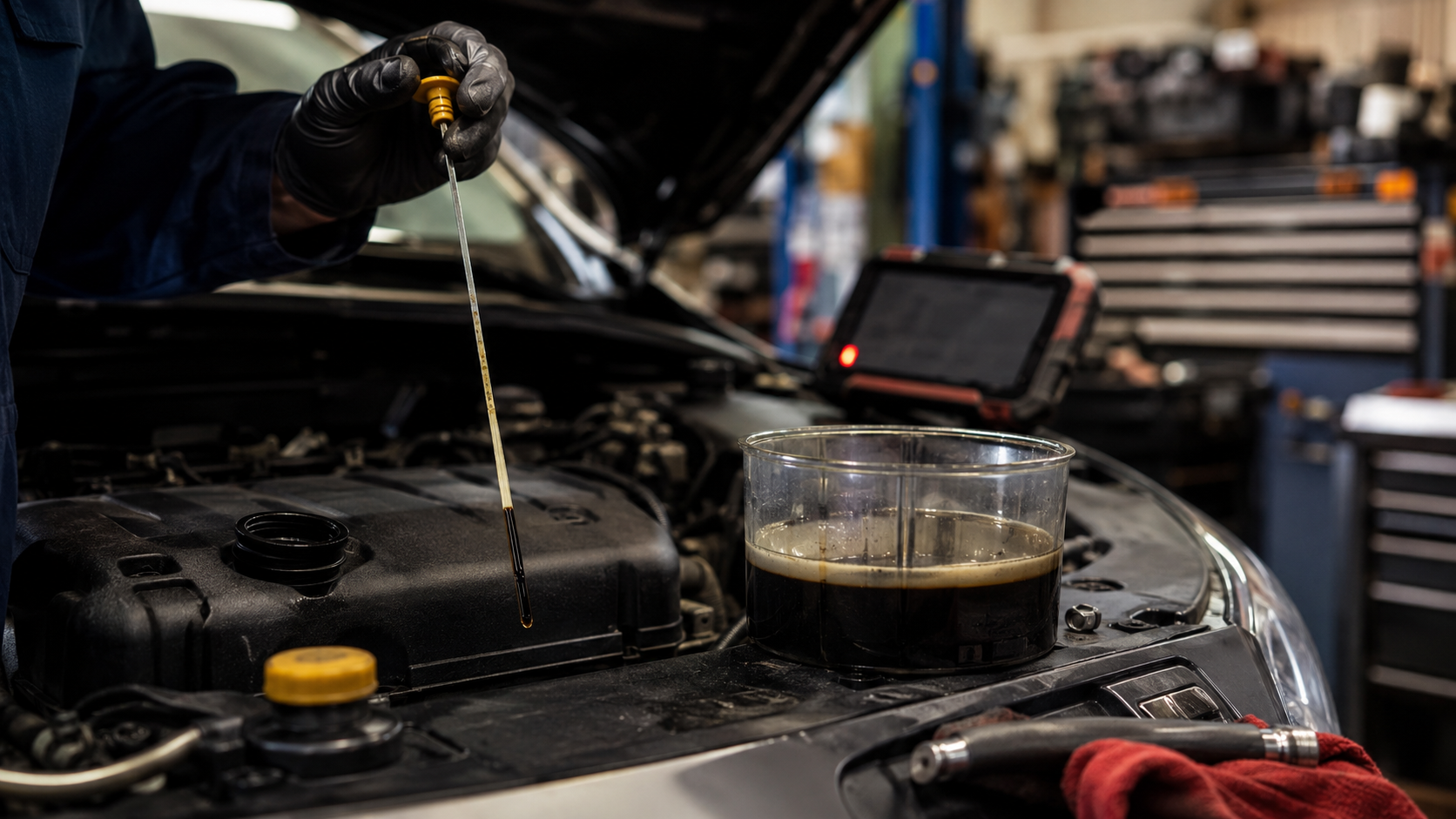
A driver checks the engine oil level before a longer journey. One month ago, it was exactly between the MIN and MAX marks, but now the dipstick shows almost full. At first, everything appears excellent — the oil has not disappeared, so the engine must be in good condition.
A few weeks later, the level is already above MAX. The oil seems unusually thin, and the dipstick smells slightly of fuel. There are still no warning lights on the dashboard, the engine starts and the vehicle continues to drive almost normally.
This situation may be more dangerous than minor oil consumption. The amount of engine oil cannot increase by itself. If the level is genuinely rising, another substance is usually entering the sump and mixing with the oil — fuel, coolant or, less commonly, a large amount of condensation.
In diesel vehicles, one of the more common causes is repeatedly interrupted diesel particulate filter, or DPF, regeneration. In petrol engines, fuel dilution may be encouraged by very short journeys, cold starts, incorrect combustion or faulty injection. In hybrids and plug-in hybrids, the problem may sometimes be aggravated when a cold engine starts frequently but runs only briefly.
The main principle: a rising engine oil level is not “free oil”. If the measurement has been performed correctly and the level continues to rise, it is necessary to determine what is entering the sump and why.
First make sure that the level has genuinely increased
One higher reading does not prove that fuel or coolant has entered the oil. The dipstick result is significantly affected by the vehicle’s position, engine temperature, the time elapsed after shutdown and even how thoroughly the dipstick was wiped.
If the previous measurement was taken on a level garage floor but the next one is taken with the front of the vehicle pointing downhill, the two results cannot be compared fairly. Immediately after the engine is switched off, some oil also remains in the cylinder head, turbocharger and lubrication passages.
Correct measuring procedure
- Park the vehicle on a level and stable surface.
- Follow the manufacturer’s measuring procedure — with a cold engine or after waiting for a specified period following shutdown.
- Remove the dipstick and wipe it completely with a clean, lint-free material.
- Insert the dipstick fully into its intended position.
- Remove it again and read both sides.
- If the oil boundary is smeared, repeat the measurement.
- Compare the result only with measurements taken under similar conditions.
- Record the date, mileage and level position.
Some vehicles do not have a physical dipstick and determine the level electronically. In that case, follow the conditions shown by the dashboard or infotainment system — a specified engine temperature, level surface, shutdown period or running engine.
Small measurement variations and a genuine rise in level
The level differs slightly depending on the parking angle, engine temperature or waiting time, but remains stable when repeatedly measured under identical conditions.
The level is too high immediately after an oil change but does not continue to increase afterwards.
Under identical measuring conditions, the level gradually rises and the oil becomes thinner or changes in smell and appearance.
The most important sign is the trend. One unclear reading may be a mistake. Three measurements taken under identical conditions, each showing the level gradually moving upwards, already justify an inspection.
How does fuel enter the engine oil?
Fuel is intended to be injected into the cylinder, where it mixes with air and burns. Under certain conditions, however, some unburned fuel may reach the cylinder walls.
Piston rings are located between the piston and cylinder wall. They limit the movement of gases and liquids, but the system is not completely sealed. If too much fuel is present, it evaporates poorly or combustion does not occur correctly, some of it may wash the lubricating oil film from the cylinder walls and enter the sump.
Inside the sump, the fuel mixes with the engine oil. The total volume of liquid increases, but the oil’s ability to protect the engine decreases.
Why is diluted oil dangerous?
Engine oil must create a stable film between moving components. It has to function during cold starts, at high temperatures, under high pressure and at high engine speeds.
Fuel reduces the oil’s viscosity and alters the way its additives work. The liquid may still look like oil, but the protective film becomes thinner and can break down more easily at heavily loaded contact points.
Possible consequences
- accelerated crankshaft and connecting-rod bearing wear;
- turbocharger bearing and shaft damage;
- camshaft and timing-chain mechanism wear;
- cylinder-wall and piston wear;
- lower oil pressure in certain operating conditions;
- greater movement of oil vapour and liquid into the crankcase ventilation system;
- foaming and unstable lubrication because of an excessively high level;
- engine damage if the problem is ignored for a long time.
A higher level does not mean better lubrication
If fuel is added to five litres of engine oil inside the sump, there may be more liquid, but the protection may be worse. The engine cannot distinguish the correct oil from a diluted mixture.
Diesel engines and DPF regeneration
A diesel particulate filter captures solid particles from the exhaust gases. To prevent the filter from becoming overloaded, the vehicle periodically raises the exhaust temperature and burns the accumulated soot. This process is called regeneration.
Depending on the engine design, the required temperature may be achieved with additional or late fuel injection. Some of the fuel burns later and increases the temperature of the exhaust system.
If the journey is interrupted, the engine is switched off or the required conditions are not reached, the regeneration may remain incomplete. The control system will attempt to start it again later.
During repeated regenerations, some fuel may remain unburned, reach the cylinder walls and then enter the engine oil. This is why, in some diesel vehicles used mainly in urban conditions, the oil level rises gradually instead of falling.
What increases the risk of interrupted regeneration?
- regular journeys of only a few kilometres;
- frequent engine shutdown shortly after a cold start;
- prolonged slow traffic without reaching the required temperature;
- a faulty thermostat and an excessively low engine operating temperature;
- DPF pressure, temperature or other sensor faults;
- EGR, turbocharger or fuel-injection problems;
- excessive soot production caused by incorrect combustion;
- excessive ash accumulation inside the filter that regeneration can no longer remove.
How can a driver recognise an active DPF regeneration?
Many vehicles do not display a dashboard message during a normal active regeneration. The driver may only notice it through a combination of indirect signs.
After the vehicle stops, the engine may idle differently from usual.
The trip computer may show higher consumption than usual at idle or during steady driving.
The cooling fan may continue running after the vehicle stops or operate in cooler weather.
Automatic engine shutdown may be temporarily disabled to avoid interrupting the process.
More heat or an unusual hot-exhaust smell may be noticeable near the rear of the vehicle.
The engine and automatic transmission may temporarily operate in a different mode.
No single sign proves that regeneration is occurring. Similar effects may also be caused by air conditioning, a cold engine, battery charging or other processes. Accurate information can be obtained through diagnostic data showing filter load, temperatures and regeneration history.
Must regeneration always be completed with a special drive?
If the vehicle operates normally, there are no critical dashboard warnings and the driver recognises a possible regeneration, it may be sensible not to end the journey immediately after only a few minutes. There is, however, no universal speed, gear or engine-speed range suitable for every vehicle.
The correct procedure should be found in the handbook for the specific vehicle. Some manufacturers recommend a particular driving mode, while other systems complete the process automatically once the correct conditions are available.
The engine should not be held at high speed for a long time while the vehicle is stationary, the vehicle should not be driven above the legal speed limit and forced regeneration should not be started with unsuitable diagnostic equipment. Forced regeneration creates extremely high exhaust temperatures and must be performed under controlled conditions.
Faulty diesel injectors
Fuel dilution may be caused by more than DPF operation. A worn, contaminated or mechanically damaged injector may deliver the wrong quantity of fuel, with a poor spray pattern or at the wrong time.
If the fuel is not atomised finely enough, some may remain unburned and reach the cylinder walls. In a more serious case, an injector may drip even when it should be closed.
Possible signs of a fuel-injection problem
- more difficult cold or warm starting;
- uneven idle;
- smoke and a strong fuel smell from the exhaust;
- increased fuel consumption;
- more frequent DPF regenerations;
- engine vibration or knocking;
- fault codes relating to combustion, injectors or cylinder corrections;
- a rising engine oil level and fuel smell.
Petrol engines and fuel dilution
A petrol engine does not have the same diesel DPF regeneration scenario, but petrol may still enter the engine oil. Cold starts and short journeys are particularly likely to encourage this.
Fuel evaporates less effectively in a cold engine, so the control system uses a richer mixture. If the journey ends before the engine and oil have fully warmed, some fuel and moisture may not have enough time to evaporate from the sump.
The problem may be aggravated by a faulty injector, misfires, incorrect fuel pressure, a defective temperature sensor or an engine-management fault.
Direct petrol injection and particulate filters
Many modern petrol engines inject fuel directly into the cylinder. When operating correctly, this provides good efficiency, but a faulty injector or repeated cold operation may increase the amount of fuel entering the oil.
Some petrol vehicles also have a gasoline particulate filter, or GPF. Its operating and regeneration strategy differs from that of a diesel vehicle, although prolonged short-journey use may also be unfavourable for these engines.
Misfires and unburned fuel
If there is no spark inside a cylinder, the mixture is incorrect or compression is low, the fuel may not burn completely. It enters the exhaust system, damages the catalytic converter and may partly pass down the cylinder walls into the oil.
A flashing engine warning light often indicates active misfires that can quickly damage the catalytic converter. The journey should not be continued merely because the engine still runs.
Hybrids and plug-in hybrids
The internal-combustion engine in a hybrid may start and stop frequently. A properly designed and operated system accounts for this pattern, but very short engine-running periods in cold weather may encourage fuel and condensation to accumulate in the oil.
A plug-in hybrid may be driven almost entirely on electricity during daily use, while the internal-combustion engine starts briefly for heating, additional power or a system check. If the engine regularly fails to reach full operating temperature, the oil may deteriorate even when the total engine mileage is low.
Maintenance intervals should therefore not be judged only by engine mileage. The calendar interval, engine operating hours and the specific manufacturer’s requirements must also be followed.
Winter, short journeys and cold oil
In cold weather, fuel evaporates less effectively, the engine operates with enrichment for longer and the engine oil reaches full operating temperature later than the coolant.
The coolant-temperature display on the dashboard may already appear normal while the oil is still not hot enough for fuel and water contamination to evaporate actively.
Regular journeys of one or two kilometres are severe operating conditions for both petrol and diesel engines. The engine spends most of its running time warming up, when fuel consumption and contaminant formation are higher.
Can fuel simply be “driven out” of the oil?
A small amount of fuel or condensation may sometimes decrease after a proper journey during which the oil reaches a stable operating temperature. Some volatile contamination evaporates and passes through the crankcase ventilation system into the engine intake.
This principle must not be treated as a universal repair, however. If the level is above maximum, the fuel smell is strong, the oil has become very thin or an injector or DPF fault is present, a long drive may simply continue operating the engine with inadequate lubrication.
The seriousness of the situation must be assessed first. Only then can it be decided whether the vehicle needs a normal observation drive in accordance with the manufacturer’s instructions or immediate workshop diagnosis.
The level is above MAX after an oil change
If the level is too high immediately after servicing, consider the simplest explanation first — too much oil may have been added to the engine.
The oil quantity shown in service information may vary depending on whether the filter was replaced, how completely the engine was drained and which engine version the figures apply to. Correct practice is to add slightly less than the theoretical quantity, start the engine, allow the filter to fill, wait and then adjust the level precisely.
Risks of excessive oil quantity
- the crankshaft may whip the oil into foam;
- crankcase pressure may increase;
- oil may enter the intake system through crankcase ventilation;
- smoke and contamination of the catalytic converter or particulate filter may occur;
- seal and turbocharger problems may develop;
- in certain diesel engines and very unfavourable conditions, uncontrolled burning of engine oil may occur.
If the level is above the permitted range after servicing, the excess must be removed. It is not sensible to wait for the engine to “use it up”.
How far above MAX is already dangerous?
There is no universal answer in millimetres or litres. Sump shape, engine capacity, dipstick scale, crankshaft position and the manufacturer’s permitted range all differ.
A small excess does not always damage the engine immediately, but that is not a reason to ignore it. The farther the level exceeds the maximum mark and the faster it rises, the more urgently the vehicle needs inspection.
If the electronic level measurement displays an overfill warning, follow the vehicle handbook and do not continue operating the vehicle in the hope that the message will disappear by itself.
Fuel or coolant?
A rising oil level may be caused by more than fuel. Coolant may also enter the sump because of a failed cylinder-head gasket, a crack, an oil-cooler defect or another damaged connection.
The oil seems unusually thin, smells of petrol or diesel, fuel consumption has increased, and regeneration or combustion problems have occurred.
The coolant level is falling, the oil becomes cloudy or emulsified, the engine overheats and unusual vapour may be visible from the exhaust.
In winter, after short journeys, a pale emulsion may appear beneath the oil cap, but the level does not rise significantly and coolant does not disappear.
The appearance and smell of the oil may help, but they are not a precise laboratory test. Modern mixtures of oil, fuel and condensation do not always look obvious. A reliable conclusion requires diagnosis and oil analysis.
A pale deposit beneath the oil filler cap
A pale, mayonnaise-like substance beneath the oil filler cap often raises suspicion of a failed cylinder-head gasket. Sometimes it can indeed indicate coolant, but during winter and repeated short journeys it is frequently caused by condensation.
The upper part of the engine and the filler cap remain relatively cool. Water vapour condenses and mixes with oil residue. If the oil on the dipstick appears normal, the coolant level remains stable and the deposit decreases after proper longer journeys, the operating pattern may be the cause.
If emulsion is also visible on the dipstick, coolant is disappearing or the engine overheats, urgent inspection is required.
Is smelling the oil a reliable test?
A fuel smell on the dipstick may be an important sign, particularly when it becomes stronger while the level rises. Human smell, however, is not a measuring instrument.
Fresh engine oil, exhaust vapours, cleaning products and engine design can all affect the smell. Even a small amount of fuel may be noticeable before it reaches a critical concentration.
Smell is a reason to pay attention, not the sole basis for a conclusion.
The paper drop test
Online advice often recommends placing a drop of oil on paper and observing how the stain spreads. This test may sometimes show differences caused by water, fuel or soot, but it is easy to interpret incorrectly at home.
The result is affected by the paper, oil temperature, additives, mileage, soot content and waiting time. It cannot determine an exact fuel-dilution percentage and cannot replace laboratory analysis.
What should be done if the level is genuinely rising?
- Repeat the measurement under correct and identical conditions.
- Photograph the dipstick or electronic measurement display.
- Record the mileage and the date of the previous oil change.
- Check whether the level was already too high immediately after servicing.
- Assess the fuel smell, oil thickness and coolant level.
- Check dashboard warnings and changes in engine behaviour.
- Avoid high loads and high engine speeds.
- Contact a workshop and explain how quickly the level has increased.
- If the level significantly exceeds the maximum or other dangerous symptoms are present, do not start the engine again.
When should the engine no longer be run?
- the oil level is significantly above the maximum mark;
- the level has risen rapidly over a short distance;
- the oil is very thin and smells strongly of fuel;
- the oil-pressure warning light is illuminated;
- the engine knocks, rattles or runs unevenly;
- active misfires are present or the engine warning light is flashing;
- the coolant level is falling or the engine is overheating;
- a very large amount of smoke comes from the exhaust;
- the engine speed begins to rise uncontrollably;
- the workshop or manufacturer warning prohibits further driving.
Driving to a workshop is not automatically safe merely because the distance is short. Engine damage may occur within only a few kilometres if lubrication is already inadequate.
What does a workshop inspect?
Correct diagnosis does not end with draining the old oil. The reason for the contamination must be found, otherwise the new oil will soon become diluted again.
- rechecking the engine oil level and condition;
- laboratory analysis of an oil sample;
- reading control-unit faults and regeneration history;
- assessing DPF soot, ash and differential-pressure data;
- testing exhaust-temperature sensors;
- checking engine operating temperature and thermostat function;
- injector correction and leak-off testing;
- fuel-pressure testing;
- ignition, compression or cylinder-leakage testing;
- cooling-system pressure testing;
- inspection of the crankcase ventilation system;
- oil and filter replacement after the defect has been repaired.
Why may oil analysis be necessary?
A laboratory can assess the presence of fuel, water, coolant, soot and wear metals. Analysis helps determine not only whether the oil has been diluted, but also whether abnormal component wear has already begun.
The sample must be taken correctly, and the oil brand, mileage, engine operating pattern and any top-ups should be documented. A random sample collected in a dirty container may produce a misleading result.
Must the oil always be changed after repairs?
If significant fuel or coolant contamination has been confirmed, the oil and filter normally need replacement. Repairing the defect does not restore the properties of oil that has already been diluted.
In some cases, a shortened follow-up replacement interval may be required after repair to remove residual contamination. This depends on the extent of the fault, the engine design and the workshop’s recommendation.
The service-interval data should also be reset after maintenance if required by the vehicle. An incorrectly reset or non-reset oil-quality calculation may affect future warnings.
Incorrect oil may make the situation worse
For modern engines, choosing only the correct viscosity grade is not enough. The oil must also meet the manufacturer’s specification, emissions-system requirements, engine design and service interval.
Unsuitable oil may tolerate the specific temperatures and fuel dilution less effectively, encourage deposits or fail to meet DPF and catalytic-converter requirements.
Using thicker oil is not the correct way to “compensate” for fuel contamination. The entry of fuel into the sump must be stopped rather than attempting to hide the consequences.
The importance of crankcase ventilation
Some combustion gases always pass the piston rings and enter the crankcase. The crankcase ventilation system returns these gases, fuel vapours and moisture to the engine intake.
If the system is blocked, frozen or damaged, crankcase pressure may increase, leaks may develop and volatile contamination may be removed more slowly. Crankcase ventilation should therefore be assessed together with the other possible causes.
Does frequent oil replacement solve the problem?
A shorter replacement interval can reduce the time during which the engine operates with contaminated oil. This may be a sensible preventive measure under severe operating conditions.
An oil change does not repair a faulty injector, incorrect DPF operation, thermostat problem or coolant leak. If the level rises again after every oil change, the technical cause must be identified.
Illustrative cost example
Assume the driver notices an oil level above MAX and a strong fuel smell. In the first scenario, the vehicle is inspected, a faulty injector is found, the oil is replaced and excessively frequent DPF regeneration is corrected. In the second scenario, driving continues until the turbocharger and engine bearings are damaged.
The amounts are illustrative and are not a quotation from a specific workshop. Costs depend on the vehicle, engine design, extent of the fault and parts availability.
A four-week oil-level monitoring log
If the level remains within the permitted range, there are no dangerous symptoms and the workshop has not prohibited continued operation, consistent measurements may help document the trend.
- Choose one level parking location.
- Measure under the same engine-temperature conditions.
- Record the date and odometer reading.
- Photograph the dipstick in similar lighting.
- Record the journey pattern — short, long, urban or motorway.
- Note possible signs of DPF regeneration.
- Record changes in fuel consumption and engine operation.
- Monitor the coolant level with the engine cold.
- Stop monitoring and visit a workshop if the level approaches or exceeds MAX.
The monitoring log is intended only for a mild and stable situation. It is not a reason to delay repairs when the level is already too high or warning signs have appeared.
What should be checked when buying a used diesel vehicle?
The engine oil may have been replaced immediately before sale, so a single level check may not reveal previous dilution. The vehicle’s operating profile and diagnostic data should also be considered.
- whether the vehicle was mainly used for short urban journeys;
- how frequently the engine oil was replaced;
- whether DPF warning lights or forced regenerations occurred previously;
- whether the particulate filter is original and technically functional;
- whether the injectors have been replaced or repaired;
- whether the engine reaches the correct operating temperature;
- whether the oil level is above maximum;
- whether the oil smells strongly of fuel;
- whether diagnostic data show excessively frequent regenerations;
- whether the seller can document recent repairs and maintenance.
Common mistakes
A rising level may conceal fuel or coolant contamination.
The level becomes lower, but the remaining oil is still diluted and the cause has not been repaired.
This does not change the fact that fuel continues entering the sump and may violate the engine specification.
A faulty injector, overloaded filter or incorrect sensor data may make the process ineffective or dangerous.
If the technical cause remains, the new oil will soon become contaminated again.
Vehicle angle and engine temperature may create the appearance of a level change.
Driver’s checklist
☐ The vehicle is parked on a level surface
☐ The manufacturer’s measuring procedure has been followed
☐ The dipstick was wiped and inserted fully
☐ The level was compared under identical conditions
☐ The mileage and date were recorded
☐ The oil smell and thickness were checked
☐ The coolant level is stable
☐ There is no oil-pressure warning
☐ The engine operates smoothly
☐ The engine warning light is not flashing
☐ Possible DPF regeneration signs have been observed
☐ It has been confirmed that the engine reaches operating temperature
☐ The level was not already too high after servicing
☐ Driving has not continued with the level significantly above MAX
☐ The workshop received the measurement history
☐ Contaminated oil and the filter were replaced after repair
A short self-check
The oil level appears higher once, but the vehicle is parked on a slope. Does this mean fuel is in the oil?
Not necessarily. Repeat the measurement on a level surface using the same engine temperature and waiting time. The important sign is a repeated upward trend.
The oil level in a diesel vehicle is rising, but there is no DPF warning light. Can the filter still be involved?
Yes. A normal active regeneration often occurs without a separate warning. Diagnostic data should be used to check regeneration frequency, interrupted cycles, filter load and sensor operation.
After an oil change, the level is slightly above MAX but no longer rises. Is this fuel?
The engine may simply have been overfilled. The level should be measured correctly and the excess removed. Overfilling should not be ignored either.
Is replacing the diluted oil enough before continuing to drive?
No, not if the cause of fuel or coolant entering the oil has not been repaired. The new oil may become contaminated again.
Frequently asked questions
May the engine oil level change slightly during normal use?
Yes. Temperature, parking angle and the time since engine shutdown affect the reading. A stable and repeated increase under identical conditions should nevertheless be investigated.
Does a fuel smell always mean dangerous oil dilution?
Not always, but together with a rising level, thinner oil, higher fuel consumption or engine-running problems, it is a serious warning sign.
Do all short journeys automatically increase the oil level?
No. A healthy engine can tolerate short journeys, but constant cold operation increases the risk of fuel and condensation accumulation and may interrupt DPF regeneration in a diesel vehicle.
Must the engine never be switched off during DPF regeneration?
Safety and the conditions at the destination always take priority. One interruption does not normally cause immediate damage. The problem arises when regenerations repeatedly remain incomplete and the control system attempts them very frequently.
Does removing the DPF prevent fuel from entering the oil?
Illegal or poor-quality modification of the emissions system is not a proper repair. Fuel dilution may also be caused by injectors, sensors, the thermostat, engine management and combustion problems. The intended system operation should be restored.
Can an engine-oil additive restore oil diluted with fuel?
No. An additive cannot safely remove fuel, restore the exact viscosity or repair the technical cause. After the fault is corrected, oil meeting the manufacturer’s specification is required.
Can coolant cause the engine oil level to rise?
Yes. A damaged cylinder-head gasket, oil cooler, crack or another failed connection may cause it. Be especially cautious if the coolant level falls, the engine overheats or the oil becomes cloudy.
Can an electronic oil-level sensor give an incorrect reading?
Yes. Incorrect readings may be caused by the sensor, wiring, unsuitable measuring conditions or a software problem. The warning should not automatically be blamed on the sensor — the level must be checked professionally.
How often should the engine oil level be checked?
Follow the vehicle handbook. In practice, it is worth checking regularly, before a long journey, after servicing and whenever engine sound, fuel consumption, smoke or dashboard warnings change.
A rising level is a warning, not reassurance
Drivers are accustomed to watching for a low oil level, so a higher reading may feel reassuring. In reality, a rising level may mean that the oil is losing the very properties for which the engine depends on it.
In a diesel vehicle, DPF regeneration, injectors, engine temperature and the driving pattern should be assessed. In a petrol engine, cold starts, ignition, injection and fuel pressure should be checked. In a hybrid, it is important to consider how long and how often the internal-combustion engine genuinely runs at full operating temperature.
The correct response begins with an accurate measurement and a documented trend. If the level continues to rise, the cause must be diagnosed and the contaminated oil replaced, rather than merely draining the mixture back to the MAX mark.
The main takeaway: measure the engine oil level under identical conditions and monitor the trend. If the level rises, the oil smells of fuel, becomes unusually thin or exceeds MAX, reduce engine load and arrange diagnosis. If the level is significantly too high, the oil-pressure warning is illuminated, the engine knocks, overheats or begins running uncontrollably, do not start it again.