
 LV
 EN
 RU
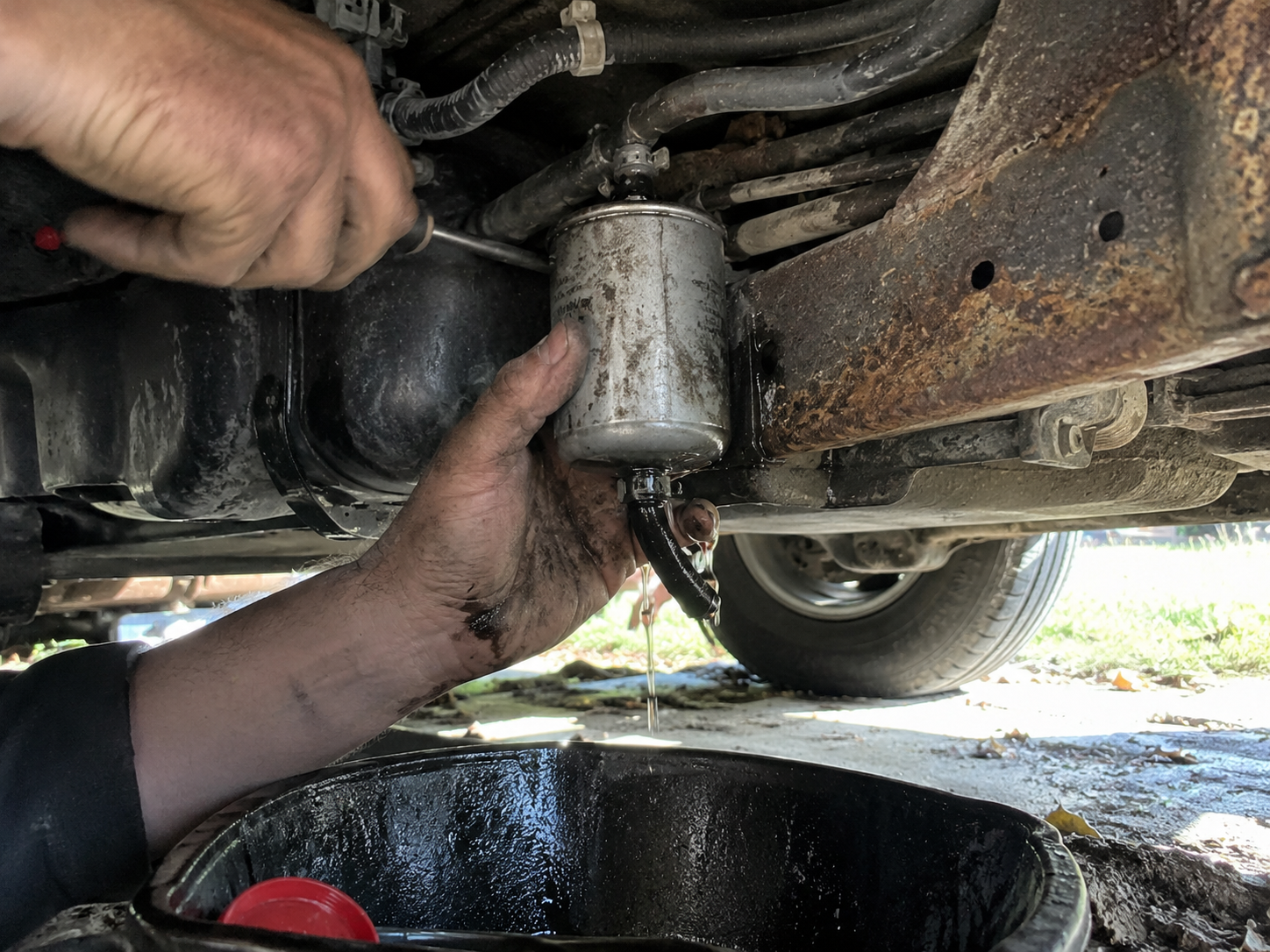
Around town, the car behaves almost perfectly. The engine starts, idle is smooth, no Check Engine light is illuminated and nothing seems wrong while driving gently. Then an opportunity to overtake appears on the motorway. The driver presses the accelerator harder, the engine begins to gain revs — and suddenly it feels as though someone has partially closed the fuel tap.
The car no longer pulls as it should. At light throttle everything seems normal again, but every time the engine is asked to produce more power, the symptom returns. In another vehicle the problem begins very differently: on a cold morning the starter has to crank for longer, the engine eventually fires, runs unevenly for a few seconds and then becomes almost normal.
In situations like these, suspicion can fall on the fuel pump, injectors, mass-airflow sensor, ignition system in a petrol engine, turbocharger in a diesel, pressure regulator, sensors and many other components. But the list also contains a much simpler part — the fuel filter.
The filter's job is not to increase engine power, and it is not an “upgrade” the driver should immediately feel after installation. Its task is much less exciting but far more important: preventing dirt, rust, solid particles and — in many diesel systems — water from reaching the fuel pump and injection system.
As long as the filter remains sufficiently free-flowing, nobody thinks about it. But as contamination accumulates, resistance to fuel flow increases. At idle the engine may require so little fuel that everything still works normally. As soon as the driver accelerates hard and fuel demand rises, the system may no longer be able to provide the same reserve.
That is why a clogged fuel filter is one of those faults that can sometimes imitate a much more expensive problem for quite a long time.
Quick answer
The fuel-filter replacement interval should be taken from the maintenance schedule for the specific vehicle — there is no universal mileage figure that applies to every car. On some diesels the filter is a regularly replaced service item, while on certain modern petrol cars the manufacturer may consider it maintenance-free or require only inspection. A clogged filter can cause loss of power, hesitation, difficult starting, fuel-pressure problems and, in severe cases, engine stalling. Diesel filters often also perform a water-separation function. If symptoms appear, the filter can be one of the first logical things to check, but the symptoms do not automatically prove that the filter itself is the cause.
A fuel filter usually does not make the engine stronger. A good filter simply allows the fuel system to receive as much clean fuel as it was designed to receive.
What does the fuel filter actually catch?
Even high-quality fuel does not reach a vehicle's tank through a completely sterile environment. Fuel is produced, transported, stored in large tanks, pumped into road tankers, transferred into filling-station reservoirs and finally delivered into the car's own tank. Over time, extremely fine solid contaminants, rust particles, fuel-degradation products and other debris can find their way into the system.
In older fuel systems, a small amount of contamination was sometimes less critical. Modern direct-injection systems — and especially common-rail diesels — use extremely small component clearances and very high operating pressures. That means a particle too small to see with the naked eye can still be highly undesirable for a precision pump or injector.
Donaldson technical material explains that the sensitive components in modern high-pressure common-rail, or HPCR, systems need protection even from contamination only a few microns in size. In practice, the filter becomes the barrier between everything the fuel has encountered on its journey and some of the most expensive parts of the engine's fuel system.
Why is the diesel fuel filter's job even more complicated?
A diesel fuel filter often has another problem to deal with — water.
Water can enter diesel fuel in several ways. Some may enter during storage or transfer, while some can develop through condensation and temperature cycling. Inside a fuel tank or filter, water is not simply a harmless liquid that the engine will somehow burn away.
In a modern diesel system, water can promote corrosion, reduce the lubrication required by components, damage the precision surfaces of the high-pressure pump and injectors and create conditions that encourage microbiological contamination in the fuel system.
That is why many diesel filters work not only as solid-particle filters but also as fuel-water separators. Water is separated from the diesel and collected at the bottom of the filter assembly or inside a dedicated chamber.
Some vehicles also have a water sensor and a dashboard warning. Current Ford diesel documentation, for example, describes a “Water/Moisture in Fuel System” warning and provides procedures for draining the filter's water collection chamber depending on the specific model.
If a diesel displays “Water in Fuel” or a similar warning, do not assume it is just another unimportant light. Check the procedure in the vehicle's manual, because prolonged water contamination in a high-pressure diesel system can result in very expensive damage.
How often should the fuel filter be changed?
It is very tempting to give one neat figure here — perhaps 30,000, 40,000 or 60,000 kilometres. The problem is that such a number would be correct for some cars and completely wrong for others.
A useful example comes from a Hyundai European maintenance schedule for a particular diesel engine, where the fuel-filter cartridge is inspected at 30,000 km and replaced at 60,000 km before the cycle repeats. The manufacturer also notes that poor fuel quality may require more frequent replacement and that flow restriction, hesitation, loss of power or difficult starting can justify replacing the filter regardless of the scheduled interval.
But that does not make 60,000 km the new universal figure. In another 2026 Hyundai petrol maintenance schedule, the fuel filter is actually listed as a maintenance-free item, although inspection and replacement are still recommended if fuel-flow restriction, loss of power or difficult starting occurs.
Two genuine manufacturer examples — and two completely different maintenance philosophies.
| Situation | Correct approach |
|---|---|
| The manufacturer specifies a replacement interval | Replace the filter according to the manufacturer's schedule rather than waiting for symptoms |
| The filter is listed as maintenance-free | Do not invent your own interval, but still consider the filter during diagnosis if fuel-delivery problems appear |
| A used car has no known service history | Identify the system design and maintenance requirement; a serviceable filter is often sensible to replace preventively |
| Power loss or difficult starting has appeared | The filter becomes one of the diagnostic points regardless of mileage |
| Water or serious contamination has entered the fuel system | Do not simply wait until the next scheduled service — the entire system may need assessment |
1. The car loses power specifically under heavy load
This is one of the classic scenarios. At idle, an engine uses relatively little fuel. Even when cruising gently at a steady speed, flow demand is nowhere near maximum. A partially restricted filter may still pass enough fuel for those conditions.
During hard acceleration, however, the situation changes. The fuel system suddenly needs to provide a much higher flow rate. If the filter creates excessive restriction, the low-pressure supply may be unable to keep up with engine demand.
Drivers describe this in many ways: “it doesn't pull”, “it chokes when I accelerate”, “above 3,000 rpm it runs out of power”, “I can't overtake properly”, or “it is fine at half throttle but jerks at full throttle”.
Bosch specifically lists engine power loss and fuel-supply problems among the possible consequences of a clogged fuel filter.
But it is important not to jump straight to the conclusion “no power = fuel filter”. A failing fuel pump, faulty pressure regulator, injector problem, air-supply fault, ignition problem in a petrol engine, turbo-system fault in a diesel or various sensor problems can produce very similar symptoms.
2. The engine jerks when you press the accelerator harder
If flow through the filter is right on the limit, fuel pressure may become unstable under load. The engine receives enough fuel, then briefly not enough, then pressure recovers — and to the driver this can feel like uneven or jerky acceleration.
That is why the fuel filter is worth keeping in mind when a car behaves normally during gentle driving but begins to hesitate under heavier load.
However, this symptom is extremely non-specific. In a petrol engine, worn spark plugs or ignition coils can cause similar hesitation. In a diesel, fuel-pressure, injector or turbo problems may do the same. Both engine types can also suffer from air-supply or engine-management faults.
For a deeper explanation of this symptom, read “Car Jerks When Accelerating: How to Tell Whether the Problem Is Spark Plugs, Coils, Injectors, Turbo or Transmission”.
3. The engine takes longer to start in the morning
Difficult starting is another possible sign. For an engine to start, the fuel system must establish the required supply and pressure within a certain amount of time. If flow is restricted, that can take longer.
Hyundai specifically lists hard starting in its diesel maintenance information as one of the symptoms that can justify fuel-filter replacement regardless of the scheduled service interval.
But once again, the filter is not the only candidate. A weak battery, slow starter, fuel draining back, air entering the fuel system, incorrect pressure, a temperature sensor, injectors, diesel glow plugs and several other faults can create a very similar result.
If the engine will not start at all, or you cannot tell whether the problem lies with the battery, starter, fuel supply or ignition, see “Car Will Not Start: The Starter Does Not Crank, Cranks Slowly or the Engine Will Not Fire — How Do You Find the Real Cause?”.
4. The engine stalls unexpectedly
A severely restricted fuel supply can reach the point where the engine can no longer maintain operation. Bosch lists engine stalling among the possible consequences of an excessively clogged filter.
But sudden stalling should never automatically be blamed on a cheap filter. A crankshaft-position sensor, electric fuel-pump failure, power-supply fault, relay, control unit, immobiliser and several other failures can stop an engine just as effectively.
If the engine stalls while driving and then refuses to restart, the priority is to move the vehicle to a safe location rather than repeatedly cranking the starter in the hope that the filter will somehow “clear itself”.
5. Low fuel pressure or a related fault code appears
In a modern vehicle, fuel delivery is monitored electronically. If the engine-control unit requests a certain pressure but the system cannot achieve or maintain it, a fault code may be stored and, in some cases, the Check Engine light may illuminate.
A restricted filter can be one reason the pressure system is no longer receiving sufficient supply, but a “fuel pressure too low” code does not automatically mean “replace the filter”.
Requested and actual pressure data, the supply pump, electrical power, regulator, sensors, possible leaks, injector return flow and other parameters relevant to the specific fuel system may all need to be checked.
6. The car suddenly starts worse after the fuel filter was replaced
This is a particularly interesting scenario because the driver expected an improvement and instead got the opposite.
After replacing the filter in a diesel low-pressure fuel system, the vehicle may require a specific priming and bleeding procedure. If air remains inside the system, the engine may struggle to establish normal fuel supply.
On some cars, the electric fuel pump performs the initial priming automatically when the ignition is switched on. Others use a manual hand primer or a specific service procedure. On certain systems, bleeding becomes particularly important after the vehicle has run completely out of fuel or the fuel system has been opened.
If the problem began immediately after a filter change, check the simple things first: was the correct filter installed, are all hoses connected properly, are the seals seated correctly, are any connections drawing in air and was the required priming procedure followed?
If the car became harder to start immediately after a fuel-filter change, do not rush to conclude that the new filter is “too restrictive”. First check the correct part, seals, connections and the system's bleeding or priming procedure.
7. A diesel shows a water-in-fuel warning
This symptom points in a much more specific direction. Some diesel vehicles have a water sensor in the fuel-filter housing that detects when a certain amount of water has accumulated.
Depending on the design, the service procedure may require draining the water separator, replacing the filter or carrying out a broader fuel-quality inspection. It should not automatically be assumed that simply clearing the warning and continuing to drive is enough.
Hyundai diesel documentation even warns that continuing to drive with a fuel-filter warning can damage injectors, the common-rail system and the high-pressure pump.
8. The problem suddenly appears during severe frost
For drivers in Latvia and other cold climates, this is a particularly relevant scenario. The car drove normally in autumn, but during the first serious cold spell the diesel becomes difficult to start or loses power after a few kilometres.
The cause is not always simply an “old filter”. Diesel fuel contains paraffin compounds that can begin to crystallise at low temperatures. If the fuel is not suitable for the actual temperature, these crystals can significantly restrict flow through the filter media.
A contaminated filter may be even more sensitive in this situation because its available flow reserve is already reduced.
That is why a winter problem should not automatically be “fixed” by pouring in any bottle labelled diesel anti-gel. First establish what fuel is in the tank, what the actual temperature is, whether the vehicle has fuel-filter heating and which additives the manufacturer permits.
9. The new filter becomes clogged again very quickly
If the filter has been replaced and the same problem returns after only a few thousand kilometres, simply fitting a third filter and hoping for the best is not a good strategy.
A much more useful question is: what is filling the filter so quickly?
There may be contamination inside the fuel tank, rust, water, deposits from aged or degraded fuel or another source of debris. Diesel systems that contain free water for long periods can also develop microbiological contamination, commonly referred to as “diesel bug”. The resulting deposits and slime can clog filters surprisingly quickly.
In that situation, the new filter is doing exactly what it is supposed to do — catching contamination. The real problem lies upstream of the filter.
Petrol and diesel fuel filters — what is the difference?
In both cases, the basic job is to stop contamination before it reaches sensitive fuel-system components. But the actual system design can be very different.
An older petrol car may have a simple inline filter underneath the vehicle or inside the engine bay. Another vehicle may integrate the filter into the fuel-pump module inside the tank, where it is not intended for routine separate replacement.
Diesel vehicles are more likely to use a separate serviceable filter assembly because good water separation is required in addition to solid-particle filtration. Some units also include a heater, water sensor, drain valve or other additional components.
That is why an online video titled “fuel filter replacement in five minutes” may be completely accurate for one vehicle and completely irrelevant to another.
Is a more expensive fuel filter really better?
Price alone is not a quality standard, but a fuel filter is also not a part where the only criteria should be “the thread fits and this one is cheapest”.
Filtration efficiency matters, as does the ability to hold contamination without creating excessive flow restriction, the durability of the filter medium, the quality of the seals and, in a diesel filter, the effectiveness of water separation.
In a modern common-rail diesel, solid particles only a few microns in size are no longer a purely theoretical issue. The high-pressure pump and injectors use extremely precise surfaces, and the filter is effectively one of the cheapest forms of protection they have.
The safest approach is to select a filter that meets the specification listed for the particular vehicle and comes from a reputable manufacturer, rather than choosing only by external dimensions.
Can a fuel filter itself increase fuel consumption?
It is important not to exaggerate this point. A partially restricted filter is not the same as a dragging brake that constantly increases rolling resistance.
If the filter can still supply all the fuel and pressure the engine needs, there may be no meaningful change in consumption at all. The issue becomes important when normal fuel delivery is disturbed and the engine begins operating outside its intended conditions.
At that stage, there may be loss of power, unstable running, incorrect fuel delivery or the driver may unconsciously press the accelerator harder in an attempt to compensate for the missing performance.
So an advertising promise such as “a new fuel filter will reduce consumption by 10%” is not universally justified. If the old filter was badly restricted, replacement restores normal operation. If the old filter was perfectly healthy, dramatic fuel savings should not be expected.
Can you tell by looking at the old filter whether it was clogged?
Sometimes. A filter may be extremely dark, or visible deposits, rust or water may be present. But appearance alone is not a perfect measure of flow restriction.
Microscopic contamination trapped inside the filter media can significantly increase resistance even when the removed element does not look like a lump of mud.
On the other hand, a heavily contaminated old filter contains useful diagnostic information. If rust, water or an unusually large amount of deposits are found, attention should turn not only to fitting a new element but also to identifying the source of the contamination.
Why should you not pour random “cleaning” products into the fuel filter?
You may occasionally hear advice to fill a new filter with fuel-system cleaner, transmission fluid, two-stroke oil or another liquid so that the engine “cleans itself out”. In a modern high-pressure fuel system, this kind of improvisation is not a sensible universal maintenance method.
Only fuels and additives that comply with the manufacturer's requirements should be used. Current Hyundai diesel documentation, for example, warns that unapproved fuels or additives can increase wear and damage the engine and fuel system.
Replacing a fuel filter is not an opportunity to conduct a chemistry experiment on the injectors.
Do not test a common-rail system by loosening a high-pressure fuel pipe
On an older diesel, mechanics sometimes checked fuel delivery by slightly loosening an injector-line connection. That old habit should not be transferred to a modern common-rail diesel.
The high-pressure pump, rail and injector pipes operate at extremely high pressure. Hyundai warns against touching the injection system while the engine is running and for a period after shutdown because high pressure can remain inside the system and a fuel jet can cause serious injury.
Bosch service guidance similarly states that the high-pressure system must be depressurised before repair and that fuel lines must not be disconnected while the engine is running.
On a modern direct-injection petrol or common-rail diesel high-pressure system, never check whether fuel is “getting through” by loosening a pipe at the injector. High-pressure fuel can cause serious injury. Use the diagnostic procedure specified for the particular system.
Should the fuel filter be changed immediately after filling with “bad fuel”?
That depends on what “bad fuel” actually means. If the engine simply seems to run differently after refuelling, that alone does not prove that the fuel contains physical contamination.
But if water, dirt, the wrong fuel or another serious contaminant has been confirmed, the filter becomes only one part of the problem. Depending on how much incorrect or contaminated fuel entered the system and whether the engine was operated with it, the tank may need to be drained, the system cleaned and additional components inspected.
If petrol has been put into a modern diesel — or diesel into a petrol car — do not try to “dilute it with the correct fuel” and hope the filter will save everything.
Is it okay to run the fuel tank completely empty?
Doing it deliberately is not a useful maintenance strategy. If the engine stops because the tank is empty, some diesel systems require a specific bleeding or priming procedure after fuel is added.
In many designs, the electric fuel pump also relies on fuel for cooling and lubrication. Regularly driving until the tank is completely dry provides no benefit to the fuel system.
At the same time, the popular story that “as soon as the reserve light comes on, the pump starts sucking all the dirt from the bottom of the tank” is overly simplistic. The fuel pickup is already located near the bottom of the tank during normal operation. What matters much more is whether contamination is actually present and whether the filtration system is working properly.
What should you check if you suspect a clogged fuel filter?
A good diagnostic process begins with questions rather than buying parts.
- When was the filter last replaced, and what interval does the manufacturer specify?
- Is power loss present all the time or only under heavy load?
- Is the engine difficult to start when cold, hot or in both situations?
- Is there a Check Engine, fuel-filter or water-in-fuel warning?
- Did the problem begin after refuelling at a particular station?
- Did the problem begin immediately after the filter was replaced?
- In OBD live data, does actual fuel pressure follow requested pressure under load?
- Can the low-pressure pump provide the specified supply?
- Does the old filter contain water, rust or an unusual amount of contamination?
How can you distinguish a clogged filter from a failing fuel pump?
It is not always possible from driving symptoms alone. Both a restricted filter and a weak supply pump can result in insufficient fuel delivery under load.
The difference is found through diagnosis. Depending on the system, a workshop may measure low-pressure supply pressure and flow, compare requested and actual rail pressure, check pump current draw or carry out other manufacturer-specified tests.
If the filter is far beyond its scheduled service interval, replacing it may be a logical first step. If the filter was replaced yesterday and supply pressure still collapses, blindly installing another filter is no longer diagnosis.
How can you distinguish a filter problem from an injector problem?
A clogged filter usually affects the overall supply of fuel to the system. An injector fault may be more obvious in one particular cylinder.
For example, one cylinder may show a correction or misfire fault, the engine may vibrate at idle, or one diesel injector may return significantly more fuel than the others.
In practice, however, faults can overlap. Weak overall fuel supply can make the entire system operate outside its intended range, while faulty injectors can make it appear that pressure is insufficient. Replacing a fuel filter is a maintenance task; diagnosing injectors is the next level of investigation.
8 fuel-filter mistakes you should avoid
- Inventing one universal replacement interval for every car. On one vehicle the filter may be a regular service item, while on another it may not be scheduled for periodic replacement at all.
- Ignoring the filter simply because there is no dashboard warning. Flow restriction can become noticeable under load before a clear warning appears.
- Assuming every loss-of-power problem is a clogged filter. Pumps, injectors, ignition, turbo systems and sensors can produce similar symptoms.
- Failing to follow the priming or bleeding procedure after replacement. Air trapped in the system can cause difficult starting.
- Ignoring a water warning on a diesel. Water in a modern common-rail system can cause extremely expensive damage.
- Filling the new filter with random chemicals. A fuel system is not the place for improvised additive combinations.
- Testing high-pressure delivery by loosening an injector pipe. On a modern system this can be dangerous.
- Repeatedly replacing filters without investigating the source of contamination. If a new filter clogs quickly, the real problem is likely in the tank or fuel.
Mini test: fuel filter or should you keep looking?
A diesel fuel filter has not been changed for 80,000 km; the car is fine in town but loses power while overtaking
If that vehicle has a shorter scheduled replacement interval, the fuel filter is a very logical thing to check. At the same time, fuel-pressure data should be reviewed and the pump, turbo system and other possible causes of power loss should be ruled out.
The new filter was fitted yesterday, and today the engine takes a long time to start
Check the work that was just carried out first: correct filter, seals, connections, possible air leaks and the vehicle's priming or bleeding procedure. The timing of the symptom in relation to the service is an important diagnostic clue.
A diesel shows a “Water in Fuel” warning, but the engine runs normally
Normal engine operation is not a reason to ignore the warning. Check the vehicle manual — draining the water separator, servicing the filter or carrying out a workshop inspection may be required.
On the first -20 °C morning, the diesel starts but loses power after a few kilometres
Consider not only a mechanically clogged filter but also whether the diesel fuel is suitable for the temperature and whether paraffin crystallisation is restricting flow. It is particularly suspicious if much of the fuel in the tank was purchased during significantly warmer weather.
The filter was replaced 5,000 km ago but is already heavily contaminated again
Look for the contamination source — the tank, water, rust, degraded fuel or microbiological growth. Fitting a third filter without finding the cause will simply repeat the same cycle.
The owner's manual lists the fuel filter as maintenance-free, but difficult starting has appeared
“Maintenance-free” does not mean the component can physically never cause a problem. It means no routine periodic replacement is scheduled under normal operating conditions. The fuel-supply system still needs to be considered during diagnosis.
Myths and facts
| Claim | Myth or fact? | Explanation |
|---|---|---|
| Every car needs a new fuel filter every 30,000 km. | Myth | Intervals — and even the entire service concept of the filter — vary significantly between vehicle models. |
| A clogged fuel filter can cause the engine to lose power. | Fact | Excessive flow restriction can limit the amount of fuel available to the engine. |
| If the engine idles perfectly, the fuel filter cannot be clogged. | Myth | The engine requires much less fuel at light load, so restriction may only become apparent during acceleration. |
| A diesel fuel filter can also separate water. | Fact | In many systems, water separation is one of the filter's most important functions. |
| If a new filter clogs quickly, you simply need a better brand of filter. | Not necessarily | Rapid repeat clogging may indicate water, rust or another contamination source inside the tank. |
| A diesel fuel system may need bleeding after the filter is replaced. | Fact | The exact priming procedure depends on the particular fuel-system design. |
| On a common-rail system, it is safe to check fuel delivery by loosening an injector high-pressure pipe. | Myth | High-pressure fuel can cause serious injury; the system must be depressurised and diagnosed using the correct procedure. |
Frequently asked questions
How often should the fuel filter be changed?
Use the interval specified in the maintenance schedule for the particular vehicle. On some diesels the filter is a regularly replaced service item, while on certain petrol cars no periodic replacement may be scheduled. If fuel-flow restriction, power loss or difficult starting appears, the filter may need to be checked regardless of the calendar or mileage interval.
How can you tell if a fuel filter is clogged?
Possible signs include power loss under heavy load, hesitation, difficult starting, low fuel-pressure faults and, in severe cases, stalling. However, all of these symptoms can also be caused by other faults.
Can a clogged fuel filter increase fuel consumption?
Indirectly, yes, if restriction has already begun to interfere with normal fuel delivery and engine operation. But a new filter is not guaranteed to improve fuel economy on an otherwise healthy car. Its primary purpose is to ensure correct fuel supply and protect the fuel system.
Why is there water in a diesel fuel filter?
Water can enter diesel during storage and transport or develop through condensation and temperature cycling. Many diesel fuel filters are designed to separate this water before it reaches the high-pressure pump and injectors.
Can a diesel fuel filter suddenly become restricted in winter?
At very low temperatures, paraffin crystals in diesel can restrict flow through the filter, particularly if the fuel is not suitable for the conditions. An old or already partially contaminated filter can make the problem worse.
Can a fuel filter simply be blown clean and reused?
A disposable filter element is intended to be replaced, not restored with compressed air or washing. Such “cleaning” can damage the filter media and may no longer provide the required filtration performance.
Do fault codes need to be cleared after replacing the fuel filter?
That depends on the vehicle. Some need nothing beyond correct priming and starting, while others may have a maintenance counter or stored diagnostic faults. Codes should not simply be erased without checking that their underlying cause has actually been corrected.
Conclusion
The fuel filter is one of those car components that spends most of its life doing its job in complete silence. The driver cannot see everything it catches, does not feel each individual dust or rust particle and rarely thinks about the microscopic droplets of water that may be separated from diesel before they reach expensive injectors.
That is exactly how it should be.
But every filter has a limited capacity for storing contamination. As that contamination accumulates, resistance to flow increases. And the interesting part is that the driver does not always feel the limit immediately.
The engine still idles perfectly. Around town everything seems normal. Only when the accelerator is pressed hard does the engine suddenly need much more fuel, and the system may no longer be able to provide it with sufficient reserve. That is why a partially clogged filter can sometimes appear as “the car only loses power when overtaking”.
But it is equally important not to fall into the opposite trap. Loss of power does not automatically mean the fuel filter. Difficult starting does not automatically mean the fuel filter. A P0300 code, low rail pressure or jerky acceleration is not the name of a failed component — these are clues that guide diagnosis.
The correct approach begins with service history. If the manufacturer specifies fuel-filter replacement at 60,000 km, the odometer now shows 110,000 km and nobody remembers whether the filter was ever changed, replacing it is a very logical maintenance step even before symptoms appear.
On the other hand, if the manufacturer considers the filter maintenance-free and the car has covered only 40,000 km, there is little sense in inventing your own 20,000 km replacement schedule simply because the owner of a completely different model recommended it online.
With a diesel there is another factor to remember — water. The pump and injectors in a modern common-rail system are extremely precise and expensive components. A fuel filter with effective water separation is one of the simplest protection stages between the imperfect outside world and this precision equipment.
That is why a “Water in Fuel” warning is not decoration, and a new filter cannot magically turn contaminated fuel into good fuel after two kilometres. If there is a large amount of contamination, its source needs to be found.
And finally, modern fuel systems are not the place for old garage habits. High-pressure pipes should not be loosened to see whether fuel “sprays out”. Filters should not be filled with random oils or cleaners. After replacement, the priming and bleeding procedure specified for the particular system should be followed.
A good fuel filter is inexpensive compared with a high-pressure pump or a set of injectors. But its true value is not that the engine suddenly gains ten horsepower after replacement. Its value is that the fuel system continues receiving a sufficient amount of clean fuel for years, while the driver does not have to think about the filter again until the next scheduled service.
Driver's short takeaway: there is no single universal fuel-filter replacement interval — check your vehicle's maintenance schedule. If the engine begins losing power under load, hesitates, becomes harder to start or develops low fuel-pressure problems, the filter is one of the logical things to check. Water separation is especially important on a diesel. If a new filter becomes clogged quickly, find the source of the contamination instead of simply installing another one. And on a common-rail high-pressure system, never check fuel delivery by loosening an injector pipe while the engine is running.
Sources and technical note
The technical information in this article was checked against Bosch Mobility Aftermarket material covering petrol and diesel fuel filters, the consequences of restriction and water separation; Donaldson technical information on the sensitivity of modern high-pressure common-rail systems to solid particles, water, fuel-degradation products and microbiological contamination; current Hyundai maintenance documentation showing both scheduled diesel fuel-filter replacement and a maintenance-free approach on certain petrol models, together with symptoms that can justify inspection regardless of the normal schedule; Ford information concerning water in diesel fuel filters; and Hyundai and Bosch safety guidance for working with high-pressure fuel-injection systems. The exact filter replacement interval, filter design and priming or bleeding procedure should always be determined from the technical documentation for the specific vehicle.