
 LV
 EN
 RU
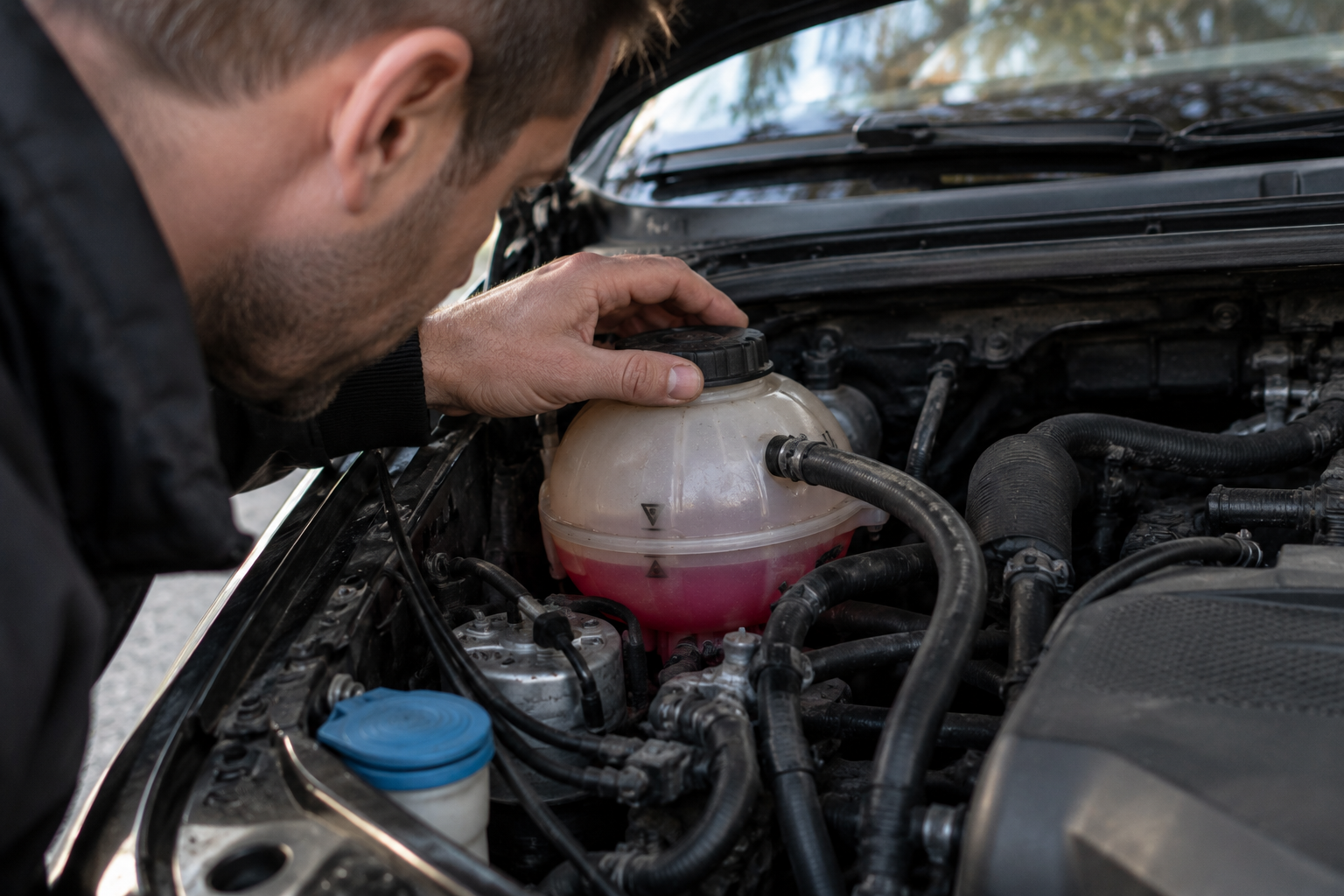
A month ago, you happened to look under the bonnet and noticed that with the engine completely cold, the coolant level was almost exactly at the MAX mark. This morning you check again and it is somewhere halfway between MAX and MIN. Another couple of weeks pass, and the level is approaching MIN. The car never leaves a coloured puddle behind, nothing obvious is dripping inside the engine bay, the temperature gauge sits where it always has and the engine seems completely healthy.
The first reaction is often simple: add a little more coolant and keep driving. If the level drops again a few months later, add some more. Over time, regularly topping up the cooling system begins to feel like a normal characteristic of an ageing car.
But a healthy sealed cooling system should not regularly require litres of additional coolant. The level does change between a cold and hot engine, and after repairs or a coolant change some remaining air may leave the system and require a one-off correction. Repeated and measurable loss, however, means there is a reason that needs to be found.
And this is where the problem becomes more interesting: the absence of a puddle does not prove the absence of a leak.
Coolant may escape only while the engine is hot and the system is under pressure. It can land on a component hot enough for much of it to evaporate before anything reaches the ground. The engine undertray may collect part of the leak. Coolant can enter the passenger compartment, the exhaust system or even the inside of the engine. On some diesel engines, there is another possible route — through the EGR cooler.
So the important question is not simply “where is the puddle?”. The better question is: where can coolant disappear in a way that the driver never sees it reaching the ground?
Quick answer
If the coolant level repeatedly falls when checked with the engine cold, a leak or another fault needs to be investigated even when there is no puddle under the car. Common causes include small leaks from hoses, the radiator or connections, an expansion tank or pressure-cap problem, a leaking water-pump seal, thermostat housings and other plastic components, the heater core, a diesel EGR cooler or an internal engine leak such as a failed head gasket. First compare the level only with the engine cold, then look for dried coolant residue, a sweet smell, unusual window fogging, persistent white exhaust and abnormal temperature behaviour. Never open the cap of a hot pressurised cooling system.
Coolant loss without a visible puddle is not mysterious. It simply means the coolant is escaping at a different time or in a different place from where you are looking.
First make sure the level is actually falling
You cannot accurately compare the coolant level one day with the engine completely cold and the next day immediately after an 80-kilometre drive. Coolant expands as it heats up, so the level in the expansion tank can rise. Vehicle manufacturers also note that with the engine hot, the level may temporarily sit above the MAX mark without that automatically meaning there is a fault.
If you want to know whether the car is genuinely losing coolant, compare it under the same conditions. Park the vehicle on approximately level ground and allow the engine to cool completely, ideally overnight. Note the level or take a photograph, then compare it again after several days or weeks under similar conditions.
Another situation is recent cooling-system work. If air remains trapped after a coolant change or repair, it may escape after several heat cycles and the level may drop once. That is very different from a vehicle that needs another top-up every few weeks.
If you need to know which coolant may safely be added and why coolant colour alone does not reliably identify the correct specification, read “How Often Should You Change Engine Coolant or Antifreeze? Does Colour Matter and Can Different Coolants Be Mixed?”.
Where can coolant go if nothing appears on the ground?
| What you notice | What is worth checking |
|---|---|
| Level slowly drops but the engine bay appears dry | Small leaks that appear only when hot/pressurised, pressure cap, connections |
| Dried coloured residue around the pump | Water-pump seal or weep/drain area |
| Sweet smell inside the cabin and unusual window fogging | Heater core or its connections |
| A fully warm engine continues producing thick white vapour/exhaust | Internal coolant entry into the cylinders or exhaust side |
| Diesel coolant level falls with no obvious external leak | EGR cooler together with the rest of the cooling circuit |
| Unusual contamination appears in the coolant or oil | Head gasket, heat exchanger or another internal leak |
| More coolant disappears after motorway driving than around town | Leak that appears only at higher temperature and system pressure |
| Tank drops again after topping up and there is dried residue around it | Pressure cap, overpressure, overfilling or combustion gases in the system |
1. A hose, radiator or connection leaks only when the system is hot
This is one of the simplest explanations for why the ground is completely dry in the morning. A cold cooling system and a fully warmed, pressurised cooling system are not operating under the same conditions. As the coolant heats up, system pressure increases, hoses and plastic components expand and a small crack or weak connection may begin leaking only at that point.
If the opening is tiny, the leak may not form a visible stream at all. It may simply seep. When the coolant lands on a hot engine component, turbocharger area or another hot surface, part of it can evaporate. By the time the vehicle is parked and the cooling system loses pressure, the leak has stopped. The road beneath the car is dry the next morning.
In this situation, dried coolant residue can be more valuable than searching for a puddle. Depending on the coolant being used, it may leave pink, whitish, blue or differently coloured crystalline deposits around a joint, radiator seam or engine component.
Also inspect hose connections, clamps, quick-connect fittings and the plastic side tanks of the radiator. Years of temperature cycling can make plastic increasingly brittle, and a very small crack may become visible only while the system is under pressure.
2. The expansion tank or pressure cap is no longer working correctly
The expansion-tank cap looks like a very simple component, but in many cooling systems it also acts as a pressure regulator. The system is designed to operate within a particular pressure range, and the valves in the cap help control that pressure.
If the cap no longer seals correctly or opens at the wrong pressure, coolant may escape or vent around the tank. A pressure-control fault in the other direction can allow excessive pressure to develop and place additional stress on hoses, the radiator or the expansion tank itself.
Technical cooling-system guidance lists coolant loss and excessively high temperature among the possible symptoms of expansion-tank or pressure-cap faults, with system pressure testing being one useful diagnostic step.
Look around the cap and tank seams for dried coolant residue. On an older tank, also inspect the body for very fine cracks. These can be almost invisible when the plastic is cold but open as the tank becomes hot and pressurised.
Never remove the cooling-system cap with the engine hot. The system may be pressurised and hot coolant or steam can be released violently. Only inspect or open the system after it has cooled and according to the vehicle manufacturer's instructions.
3. The water pump is slowly leaking past its seal
The water pump — more accurately the coolant pump — continuously circulates coolant through the engine and radiator. Its shaft seal operates under difficult conditions involving temperature, rotational speed and changing system pressure.
A failing pump can show itself through noise, coolant loss and inadequate cooling or overheating. Many pumps also have a drain or weep opening around which traces of coolant may appear when the shaft seal begins to deteriorate.
There is an important nuance here: on some pump designs, extremely minor residue around the drainage area does not automatically prove that the pump has failed because the mechanical seal design may allow a very small amount of fluid. Persistent or significant leakage combined with a falling coolant level is a different matter.
On some engines the water pump sits behind timing-belt covers or in another difficult-to-see location. A small leak can therefore remain unnoticed for a long time, with the driver's only clue being the steadily falling level in the expansion tank.
4. The thermostat housing, plastic flange or quick connector is cracked
In a modern engine bay, coolant no longer travels through only one radiator and a few rubber hoses. The system may include multiple plastic housings, thermostat modules, distribution blocks, quick connectors, electric pumps and different heat exchangers.
Plastic allows manufacturers to create complex and lightweight components, but years of repeated hot-and-cold cycles can make some housings brittle. A tiny crack near a bolt, seam or hose connection may open only once the engine reaches full operating temperature.
Connections located at the rear of the engine near the bulkhead or underneath the intake manifold can be particularly difficult to see. Coolant can run down the engine block, dry away and never reach the ground in sufficient quantity to form a puddle.
That is why a proper visual cooling-system inspection involves more than simply looking at the top of the radiator. The whole circuit may need to be examined with good lighting, and engine covers or undertrays may sometimes need to be removed.
5. Coolant is entering the cabin through the heater core
If there is no puddle under the car, look in the opposite direction too — inside the vehicle.
Cabin heating in many cars uses a small heat exchanger known as the heater core. Hot engine coolant flows through it while the ventilation fan blows air across the core to warm the cabin. Like other heat exchangers, the heater core can eventually develop leaks through corrosion or damaged connections.
If the leak is small, coolant may not immediately produce an obvious wet patch on the carpet. Some of it can evaporate into the ventilation system, creating much stranger first symptoms: a sweet chemical smell inside the car, a greasy film on the windscreen and windows that become unusually difficult to demist.
With a larger leak, dampness may appear in the front footwell on the passenger or driver's side depending on the vehicle design. But not every wet carpet automatically means coolant — rainwater can enter through door membranes, blocked air-conditioning drains, sunroof drains and several other routes.
If your main symptom is fogged windows, see the more detailed guide “Why Do Car Windows Fog Up or Freeze on the Inside?”.
6. On a diesel, coolant can disappear through the EGR cooler
This is a cause that many petrol-car owners may never need to consider, but on a modern diesel it can be very important.
Many diesel engines use a coolant-cooled EGR heat exchanger. Its job is to reduce the temperature of recirculated exhaust gas before it returns to the intake. That means coolant and the exhaust-gas path run very close together inside the same component.
If the EGR cooler casing or internal core cracks, coolant can disappear without producing a classic puddle under the vehicle. Technical service information for specific diesel engines has linked slow coolant loss directly to EGR-cooler cracks, while internal EGR-cooler faults are also one of the possibilities that may need to be considered after visual and pressure testing fails to reveal a clear external leak.
This is another reason why the statement “white smoke plus disappearing coolant equals head gasket” is too simplistic. On a diesel, coolant may also reach the exhaust side through the EGR cooler.
7. The head gasket or cylinder head is damaged
This is the cause drivers fear most, and online discussions often turn every missing cup of coolant immediately into a “blown head gasket”. Without testing, however, that conclusion is far too quick.
The head gasket separates several very different environments: cylinder combustion pressure, engine-oil passages and coolant passages. If the seal fails, the direction of leakage can vary. Coolant can enter a cylinder, combustion gases can enter the cooling system, coolant can enter the oil or, in some cases, the leak can even be external.
That is why there is no single head-gasket symptom that appears in every failure.
Signs that increase suspicion
- coolant disappears and no external leak can be found;
- unusually thick white exhaust remains after the engine is fully warm;
- the engine repeatedly overheats or unusual pressure develops in the cooling system;
- the engine briefly runs unevenly after a cold start if coolant has entered one cylinder while parked;
- oily contamination appears in the coolant or there are signs of coolant entering the engine oil;
- combustion gases are detected in the cooling system.
None of these signs on its own is perfect proof. For example, a white cloud on a cold morning is usually condensation rather than a damaged engine. A small amount of pale residue under the oil filler cap on a car used only for very short winter journeys can also be caused by condensation.
A much more worrying pattern is a combination: the coolant level repeatedly falls, the white exhaust does not disappear once the engine is warm, overheating develops or diagnostic testing detects combustion gases in the cooling circuit.
For a deeper explanation of white, blue and black exhaust smoke, read “White, Blue or Black Smoke from the Exhaust: What Does the Colour Really Tell You About an Engine Problem?”.
8. Coolant and oil meet inside a heat exchanger
The head gasket is not the only place where engine oil and coolant pass very close to each other. Many engines use a coolant-fed engine-oil heat exchanger or oil cooler.
If an internal wall or seal inside that heat exchanger fails, the two fluids can begin mixing. The result depends on the design and relative pressures in the two systems. In some cases, oil enters the coolant and the expansion tank develops a dark, oily contamination. In others, the failure pattern can be more complicated.
That is why oil contamination inside the expansion tank is not automatic proof of a failed head gasket. The particular engine's heat-exchanger design also needs to be understood and checked.
The same principle applies to other heat exchangers where engine coolant runs close to another fluid. Proper diagnosis considers the whole cooling circuit, not only the cylinder block and head.
9. Coolant is being pushed out only while the car is moving
There is another scenario that explains the phrase “there is never a puddle where I park”. Coolant may escape only while the vehicle is being driven.
An overfilled expansion tank, a faulty pressure cap, overheating, trapped air or combustion gases entering the cooling system can create conditions in which coolant is pushed out through an overflow or pressure-relief route. While driving, it can be sprayed around the engine bay or underneath the car, leaving nothing to drip once the vehicle reaches the parking space.
That is why it is worth inspecting not only the ground but also the area around the expansion tank, the underside of the bonnet, the engine undertray and nearby components. Dried splash marks can sometimes tell a very clear story about what happened while the vehicle was moving.
White exhaust means a blown head gasket? Not so fast
On a cold morning, almost any petrol or diesel car can produce a visible white cloud from the exhaust. Water is a normal product of combustion, condensation accumulates inside a cold exhaust system and that water vapour becomes very visible in cold air.
If the cloud gradually disappears as the engine warms up and the coolant level remains stable for months, ordinary condensation is a much more likely explanation.
A more suspicious scenario is different: the engine is fully warm, the outside temperature is not particularly low, but thick white vapour continues leaving the exhaust and the coolant level in the expansion tank is measurably falling at the same time. Then it becomes necessary to investigate how coolant could be reaching the combustion or exhaust side.
On a petrol engine, one possible route is through the head gasket or cylinder head. On a diesel, the EGR cooler may also appear on the list. The diagnosis therefore depends on the combination of symptoms and test results, not simply the colour of the exhaust cloud.
Do bubbles in the expansion tank prove a head-gasket failure?
Not necessarily.
Air may remain in the system after it has been drained and refilled. On some designs, normal coolant movement can also be visible in the expansion tank through a bleed or return hose. Seeing one bubble is therefore not a diagnosis.
It becomes more suspicious when unusually high cooling-system pressure develops very quickly after a cold engine is started, coolant is repeatedly forced out of the system and a diagnostic test detects combustion gases in the coolant circuit.
Even then, diagnostic order matters. Simple external leaks should be ruled out before the engine is dismantled.
What does a cooling-system pressure test show?
A pressure test is one of the most useful tools when the coolant level is falling but nothing obvious can be seen.
A special tool is used to apply controlled pressure to the cooling system according to the requirements of that vehicle. The gauge is then monitored while the system is inspected for leakage. A falling pressure reading can indicate that the system is not sealed.
This can reveal a small leak at a radiator, hose, housing, connection or pump that may not appear at all when the cold system is unpressurised. For especially difficult external leaks, a professional workshop may also use tracing dye if appropriate for the system.
However, a pressure test does not answer every possible question. Some internal leaks may occur mainly while the engine is running and combustion pressure exists inside the cylinders. Different tests are needed in that situation.
What is a CO₂ or combustion-gas test?
If there is reason to suspect that cylinder combustion gases are entering the cooling system, a workshop can use a test designed to detect combustion products in the vapour above the coolant.
This asks a completely different question from an ordinary pressure test. A pressure test asks: “Is the coolant circuit leaking somewhere?” A combustion-gas test asks: “Are gases from the cylinders entering the cooling system?”
A positive result is a very important diagnostic clue, but the final conclusion should still be combined with the engine's symptoms and other tests. Depending on the situation, further diagnosis may include compression testing, a cylinder leak-down test, borescope inspection or procedures specified by the manufacturer.
Does “mayonnaise” under the oil cap automatically mean coolant is in the oil?
No. This is one of the most popular traps in internet diagnosis.
If a vehicle is driven only on very short journeys in winter and the engine rarely reaches full operating temperature, moisture can condense around the relatively cool oil filler cap and combine with oil vapour to produce a pale emulsion.
It becomes much more worrying when the oil on the dipstick or a significant amount of oil in the sump becomes milky, the coolant level is falling at the same time and other symptoms of internal coolant leakage are present.
Again, one isolated sign should never be removed from its wider context.
Can you simply keep topping up the coolant?
Temporarily topping up with the correct coolant may sometimes be necessary to get the vehicle safely to diagnosis, but repeated topping-up is not a repair.
First, a small leak can suddenly become a large leak. Second, a low coolant level can allow air into the system and interfere with proper circulation. Third, driving for too long with insufficient coolant can cause overheating, turning a relatively small original fault into a much more expensive engine repair.
If the temperature begins climbing, steam appears or an overheating warning is displayed, the situation has already changed. For more detail, read “What Causes Engine Overheating and What Should You Do?”.
Should you pour a “stop leak” product into the cooling system?
The idea is tempting: the leak is small, the proper repair is inconvenient and a bottle on the shelf promises to “seal the radiator in five minutes”.
Such products are not universally harmless. Vehicle manufacturers warn against using unsuitable cooling-system sealants because they can damage or interfere with the cooling and heating system, while technical cooling-system guidance also notes that sealants can obstruct the narrow passages inside radiators and heater cores.
A chemical patch also does not answer the question of why the leak appeared in the first place. A cracked plastic housing, worn pump or failed head gasket does not become a healthy component simply because a thicker additive has been poured into the cooling circuit.
“Stop leak” should not be treated as normal scheduled repair. Before using any additive, check the instructions for the specific vehicle because some cooling systems may suffer additional problems from such products.
When should you stop driving?
A small level drop noticed with a cold engine while the car is parked at home is not the same as coolant disappearing rapidly while you are driving on the motorway. The urgency depends not only on the level itself but on the entire combination of symptoms.
It is better to switch the engine off and stop driving if:
- the temperature rises rapidly above its normal range or an overheating warning appears;
- steam is coming from the engine bay;
- the expansion tank becomes almost empty in a short period;
- a major active coolant leak is visible;
- the cabin heater suddenly stops producing heat at the same time that engine temperature rises, which may indicate poor circulation or air in the system;
- the engine is running very unevenly and thick white exhaust continues together with rapid coolant loss;
- another critical cooling-system warning specified by the manufacturer appears.
And once again, do not open the cap of a hot system simply to “see how much is left”. Pressurised coolant may begin boiling violently when pressure is suddenly released.
A five-minute check with the engine cold
- Check the level only with the engine cold and take a photo for comparison later.
- Inspect the expansion tank and pressure cap for cracks and dried coolant marks.
- Inspect visible hoses and connections, especially anywhere with coloured or whitish deposits.
- Look underneath the car and at the undertray if visible, because an undertray can retain leaking coolant.
- Notice the smell inside the cabin after switching the heater on — an unusual sweet smell combined with fogging is a valuable clue.
- Check the engine oil according to the vehicle's instructions and look for unusual contamination.
- Observe the exhaust after the engine is fully warm, not only during the first minutes of a cold start.
- Record how often and how much you need to add. “I top it up sometimes” is much less useful diagnostically than actual measurements.
Mini test: where would you look for the cause?
The level falls from MAX to MIN over one month, the ground is dry, but there are pink crystalline deposits around the thermostat housing
Investigate that external leak first. Dried coolant deposits are an extremely useful clue, and there is no reason to jump immediately to a head-gasket diagnosis before the obvious cooling-system leak has been checked.
Coolant slowly disappears, the cabin smells sweet and the windscreen has become unusually difficult to demist in wet weather
The heater core and its connections should be inspected. It becomes even more suspicious if a greasy film forms on the glass or dampness appears in the front footwell.
There is a white cloud on a cold morning, but it disappears after five minutes and the coolant level stays unchanged for months
That is much more consistent with normal condensation in the exhaust system than with an internal coolant leak.
The engine is warm, the white cloud does not disappear, coolant is falling and the temperature occasionally begins to rise
This combination is much more serious. Internal coolant loss should be investigated, including the head gasket or cylinder head, and on a diesel the EGR cooler depending on the engine design. Simply topping up the reservoir and continuing to drive is not enough.
A pressure test shows pressure loss, but nothing appears on the workshop floor
Diagnosis needs to continue. Difficult-to-see external areas, the heater core and possible internal leakage paths should be examined. A pressure drop is a diagnostic clue, not an automatic identification of one failed part.
After a coolant change, the level dropped once by a couple of centimetres and has remained stable after topping up
If the system was recently opened, remaining air may have escaped after several heat cycles. The correct bleeding procedure for that vehicle should still be followed and the level monitored. If it continues to fall, a leak must be investigated.
Myths and facts
| Claim | Myth or fact? | Explanation |
|---|---|---|
| If there is no puddle under the car, the cooling system is not leaking. | Myth | A leak may appear only when hot, evaporate, remain on the undertray or be internal. |
| Coolant level can differ between a cold and hot engine. | Fact | Coolant expands as it heats, so level comparisons should be made under similar conditions. |
| White exhaust on a cold morning always means a failed head gasket. | Myth | Visible water vapour from condensation is normal in cold weather if it disappears as the engine warms. |
| A diesel can lose coolant through an EGR cooler. | Fact | On some designs, internal or external EGR-cooler leakage is a genuine cause of coolant loss. |
| Pale emulsion under the oil filler cap definitely means the head gasket has failed. | Myth | Short winter journeys can cause condensation under the cap; the whole symptom pattern needs to be considered. |
| A pressure test can help locate a very small leak. | Fact | Controlled system pressure can expose leaks that do not appear when the cooling system is cold and unpressurised. |
| Regularly adding coolant is normal maintenance on an old car. | Myth | Repeated measurable loss means the underlying cause should be identified. |
Frequently asked questions
Why is my coolant disappearing when there is no puddle?
Coolant may leak only when the system is hot and pressurised, evaporate on the engine, remain on the undertray, enter the cabin through the heater core or leak internally into the engine or exhaust system. Diesel engines may also have model-specific heat exchangers such as an EGR cooler that need to be considered.
Can the coolant level fall slightly between services?
The level changes with temperature, and after cooling-system work a one-off correction may be required as remaining air leaves the system. Repeatedly needing to add coolant, however, should not be accepted as normal without diagnosis.
Can the head gasket be damaged even if the engine oil looks completely normal?
Yes. A head-gasket failure can connect different passages in different ways. Coolant can enter a cylinder or combustion gases can enter the cooling system without a large amount of coolant mixing into the engine oil.
Can a faulty expansion-tank cap cause coolant loss?
Yes. On many cooling systems the cap helps control pressure. If it fails to seal or its valve operates incorrectly, coolant may escape or the system may operate at the wrong pressure.
Can a sweet smell inside the cabin be coolant?
Yes, especially if the windows also fog unusually easily, develop a difficult-to-clean film or dampness appears in the front footwell. The heater core and its connections should then be inspected.
Can I keep driving if the coolant is disappearing slowly?
If the engine is cold, the level remains within the manufacturer's specified range and there are no signs of overheating or an active major leak, the vehicle should generally be taken for diagnosis as soon as practical. If the level is falling rapidly, temperature is rising, steam appears or other serious symptoms develop, you should not continue driving.
How does a workshop find a coolant leak that cannot be seen?
Depending on the situation, diagnosis may include visual inspection, cooling-system pressure testing, tracing dye, combustion-gas testing, inspection of engine oil and coolant, and procedures specific to the engine design. One test result does not always identify the exact failed component.
Conclusion
Coolant loss is an interesting fault precisely because drivers often expect one very simple piece of evidence — a puddle underneath the vehicle. When there is no puddle, it can feel as though the coolant has somehow mysteriously “evaporated”.
In reality, a vehicle contains many places and operating conditions in which coolant can disappear much less visibly.
A small hose or radiator connection may leak only when the engine is hot and system pressure has increased. A drop lands on a hot surface and evaporates. A water pump may leave only a narrow band of dried residue. A cracked thermostat housing may sit so deep inside the engine bay that the driver never sees the leak.
If the coolant is disappearing into the cabin, the clues are completely different — a sweet smell, fogging windows and sometimes a damp carpet. On a diesel, internal leakage may involve an EGR cooler. Inside the engine itself, the list expands to the head gasket, cylinder head and various heat exchangers.
The important thing is not to choose the most expensive diagnosis simply because it is the most frightening.
White vapour on a cold morning does not automatically mean a failed head gasket. Pale emulsion only underneath the oil filler cap does not automatically mean a failed head gasket. One bubble in the expansion tank does not automatically mean a failed head gasket. At the same time, perfectly clean engine oil does not by itself rule out every possible form of head-gasket failure.
Diagnosis should move from simple possibilities to more complex ones. First make sure the level really is falling by comparing it with the engine cold under similar conditions. Inspect the tank, cap, hoses and connections. Look for dried coolant residue. Pay attention to the cabin and to the exhaust after the engine is warm. If nothing is visible, a pressure test may reveal what the eye cannot.
Only after external leakage has been reasonably excluded and the symptoms suggest an internal problem does it become logical to investigate combustion gases in the cooling system, the EGR cooler, head gasket, cylinder head or other heat exchangers.
There is also a line that should not be crossed. Coolant loss can be investigated calmly while the engine maintains normal temperature and there is sufficient coolant in the system. Once overheating begins, the level falls rapidly or steam appears from the engine bay, the priority is no longer finding a convenient workshop appointment — it is preventing serious engine damage.
A small external leak may eventually cost nothing more than a connector, pressure cap or plastic housing. An ignored leak that ends in overheating can cost a cylinder head or an entire engine. That is why repeatedly adding coolant is a far worse long-term habit than finding out once and for all where it is actually going.
Driver's short takeaway: if the coolant level repeatedly falls with the engine cold, do not wait for a puddle to appear under the car. Inspect the expansion tank and cap, hoses, radiator, water pump and plastic housings, and pay attention to a sweet smell in the cabin and the exhaust after the engine is warm. On a diesel, remember the EGR cooler as well. If no external leak can be found, pressure and combustion-gas testing can help narrow the diagnosis. Never open a hot cooling system, and if overheating, steam or rapid coolant loss develops, switch the engine off.
Sources and technical note
The technical information in this article was checked against HELLA material covering cooling-system pressure and leak testing, water-pump leakage and diesel coolant-loss cases involving EGR coolers, head gaskets and cylinder-head faults; MAHLE information on expansion tanks and pressure-cap problems; Nissens material on heater-core operation and corrosion-related leakage; current vehicle-manufacturer coolant inspection and safety guidance, including warnings not to open a hot pressurised cooling system and cautions regarding unsuitable cooling-system sealants; and breakdown-service technical guidance covering head-gasket symptoms and the difference between ordinary cold-exhaust condensation and persistent white exhaust. The correct cooling-system pressure, coolant specification, bleeding procedure and diagnostic methods must always be taken from the technical documentation for the specific vehicle.