
 LV
 EN
 RU
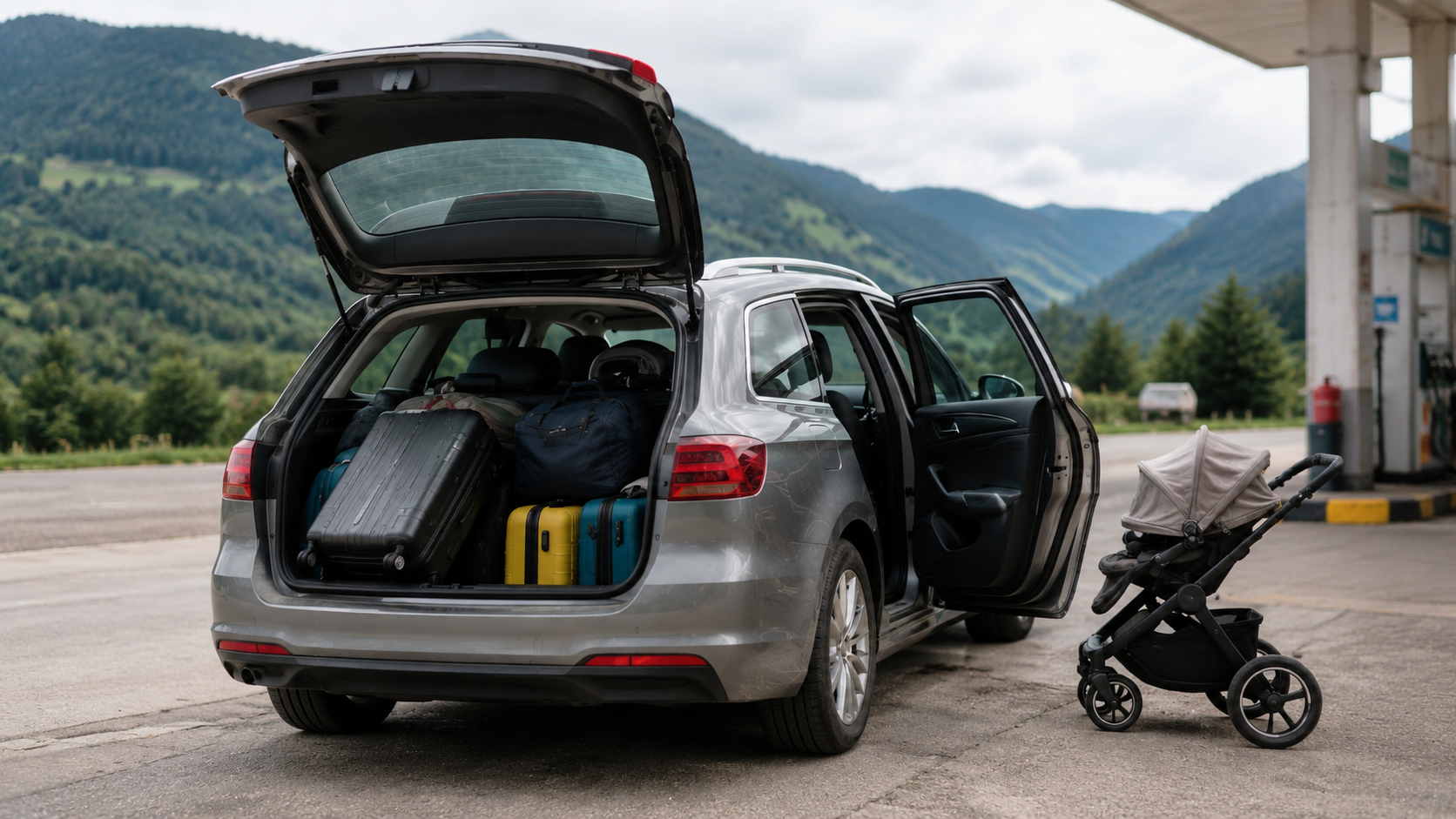
Many drivers associate fuel consumption with the engine, speed, tyres, traffic jams and driving style. All of that really matters. But there is another quiet factor we often do not think about in daily life: how much unnecessary weight we carry in the car.
Toolboxes left in the boot. A baby stroller in the back. Old fluids, chains, a sports bag, work equipment, spare shoes, picnic chairs or winter gear still sitting there since February. Then there is also a full fuel tank, passengers, shopping bags, roof rails and sometimes even a bike rack or trailer. Each kilogram may seem like nothing on its own, but together they can become a regular extra load.
Does that mean you should drive an almost empty car and count every kilogram? No. A car is meant to be used, not treated like a laboratory experiment. But it is worth understanding when weight starts to affect fuel consumption and when we are simply carrying things around for months without needing them.
In this article, we will look at extra weight practically: how much it affects consumption in the city and on the highway, why a full tank is not the biggest “culprit”, when a heavy boot really starts to cost money, how to calculate it and how to find out in 7 days whether your car has a hidden fuel consumption booster.
The driver’s short takeaway right at the start: a few extra kilograms will not change much, but constantly carrying 40, 70 or 100 kg of unnecessary items means paying for it on every trip.
Quick answer: does extra weight increase fuel consumption?
Yes, extra weight can increase fuel consumption, especially in the city.
The heavier the car, the more energy it needs to start moving. This is especially noticeable where you often have to stop and move off again: in the city, in traffic jams, at traffic lights and on short trips.
On the highway, the effect of weight is usually smaller than the effect of aerodynamics and speed, but even there extra weight can increase rolling resistance and the overall load.
The most important thing is to understand the scale. One water bottle or jacket in the boot will not meaningfully change your fuel consumption. But a heavy toolbox, a baby stroller, snow chains, a boot full of unnecessary things and a few more items in the cabin can together create a load comparable to an extra passenger.
Why does a heavier car use more fuel?
For a car to start moving, the engine has to move the entire mass of the vehicle. The heavier the car, the more energy is needed to accelerate it. That is exactly why weight affects fuel consumption the most when the car often starts moving: from an intersection, a parking spot, a traffic jam, a traffic light or slow crawling traffic.
In steady driving, weight becomes less noticeable because the car is already moving. At that point, air resistance, tyres, speed, road surface and engine efficiency play a bigger role. But in the city, where the car constantly accelerates and brakes, extra weight becomes much more important.
You can think about it very simply: if you need to push an empty shopping trolley, it is easy. If it is full of heavy bottles, potato bags and a child seat, getting it moving is harder. The same thing happens with a car — only the engine does the work for you, and its “effort” shows up in fuel consumption.
A good everyday comparison: a car with a full boot in the city is like a person climbing stairs all day with a heavy backpack. Once is not a problem, but every day it starts to cost energy.
Does a full fuel tank significantly increase consumption?
This is one of the more interesting questions. Some drivers think it is better to drive with a half-empty tank because a full tank is heavy. In theory, that is true: fuel has weight. If the tank is full, the car is heavier than if it contains only a few litres.
But in practice, a full tank is usually not the biggest problem. Yes, it adds weight, but that is part of normal car use. Besides, going to the fuel station too often can also cost time, kilometres and nerves. If you make a special trip to a petrol station just to avoid ever having a full tank, the saving can disappear already on the way to refuel.
It is smarter not to start with the tank, but with unnecessary items. A full tank gives peace of mind and practicality, especially in winter, on longer trips or outside the city. Meanwhile, an old toolbox, unnecessary fluids, sports gear and seasonal items in the boot often give no benefit at all, but weigh something every day.
Practical thought: if you want to reduce weight, do not start by “saving” on fuel tank level. Start with the boot. That is usually where more unnecessary weight is hiding than you think.
Where does extra weight usually hide in a car?
Extra weight usually does not appear as one large box labelled “80 unnecessary kilograms”. It builds up gradually. One item after another. At first it seems harmless, but after a few months the boot has turned into a small storage room on wheels.
| Item in the car | Is it often needed? | What to do? | Driver’s takeaway |
|---|---|---|---|
| Heavy toolbox | Not always | Keep only a basic set | If you are not a mechanic on call, you do not need to carry the whole set every day |
| Baby stroller | Depends on the day | Remove it if you clearly know it will not be needed | Convenience often matters more, but there is no need to carry it around without reason |
| Sports equipment | Seasonal | Remove it after training or when the season ends | Skis in July are usually not friends with fuel economy |
| Fluids, canisters, cleaning products | Partly | Keep one necessary item, not the whole shelf | Litres quickly become kilograms |
| Unnecessary seasonal items | Rarely | Check the boot once a month | A car is not a storage room for all seasons at once |
Weight in the city and on the highway: the difference is big
In the city, extra weight is usually more noticeable than on the highway. The reason is simple: in the city, the car more often has to start moving from zero or from low speed. Every start from a traffic light, every move from an intersection and every acceleration after congestion requires more energy if the car is heavier.
On the highway, the car drives steadily for longer. Weight is still a factor there, but aerodynamics and speed often become more important. If you drive fast, air resistance can become much more significant than whether there are 20 kg or 40 kg of items in the boot.
Still, you should not assume that weight is completely irrelevant on the highway. If the car is heavily loaded, with passengers and luggage, it may have more difficulty maintaining speed on hilly sections, while overtaking and on poorer road surfaces. A heavier car can also demand more from the tyres, brakes and suspension.
Simple principle:
In the city, weight affects acceleration more.
On the highway, speed and aerodynamics are often more important than a small amount of weight.
On long trips with a fully loaded car, everything matters together: weight, tyres, speed, luggage and driving style.
Practical example: how much can an extra 50 kg cost?
The exact increase in consumption will depend on the car, route, engine, tyre pressure, road surface and driving style. Still, we can look at a simple calculation example. It is not a laboratory measurement, but a practical way to understand the scale.
Let’s assume a car normally uses 7.0 l/100 km. If you constantly carry an extra 50 kg and in city driving consumption increases by even 0.2 l/100 km, it may seem almost invisible in one day. But over a year, this habit starts to appear on fuel receipts.
| Situation | Monthly mileage | Extra consumption | Extra fuel per month | Cost at €1.70/l |
|---|---|---|---|---|
| Small amount of extra weight | 800 km | +0.1 l/100 km | 0.8 l | €1.36 |
| Noticeable extra weight in the city | 800 km | +0.2 l/100 km | 1.6 l | €2.72 |
| Heavy car with lots of stop-start driving | 800 km | +0.4 l/100 km | 3.2 l | €5.44 |
These numbers are not meant as a universal guarantee. They show the principle: a small increase per 100 km looks tiny, but it repeats every month. If extra weight is combined with low tyre pressure, traffic jams and aggressive driving, the total effect becomes larger.
The simple formula:
Extra fuel per month = monthly km × extra consumption / 100
Extra cost = extra litres × fuel price
Example: 800 km × 0.2 / 100 = 1.6 litres. At €1.70/l, that is €2.72 per month.
Do passengers count as “extra weight”?
Here we should be honest: passengers are not extra weight. A car is meant to carry people, and there is no point looking at family, friends or colleagues as a fuel problem. If four people travel in one car, it is often much more economical than four people driving four separate cars.
Technically, however, passengers increase the mass of the car, and that affects consumption. Especially in the city, on hilly sections and in situations where you often have to start moving. A full car with passengers, luggage and a roof box will definitely use more fuel than the same car with one driver and an empty boot.
The key is not to “avoid carrying people”, but to adapt your driving. With a fully loaded car, you should avoid hard starts, late braking and aggressive overtaking. A heavier car reacts differently, and calm driving becomes even more important for both fuel consumption and safety.
Practical thought for families: baby strollers, child seats, bags and shopping are normal life, not a mistake. But it is worth occasionally removing what is not needed for the current week.
Heavy boot and safety: not only fuel
Extra weight is not only about fuel. It also affects handling, braking distance and the car’s reaction in emergency situations. The heavier the car, the more energy the brakes need to stop. This does not mean that a fully loaded car becomes dangerous, but it does mean the driver needs to drive more thoughtfully.
You should be especially careful if heavy items in the boot are not secured. During hard braking or a collision, loose objects can become dangerous. A heavy bag, tool or canister is not just “something in the boot” — it is mass that keeps moving forward during sudden deceleration.
Important warning:
Always secure heavy items in the boot or cabin. Fuel economy is a nice bonus, but safety is more important than any saved litre.
What is a smart minimum to keep in the car?
It is not right to simply empty the car down to the last item. Some things should be carried for safety and practicality. The smart goal is not an “empty car”, but a “car without unnecessary weight”.
| Item group | Keep in the car? | Why? | What not to overdo? |
|---|---|---|---|
| Safety equipment | Yes | It may be needed in an emergency | Do not replace it with a pile of unnecessary items |
| Basic tools | Yes, in reasonable amount | For small roadside situations | No need to carry a full garage set |
| Seasonal items | Only in season | Winter needs one set, summer another | Do not carry winter items all summer |
| Family items | As needed | For everyday convenience | Review once a week what is actually needed |
| Work equipment | If truly needed | For some people, the car is a work tool | Separate daily driving from work trips |
Mini test: is your car carrying extra weight?
Answer honestly. If several answers are “yes”, your car may be carrying more than it needs every day.
Boot mini test:
1. Are there items in the boot that you have not used in the last 30 days?
2. Are there seasonal items from the previous season?
3. Do you sometimes avoid opening the boot because “it is full of stuff”?
4. Are there heavy items in the car that “might be useful one day”?
5. Do baby strollers, sports equipment or work items stay in the car even when they are not needed?
If you answered “yes” to at least 3 questions, your car probably has practical fuel-saving potential.
7-day experiment: clean out the car and check consumption
To understand whether extra weight affects your car specifically, the best approach is a small experiment. It is not complicated, but it can give you a very clear feeling of how many items are carried around daily without being needed.
| Day | What to do? | What to write down? |
|---|---|---|
| Day 1 | Take a photo of the boot and cabin | Write down what is inside |
| Day 2 | Remove everything that is not needed this week | Roughly estimate the weight removed |
| Day 3 | Drive your usual route in a calm style | Average consumption, time, traffic conditions |
| Day 4 | Repeat a similar trip at a similar time | Is consumption more stable? |
| Day 5 | Check tyre pressure | Write down whether there were differences between tyres |
| Day 6 | Drive with a “clean” car for one more day | Feeling, acceleration, consumption |
| Day 7 | Compare with your usual consumption | Is there a visible difference? |
Important: do not compare completely different trips. If one day you drive on an empty highway and the next day you sit in city traffic, the result will not be fair. It is best to compare the same route at similar times.
Practical tip: if the fuel consumption difference after cleaning the boot is not large, the experiment has still worked. You have gained a tidier car, more space and a safer cabin.
Myths and truth about car weight
| Myth | Truth | What does it mean in practice? |
|---|---|---|
| A full tank is the main source of extra weight | Unnecessary items are usually a bigger problem | Start with the boot, not by driving with a half-empty tank |
| A few kilograms greatly increase consumption | A small amount of weight is usually not important | Focus on dozens of kilograms, not tiny items |
| Weight does not matter at all on the highway | It matters, but often less than speed and aerodynamics | On long trips, all factors matter together |
| If the car is powerful, weight does not matter | A powerful engine can pull more easily, but fuel is still used | Physics applies to powerful cars too |
How to decide what to remove and what to keep?
A good principle is to divide items into three groups: must-have items, sometimes-needed items and “maybe useful one day” items. The first group stays in the car. The second can stay seasonally or on specific days. The third should usually be removed.
Simple action plan:
1. Remove everything from the boot.
2. Put back only safety items and what is truly needed this week.
3. Store seasonal items at home or in the garage.
4. Secure heavy items if they stay in the car.
5. Repeat this check once a month.
Is it worth removing the spare wheel to save fuel?
Usually, this is not the best place to start. A spare wheel or repair kit can be important for safety and practicality. If the car manufacturer has included specific equipment, it should not be removed just because of a few kilograms, especially on longer trips.
Do child seats significantly increase fuel consumption?
Individual child seats are usually not a significant fuel consumption factor. They are safety equipment, not unnecessary items. If you want to reduce weight, it is better to review the boot, sports equipment, tools and seasonal items.
Does extra weight matter for electric cars and hybrids too?
Yes, weight also affects hybrids and electric cars because a heavier vehicle needs more energy to accelerate. Hybrids and EVs can recover some energy through braking, but that does not mean extra weight becomes completely free.
When should you not reduce weight at any cost?
There are situations where reducing weight is not the priority. If you are going on a long winter trip, it is sensible to carry a warm blanket, washer fluid, a small shovel or other safety items. If you drive with children, the necessary family items are part of normal daily life. If the car is a work tool, equipment may be necessary.
Fuel economy should not become silly. There is no point saving a few cents if it leaves you without things that could help in a problem situation. The goal is not to remove everything, but to remove what is truly not needed.
Good balance: safety items stay, everyday essentials stay, but “maybe one day” items live at home, not in the car every day.
Common mistakes that make you pay for weight
Most often, drivers do not pay for one big mistake, but for a collection of small habits. The car slowly fills up, the boot becomes heavier and the driver gets used to it. Consumption becomes “normal”, even though part of it is caused by things that could have been removed long ago.
Watch out for these mistakes:
• using the boot as permanent storage;
• carrying heavy tools that are needed once a year;
• not removing seasonal items after the season ends;
• leaving heavy, unsecured items in the cabin;
• thinking that “one small thing changes nothing” until the boot is full of small things.
Conclusion: weight is not the biggest fuel thief, but it is easy to fix
Extra weight in a car is usually not the biggest reason for higher fuel consumption. Driving style, tyre pressure, traffic jams, speed and technical condition often matter more. But weight has one big advantage: it is very easy to check and reduce.
You do not need to change the car, repair the engine or buy new technology. Sometimes it is enough to open the boot, remove what is unnecessary, organise what is needed and stop carrying what you do not use. The saving may not be huge in one day, but in the long term it is one of the simplest ways to avoid wasting fuel for no reason.
The smartest solution is not to drive an empty car, but to drive an organised car. Safety items stay. What is needed for daily life stays. Everything else can wait at home instead of travelling with you every day at your expense.
The driver’s final takeaway: if there are things in the boot you have not used for a month, you may not be storing them — you may be transporting them with fuel money.