 LV
 EN
 RU
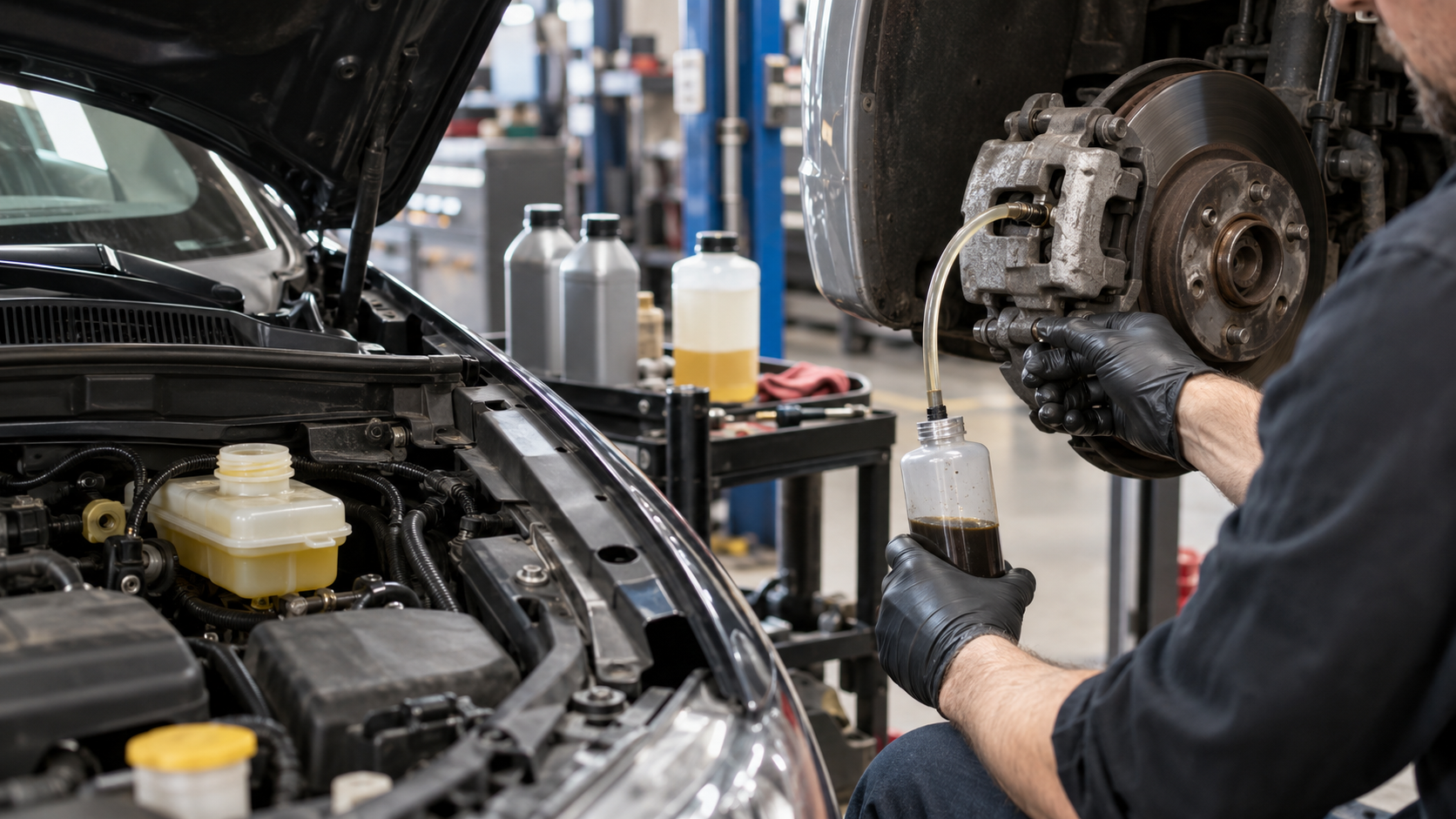
You take the car in for routine servicing. The engine oil has been changed, the filters checked and the brake pads still have plenty of material remaining. Then the technician looks through the service history and says: “The brake fluid should be changed as well.”
At first, that may sound strange. Nothing is leaking under the car. The level in the brake-fluid reservoir sits between MIN and MAX. The pedal does not feel soft, no warning lights are illuminated and the car stops completely normally in everyday driving. Brake fluid is not engine oil either — it does not lubricate pistons inside the engine, enter the combustion chamber or get burned.
So why replace a fluid when the reservoir is still full?
That question is exactly what makes brake fluid more interesting than many other maintenance items. Its condition can deteriorate without any obvious loss of fluid. Glycol-based brake fluids, including most DOT 3, DOT 4 and DOT 5.1 products used in passenger cars, gradually absorb moisture. As the water content increases, the fluid's boiling point falls.
In gentle city driving, braking lightly at traffic lights, a driver may never notice this for years. But the situation changes when the brakes are subjected to prolonged heavy use — for example while descending a long mountain road, towing a trailer or repeatedly slowing down hard from motorway speeds. Brake temperatures rise, heat reaches the calipers and fluid, and old moisture-contaminated fluid may have significantly less thermal reserve than fresh fluid.
That can create a particularly unpleasant scenario: the fluid begins to boil locally, vapour bubbles form, and unlike liquid, vapour can be compressed. The driver presses the brake pedal, but part of the pedal movement is spent compressing those bubbles instead of applying the brakes.
The pedal may suddenly feel unusually soft, its travel may increase and the entire braking response can feel completely different from what it did only a few minutes earlier.
Quick answer
Brake fluid should be changed according to the maintenance schedule specified by the vehicle manufacturer. Two years is a very common guideline, and Bosch recommends replacing brake fluid at least every two years, but it is not a universal rule for every vehicle and every fluid. The main reason for replacement is that widely used glycol-based DOT 3, DOT 4 and DOT 5.1 fluids absorb moisture over time, lowering their boiling point. DOT 5, however, is silicone-based and is not the same as DOT 5.1. When choosing or topping up brake fluid, always follow the exact specification required by your vehicle.
A full brake-fluid reservoir tells you how much fluid is in the system. It does not tell you what condition that fluid is in.
What does brake fluid actually do?
When you press the brake pedal, your foot does not directly push the brake pads against the discs. Pedal force acts through the master cylinder to create hydraulic pressure in the brake fluid, and that pressure travels through pipes and hoses to the brakes at each wheel.
In a disc-brake system, fluid pressure moves the caliper piston or pistons, pressing the pads against the brake disc. Friction then converts much of the vehicle's kinetic energy into heat.
And heat is extremely important in this story.
During gentle everyday braking, the system has a large safety margin. But during more enthusiastic driving, a long mountain descent, towing a heavy trailer or repeated high-speed braking, the discs and calipers can become extremely hot. Some of that heat reaches the brake fluid too.
That is why brake fluid needs more than the correct viscosity and compatibility with seals — it must also retain its hydraulic properties across a very wide temperature range.
Why does brake fluid absorb moisture?
DOT 3, DOT 4 and DOT 5.1 brake fluids, which are used in a very large proportion of passenger cars, are mainly glycol-ether based and hygroscopic. In simple terms, that means they absorb water from the surrounding environment over time.
A logical question follows: how can moisture get into what appears to be a closed braking system?
The braking system is not a hermetically sealed laboratory capsule. Moisture can slowly enter through flexible components, reservoir ventilation and other routes. The process is gradual, so nothing dramatic happens in a week. But over a period of years, the fluid's properties change.
Brembo explains that moisture absorption lowers the fluid's original boiling point over time and increases the risk of vapour lock — the formation of compressible vapour bubbles.
That is exactly why brake fluid has a service interval even if the level in the reservoir has remained perfectly stable.
What are “dry” and “wet” brake-fluid boiling points?
On the packaging or technical data sheet of a quality brake fluid, you may see two different boiling-point figures. At first glance, they may look like little more than manufacturers competing over larger numbers, but they actually explain the ageing problem very well.
Dry boiling point refers to fresh fluid with a very low water content. Wet boiling point refers to fluid after a standardised moisture-conditioning process and is intended to represent more closely what happens to the fluid during service.
FMVSS 116 requirements and Brembo specifications show just how large the difference can be.
| Class | Minimum dry boiling point | Minimum wet boiling point | Basic type |
|---|---|---|---|
| DOT 3 | approx. 205 °C | approx. 140 °C | Glycol-based |
| DOT 4 | approx. 230 °C | approx. 155 °C | Glycol-based |
| DOT 5 | approx. 260 °C | approx. 180 °C | Silicone-based |
| DOT 5.1 | approx. 260 °C | approx. 180 °C | Non-silicone, mainly glycol-based |
These are minimum standard requirements, not a guarantee that every product will have exactly these values. Many high-quality brake fluids significantly exceed the minimum figures.
The more important point is this: water content can significantly reduce the thermal safety margin of brake fluid.
What does boiling brake fluid feel like in a real drive?
Imagine a long mountain descent. The driver keeps light pressure on the brake pedal almost continuously instead of using a lower gear and engine braking. Everything feels normal at first. After several kilometres, however, a hot-brake smell appears, the pedal begins to feel different and at the next bend it needs to be pressed farther than before.
Several things could cause this. The brake pads and discs may have overheated, but one of the more dangerous possibilities is boiling brake fluid.
Liquid is effectively incompressible, which is why it transmits pedal pressure so efficiently. A vapour bubble is compressible. When the pedal is pressed, some of the movement first compresses that bubble before sufficient hydraulic pressure reaches the wheel brakes.
To the driver, the result can be frightening: the pedal becomes “spongy”, its travel increases or it moves much closer to the floor.
If the brake pedal suddenly becomes significantly softer, travels much farther than normal or the vehicle no longer brakes predictably, continuing to drive as if nothing happened is not safe. The cause may be overheated fluid, air in the system, a leak or another braking-system fault.
So how often should brake fluid be changed?
The figure most commonly heard is two years. And there is a reason for that — Bosch recommends replacing brake fluid at least once every two years.
But just as with engine oil or coolant, one universal number is not perfect for every vehicle in the world.
ATE's product range shows that the manufacturer's own technical replacement interval for certain fluids can be one, two or even three years. At the same time, ATE stresses the most important principle: the vehicle manufacturer's specified replacement interval and fluid specification must be followed.
So the best question to ask a workshop is not “does every brake fluid need changing every two years?”, but rather “what interval applies to my car, and do we know when the fluid was last changed?”.
| Situation | Practical approach |
|---|---|
| Vehicle manufacturer specifies replacement every 2 years | Follow that schedule even if the fluid level is perfect |
| Used car with unknown brake-fluid history | Identify the correct specification and consider preventive replacement |
| Fluid is only a year old, but the hydraulic system has been opened for repair | Follow the repair procedure; replacement and bleeding may be required |
| Workshop tester shows a low boiling point | Replacement may be justified even before the calendar interval |
| Reservoir level repeatedly falls | Investigate a possible brake-system leak or another cause first |
Does brake fluid last longer in a car that is driven very little?
Brake fluid differs significantly from brake pads in this respect. Pad wear depends heavily on how much and how aggressively the brakes are used. With brake fluid, time itself is also a major factor.
If a car covers only 3,000 kilometres per year, that does not mean its original brake fluid will automatically be as good as new after ten years. Moisture absorption continues even when the odometer moves very slowly.
That is why brake-fluid service intervals are often specified in years rather than mileage alone.
DOT 3 and DOT 4 — what is the difference?
DOT classifications are linked to brake-fluid performance requirements, including boiling point and viscosity.
The minimum dry and wet boiling-point requirements for DOT 4 are higher than those for DOT 3. That is one reason DOT 4 is extremely common in modern European passenger cars.
However, the logic “DOT 4 has the bigger number, so I can safely use it in every DOT 3 car” is not a precise enough service principle. The braking system is designed around specific fluid requirements, so the safest approach is to use the specification required by the vehicle manufacturer.
Some older vehicles may also use entirely different hydraulic fluids. Certain Citroën models and other specialised hydraulic systems, for example, have used mineral-based fluids that should not be treated as ordinary DOT 3 or DOT 4 systems.
What is DOT 4 LV, and why does viscosity matter in modern ABS/ESP systems?
In a modern braking system, the fluid does more than sit quietly in a pipe between the master cylinder and caliper. ABS and stability-control systems regulate hydraulic pressure extremely quickly through small valves and passages.
At very low temperatures, fluid viscosity becomes particularly important. DOT 4 LV, meaning Low Viscosity, products are intended for systems that require the fluid to remain highly mobile even in severe cold.
Brembo notes that lower viscosity is particularly important for modern ABS, ESP, ASR, TCS and similar electronically controlled systems.
This again shows why choosing brake fluid should not be reduced to the words “DOT 4”. Two fluids may both meet the DOT 4 class, while a particular vehicle may also require a specific manufacturer approval or low-viscosity specification.
DOT 5 and DOT 5.1: the dangerous numbering trap
The names make it sound as though DOT 5.1 is simply a slightly improved version of DOT 5. Chemically, however, there is a major difference between them.
DOT 5 is silicone-based. DOT 5.1 is non-silicone and its base chemistry is much closer to glycol-based DOT 3 and DOT 4 products.
FMVSS 116 labelling requirements make this distinction explicit on packaging — DOT 5 is identified as silicone base, while DOT 5.1 is identified as non-silicone base.
ATE specifically warns that its glycol-ether-based DOT 5.1 fluid must not be mixed with silicone-based DOT 5 brake fluid.
DOT 5.1 is not “DOT 5 plus 0.1”. DOT 5 and DOT 5.1 are chemically different categories. If your vehicle requires DOT 4 or DOT 5.1, do not choose silicone DOT 5 simply because the number looks higher.
Is DOT 5.1 better than DOT 4?
Again, a larger number is not a universal synonym for “better”. DOT 5.1 has higher standard requirements for boiling point and low-temperature viscosity than ordinary DOT 4, so it can be very suitable for systems with demanding requirements.
But a car's braking system is not a place to choose fluid according to the principle “I will use the most sporting product possible”.
If the manufacturer specifies a particular DOT 4 LV fluid or its own OEM specification, that requirement matters more than trying to “upgrade” the brakes with another class. The correct fluid is the one the system was designed to use.
Can DOT 3, DOT 4 and DOT 5.1 be mixed?
Some specific glycol-based products are technically miscible. ATE, for example, states compatibility of its Super DOT 5.1 with fluids meeting certain DOT 4 and DOT 5.1 requirements.
But that should not become a universal garage rule that “DOT 3 + DOT 4 + DOT 5.1 can be mixed in any proportion”. Once products with different properties are combined, the final mixture no longer has the same performance as the best fluid in the mix, and a particular vehicle may also have additional viscosity or OEM-approval requirements.
The safest rule is simple: use exactly the specification required by the vehicle.
And once again, this logic does not apply to silicone DOT 5.
Does brake-fluid colour reveal its condition?
If the fluid is extremely dark, cloudy or visibly contaminated, that is certainly a reason to pay attention to the condition of the system. Brembo notes that clean fluid should normally be light and clear, while dark and cloudy fluid can indicate contamination.
But the opposite conclusion is not safe: light-coloured fluid does not automatically mean that no moisture has accumulated or that its boiling point remains the same as when it was new.
Colour is therefore a visual clue, not a precise laboratory test.
Does a cheap electronic brake-fluid tester tell the truth?
Simple testers with several LED lights are widely available online and in shops. They promise to estimate the percentage of water in brake fluid within seconds. As an indicative tool they can be useful, but their readings should not be treated as absolute laboratory truth for every possible brake-fluid formulation.
A professional approach can instead involve directly measuring the fluid's boiling point. ATE states that its workshop test equipment measures the actual boiling temperature of glycol-based DOT 3, DOT 4 and DOT 5.1 fluids by heating a sample.
ATE materials mention replacement when the measured boiling point falls below 180 °C as one practical threshold, although this should not be treated as the only maintenance criterion for every vehicle — the manufacturer's scheduled service interval still matters.
Testing can help evaluate fluid condition, but it is not a reason to ignore the vehicle manufacturer's specified maintenance interval indefinitely.
The level is approaching MIN — should you simply top it up?
Not necessarily. The level in the brake-fluid reservoir can fall slightly as the brake pads wear. As the pads become thinner, the caliper pistons remain farther out of their bores, which means slightly more fluid stays in the working part of the hydraulic system.
So a small gradual reduction in level does not automatically prove there is a leak.
A sudden, unexplained or repeatedly falling level is a completely different matter. A brake-system leak is a safety fault, not normal fluid consumption that should simply be topped up periodically.
If the fluid level falls rapidly, the brake pedal becomes soft or fluid appears under the vehicle near a wheel or another visible braking component, the system should be inspected immediately. Simply topping up the reservoir does not repair a leak.
For a broader guide to squeaking, vibration, a soft pedal and other brake-system warning signs, read “Brakes Squeaking, Vibrating or the Pedal Feels Soft: When Can You Drive and When Must You Stop Immediately?”.
Why can the brake-fluid level rise after new pads are fitted?
This is a very practical reason not to automatically fill the reservoir all the way to MAX simply because the level has fallen slightly while the old pads are worn.
When new, thicker pads are installed, the caliper pistons are pushed back into their bores. Brake fluid is displaced from the calipers back towards the reservoir, causing the level to rise.
If a large amount of extra fluid was added unnecessarily before the pad replacement, the reservoir can become overfilled once the pistons are pushed back.
Is changing brake fluid the same as sucking fluid out of the reservoir?
There is an important difference. Removing old fluid from the reservoir with a syringe and pouring in fresh fluid is not the same as replacing the brake fluid throughout the entire hydraulic system.
A substantial amount remains inside the brake pipes, ABS hydraulic unit and wheel brakes — exactly the areas where heat is generated and where old fluid also needs to be removed.
During a proper fluid replacement, fresh brake fluid is moved through the system while old fluid and any air are expelled through the bleed points, following the procedure specified for that particular vehicle.
Why must the brakes be bled after brake-fluid service?
Air in a hydraulic braking system is undesirable for the same reason vapour is undesirable — it can be compressed.
If an air bubble remains in a brake line, part of the pedal movement is used to compress it. The pedal may therefore feel softer and travel farther.
On an older vehicle, bleeding can be a relatively traditional procedure. On a modern car with a complex ABS/ESP hydraulic unit, certain repair situations may require diagnostic equipment to activate pumps or valves and remove trapped air completely.
That is another reason why the braking system is not the ideal place for the experiment “the YouTube video made it look easy”.
Will changing brake fluid immediately improve the brakes?
If the old fluid is badly aged or air is present in the hydraulic system, a correct fluid change and bleed can make the pedal feel more consistent. But fresh fluid should not be expected to repair mechanical brake faults.
If the discs are damaged, pads worn out, calipers seized or the master cylinder is faulty, new fluid will not repair those components.
Fresh fluid also does not change tyre grip. During emergency braking, the maximum deceleration available still depends heavily on the grip between the tyres and road surface, but the hydraulic system must be capable of delivering braking force predictably and repeatedly.
Why can the pedal feel different after prolonged heavy braking, then seem “fixed” once everything cools down?
This can be a dangerous situation because once the brakes cool down, the driver may conclude that the problem has disappeared.
If the fluid boiled locally while overheated, the vapour can condense again as temperatures fall and the pedal may begin to feel more normal. That does not mean the brake fluid has suddenly become fresh or that the underlying problem has been solved.
On the contrary, it is an excellent reason to inspect the braking system and the condition of the fluid before the next heavy braking event.
Is racing brake fluid better for an everyday car?
High-performance brake fluids can offer very high dry and wet boiling points, which can be a major advantage on a race circuit. But for an everyday road car, choosing a product solely because it has the highest number on the bottle does not necessarily make sense.
Low-temperature viscosity, compatibility with the braking system and service interval also matter. Some high-performance fluids may require more frequent replacement than products intended primarily for normal road use.
If the car mainly drives to work and goes on a longer trip once a year, the correct fluid is not automatically a racing product. It is the fluid that meets the specification of the particular braking system.
An opened bottle in the garage — can you still use it three years later?
This is where the hygroscopic nature of glycol-based brake fluid becomes important again. Once a bottle has been opened, the fluid can absorb moisture from the surrounding air before it even enters the vehicle.
FMVSS 116 labelling requirements even specify warnings to keep brake fluid clean and dry and store it in its original tightly closed container to limit moisture absorption.
For that reason, a half-used bottle that has been sitting around for several years is not the best choice for servicing a safety-critical hydraulic system simply because the fluid still looks normal.
Brake fluid and vehicle paint — another expensive mistake
Glycol-based brake fluid is not something you want to leave sitting on a painted body panel. Bosch specifically recommends rinsing brake fluid from painted surfaces with plenty of water.
That means it is not a good idea to place an open bottle on the wing while topping up the reservoir or pour fluid carelessly without protecting nearby paintwork.
If brake fluid is spilled, deal with it immediately according to the product and vehicle manufacturer's instructions rather than leaving it until later.
7 signs the braking system and fluid should not be ignored
- The manufacturer's replacement interval has passed. There is no need to wait for symptoms before carrying out scheduled maintenance.
- You do not know when the fluid was last changed. This is particularly common after buying a used car.
- The pedal feels softer or its travel has increased. Possible causes include air, overheated fluid, a leak or another braking-system fault.
- Pedal feel deteriorates after heavy braking. This is a serious warning sign and should not simply be dismissed as “hot brakes”.
- The fluid is extremely dark or cloudy. This may indicate ageing or contamination.
- The fluid level drops rapidly or repeatedly. A leak and brake wear must be investigated.
- A workshop measures an excessively low boiling point. That is a good reason not to postpone replacement.
8 brake-fluid mistakes you should avoid
- Assuming a full reservoir means the fluid is good. Fluid level and fluid condition are two different things.
- Choosing brake fluid only by the highest DOT number. DOT 5 is chemically very different from DOT 5.1.
- Mixing DOT 5 with DOT 3, DOT 4 or DOT 5.1. Silicone- and glycol-based fluids are not the same system.
- Ignoring a manufacturer requirement for low viscosity or another OEM specification. In a modern ABS/ESP system, boiling point is not the only important property.
- Replacing only the fluid in the reservoir. That is not a complete brake-fluid change throughout the hydraulic system.
- Bleeding the system poorly after it has been opened. Air can create a soft pedal and reduce the precision of hydraulic pressure transfer.
- Using a bottle that has been open for years. Hygroscopic brake fluid can absorb moisture during storage too.
- Leaving spilled brake fluid on painted surfaces. It should be removed immediately according to the manufacturer's instructions.
A five-minute check before your next service
- Find the date of the last brake-fluid change in the service history.
- Check the vehicle manual for the required interval and specification.
- Look at the reservoir level without opening it unnecessarily.
- Consider whether the level has changed significantly during recent months.
- Think about whether the brake pedal feels different from how it used to.
- If the fluid history is unknown, ask the workshop about testing and replacement.
- When buying fluid, check not only the DOT class but also the vehicle manufacturer's requirements.
- If the system is leaking or the pedal behaves abnormally, do not wait until the next scheduled service.
Mini test: what would you do?
The brake-fluid level is at MAX, but the fluid has not been changed for four years
A full reservoir does not change the fact that glycol-based brake fluid absorbs moisture over time. Check the maintenance interval for the specific vehicle; if it has already been exceeded, replacement should not be postponed simply because the level looks good.
The owner's manual requires DOT 4, but DOT 5 is more expensive and looks “better”
Do not treat DOT 5 as an automatic upgrade. DOT 5 is silicone-based and is not the same as DOT 4 or DOT 5.1. Use the specification required by the vehicle manufacturer.
After a long mountain descent, the pedal became soft but returned to normal half an hour later
Do not ignore it. The braking system should be inspected, including the condition and boiling point of the brake fluid. The fact that the pedal feels normal again after cooling does not mean the cause has disappeared.
The fluid level rose after new brake pads were fitted
This can be normal because the caliper pistons are pushed farther back into their bores to make room for the thicker new pads, sending fluid back towards the reservoir. That is exactly why the reservoir should not be unnecessarily overfilled while the old pads are worn.
There is a three-year-old opened bottle of DOT 4 in the boot
Brake fluid is hygroscopic, so an opened bottle can absorb moisture from the air. For servicing a safety-critical system, using fresh, properly stored fluid that meets the correct specification is far more sensible.
The fluid repeatedly falls below MIN, but after topping up the brakes feel normal again
That is not a normal maintenance routine. A rapid or recurring drop in level requires inspection for leaks, brake-pad wear and other faults. Topping up does not repair the reason the fluid is disappearing.
Myths and facts
| Claim | Myth or fact? | Explanation |
|---|---|---|
| If the brake-fluid reservoir is full, the fluid does not need replacing. | Myth | The level does not reveal moisture content or the fluid's boiling point. |
| Glycol-based brake fluid absorbs moisture over time. | Fact | Moisture lowers the boiling point and reduces the safety margin under heavy thermal load. |
| DOT 5.1 is basically DOT 5 with a small upgrade. | Myth | DOT 5 is silicone-based, while DOT 5.1 is non-silicone. |
| Air in the braking system can create a soft pedal. | Fact | Air can be compressed, so part of the pedal movement is spent compressing the bubble. |
| A higher DOT number always means a better fluid for every car. | Myth | The fluid must meet the specification required by the particular braking system, including the correct viscosity. |
| Brake fluid still ages in a car that is driven very little. | Fact | Moisture absorption is related to time as well as mileage. |
| Changing only the fluid in the reservoir is the same as changing it throughout the braking system. | Myth | Old fluid remains inside the brake lines, ABS hydraulic unit and wheel brakes. |
Frequently asked questions
How often should brake fluid be changed?
Follow the maintenance schedule specified by the vehicle manufacturer. Two years is a very common guideline, and Bosch recommends replacement at least every two years, but exact intervals can vary between vehicles and fluid types.
Why does brake fluid age?
Widely used glycol-based DOT 3, DOT 4 and DOT 5.1 fluids are hygroscopic and absorb moisture over time. This lowers their boiling point and reduces the thermal safety margin when the brakes become extremely hot.
Can DOT 4 be replaced with DOT 5?
No, not simply because DOT 5 has a higher number. DOT 5 is silicone-based and chemically differs substantially from ordinary DOT 4. Use the brake-fluid specification required by the vehicle manufacturer.
What is the difference between DOT 5 and DOT 5.1?
DOT 5 is a silicone-based brake fluid, while DOT 5.1 is a non-silicone, mainly glycol-based product. Despite the similar names, they are not the same type of fluid.
Can brake fluid be checked with a tester?
Yes, although testing methods differ. Simple electronic testers generally provide an indicative moisture reading, while professional equipment can directly measure the fluid's boiling point. Test results should be considered together with the manufacturer's replacement interval.
Does black brake fluid mean it needs replacing?
Very dark or cloudy fluid is a reason for inspection and is generally not a good sign. But even light-coloured fluid can be old and moisture-contaminated, so condition cannot be determined from colour alone.
Does brake fluid also need changing in hybrids and electric cars?
Yes, if the vehicle uses a conventional hydraulic service-brake system, brake fluid remains a maintenance item. Regenerative braking may reduce use of the mechanical brakes, but it does not eliminate the hydraulic system or its fluid-service requirements. The exact interval is specified by the vehicle manufacturer.
What should you do if brake fluid gets on the paintwork?
Act immediately. Bosch recommends rinsing brake fluid from painted surfaces with plenty of water. Do not leave it sitting on the paint until the next day.
Conclusion
Brake fluid is a very good example of a component — or more accurately, an operating fluid — whose deterioration is almost impossible for a driver to feel in normal everyday use while everything is still working correctly.
Brake-pad thickness can be measured. A wear lip can be seen on a disc. A leaking shock absorber may be visible. Tyre tread can be inspected. Brake fluid can remain inside the same transparent reservoir, look reasonably light and sit at the perfect level even though its thermal safety margin is no longer what it was when the fluid was new.
That is exactly why it should not be replaced only after symptoms appear.
Glycol-based DOT 3, DOT 4 and DOT 5.1 fluids absorb moisture over time. Moisture lowers the boiling point. During everyday commuting between home and work, this may remain completely unnoticed, but in prolonged, heavily loaded and very hot brakes, the difference can matter at the worst possible moment.
That is why the common two-year replacement interval was not invented merely to give workshops another line on the invoice. At the same time, it should not be treated as a universal number carved in stone — the vehicle manufacturer's maintenance schedule and the correct fluid specification always take priority.
Understanding DOT classifications is equally important. DOT 5.1 is not simply the next evolution of DOT 5. Silicone-based DOT 5 and non-silicone DOT 5.1 are different fluid types, and choosing the wrong one is not an experiment worth conducting in a braking system.
Nor is a more “sporting” fluid automatically better. A modern ABS and ESP-equipped vehicle may depend on very low viscosity in cold weather and an exact manufacturer specification. Brakes are not the place to choose parts and fluids simply by picking the largest number.
And finally, if fluid is disappearing, pedal feel changes or the brakes behave differently after becoming hot, the issue has moved beyond routine maintenance. That requires braking-system diagnosis.
Good brake fluid spends most of the car's life doing something very unremarkable: every time you touch the pedal, it accurately transfers the pressure from your foot to the brakes. The driver does not think about it — and that is exactly how it should be. But to keep the system reliably invisible, the fluid should not be forgotten for ten years simply because the reservoir is still full.
Driver's short takeaway: check the brake-fluid replacement interval specified by your vehicle manufacturer — around two years is very common, but not universal. Glycol-based DOT 3, DOT 4 and DOT 5.1 fluids absorb moisture over time, which lowers their boiling point. Do not choose fluid simply by selecting the highest DOT number: DOT 5 is silicone-based and is not the same as DOT 5.1. If the pedal becomes soft, fluid is disappearing or the brakes feel different after heavy use, do not wait until the next scheduled service.
Sources and technical note
The technical information in this article was checked against Bosch Mobility Aftermarket material covering brake-fluid replacement intervals and boiling-point testing; ATE/AUMOVIO technical documentation covering the hygroscopic properties, viscosity, replacement intervals and compatibility of DOT 3, DOT 4, DOT 4 LV and DOT 5.1 fluids; Brembo material explaining moisture absorption, vapour lock, boiling temperatures and low-viscosity fluids for modern ABS/ESP systems; and the U.S. FMVSS 116 requirements, which technically distinguish silicone-based DOT 5 from non-silicone DOT 5.1 brake fluid. The exact brake-fluid specification and replacement interval should always be taken from the technical documentation for the specific vehicle.