
 LV
 EN
 RU
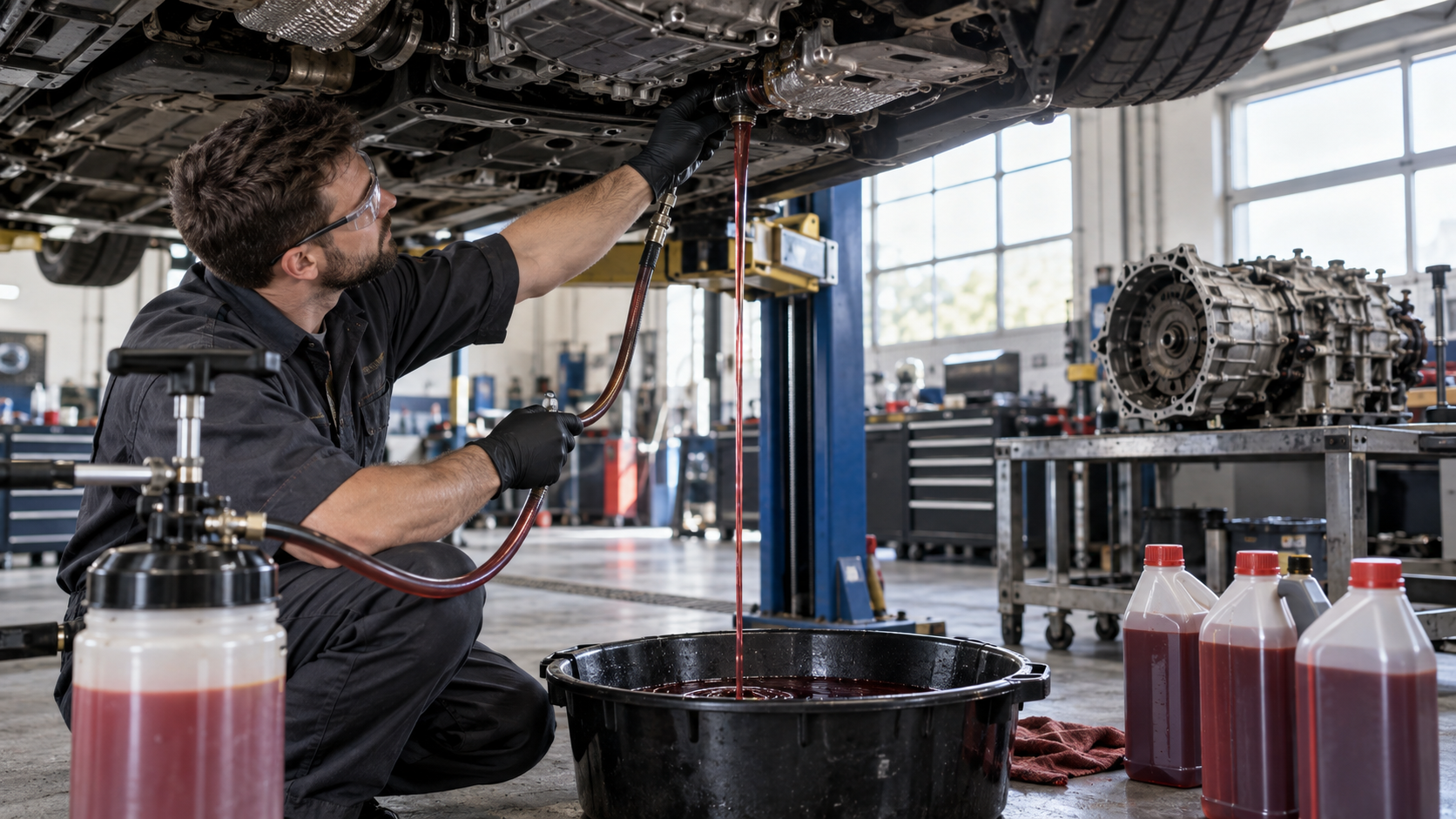
You are looking at a used car. Mileage: 184,000 kilometres. The engine runs smoothly, the body looks good and during the test drive the automatic transmission shifts without any obvious jolts. You ask the seller one of the most important questions: “When was the transmission fluid last changed?”
The answer comes without hesitation: “Never. It has lifetime fluid — the manufacturer says it does not need changing.”
Drivers usually split into two camps after hearing that. One group believes the gearbox should never be touched because the factory must know best. The other is convinced that automatic-transmission fluid must be changed every 60,000 kilometres regardless of the car, transmission type or manufacturer.
The reality is much more interesting, because both universal answers can be wrong.
An automatic transmission is not one single type of mechanism. The word “automatic” can describe a conventional torque-converter gearbox, a dual-clutch DCT or DSG, a CVT, an automated manual transmission or a hybrid transmission marketed as an e-CVT even though its construction may have almost nothing in common with a traditional belt-driven CVT.
That is why the correct question is not “at what mileage should automatic-transmission fluid be changed?” The better question is: what exact transmission is installed in my vehicle, what fluid does the manufacturer specify, what is the official service schedule and under what conditions has the car been used?
Quick answer
Yes — many automatic transmissions will need their transmission fluid changed during the life of the vehicle, but there is no universal interval that applies to every car. The first priority is the service requirement for the specific vehicle and transmission. For example, ZF describes the factory fill in several generations of its 5-, 6-, 8- and 9-speed automatic transmissions as “maintenance-free”, yet also recommends a fluid change at around 150,000 km and earlier when the transmission has operated under high temperatures or heavy loads. Some CVTs, meanwhile, may have much shorter and very specific manufacturer-defined intervals. “Lifetime” therefore should not automatically be interpreted as “the fluid never ages and never needs changing”.
The most dangerous word in automatic-transmission servicing is “always”. Always every 60,000 km, always every 100,000 km, always never change it, always flush it — none of these rules applies to every transmission.
Why does an automatic transmission need fluid in the first place?
Drivers often think of transmission fluid as a simple lubricant, something roughly comparable to the oil inside a differential. In an automatic transmission, however, its jobs can be much broader.
The fluid lubricates bearings, gears and other mechanical components, helps remove heat, protects against corrosion and carries contaminants towards filters and magnets. In a conventional automatic, ATF is also a hydraulic working fluid — the transmission uses its pressure to apply clutch packs and control gear changes.
It also needs very specific friction characteristics. The internal clutch packs must neither slip uncontrollably nor engage too abruptly. Fluid chemistry and the additive package are therefore part of the way the transmission actually shifts.
CVT requirements can be even more specialised. In many CVT designs, the fluid must simultaneously provide hydraulic control, cooling, wear protection and the correct friction behaviour between the transmission's working components. That is why you cannot simply pour “any ATF” into a CVT just because both transmissions are automatic.
ZF even describes transmission oil in its technical material as a functional component of the transmission: the specific fluid and additive package are matched to the requirements of the particular gearbox.
So why does transmission fluid age?
Life inside a transmission is not easy for the fluid. It repeatedly heats up and cools down, is pumped through narrow hydraulic passages, experiences mechanical shear and works in direct contact with clutch friction material, gears, bearings and other components.
Over time, not only can the properties of the base fluid change, but the effectiveness of its additives can change too. Microscopic particles of friction material and metal may enter the fluid. Some are captured by the filter and magnets, but the fluid still no longer remains identical to what was filled at the factory.
Temperature is particularly important. The longer the fluid operates at high temperatures, the faster it tends to age. Towing, prolonged high load, very aggressive driving or other conditions that significantly raise transmission temperature can therefore affect the ideal servicing strategy.
This does not mean transmission fluid suddenly becomes “bad” on one exact day after a certain mileage. Ageing is gradual — and that is precisely why service intervals differ between transmissions.
What does “lifetime oil” actually mean?
This phrase has probably created more arguments than almost any other transmission-maintenance topic. To a driver, “lifetime” naturally sounds like “for life”. And if something is designed for life, why would it ever need replacing?
The problem is that the technical phrase “lifetime fill” cannot automatically be turned into a promise that the fluid's chemical properties will remain perfect at 300,000, 500,000 or 700,000 kilometres regardless of how the vehicle has been used.
ZF provides a useful example. In its current TE-ML 11 lubricant list, several 5-, 6-, 8- and 9-speed automatic transmissions are described as being factory-filled with “maintenance-free” ATF. Yet in the same document ZF explains that, because many factors affect transmission service life, it recommends an oil change at around 150,000 km, or earlier where high temperatures, high loads or an unknown previous service history are involved.
That illustrates very well why the simple sentence “it says lifetime, so you never change it” can be far too simplistic.
Important: this does not mean ZF's 150,000 km recommendation should automatically be applied to every Toyota, Volkswagen, Nissan, Mercedes, Volvo or other transmission. The service information for the specific vehicle and gearbox must always take priority.
Why can we not simply say “change it every 60,000 km”?
Because technically very different mechanisms live under the same word “automatic”. Even within one manufacturer, two automatic transmissions may use different fluids, filters, servicing procedures and replacement intervals.
| Transmission type | What is different about it? | What does that mean for servicing? |
|---|---|---|
| Conventional torque-converter automatic | ATF provides lubrication, hydraulic operation, cooling and clutch control | The correct fluid specification, level-setting procedure, filter and service interval for the exact gearbox must be followed |
| Wet-clutch DSG/DCT | The clutches operate in oil | Fluid condition matters to clutch and hydraulic operation; the interval depends on the specific DCT |
| Dry-clutch DCT/DSG | The clutches are not immersed in a shared oil bath like those in a wet-clutch DCT | Servicing requirements cannot simply be copied from a wet DSG; different designs use different fluids and components |
| CVT | Continuously variable ratio with specific friction requirements | The exact specified CVT fluid and service interval must be used |
| Hybrid e-CVT | The name does not necessarily describe a conventional belt-driven CVT | Follow the manufacturer procedure for that exact hybrid transaxle rather than a generic CVT recommendation |
Volkswagen has historically used both DSG transmissions with wet clutches operating in oil and DSG designs with dry clutches. That fact alone shows why saying “my car has DSG” is not enough information to determine the correct fluid or maintenance regime.
For a broader explanation of how different automatic-transmission designs compare and how they affect fuel consumption, read “Automatic or Manual Transmission: Which Uses Less Fuel Today?”.
So how often should transmission fluid actually be changed?
If you are waiting for one neat number, this is the inconvenient part of the article: there isn't one.
Some transmissions have a clearly defined mileage interval and sometimes a time interval too. Others may officially be listed only for inspection or described as having a “lifetime” fill, while the transmission manufacturer itself may recommend a preventive fluid change at a higher mileage.
For example, ZF recommends an oil change at around 150,000 km for the transmissions mentioned above. Nissan's current 2026 Rogue CVT maintenance information, meanwhile, specifies regular CVT-fluid inspection and, under severe-service conditions for certain models, replacement every 60,000 miles — roughly 96,000 km. Other Nissan models and model years may have different schedules.
These examples are not intended to help you calculate an “average” interval. They prove the opposite: the interval is a characteristic of the specific transmission, not a universal law for every automatic gearbox.
The correct sequence is:
- Identify the exact vehicle model, year, engine and transmission code.
- Check the vehicle manufacturer's official maintenance schedule.
- Where relevant, also check the technical information from the transmission manufacturer.
- Consider how the vehicle has been used — high loads, towing, high temperatures and an unknown used-car history all matter.
- Use only fluid that meets the exact required specification and follow the correct service procedure.
Is time as important as mileage?
Some transmission service schedules specify both mileage and time, while others specify only mileage or particular operating conditions. Once again, this is a good reason not to turn one interval found online into a universal rule.
A ten-year-old car that has covered only 60,000 kilometres is not identical to a three-year-old vehicle with the same mileage. Its fluids and seals have experienced far more calendar time, thermal cycles and periods of storage even though both odometers display the same number.
But that does not mean you should invent your own time interval where the manufacturer specifies none. The broader point is simply that mileage is not the only factor that describes a vehicle's condition.
Which conditions age transmission fluid more quickly?
ZF specifically points to high operating temperatures and heavy loads. In practice, that can mean regular trailer towing, aggressive driving, prolonged operation at high speed or other conditions that generate significant transmission heat.
Mountainous routes with a heavily loaded vehicle can also be much more demanding on a transmission than calm driving on a flat motorway. Heat is one of the key factors in transmission-fluid ageing.
At the same time, statements such as “I only drive in the city, so I must change the fluid twice as often” should not be made without support from the manufacturer of the specific transmission. Definitions of severe service vary considerably.
How can you tell that the transmission already has a problem?
There is an important boundary between preventive maintenance and repairing a fault. A fluid change is maintenance. It is not a universal cure for a transmission that is already worn out.
If an automatic transmission suddenly begins shifting harshly, delaying engagement, slipping, vibrating or making unusual noises, fluid condition or level may indeed be part of the problem. But the same symptoms can also result from worn clutches, solenoids, mechatronics, hydraulic faults, bearings, a torque converter or other components.
| Symptom | What could it mean? |
|---|---|
| Long delay before Drive or Reverse engages | Incorrect fluid level, hydraulic problem, wear or control-system fault |
| Transmission jolts during shifts | Fluid/level, adaptations, mechatronics, clutches, hydraulics or mechanical wear |
| Revs flare between gears | Possible clutch or other internal transmission slipping |
| Vibration at a particular road speed | Depending on the transmission, possible torque-converter or clutch issue — or a fault outside the gearbox entirely |
| Fluid leaking under the vehicle | The source must be found and the fluid level checked; driving with insufficient fluid can cause damage |
If the transmission is already slipping badly or shifting violently, proper diagnosis should come first. Simply adding fresh fluid and hoping mechanically worn parts will somehow become new again is not realistic.
Is it dangerous to change the fluid in an old automatic transmission?
This may be the most popular automatic-transmission myth of all: “If the fluid has not been changed for 200,000 km, never touch it now — the gearbox will die after the change.”
As an absolute statement, that is poor advice. Fresh transmission fluid of the correct specification is not poison to a gearbox. However, a transmission with 200,000 or 300,000 kilometres and an unknown service history may already be mechanically worn, which means the situation deserves greater care.
If the gearbox already slips, stores fault codes, the fluid smells strongly burned or the sump contains an unusual amount of metal and friction material, a fluid change alone will not repair the underlying problem. In such a case, diagnosis is the correct first step rather than a blind preventive service.
A transmission can also behave worse after a poorly performed service, but the reason may be the wrong fluid, an incorrectly set level, failure to follow the required temperature procedure, the wrong filter or wear that was already present — not simply the fact that fresh fluid was installed.
If you have bought a high-mileage used car with no evidence of transmission servicing: do not ignore the transmission purely out of fear, but do not begin with an aggressive procedure at random either. First identify the exact transmission, check for faults, leaks and shift quality, and speak to a workshop that genuinely understands that gearbox.
Normal fluid change or complete flush — which is better?
There is no universal winner here either. During a conventional drain-and-fill service, the drain plug is removed or the transmission sump is taken off and as much fluid as the particular design allows is drained. Some old fluid may remain inside the torque converter, hydraulic passages, cooler and other parts of the system.
A complete fluid exchange or flushing procedure can replace a much larger proportion of the fluid, including in some cases fluid that would remain in the torque converter during a normal drain. But that does not automatically make a full flush the better choice for every old transmission.
ZF distinguishes between an oil change and a transmission flush in its technical guidance and notes that flushing can make sense in certain cases. At the same time, ZF clearly advises against using aggressive additional cleaning agents inside its transmissions — where flushing is performed, the correct approved transmission fluid should be used.
That is why the advertising claim “a 100% dynamic fluid change is always better than a normal one” is too simplistic. The correct method is the one that matches the design, condition and manufacturer procedure of the specific transmission.
What about the filter and magnets?
On many automatic transmissions, servicing involves more than draining old fluid and pouring in new fluid. The transmission contains a filter designed to capture contamination and magnets that collect ferromagnetic wear particles.
Designs differ. Some ZF transmissions use a separate filter, while on several 6HP and 8HP units the filter may be integrated into the plastic oil pan. That means a proper service on a particular model may involve replacing the complete sump assembly rather than simply draining the fluid.
A small quantity of fine wear material on a magnet after high mileage is not automatically catastrophic. Large metal fragments, a significant quantity of shavings or an unusually large amount of clutch friction material, however, can justify deeper mechanical investigation.
Can you tell from the fluid colour that it needs changing?
Colour can provide useful information, but it is not a universal laboratory test. New transmission fluids may be red, green, amber or another colour depending on their specification. The rule “automatic-transmission fluid must always be bright red” therefore is not universal.
Fluid can darken with use. More important than one particular shade is the complete picture: a burned smell, deposits, metal particles, fluid level, transmission behaviour and service history.
Likewise, fluid that still looks visually clean does not prove that all of its friction characteristics and additive properties remain identical to those of a new product.
The correct specification matters more than the letters “ATF” on the bottle
This is one area where trying to save a few dozen euros can become extremely expensive. Transmission fluids are not interchangeable simply because they belong to the same general product category.
A specific automatic transmission requires fluid with particular viscosity, friction, anti-foaming, oxidation and other properties. The control system and hydraulics are calibrated to work with the intended fluid.
ZF specifically warns that unsuitable transmission fluid can lead to anything from poorer shift quality to transmission damage.
So “universal ATF that fits almost everything” is not enough of an argument. What matters is approval for the exact transmission specification, not simply a similar-looking bottle on the shelf.
Why is the correct fluid level so critical?
Many modern automatic transmissions no longer have a simple dipstick that the driver can pull out under the bonnet. Instead, fluid level is set using a specific procedure within a defined temperature range.
This is not unnecessary workshop complication. Transmission fluid expands as it warms, so the level in the same gearbox at 20 °C will not be identical to the level at, for example, 50 °C.
If the fluid level is too low, the pump may not receive enough fluid, hydraulic pressure may fall and lubrication may suffer. If the level is too high, the fluid may foam, overheat or be forced out through the transmission's ventilation or overflow system.
ZF specifically stresses in its service guidance that an incorrect level or incorrect fluid temperature during filling can damage the transmission.
That is why “I will put back exactly as many litres as came out” is not a universal automatic-transmission service method. A previous incorrect level, leakage, fluid remaining elsewhere in the system and temperature can all mean that such a calculation is inaccurate.
Can automatic-transmission fluid be changed at home?
On some transmissions, technically yes — provided the person doing the job has the correct equipment, documentation and experience. But changing automatic-transmission fluid is not the same procedure as changing engine oil.
The vehicle may need to be perfectly level, a diagnostic tool may be required to monitor fluid temperature, the gear selector may need to be moved through a specific sequence, the fluid may need to be set within a narrow temperature range, bolts may require exact tightening torques and a dedicated filling tool may be needed.
Incorrect fluid or an incorrect level can cost far more than a professional service. If you do not have the procedure for the exact transmission and have no previous experience, this is not the ideal vehicle on which to learn transmission servicing for the first time.
What should you do when buying a used car with no transmission service history?
This is an extremely common situation in the used-car market. The service history shows engine-oil changes, brakes, tyres and perhaps a timing belt, but when it comes to the automatic transmission there is complete silence.
The first step is neither to change the fluid immediately nor to decide never to touch it. First identify what transmission is actually installed in the car. The VIN, transmission code and manufacturer catalogue are far more useful than the seller saying “I think it has DSG”.
Next, establish the official service requirements. If that transmission should already have received a fluid service but there is no evidence that it happened, this should be considered both in the purchase price and in your immediate maintenance plan.
During the test drive, pay attention to the gearbox both cold and warm. Do Drive and Reverse engage without a long delay? Are the shifts smooth? Is there any vibration under light load? Does its behaviour change after warming up? Are there fault codes or leaks?
If the transmission works well, a knowledgeable workshop can help choose a sensible preventive maintenance strategy. If it is already slipping or shifting violently, diagnosis should come before any supposedly miraculous fluid change.
7 mistakes that can make an automatic-transmission fluid change expensive
- Using a “similar” fluid. ATF, DCT and CVT specifications are not interchangeable simply because the fluids look similar or have similar viscosity.
- Assuming every automatic has the same interval. The correct answer depends on the exact transmission.
- Setting the level at the wrong temperature. On many transmissions, the specified fluid-temperature range is part of the service procedure.
- Ignoring the filter. If the service procedure requires a filter or complete sump with integrated filter, draining the fluid alone is not a complete service.
- Using random cleaning chemicals. ZF does not recommend additional cleaning agents when flushing its transmissions.
- Expecting fresh fluid to repair a worn gearbox. Mechanical wear in clutches, bearings or other parts does not disappear when fresh fluid is added.
- Never changing the fluid simply because somebody online warned you about “old automatics”. Identify the transmission requirements and current condition first.
A five-minute check for your own car
Before booking a fluid change, find out:
- What is the exact vehicle year, engine and transmission code?
- Is it a conventional automatic, DSG/DCT, CVT or another design?
- What does the manufacturer service schedule say about fluid changes?
- Is there documented evidence of a previous service?
- Does the transmission currently shift normally?
- Are there any leaks or stored fault codes?
- What exact fluid specification is required?
- Does the service require a filter, sump, seals or other parts to be replaced as well?
Mini test: what would you do?
The car has 80,000 km, the manufacturer specifies a transmission-fluid change at 60,000 km, but there is no documentation of the previous service
There is no good reason to assume the service definitely happened. Check the service history and plan the maintenance according to the manufacturer procedure if there is no reliable evidence that the fluid was changed.
The car has 210,000 km, the fluid has never been changed, but the gearbox works well
There is no universal rule saying “never touch it now”. Identify the exact transmission and its manufacturer requirements, assess its condition and choose the procedure together with a workshop that knows that gearbox. High mileage and unknown history are reasons for greater care, not an automatic ban on servicing.
The gearbox slips badly, the fluid smells burned and transmission fault codes are stored
Diagnosis is the primary task here. Fresh fluid may be required as part of the repair or service process, but a simple fluid change should not be presented as a guaranteed cure for an existing mechanical or hydraulic fault.
A workshop offers “universal ATF that works in every transmission”
Before agreeing, ask for the exact product specification and confirm that it is officially suitable for your particular transmission. “We always use this one” is not enough.
The gearbox begins shifting worse after a fluid change
First verify the correct fluid specification, fluid level, filling temperature, service procedure and fault codes. Do not automatically conclude that “fresh oil destroyed the transmission”. Existing wear may also be involved, but service errors should be ruled out first.
Myths and facts
| Claim | Myth or fact? | Explanation |
|---|---|---|
| “Lifetime” means the fluid never needs changing regardless of mileage. | Myth | The exact manufacturer requirements must be checked. Even ZF recommends preventive fluid changes on some transmissions initially described as maintenance-free. |
| Every automatic transmission needs a fluid change every 60,000 km. | Myth | Intervals and service requirements differ significantly between transmission designs. |
| The wrong ATF specification can affect shifting and damage the transmission. | Fact | The fluid is part of the hydraulic and clutch-friction system, not merely a lubricant. |
| You must never change the fluid in an automatic once it has passed 200,000 km. | Myth | The specific transmission, its service requirements and its current condition should be assessed first. |
| A complete flush is always better than a normal fluid change. | Myth | The method should be chosen according to transmission design, condition and manufacturer guidance. |
| An incorrect transmission-fluid level can cause serious problems. | Fact | Both underfilling and overfilling can interfere with normal transmission operation and increase the risk of damage. |
Frequently asked questions
At what mileage should automatic-transmission fluid be changed?
There is no single interval for every transmission. Check the maintenance schedule from the vehicle and transmission manufacturer. The differences between conventional automatics, DCT/DSG and CVT transmissions can be substantial.
Does “lifetime ATF” really never need changing?
Not necessarily. The word “lifetime” must be interpreted together with the technical service documentation for the specific transmission. For example, ZF recommends an oil change at around 150,000 km for several automatic transmissions whose factory fill is described as maintenance-free.
Can changing the fluid damage an old automatic transmission?
Correctly specified fluid installed using the correct procedure is not automatically harmful to an old transmission. However, an old gearbox may already be significantly worn, while the wrong fluid, level or procedure can cause problems. If the transmission already slips or shifts violently, diagnose it before carrying out routine servicing.
Do all DSG transmissions use the same fluid-change schedule?
No. The DSG family includes different transmission designs, including wet-clutch and dry-clutch versions. You need the exact gearbox code and its specific service requirements.
Can ordinary ATF be used in a CVT?
Only if that exact product is specifically approved for the required CVT specification. CVT fluid has specialised operating requirements, so a random conventional ATF is not a safe substitute.
Should the transmission filter always be changed with the fluid?
That depends on the transmission design and service procedure. Some transmissions use a separate filter, while others integrate the filter into the oil pan. The technical information for the specific model should be followed.
Conclusion
The question of automatic-transmission fluid would be much easier if every vehicle used the same gearbox. Then we could write one interval on the garage wall and never think about the subject again.
But in reality, even the word “automatic” tells you very little. A conventional eight-speed torque-converter automatic, a six-speed wet-clutch DSG, a seven-speed dry-clutch DCT and a belt-driven CVT are completely different designs with different fluid requirements and service procedures.
That is why both “never change it because it is lifetime” and “change it every 60,000 km in absolutely every automatic” are oversimplified pieces of advice.
The correct approach starts with one apparently boring detail — the transmission code. Once you know what is actually installed in the car, you can find the manufacturer's service requirements, correct fluid specification, filter design and exact filling procedure.
The second important principle is not to confuse maintenance with repair. If the transmission shifts properly, changing the fluid at the appropriate interval is preventive maintenance. If it already slips, jolts, delays engagement and stores fault codes, fresh fluid alone will not reverse mechanical wear.
The third principle is that the procedure matters just as much as the fluid itself. The wrong ATF, an incorrect level, an ignored filter or filling the transmission at the wrong temperature can create problems even in a gearbox that worked well before the service.
And finally, “lifetime” is not a magical property of transmission oil. The fluid still works under heat and pressure alongside components that create wear particles. Whether and when it should be changed in a particular vehicle is a matter of technical documentation, not an internet argument about which side is right.
Driver's short takeaway: do not treat “lifetime” as an automatic promise that transmission fluid never needs changing, but do not apply one mileage interval to every automatic either. Identify the exact gearbox, check the manufacturer schedule and use only fluid with the approved specification. If the transmission already slips or shifts violently, diagnose it first. And if a workshop cannot tell you either your gearbox code or the exact fluid specification it intends to use, it may not be the best place to experiment with one of the most expensive components in the car.
Sources and technical note
The technical information in this article was checked against current ZF Aftermarket TE-ML 11 transmission lubricant and maintenance information, ZF technical guidance on automatic-transmission fluid changes and flushing, Volkswagen material explaining differences between DSG designs and current Nissan CVT maintenance-schedule examples. ZF states that the factory fill in many 5-, 6-, 8- and 9-speed transmissions is described as maintenance-free, while recommending a fluid change at around 150,000 km and earlier in certain high-temperature, high-load or unknown-service-history conditions. The exact interval and procedure must always be determined for the specific vehicle and transmission.