
 LV
 EN
 RU
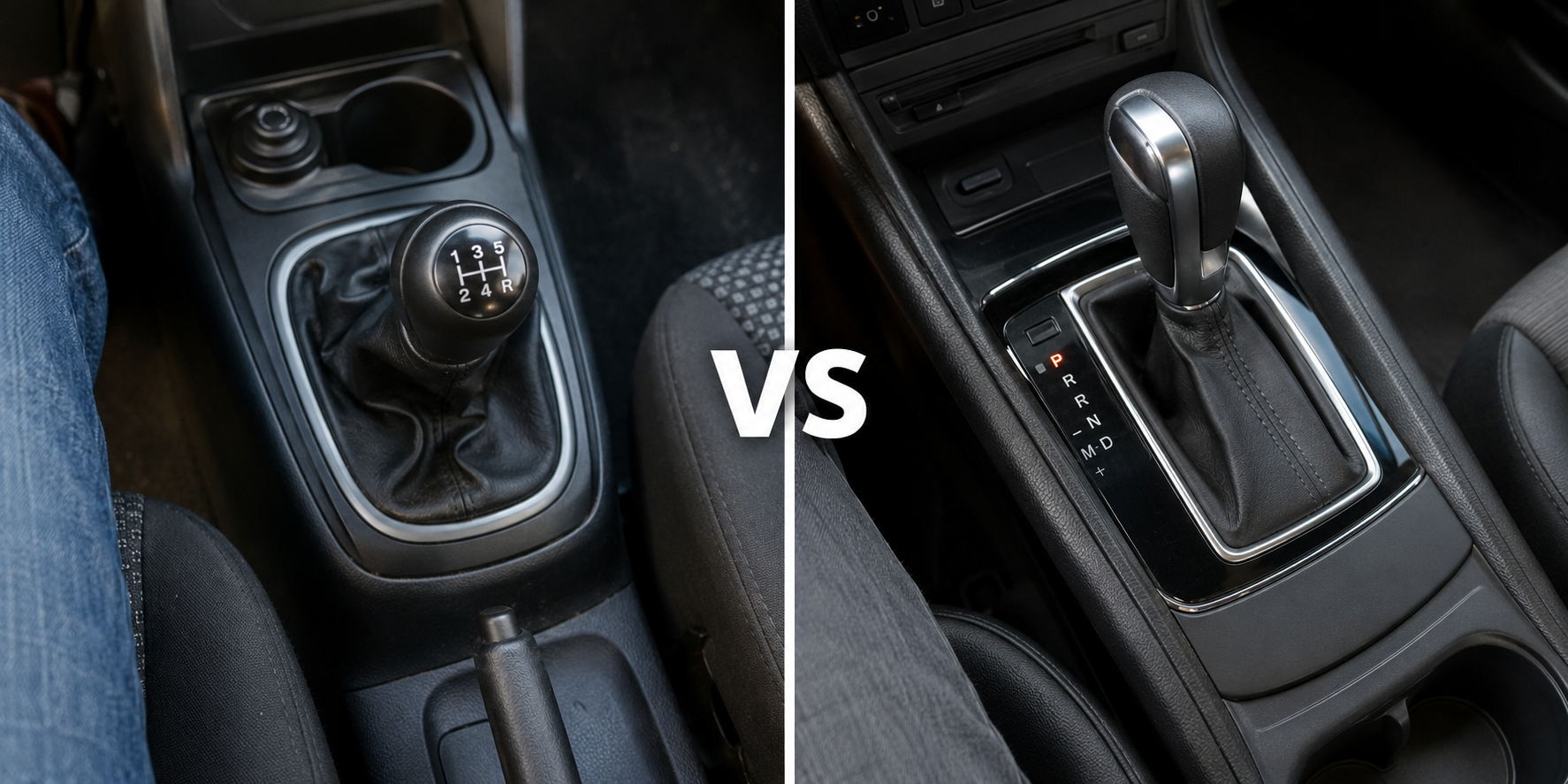
A few decades ago, the answer appeared obvious: a manual transmission was more economical, while an automatic was more comfortable but used more fuel. Older automatic transmissions often had only three or four gears, substantial hydraulic losses and relatively slow control systems. An experienced driver using a manual transmission could choose gears more precisely and avoid unnecessary engine speed.
That assumption is no longer universally correct. A modern automatic transmission may have eight, nine or ten gears, a lock-up torque converter, extremely fast electronic control and close integration with the engine, navigation, cruise control and hybrid systems.
The word “automatic” also covers several very different designs. A conventional torque-converter automatic is not the same as a dual-clutch DCT. A DCT is not the same as a CVT, while a hybrid e-CVT may use neither a traditional clutch nor a belt-driven variator.
The question “automatic or manual?” is therefore similar to asking “petrol or diesel?” Without knowing the specific vehicle, engine, route and driver, it is impossible to provide a completely honest answer.


The driver’s short takeaway right at the start: in a modern car, an automatic can often use the same amount of fuel or even less than a manual. In a used car, the winner is not the transmission label but the specific design, technical condition and previous maintenance.
Quick answer: which transmission uses less fuel?
When comparing modern vehicles, an automatic is no longer automatically less economical.
A modern eight-speed automatic, DCT or well-calibrated CVT can keep the engine at lower revolutions and shift more consistently than the average driver.
A manual transmission can be highly efficient when it has suitable gear ratios and the driver shifts correctly.
In older cars, a manual often retains an advantage over an old four-speed automatic.
When buying used, one worn or unsuitable automatic transmission can cost more to repair than several years of fuel savings.
The important catch: “automatic” is not one type of transmission
A classified advertisement may simply say “automatic”, but that word can describe at least five substantially different systems. They differ in driving behaviour, efficiency, maintenance and potential repair costs.
| Transmission type | How does it work? | Efficiency potential | Typical driving feel | What should be checked? |
|---|---|---|---|---|
| Manual | The driver selects gears using a clutch and gear lever | High when the ratios and driver technique are suitable | Direct control | Clutch, dual-mass flywheel and synchronisers |
| Conventional automatic | Torque converter and planetary gearsets | Moderate in older units and very high in modern ones | Smooth pull-away | Fluid, temperature, solenoids and valve body |
| DCT or DSG | Two clutches and two separate gear paths | Often very high | Extremely quick shifts | Clutches, mechatronics and behaviour in congestion |
| CVT | Continuously varies the transmission ratio | High during calm driving | Engine speed does not always follow road speed in the usual way | Correct fluid, overheating and towing restrictions |
| Automated manual or AMT | A manual gearbox whose clutch and shifts are operated by actuators | Can be high | A noticeable pause during gear changes | Clutch wear, actuators and calibration |
| Hybrid e-CVT | Engine, motor-generators and a power-split mechanism | Very high in city and mixed driving | Smooth power delivery without conventional shifts | Hybrid battery, cooling and system diagnostics |
Before buying a car, find out not only whether it is automatic but also the exact transmission type and code. Two versions of the same model with similar engines may use completely different transmissions.
Why did manuals almost always win in the past?
In older automatic transmissions, the torque converter allowed more slip during pull-away and in certain driving conditions. Part of the engine’s energy became heat rather than useful movement at the wheels.
Automatics also had fewer gears. A manual might have five gears while the automatic version had only three or four. This meant larger gaps between ratios and higher engine speed on the motorway.
The control systems were slower and less precise. The transmission could not interpret driver intention, road gradient or engine load as accurately as a modern system.
A manual was simpler, lighter and more mechanically direct. A skilled driver could engage a higher gear early and avoid unnecessary engine speed.
A typical older-car comparison:
five-speed manual — simple, light and connected through a direct clutch;
four-speed automatic — heavier, with wider ratio gaps and greater hydraulic losses;
in this pairing, the manual transmission’s efficiency advantage was entirely logical.
What changed in modern automatic transmissions?
A modern automatic can have a very wide ratio spread. First gear can be short enough for easy pull-away, while the highest gear allows low engine speed on the motorway.
The torque converter can be locked after the vehicle begins moving. Once the lock-up clutch engages, the connection between the engine and transmission becomes much more direct and slip losses fall considerably.
Electronics analyse accelerator position, engine load, temperature, speed, braking, road gradient and sometimes navigation data. The system can select a gear more quickly and consistently than the average driver.
An automatic also does not become tired. It does not remain in third gear because the driver forgot to shift, and it does not select an excessively high gear if the engine would be forced to work inefficiently under heavy load at very low revolutions.
The main advantage of a modern automatic is not that it always makes the perfect decision. Its advantage is that it makes a sufficiently good decision thousands of times in succession without becoming tired or distracted.
The conventional torque-converter automatic
A conventional automatic uses a torque converter when the vehicle begins moving. This allows the car to pull away smoothly without a separate clutch pedal.
In older transmissions, torque-converter slip created significant losses. In modern designs, the lock-up clutch can engage early and operate in several gears, greatly reducing the time spent slipping.
Eight or more gears allow the engine to remain more frequently within an efficient speed and load range. A good modern automatic may therefore use less fuel on the motorway than the manual version of the same model with only six gears.
Strengths of a conventional automatic:
• smooth pull-away;
• good suitability for high torque;
• comfort in congestion and during manoeuvring;
• a very wide ratio spread in modern versions;
• often good suitability for towing when approved by the manufacturer.
Dual-clutch transmissions: DCT, DSG and other names
A dual-clutch transmission can be imagined as two automated manual gearboxes inside one housing. One clutch operates one group of gears, while the second clutch operates the other group.
While the vehicle is travelling in one gear, the next gear may already be prepared. The shift is completed by opening one clutch and closing the other, so the interruption in power delivery can be extremely brief.

The mechanical connection in a DCT can be highly efficient because it does not require continuous torque-converter slip while driving. During pull-away and very slow movement, however, its clutches must slip in a similar way to those in a manual car.
This is why prolonged crawling in congestion, holding the vehicle on a slope using the accelerator and repeated centimetre-by-centimetre manoeuvring can create more clutch heat and wear.
A DCT can be highly economical, but it should not be treated exactly like a conventional torque-converter automatic. In congestion, leave more space, allow the vehicle to move in longer sections and do not hold it on an incline using the accelerator.
Illustrative driver comment: “On the motorway, my dual-clutch transmission shifts almost invisibly and keeps the engine speed very low. But after crawling in traffic for 40 minutes every morning, I realised that this transmission does not enjoy moving half a metre at a time.”
CVT: a transmission without traditional gear steps
A continuously variable transmission can change its ratio continuously. It is not restricted to five, six or eight fixed gears.
During calm driving, the system can select a ratio that allows the engine to operate within an economical speed range. During hard acceleration, it may raise engine speed and hold it almost constant while vehicle speed continues to increase.
Some drivers dislike this sensation because engine sound is not directly connected to traditional gear changes. Manufacturers therefore often programme simulated gear steps into the control software.
A CVT can offer excellent efficiency, but the correct fluid, operating temperature and manufacturer-defined towing or load limits are important.
The CVT paradox: the feeling that the engine is “revving too much” does not necessarily mean that the transmission is wasting fuel. During strong acceleration, it may hold the engine at the speed where it produces the required power most effectively.
The automated manual transmission or AMT
An automated manual transmission is often mechanically very similar to a conventional manual gearbox. The difference is that electrical or hydraulic actuators control the clutch and gear selection.
This design can be light and efficient, but a pause is often noticeable during gear changes. When the driver holds the accelerator in one position, the vehicle may briefly nod forward and backward during the shift.
Some AMT systems respond more smoothly when the driver slightly releases the accelerator as the transmission prepares to shift. The correct technique depends on the particular model.
In the used-car market, an AMT is sometimes mistaken for a conventional automatic. Before buying, it is important to determine whether the shifting pauses are a normal characteristic or a sign of worn clutches and actuators.
A hybrid e-CVT is not a conventional CVT
In many full hybrids, the term e-CVT does not describe a traditional belt- or chain-driven variator. The system combines a combustion engine, electric motor-generators and a planetary power-split mechanism.
The electrical machines help control the relationship between engine speed and wheel speed. The driver experiences smooth automatic operation even though the system is not changing between conventional fixed gears.

In the city, this system can frequently switch off the petrol engine, use electric drive and recover part of the energy during braking. This makes very good fuel economy possible without a clutch pedal or conventional gear shifts.
During hard acceleration, engine speed may rise immediately and remain high. Some drivers find this unusual, but it is not automatically a sign that the transmission is slipping or damaged.
The advantage of an e-CVT is not “more gears”. Its advantage is the ability to distribute power flexibly between the combustion engine, generator, electric motor and wheels.
Can an automatic really shift better than a person?
An experienced driver can anticipate situations further ahead than the vehicle’s sensors. The driver can see an approaching overtake, bend, hill or traffic queue and select a suitable gear in advance.
The average driver does not always shift optimally. Some remain in a lower gear for too long, while others select a higher gear too early and force the engine to operate under heavy load at very low revolutions.
An automatic transmission receives precise information about engine load, throttle position and temperature. It can shift frequently without worrying whether the driver might find the constant changes annoying.
An automatic may therefore be more economical not because it is always more intelligent than an excellent driver, but because it is more consistent than the average driver.
Illustrative driver comment: “I considered myself an economical driver with a manual transmission. After changing to an eight-speed automatic, I discovered that it selected the highest gear on the motorway much earlier than I would have done myself.”
When can a manual transmission still be more economical?
| Situation | Why might the manual win? | Important detail |
|---|---|---|
| Older car with a four-speed automatic | Lower transmission losses and more driver control | The same engine and body style should be compared |
| Calm motorway driving | The driver can remain in a suitable high gear for long periods | An eight-speed automatic may maintain even lower engine speed |
| Light and simple city car | The manual transmission may be lighter and simpler | A modern CVT or hybrid may be more efficient in urban driving |
| Driver knows the route well | A suitable gear can be selected before a hill or overtake | Poor shifting technique quickly removes the advantage |
| Low purchase and repair costs | Simpler construction may reduce total ownership costs | A clutch and dual-mass flywheel can also be expensive |
When can an automatic be more economical?
| Situation | Why might the automatic win? | Important detail |
|---|---|---|
| Heavy urban traffic | Consistent shifting and good integration with start-stop or hybrid systems | A DCT should not be forced to crawl continuously |
| Motorway with changing gradients | More gears allow more precise engine-load control | Sport mode may maintain unnecessarily high engine speed |
| Hybrid vehicle | The transmission coordinates the engine, electric motor and regenerative braking | An e-CVT cannot be compared with a manual as an isolated component |
| Driver frequently forgets to shift | The automatic prevents prolonged driving in an unsuitable gear | Aggressive accelerator use still increases consumption |
| Powerful turbocharged engine | The transmission can manage high torque and quickly select a suitable ratio | The specific transmission’s load and maintenance requirements must be checked |
City driving: comfort does not always mean higher consumption
In the city, a manual-transmission driver may perform hundreds of clutch and gear actions. As the driver becomes tired, shifts may become less precise and pull-away may become more abrupt.
An automatic can provide smoother progress and engage a higher gear at the appropriate time. A hybrid e-CVT can switch off the engine and perform part of slow urban driving electrically.
Not every automatic behaves in the same way in the city. A conventional torque-converter automatic normally creeps smoothly, while a DCT must use clutch slip when beginning to move.
When traffic moves one metre at a time, leaving a larger gap and travelling in longer sections is often more economical and mechanically sympathetic than repeatedly beginning to move every few seconds.
Motorway driving: number of gears and final-drive ratio
On the motorway, the transmission type is not the only important factor. The highest gear ratio and final-drive ratio also matter. Two otherwise similar cars may have different engine speeds at 100 km/h.
A six-speed manual does not automatically have a very tall sixth gear. The manufacturer may choose shorter ratios to improve acceleration.
An eight-speed automatic can use low engine speed during steady driving and then shift down by only one gear when a hill or headwind appears. A manual may have a much larger gap between fifth and sixth.
When comparing cars, check engine speed at 90, 100 and 120 km/h. This can reveal more about motorway fuel consumption than a simple “6MT” or “8AT” label.
Hills and gradients: anticipation versus electronics
A manual-transmission driver who sees a climb ahead can select a lower gear in advance. This prevents the engine from struggling at excessively low revolutions.
An automatic responds to load, accelerator position and falling speed. When its calibration is good, it changes gear at the appropriate time. When the software prioritises low consumption, the transmission may occasionally attempt to remain in a high gear for too long.
In some situations, manual mode or selecting a lower gear can help. This is particularly useful on a long descent where engine braking is needed.
Coasting downhill in neutral is not a good fuel-saving method. A modern engine travelling in gear with the accelerator released may stop injecting fuel under certain conditions, while the driver retains engine braking and full control.
Towing and heavy loads
A trailer increases both vehicle mass and aerodynamic drag. The transmission must operate under greater torque and thermal load.
A manual transmission gives the driver direct control, but repeated hill starts can place heavy stress on the clutch.
A conventional automatic can pull away very smoothly, but heat is generated inside the torque converter. Some vehicles include a dedicated towing mode that changes shift behaviour and avoids unnecessarily high gears.
The suitability of DCT and CVT transmissions for towing varies greatly between models. The manufacturer’s permitted trailer weight and operating conditions must always be followed.
Do not assume that every automatic is ideal for towing. Check the permitted towing weight, transmission cooling, fluid-service requirements and the driving mode specified by the manufacturer.
Winter driving
On a slippery road, smooth torque delivery and good tyres matter more than the transmission type.
In a manual car, the driver can operate the clutch very gently and, in some vehicles, begin moving in a higher gear. Prolonged clutch slip, however, increases wear.
An automatic may include a winter or snow mode that reduces initial torque and softens accelerator response.
A DCT can operate well in winter, but prolonged rocking between forward and reverse may overheat its clutches. CVT and e-CVT systems can provide particularly smooth changes in tractive force.
Manual-transmission mistakes that increase consumption
| Mistake | What happens? | Better approach |
|---|---|---|
| Remaining in a low gear for too long | The engine operates at unnecessarily high revolutions | Shift up when the engine can pull smoothly |
| Selecting a higher gear too early | The engine works under heavy load at excessively low revolutions | Choose a gear in which the engine does not shudder or vibrate |
| Resting a foot on the clutch pedal | May partially load the clutch mechanism and accelerate wear | Remove the foot completely after changing gear |
| Holding the car on a hill using the clutch | The clutch slips continuously and becomes hot | Use the brake or parking brake |
| Coasting in neutral | Control is reduced and fuel savings are not guaranteed | Remain in gear and release the accelerator early |
| Releasing the clutch abruptly | Creates jerky movement and unnecessary acceleration | Engage the clutch smoothly without excessive engine speed |
Automatic-transmission mistakes that increase consumption or wear
| Mistake | Consequences | Better approach |
|---|---|---|
| Driving constantly in Sport mode | The transmission holds lower gears and higher engine speed for longer | Use Normal or Eco mode for daily driving |
| Pressing the accelerator sharply | The transmission performs a kick-down and may shift down several gears | Apply the accelerator progressively when rapid acceleration is unnecessary |
| Holding the car on a slope using the accelerator | Creates heat in the torque converter or DCT clutches | Use the brake or Auto Hold |
| Selecting D from R while the car is still moving | The transmission must stop movement in the opposite direction | Stop completely before changing direction |
| Prolonged DCT crawling | The clutches slip and heat more frequently | Leave a larger gap and move in longer sections |
| Using incorrect transmission fluid | Can affect pressure, friction, cooling and shift quality | Use fluid that precisely matches the required specification |
Illustrative driver comment: “At first I thought Eco mode changed nothing. Then I realised that the main difference was in my right foot — the mode simply helped me use the accelerator more gently.”
Should an automatic be shifted into N at traffic lights?
During a short stop, it is generally unnecessary to shift from D to N every time. A modern automatic is normally designed to remain in D with the brake applied unless the manufacturer’s instructions state otherwise.
Constantly moving between D and N creates additional driver actions and does not necessarily produce measurable fuel savings.
During a longer stop, Auto Hold, N or P may be used according to the vehicle’s instructions and the situation. The important points are to prevent the vehicle from moving and to avoid hurried selector movements.
There is no universal rule for every transmission. A DCT, CVT, hybrid e-CVT and conventional automatic can use different control strategies, so the instructions for the particular vehicle should be followed.
A practical fuel-cost comparison
Consider a hypothetical example. The manual version of one model averages 6.5 l/100 km, while the automatic averages 6.3 l/100 km. Annual distance is 15,000 km and fuel costs €1.70 per litre.
| Version | Consumption | Fuel per year | Annual fuel cost |
|---|---|---|---|
| Manual transmission | 6.5 l/100 km | 975 litres | €1,657.50 |
| Automatic transmission | 6.3 l/100 km | 945 litres | €1,606.50 |
| Difference | −0.2 l/100 km | −30 litres | −€51.00 per year |
In this example, the automatic saves only €51 per year in fuel. If the automatic version costs €1,500 more to buy, recovering the price difference through fuel savings alone would be extremely difficult.
Now consider the opposite example: an older automatic version uses 7.2 l/100 km, while the manual uses 6.5 l/100 km.
| Version | Consumption | Fuel per year | Annual cost |
|---|---|---|---|
| Manual transmission | 6.5 l/100 km | 975 litres | €1,657.50 |
| Older automatic | 7.2 l/100 km | 1,080 litres | €1,836.00 |
| Difference | +0.7 l/100 km | +105 litres | +€178.50 per year |
Simple formula:
Annual fuel quantity = annual distance × consumption / 100.
Annual cost = annual fuel quantity × price per litre.
Transmission difference = annual cost of one version − annual cost of the other.
How much does a difference of 0.2, 0.5 or 1.0 l/100 km cost?
| Consumption difference | Additional litres over 15,000 km | Additional cost at €1.70/l |
|---|---|---|
| 0.2 l/100 km | 30 litres | €51.00 per year |
| 0.5 l/100 km | 75 litres | €127.50 per year |
| 0.7 l/100 km | 105 litres | €178.50 per year |
| 1.0 l/100 km | 150 litres | €255.00 per year |
The table shows why a small official consumption difference should not be the only selection criterion. Comfort, purchase price, maintenance and potential repairs may be far more important financially.
Fuel consumption is not the same as total ownership cost
The most economical car is not necessarily the one that uses the fewest litres. The complete ownership picture must be considered.
| Cost category | Manual transmission | Automatic transmission |
|---|---|---|
| Purchase price | Often lower | Often higher, depending on the market |
| Routine maintenance | Normally simpler | May require specific fluid, filters and service procedures |
| Wear components | Clutch, release bearing and dual-mass flywheel | Clutches, valve body, solenoids, mechatronics or CVT components |
| Risk from incorrect use | Clutch overheating and incorrect gear selection | Overheating, incorrect fluid, unsuitable towing or prolonged crawling |
| Comfort in congestion | Lower | Usually higher |
| Used-market demand | Depends on the model and buyer group | Higher in many market segments |
A saving of 0.2 l/100 km cannot compensate for a major repair. When buying a used vehicle, documented maintenance and the transmission’s actual condition may matter far more than theoretical consumption.
Is automatic-transmission fluid really “for life”?
The phrase “lifetime fluid” can create the impression that the fluid never needs to be changed. However, “lifetime” may be defined according to a particular operating period, market and usage profile.
Transmission fluid operates at high temperature, transfers hydraulic pressure, lubricates components and removes heat. Its properties and additive performance can change over time.
At the same time, one universal replacement interval should not be applied to every automatic transmission. Different units require different fluids, filters, filling temperatures and level-checking procedures.
The safest approach is to check the vehicle and transmission manufacturer’s instructions and consider severe usage such as frequent towing, urban congestion, mountain driving and high temperatures.
Inspecting a used car with a manual transmission
Check:
• whether the clutch pedal operates smoothly;
• whether the clutch slips under strong acceleration in a high gear;
• whether there is excessive vibration when pulling away;
• whether every gear engages without grinding or excessive force;
• whether any gear disengages by itself;
• whether suspicious noises change at idle when the clutch is pressed;
• whether there is documentation for clutch or dual-mass flywheel replacement.
Inspecting a used car with an automatic transmission
Check the transmission when cold and fully warmed:
• whether D and R engage without excessive delay or impact;
• whether shifts are consistent under light and moderate load;
• whether engine speed rises without corresponding acceleration;
• whether there is vibration, shuddering or whining;
• whether transmission warnings or stored fault codes are present;
• whether fluid and filter maintenance records are available;
• whether the transmission type and code match the advertisement;
• whether undocumented software modifications have been performed.
Do not treat one short drive around a car park as an inspection. Some problems appear only after the transmission warms up, under load, during slow manoeuvring or while travelling at a steady speed.
A 15-minute test-drive routine
| Stage | What should you do? | What should you observe? |
|---|---|---|
| Minutes 1–3 | Manoeuvre slowly forwards and backwards | Delay, impacts, clutch vibration and unusual sounds |
| Minutes 4–6 | Accelerate gently to urban speed | Shift smoothness and engine speed |
| Minutes 7–9 | Perform one moderately strong acceleration | Slipping, kick-down response and power delivery |
| Minutes 10–12 | Drive steadily at a constant speed | Vibration, gear hunting and unusual noise |
| Minutes 13–15 | Stop and repeat R and D selection or manual gear engagement | Whether behaviour has worsened after warming up |
Ideally, the test drive should be completed with a specialist and diagnostic equipment. Fifteen minutes cannot guarantee a complete evaluation, but it provides much more information than a brief drive around the block.
Common myths about automatic and manual transmissions
| Myth | Fact | Practical takeaway |
|---|---|---|
| An automatic always uses more fuel | A modern automatic can be equally economical or more economical | Compare specific versions of the same model |
| A manual is always cheaper to repair | A clutch and dual-mass flywheel can be expensive | Evaluate the costs of the specific design |
| High engine speed with a CVT always means slipping | A CVT may deliberately hold the engine in an efficient power range | Distinguish normal operation from rising revolutions without acceleration |
| An e-CVT uses a conventional variator belt | In many hybrids, it is a power-split system using electric motors | Do not confuse e-CVT with a conventional CVT |
| N must always be selected at traffic lights | This is normally unnecessary during a short stop | Follow the instructions for the specific car |
| Sport mode makes the transmission more efficient | It normally prioritises response and holds lower gears longer | Use Normal or Eco mode for daily efficiency |
| Coasting in neutral saves the most fuel | It can reduce control without producing savings | Remain in gear and release the accelerator early |
Is a manual transmission more reliable than an automatic?
A simple manual transmission is often mechanically less complicated, but its clutch, synchronisers, bearings and dual-mass flywheel also wear. Automatic-transmission reliability varies greatly between designs and models. The reputation, maintenance and usage of the exact version matter more than the general transmission category.
Does an automatic always shift more economically than the driver?
No. An experienced driver may anticipate certain situations better, such as an approaching climb or overtake. However, an automatic is highly consistent and often outperforms a driver who shifts too late, too early or unevenly.
Is a DCT a manual or automatic transmission?
Mechanically, a DCT uses gear pairs and clutches in a way that resembles a manual gearbox, but the driver has no clutch pedal and electronics control the shifts. In normal use, it is considered an automatic transmission.
Can an automatic be shifted into N while driving?
This is not recommended as a fuel-saving method. The driver loses engine braking, and re-engaging D while moving may not be appropriate in every situation or transmission design. Driving modes should be used according to the vehicle’s instructions.
Does using manual mode in an automatic reduce consumption?
In certain situations, it can help maintain a suitable gear, such as on a long descent or a hilly road. In normal driving, however, the control system often selects the more economical gear itself. Incorrect use of manual mode may keep engine speed unnecessarily high.
Mini test: which transmission is better suited to you?
Answer these questions:
1. Do you drive in congestion every day?
2. Is comfort more important to you than complete control over gear selection?
3. Will the vehicle be a full hybrid?
4. Do you regularly tow a trailer or carry heavy loads?
5. Are you prepared to examine an automatic transmission’s service history carefully?
6. Do you enjoy selecting gears yourself and using engine braking?
7. Do you want the simplest and least expensive small car possible?
If the answer is “yes” to most of the first five questions, a suitable automatic may be the better choice. If mechanical simplicity, direct control and a lower purchase price are more important, a manual remains entirely sensible.
A 14-day experiment: reduce consumption with your existing transmission
Most drivers cannot replace a manual transmission with an automatic in the same car for a two-week comparison. They can, however, compare two driving styles using the transmission they already have.
| Period | Manual transmission | Automatic transmission |
|---|---|---|
| Days 1–7 | Drive normally and record consumption, route and temperature | Drive normally and record the selected mode, consumption and route |
| Days 8–14 | Shift more smoothly, avoid unnecessary engine speed and anticipate traffic | Use Normal or Eco mode, accelerate progressively and avoid unnecessary kick-down |
| Comparison | Compare average consumption and shifting comfort | Compare average consumption, transmission behaviour and journey time |
During the experiment, try to maintain similar routes, tyre pressures and travel times. One good or bad journey proves very little, so compare the average result over several days.
The most interesting result is often not which transmission is theoretically more efficient, but how much your accelerator use and traffic anticipation change consumption.
A simple selection process
Choose in this order:
1. Select a specific vehicle model and engine.
2. Identify the exact manual or automatic transmission type and code.
3. Compare official fuel-consumption figures for equivalent versions.
4. Review real owner data, but do not rely on one comment.
5. Calculate the fuel-cost difference for your annual distance.
6. Add the difference in purchase price and maintenance costs.
7. Research common problems and repair complexity for the exact transmission.
8. Complete a test drive with the transmission cold and fully warmed.
9. Choose the transmission whose operation suits your daily route rather than the one with the best theoretical figure.
Which option suits different drivers?
| Driver profile | Possible best choice | Why? |
|---|---|---|
| Daily urban driver | Conventional automatic, CVT or hybrid e-CVT | Comfort and consistent behaviour in congestion |
| Long motorway journeys | Six-speed manual or modern multi-speed automatic | Low engine speed and steady progress |
| Enthusiast who enjoys sporty control | Manual or a good DCT | Direct control or extremely quick shifts |
| Driver seeking maximum urban efficiency | Full hybrid with e-CVT | Engine shut-off, electric movement and regenerative braking |
| Buyer seeking a simple and inexpensive small car | Manual transmission | Lower price and simpler construction |
| Regular trailer towing | Manufacturer-approved conventional automatic or suitable manual | Cooling, torque capacity and permitted load are important |
Conclusion: today, the specific car matters more than the transmission label
The claim that a manual transmission always uses less fuel is outdated. A modern automatic with many gears, early torque-converter lock-up and precise electronic control can be equally economical or even more efficient.
Automatic transmissions should not all be placed into one category. A conventional automatic, DCT, CVT, AMT and hybrid e-CVT operate differently and require different driving habits.
A manual remains an excellent option for a driver who wants a lower purchase price, direct control and simpler construction. It may be particularly suitable in an older car or a simple small vehicle.
An automatic can be entirely justified in urban traffic, on long journeys, in a hybrid or whenever comfort and consistent shifting matter more than having a clutch pedal.
For a used-car buyer, the most important steps are identifying the exact transmission, examining its maintenance history and completing a thorough test drive. A theoretical saving of 0.2 l/100 km means very little if an expensive transmission repair is approaching.
Driver behaviour also remains extremely important. Aggressive acceleration, unsuitable gear selection, constant Sport-mode use and poor traffic anticipation can erase the technical advantages of any modern transmission.
The driver’s final takeaway: do not choose a manual simply because “it is always more economical”, and do not choose an automatic simply because “it will do everything for you”. Choose the exact transmission whose design, maintenance requirements and behaviour best suit your route.