 LV
 EN
 RU
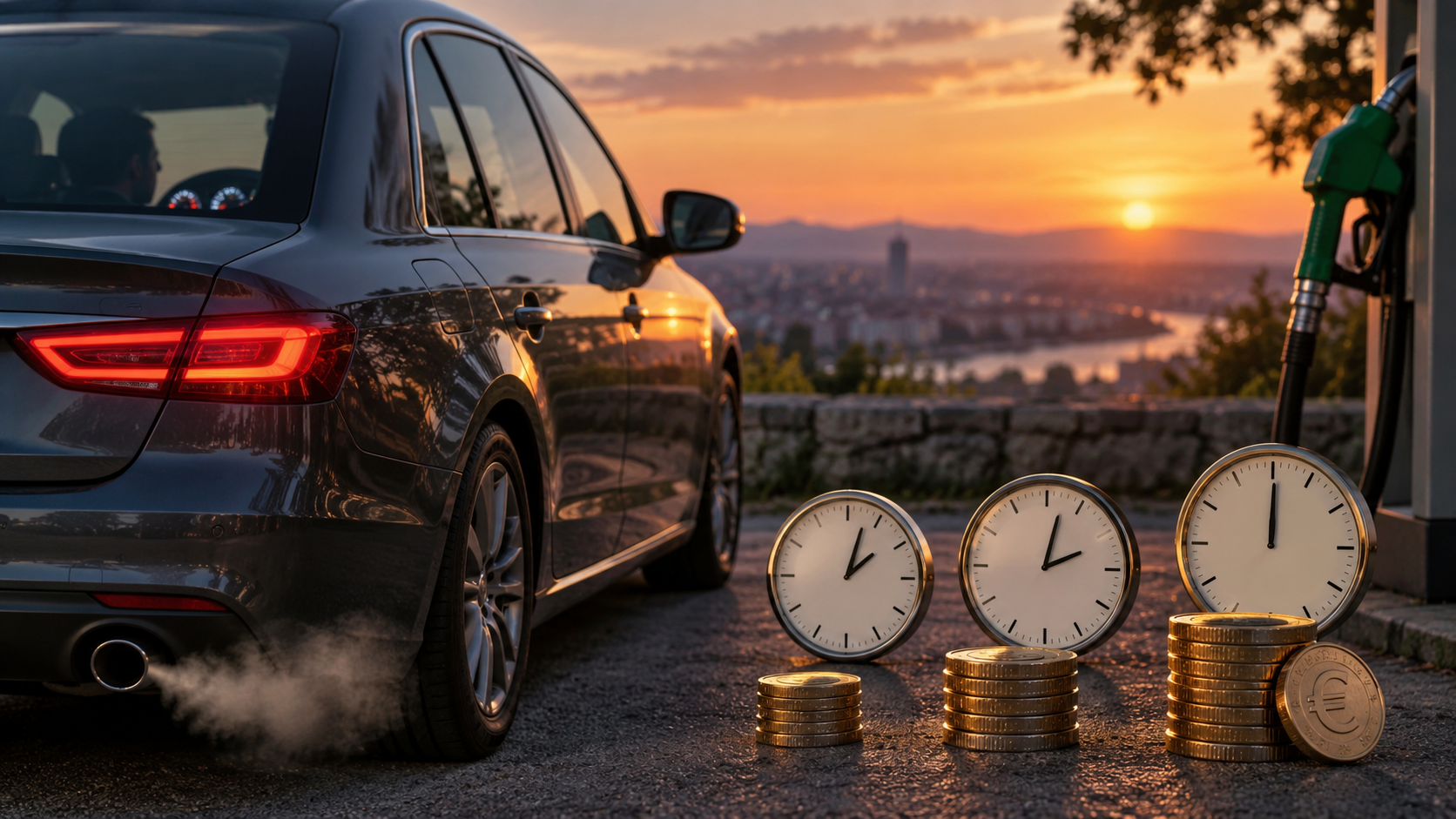
You arrive in a car park ten minutes before a meeting. It is cold outside, so you leave the engine running. On another day, you wait for your child outside school. Another ten minutes. Then you sit in the car outside a shop while your passenger quickly goes inside. The engine is running again.
None of these situations seems particularly important. The car is not moving, the engine speed is low, and the trip computer may not even show the familiar litres per 100 kilometres. But the engine is still burning fuel.
And if those ten-minute periods happen almost every day, by the end of the year we are no longer talking about just a few drops.
Quick answer
There is no single universal fuel-consumption figure for idling. Official sources show base values of roughly 0.6–0.9 l/h for some passenger cars, while a larger engine, cold weather, air conditioning, heated windows and other loads can increase consumption. For a useful calculation, it is better to look at several scenarios rather than assume that every car uses the same amount of fuel while idling.
While idling, the car travels 0 kilometres, but its fuel consumption is not 0 litres.
How much fuel can disappear in 10, 30 and 60 minutes?
Let us start with a simple calculation. We will use four different idling-consumption scenarios. These are not factory specifications for particular cars, but practical examples showing how large the difference can be between an economical engine and a much more demanding operating condition.
| Idling consumption | 10 minutes | 30 minutes | 60 minutes |
|---|---|---|---|
| 0.65 l/h | ~0.11 l | ~0.33 l | 0.65 l |
| 0.90 l/h | 0.15 l | 0.45 l | 0.90 l |
| 1.50 l/h | 0.25 l | 0.75 l | 1.50 l |
| 3.00 l/h | 0.50 l | 1.50 l | 3.00 l |
This is exactly why very different figures can be found online. A small, fully warmed-up engine with little additional load is not the same as a large petrol engine on a cold winter morning with the heated rear window, cabin fan and other electrical consumers switched on.
How much does it cost in euros?
To keep the calculation easy to understand, we will use an example fuel price of €1.60/l. This is not a claim about today's fuel price — for your own calculation, simply enter the price shown at your local filling station.
| Idling consumption | 10 min. | 30 min. | 1 hour |
|---|---|---|---|
| 0.65 l/h | ~€0.18 | ~€0.52 | €1.04 |
| 0.90 l/h | €0.24 | €0.72 | €1.44 |
| 1.50 l/h | €0.40 | €1.20 | €2.40 |
| 3.00 l/h | €0.80 | €2.40 | €4.80 |
Important: the purpose of this table is not to say that your car definitely uses exactly 0.65, 0.90 or 1.50 l/h. It shows how costs change at different idling-consumption levels. If your trip computer displays fuel consumption in litres per hour while stationary, you can use your own car's reading.
Why does an engine use fuel when the car is not moving?
An engine cannot continue running without consuming energy. Even at idle, it has to overcome internal friction, drive auxiliary equipment and maintain enough engine speed to keep itself running.
Fuel is injected into the cylinders, the mixture burns, the pistons move and the crankshaft continues to rotate. The main difference is that most of the energy being produced is not being used to move the vehicle forward.
That is why it is not especially useful to express idling consumption in litres per 100 kilometres. If the car is stationary, the distance travelled is zero. Many trip computers therefore switch to a l/h, or litres per hour, display in this operating mode.
Petrol or diesel — which uses less fuel while idling?
In the U.S. Alternative Fuels Data Center calculation methodology, approximately 0.23 US gallons per hour is used for a light-duty petrol vehicle, while approximately 0.17 gallons per hour is used for a light-duty diesel vehicle.
Converted into litres, that is approximately 0.87 l/h for petrol and 0.64 l/h for diesel.
However, these figures should not be treated as guaranteed consumption values for every car. Two vehicles using the same type of fuel can differ significantly in engine size, design, idle speed and additional load.
The simple idea: fuel type affects the result, but the words “petrol” or “diesel” alone are not enough to determine your car's exact idling consumption.
Engine size matters
A 1.0-litre three-cylinder engine and a 5.0-litre V8 do not run at idle using the same amount of fuel. A larger engine usually has more cylinders, greater displacement and larger internal losses.
That is why Natural Resources Canada notes that ten minutes of idling can result in very different fuel consumption depending on the vehicle and conditions. The difference can be particularly noticeable between a small passenger car and a large vehicle with a powerful engine.
A cold engine can change everything
Immediately after a cold start, an engine is usually not operating in its most efficient state. The oil is cold, internal resistance is higher, and a petrol engine may use a richer mixture while warming up.
That is why the l/h figure shown immediately after starting the engine on a winter morning can be significantly higher than the reading after the engine has reached operating temperature.
If you want to understand winter warm-up in more detail, you can also read our article “Is it worth warming up a car at idle in winter?”.
Does air conditioning increase idling fuel consumption?
It can. The air-conditioning compressor requires energy. Depending on the vehicle design, cabin temperature and outside heat, compressor load can vary substantially.
On a very hot day, a car sitting in the sun and trying to cool the cabin quickly may operate under a much greater load than a car in mild weather with an already-cooled interior.
Consumption can also be affected by
- the cabin fan;
- rear-window heating;
- heated seats and steering wheel;
- headlights;
- battery charging demand;
- cooling fans;
- other electrical consumers.
These devices need electricity, which is generated by the alternator, and the alternator is driven by the engine. Electricity in a conventional car with the combustion engine running does not appear without energy consumption.
A simple formula for calculating your own car's consumption
Fuel used while idling
Idling minutes ÷ 60 × consumption in l/h = litres used
For example, your car uses 0.9 l/h at idle and you wait for 20 minutes with the engine running.
20 ÷ 60 × 0.9 = 0.30 litres.
If fuel costs €1.60/l:
0.30 × 1.60 = €0.48.
That is not much once. But now let us see what happens if it becomes a habit.
Ten minutes every working day
Let us assume you spend 10 minutes idling every working day. There are around 22 such days in a typical month.
That means:
22 × 10 min = 220 min, or approximately 3.67 hours per month.
| Idling consumption | Litres per month | At €1.60/l | Over 12 months |
|---|---|---|---|
| 0.65 l/h | ~2.4 l | ~€3.82 | ~€45.80 |
| 0.90 l/h | ~3.3 l | ~€5.28 | ~€63.40 |
| 1.50 l/h | ~5.5 l | ~€8.80 | ~€105.60 |
And this is based on only 10 minutes per working day. For drivers who regularly wait in their cars because of work, deliveries, passengers or other reasons, idling hours can accumulate much faster.
Why does the trip computer show 99.9 l/100 km?
In some cars, when you stop with the engine running, the instantaneous fuel-consumption display can jump to a very high number — for example 30, 50 or even 99.9 l/100 km.
That does not mean the engine has suddenly started burning 100 litres per hour.
The problem is the unit itself. Litres per 100 kilometres describes fuel consumption relative to distance travelled. If the car is burning fuel while covering virtually no distance, the mathematical result rises dramatically.
For evaluating idling, a much more useful figure is l/h — how many litres the engine would use in one hour if it remained in the same operating condition.
How does a start-stop system save fuel?
The idea behind a start-stop system is very simple: if the vehicle is stationary and the engine is not currently needed to drive the car, the system temporarily switches it off.
Natural Resources Canada notes that start-stop technology can reduce fuel consumption in city driving because the engine no longer runs unnecessarily during stops.
That does not mean the system will switch the engine off every single time. The vehicle's control system may prevent it because of a cold engine, battery condition, climate-control requirements or other reasons.
You can read more about this technology in our article “Start-Stop System: Does It Really Save Fuel or Damage the Battery?”.
Does restarting the engine use more fuel than idling?
This is one of the most common arguments in favour of leaving an engine running: “It is better to keep it running because every restart uses a lot of fuel.”
Modern electronic fuel injection has largely changed this picture. Information published by the U.S. Department of Energy indicates that, from a fuel-use perspective, even a relatively short period of idling can consume more fuel than switching the engine off and restarting it.
However, do not apply this mechanically: do not switch off the engine in moving traffic or in situations where doing so could reduce safety. Automatic start-stop systems take many operating conditions into account. With older vehicles, the design and condition of the starter, battery and control system should also be considered.
What about a hybrid?
A full hybrid can behave very differently while stationary compared with a conventional petrol car. In many operating modes, the combustion engine switches off automatically while the electrical system continues to power the necessary vehicle functions.
That does not mean a hybrid will always remain stationary with the engine off. The engine may restart to charge the traction battery, provide cabin heat or perform other system tasks.
For this reason, the classic formula “one hour stationary = X litres” may be even less accurate for a hybrid than for a conventional petrol car.
Myths and facts
| Claim | Myth or fact? | Explanation |
|---|---|---|
| A car uses almost no fuel while idling. | Myth | Even while stationary, the engine continues to burn fuel. |
| A large engine can use more fuel at idle than a small engine. | Usually true | Engine size and design are among the factors that affect consumption. |
| Air conditioning makes no difference while idling. | Myth | The climate-control system requires energy and can increase engine load. |
| A cold engine can consume more fuel. | Fact | During warm-up, the engine operates differently and has not yet reached its optimal temperature. |
| All cars use around 1 l/h at idle. | Myth | Consumption can be lower or significantly higher. |
Mini test: is idling costing you more than you think?
Answer these five questions:
- Do you regularly warm up your car for more than a few minutes before driving in winter?
- Do you often wait for passengers with the engine running?
- Do you sometimes spend lunch or work breaks sitting in a stationary car with the engine running?
- Do you leave the engine running while quickly going into a shop or waiting for something?
- Do you have no idea how many minutes your car spends idling each month?
If you answered “yes” to several questions, your idling fuel consumption may be higher than you notice in everyday driving.
7-day experiment: measure your real idling time
There is no need to deliberately leave the engine running for this experiment. Quite the opposite — simply observe your normal week.
7-day idling experiment
- Every time you remain stationary with the engine running, write down the number of minutes.
- At the end of the week, add up the total time.
- If your car displays l/h, note the approximate reading with the engine fully warmed up.
- If it does not show l/h, you can use around 0.8–1.0 l/h for an approximate calculation and treat the result only as an estimate.
- Convert the minutes into hours.
- Multiply the hours by l/h.
- Multiply the litres by your current fuel price.
For example, you accumulate 85 minutes of idling during one week.
85 ÷ 60 = 1.42 hours.
If the car uses around 0.9 l/h:
1.42 × 0.9 = 1.28 litres per week.
At the example fuel price of €1.60/l, that is around €2.05 per week. Over a full year, a repeated habit can become a noticeable expense.
When should you not switch off the engine just to save fuel?
Fuel economy should never become more important than safety and normal vehicle operation.
There is no need to mechanically switch off the engine during every stop lasting only a few seconds. In traffic, operate the car as intended by its manufacturer, and with an automatic start-stop system, allow the vehicle's electronics to control the process.
There are also situations where the vehicle needs to remain running to provide specific functions or maintain safe conditions. The goal is not to “never idle”, but to avoid unnecessary prolonged idling.
Quick self-check
Can 10 minutes of idling use half a litre of fuel?
For a particular vehicle under certain operating conditions, it is possible, but it is not a universal figure. Engine size, temperature and additional load can significantly affect the result.
Does a diesel always use less fuel at idle than a petrol car?
No. Official calculation data use a lower base figure for a light-duty diesel than for a petrol vehicle, but actual fuel consumption depends on the individual car and its operating conditions.
Can idling consumption be seen on the trip computer?
Many cars display instantaneous fuel consumption in litres per hour, or l/h, while stationary. Other vehicles continue to show l/100 km or do not display instantaneous consumption in this mode at all.
Can one hour of idling use several litres of fuel?
Yes. A large engine or heavy additional load can result in much higher fuel consumption than a small, fully warmed-up engine. That is why one universal figure should not be assumed for every vehicle.
How can I get the most accurate figure for my car?
If your car shows instantaneous fuel consumption in l/h, observe the figure in different operating conditions with the engine fully warmed up. More precise data can be obtained using diagnostic equipment or a longer controlled fuel-consumption measurement. There is no need to leave the engine idling deliberately just for the test.
Conclusion
Fuel consumption during one short period of idling usually does not look particularly dramatic. A few hundred millilitres of fuel or a few tens of cents rarely seem important enough to change a driver's habits.
But what matters is not one isolated situation — it is repetition. Ten minutes in the morning, another ten in the evening and several waiting periods over the weekend can turn into several hours of idling every month.
The exact figure will differ from one vehicle to another. Engine type, displacement, temperature, air conditioning, electrical loads and even battery state of charge can affect the result.
That is why the best approach is not to memorise one number found online, but to understand the formula and measure your own habits.
Driver's short takeaway: if the car is stationary with the engine running, fuel is still disappearing from the tank. One occasion costs very little, but regular idling can add up to a surprisingly large amount over a year.
Sources and note about the figures
The idling fuel-consumption ranges and guidance were checked against materials from Natural Resources Canada and the U.S. Department of Energy / Alternative Fuels Data Center. Figures vary between official sources because they are based on different vehicles and operating conditions. The €1.60/l fuel price used in this article is only a simplified calculation example and is not presented as the current fuel price.