
 LV
 EN
 RU
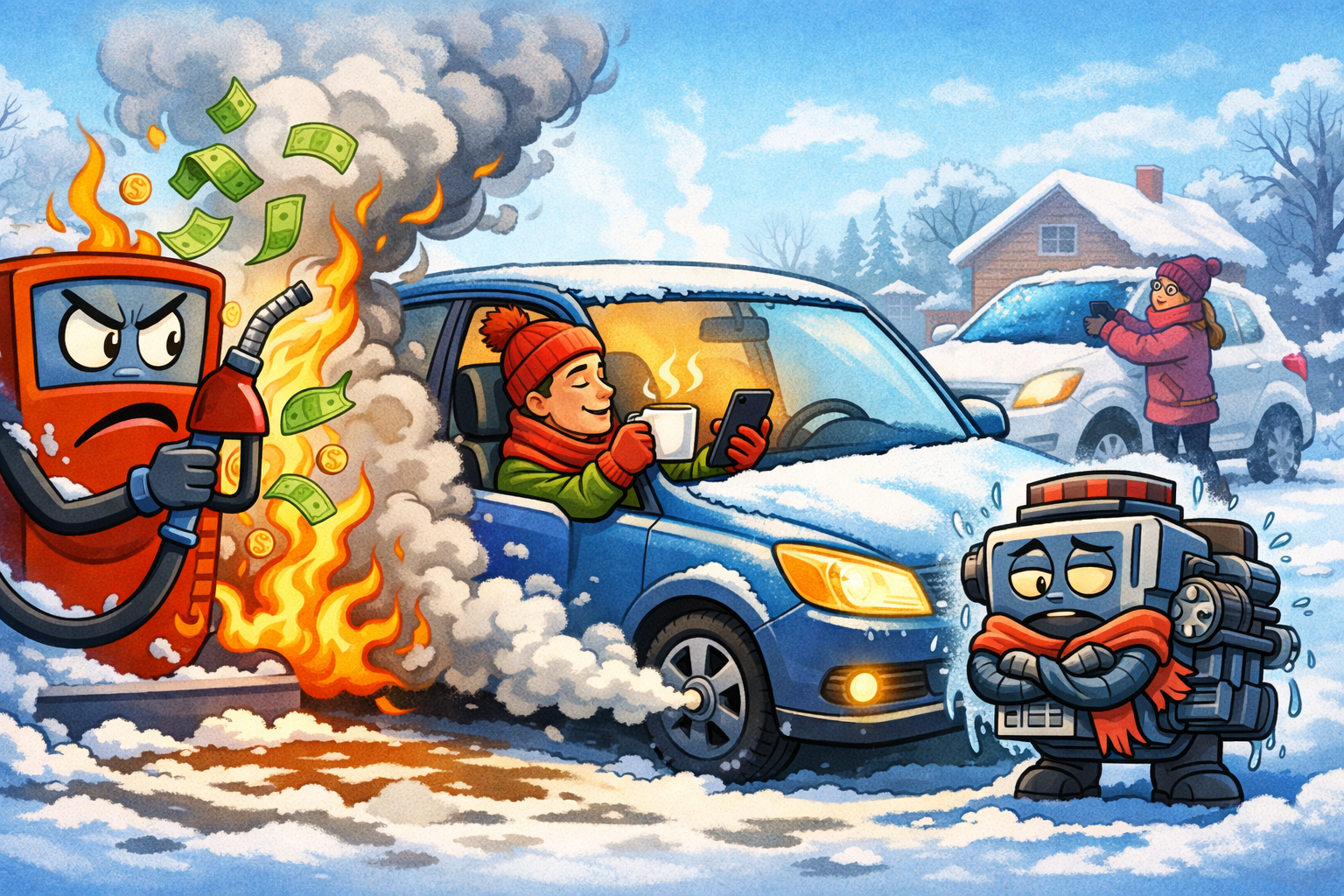
There are winter mornings when a driver’s thinking becomes very simple. Cold. The windshield is frozen. The engine seems unhappy even before the start. And then a familiar question switches on in your head: do I need to warm this car up a little before I start driving? For some people, it is almost a religion. Others proudly say it is all a myth from older times. But the truth, as often happens in the car world, does not live at either extreme. It lives in the everyday nuances where people very often confuse reasonable caution with unnecessary fuel burning.
From the outside, warming up at idle seems like an innocent ritual. You start the car, clear the windows, wait a little until the cabin becomes bearable, and only then drive off. Humanly, it seems logical. No one wants to immediately torture a cold engine. No one wants to sit in an icy cabin. And yet it is exactly in this ordinary scene that one of those questions is hidden where people spend years doing something “that seems right,” while in reality they are not always doing something smart.
This article is exactly about that. Is it worth warming up a car at idle in winter? For how long? When is it reasonable, and when does it already become unnecessary fuel consumption? What does an engine actually need in cold weather, and what is it simply the driver who wants it? And why is it that sometimes a person is convinced they are taking care of their car, when in reality they are only standing in the yard, burning fuel, and delaying their own morning?
Because this topic is not just about a technical nuance. It is about daily habits. About how we imagine the “right attitude” toward a car. And about how often old habits live longer than they should—simply because they feel familiar.
Why do people warm up cars at idle in the first place?
The reason is very simple: it feels gentler. On a cold morning, a person intuitively feels that the engine, after a night of rest, has to be “woken up.” That you cannot simply start it and drive away immediately. That the metal is cold, the oil is thick, everything feels stiff, and that is why it needs to breathe for a bit before moving. This feeling is not made up. It is very human. And that is exactly why this habit lives so long.
Another reason is the cabin. People often say they are not warming up the engine, they just want to see properly and feel normal. The windows are fogged, frost is on the glass, the steering wheel is cold, the seat is cold, the children in the back are unhappy, and the workday has not even started yet. At that moment, the idea of a few minutes of idling seems not like waste, but like normal quality of life.
And yet the problem is not that a person wants warmth or a clear window. The problem begins at the moment when this ritual becomes automatic and exaggerated. When “I’ll warm it up a little” turns into 10–15 minutes of standing still. When the car is treated as something that must always be warmed up for a long time on the spot, otherwise something bad will happen. That is exactly where the line begins between a reasonable winter routine and an inefficient habit.
A very typical thought from driver conversations: “I’m not warming it up because I like spending more. I’ve just always thought that this is the right thing to do for the engine.”
The engine really does not like a cold start—but that still does not mean it needs a long idle warm-up
Here is the most important nuance in the whole article. Yes, a cold start is not the ideal mode for an engine. Yes, in cold weather the oil and the moving parts need a moment before everything begins working more evenly. But it does not automatically follow from that that prolonged idling on the spot is the best solution. And this is exactly where many drivers combine two different truths into one inaccurate conclusion.
The engine really should not be thrown under maximum load immediately after starting. But that is not the same thing as saying it has to sit idling for a long time. A car very often reaches normal operating condition more properly and more quickly if, after a short moment, you start driving gently, rather than standing still for a long time. In other words, gentle movement is often smarter than prolonged idling.
Many people do not like this, because intuitively it feels like the opposite. A person thinks: if I stand still, I am protecting it. But in the world of cars, standing still does not always mean the best warm-up. Sometimes it simply means that the engine spends a long time in a transition mode where fuel is being used, but no real movement is happening.
Fuel consumption at idle: small by the minute, unpleasant by the month
One reason people tend to underestimate the cost of idling is very simple: psychologically, it is not dramatic. You do not see a big trip. You do not see a long distance. You are simply standing there. And that is exactly why the illusion appears that it costs almost nothing. But the car is still operating during that time. The engine is turning. Fuel is being consumed. Just not on the road, but in the yard.
One short warm-up by itself will not ruin anyone. But if it happens every winter morning, sometimes again in the evening, and before every small trip, then this “small thing” starts to add up. And just like many other car costs, the extra expense of idling does not live in one big shock, but in repetition. A little today, a little tomorrow, a little all winter. And then a person wonders why fuel disappears faster during the cold months than it seemingly should.
It becomes especially annoying in households where the car is started several times a day for very short trips. There, warming up at idle can become a habit that stands right next to the short-trip problem—expensive not because one moment is catastrophic, but because the whole system is inefficient.
A good comment from a daily driver: “When I started counting how often I simply stand there in winter with the car running, I realized I had been treating it too innocently.”
Windows, visibility, and safety—this is where idling sometimes makes sense, but differently than people think
It is important to be honest here. There are situations where starting the car and letting it run briefly on the spot is completely logical. If the windows are icy, fogged, or visibility is poor, then safety matters more than ideology. This is not a story about how a person should jump into an ice-cold car and blindly head onto the road just to “avoid wasting fuel.” No. Visibility is always the priority.
But here another thought is important: a short, practical warm-up for visibility is not the same thing as a long idle warm-up “to protect the engine.” If you start the car, clear the windows, restore visibility, and then begin driving gently, that is one scenario. If you sit for 10 minutes, stare at your phone, and wait until the cabin feels almost like May, that is a different scenario.
And that is exactly where many drivers begin to overdo it. Without noticing, they move from reasonable preparation for the road into comfort warming. Humanly, that is understandable. But in terms of fuel, time, and habits, it is not always smart.
Older cars and newer cars experience this topic differently
Here too, it is very important not to turn the subject into one absolute truth for everyone. An older car, a more worn engine, a weaker battery, an older heating system, and an overall heavier technical condition can make the winter routine more sensitive. In such a car, a person intuitively feels less secure, and sometimes there is a very practical reason for that. If the systems are slower, the windows clear worse, and the engine feels more reluctant after a cold night, then “I’ll wait a little” at idle becomes more understandable.
Meanwhile, in newer cars, people sometimes continue doing the same thing more out of habit than real necessity. They treat a more modern car as if it were the same as the old model from ten or fifteen years ago. And that is where an interesting paradox appears: the car has already changed, but the driver’s rituals have not.
That is why, in this topic too, it is very important not to blindly repeat forum phrases, but to look honestly at your own car. Did I warm it up because I really needed to? Or did I warm it up because I have always done it that way? This question sounds simple, but very often it is exactly the one that reveals the truth.
A very typical thought from a driver: “I realized that with the new car, I kept doing the same things I did with the old one, simply out of habit rather than necessity.”
What happens if you start driving too aggressively right away?
Here it is important to emphasize one more thing so the topic does not become too flat. If a person starts a cold car and immediately begins driving aggressively, with high revs, sharp acceleration, and no patience, then that is not a smart approach either. In other words, a long idle warm-up is not the ideal solution, but “jump in and go straight into sport mode” is not some kind of bravery either.
The smartest winter mode is very often somewhere in the middle. Start the car, briefly restore visibility, let the systems come to life, and then begin driving calmly. Without rushing. Without sharp load. Without the feeling that after 20 seconds the car is already fully ready for everything. Because that is not really fair to mechanical reality either.
It is very similar to a person in winter. We are not immediately in our best mode in the morning either. The only difference is that a person forgives that in themselves, but tends to expect from a car either total instant readiness or, at the other extreme, pointless long standing. The smarter approach is usually somewhere in between.
Short winter trips + idling for warm-up = a very expensive combination
If there is one situation where this topic becomes especially important, it is the life of short trips in winter. Let us imagine a typical daily routine: in the morning a person starts the car, warms it up, drives a child a few kilometers, stops, later starts it again, warms it up again, drives to work, and in the evening it is the same thing again. Every trip is short. The engine has not fully warmed up for long. And before every departure there are idle minutes as well.
In such a life model, fuel disappears in a very ugly way. And a person very often tells themselves: but I hardly drive at all. Yes, in terms of kilometers—maybe. But in terms of costs, this is one of the heaviest combinations a car can experience in everyday life. Cold weather, short routes, repeated starts, idling, another cold start. All of this together creates the feeling that in winter the car becomes disproportionately expensive. And that feeling is usually not imagined.
This is exactly where people most often begin to feel that something in their daily life is not efficient. They just cannot always immediately say where the money is disappearing. And one of the answers is very often: it disappears not only on the road, but even before the trip begins.
A good comment from a family car user: “I thought I was simply spending more in winter while driving. Later I realized that half of my morning fuel use was being burned before I even moved.”
There is often more comfort than technical necessity in idle warm-up
This is a slightly uncomfortable but very honest conclusion. Very often, when people say “I’m protecting the engine,” they are actually protecting themselves from the cold. And that is not something blameworthy. The important thing is simply not to sell your own comfort habit back to yourself as a technical necessity. If you want to sit in a warmer cabin, that is understandable. If you want the windows completely clear and the air in the cabin not freezing, that is also understandable. But it is not the same thing as saying that the engine absolutely needed 12 minutes at idle.
And this honesty is very freeing. As soon as a person starts telling themselves more precisely what they are actually doing and why, they can make smarter decisions. Maybe shorten the idle time. Maybe prepare the windows better. Maybe simply accept that part of winter discomfort is normal and does not need to be burned away with extra fuel every morning.
What is the smarter thing to do on a winter morning?
The smartest winter morning usually begins not with prolonged standing, but with an organized routine. Start the car, make sure everything is working normally, clear the windows, restore visibility, give the systems a short moment to wake up, and then start driving calmly. Not aggressively, but also not sitting there forever. This sense of balance is, in most cases, the most reasonable approach.
If the windows are heavily iced, then seeing clearly matters more than any theory. If the car is older and more sensitive, that also has to be taken into account. But if a person warms up the car every morning purely out of inertia, then it is very possible that there is room for a smarter habit. And in the world of car expenses, it is exactly habits that very often create the difference between “I’m somehow getting by” and “I finally understand where the money is going.”
Conclusion
Is it worth warming up a car at idle in winter? The honest answer is this: a little—sometimes yes, especially for visibility and sensible preparation, but for a long time and automatically—very often no. A cold start is not ideal for the engine, but that does not automatically mean that standing still for a long time is the smartest solution. Very often, gentle, calm movement after a short preparation period is much more sensible than burning fuel in the yard for a long time.
The most important thing here is not to look for one dogma for every car and every morning, but to understand what you are actually doing and why. If you warm it up for visibility—that is understandable. If you warm it up out of habit left over from another car or another era, then it is probably worth rethinking. Because idle minutes seem small only when taken separately. In everyday life, they become a real topic of fuel, time, and habits.
And perhaps that is the main conclusion of this article: winter wisdom with a car is neither blind haste nor pointless long warm-up. It is the ability to understand the line between what is necessary and what is excessive. And in car expenses, that line is very often more important than people initially think.
If you want to compare how different fuel price and consumption scenarios affect your real costs, use the calculator below.