
 LV
 EN
 RU
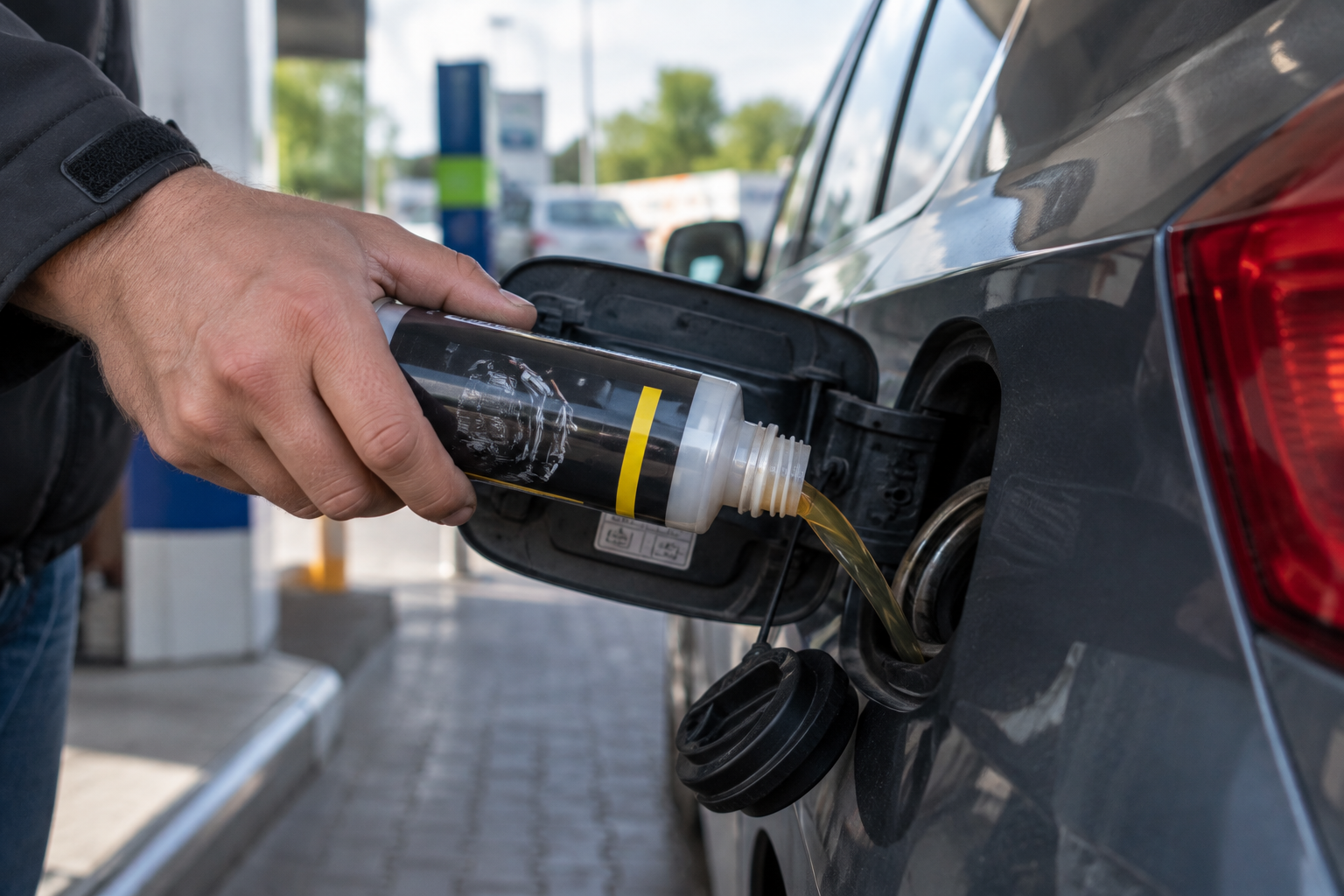
The fuel-additive shelf in a car-parts shop is one of the most interesting places in the entire automotive-chemicals section. Some bottles promise to clean injectors. Others claim to reduce fuel consumption. Still others promise to raise octane, improve diesel cetane, dissolve deposits, make cold starts easier, protect the fuel pump, clean the DPF or simply make an ageing engine run “like new” again.
The price is usually low enough to make the experiment feel harmless. If a bottle costs €8, €12 or €20, while injector repairs may cost hundreds, a very understandable thought appears: why not try it?
Some drivers are then convinced that the engine genuinely runs more smoothly. Others notice absolutely nothing. A third group begins adding something to every second tank “as prevention”, even though the vehicle manufacturer never asked them to. And a fourth group believes that every fuel additive without exception is nothing more than attractive packaging and marketing.
The truth, as usual, is much more interesting than either extreme.
Fuel additives as a technology are absolutely real. Even the fuel you buy at a filling station is not simply “pure petrol” or “pure diesel”. Fuel formulations can contain detergents and other additives designed to control deposits, modify certain fuel characteristics or help the finished fuel meet the required standard.
But that does not mean every universal bottle poured into the tank is automatically beneficial to every engine.
Some vehicle manufacturers allow specific detergent additives under particular conditions. Others explicitly state in their owner's manuals that aftermarket fuel additives and engine treatments are not recommended. Diesel engines can be even more sensitive because in a modern common-rail system the fuel is not only an energy source — it also lubricates and cools extremely precise high-pressure components.
So the right question is not: “Do fuel additives work?”
The right question is: “What exactly is this additive designed to do, what problem am I trying to solve, does the vehicle manufacturer allow it, and is the problem even something chemistry can solve?”
Quick answer
Some fuel additives can help control or reduce certain types of deposits in the fuel system, and detergent chemistry in fuel is a well-established technology. But an additive cannot repair a mechanically damaged injector, worn high-pressure pump, failed ignition coil, vacuum leak, low compression or faulty sensor. A cleaner poured into the tank of a direct-injection petrol engine also cannot wash the backs of the intake valves because fuel does not flow across them. Octane, cetane, winter and other additives should only be used when they are suitable for the specific vehicle and do not conflict with manufacturer instructions. If the engine already has obvious symptoms, diagnosing the cause is usually more sensible than pouring several different bottles into the tank one after another.
An additive can help when the problem is something chemistry can actually influence. It cannot dissolve mechanical wear and rebuild a damaged component back to new condition.
First of all: additives are already present in the fuel
Before judging a bottle from the shop, it is important to understand one fundamental point. Fuel additives were not invented yesterday morning by an automotive-marketing department.
Detergent additives have been used in petrol for deposit control for decades, and their effectiveness has been studied extensively. In the United States, the EPA has detergent-additive requirements for petrol, while the automaker-backed TOP TIER standard sets more demanding deposit-control requirements than the minimum level.
In laboratory testing conducted by AAA, petrol with a stronger detergent package produced substantially fewer intake-valve deposits under the particular ASTM test procedure than the tested fuel with a more basic detergent package. That is useful evidence that the right detergent chemistry really can influence engine cleanliness.
But that still does not prove that every separately purchased bottle will work equally well. In finished fuel, additive concentration, chemistry, compatibility and testing are controlled together with the fuel itself. A bottle from the shelf is a separate product that you are adding to an already formulated fuel.
This is where the important difference appears between “additives as a technology work” and “this particular bottle will definitely solve my vehicle's problem”.
What kinds of fuel additives are sold?
| Type of additive | What it claims to do | Main limitation |
|---|---|---|
| Injector / fuel-system cleaner | Control or reduce certain deposits | Only helps if deposits are actually part of the problem |
| Octane booster | Increase petrol's resistance to knock | Not a universal power booster; some metallic additives may be prohibited by manufacturers |
| Cetane improver | Change diesel ignition characteristics | Should only be used if suitable for the particular engine and fuel |
| Diesel anti-gel / anti-wax additive | Improve diesel cold-flow behaviour | Winter diesel is already formulated for cold conditions; some manufacturers do not recommend additional additives |
| Fuel stabiliser | Slow fuel degradation during long storage | More relevant to storage situations than normal everyday driving |
| “Water remover” | Help deal with moisture in the fuel system | Water in a modern diesel must be treated seriously; random chemistry does not replace water-separator and fuel-system diagnosis |
| DPF / emissions-system fuel additive | Assist soot treatment or regeneration in certain systems | Cannot repair a failed sensor, thermostat, injector, EGR system or physically damaged filter |
1. Can an injector cleaner really clean injectors?
This is the most popular additive category, and this is where the answer comes closest to a simple “yes” — but with a very important condition.
Fuel-injector operation really can be affected by deposits. Injector openings are extremely small, while modern injection systems control fuel quantity and spray pattern with great precision. If deposits change flow or atomisation, the engine may begin running unevenly, throttle response may deteriorate and other drivability problems may appear.
The ability of detergent chemistry to control deposits is not merely theoretical. Current Hyundai owner information for certain petrol models even states that drivers who do not regularly use high-quality detergent petrol and experience symptoms such as difficult starting or uneven engine operation may use a specified detergent additive under certain conditions.
But the same guidance contains an equally important second message: do not use random fuel-system cleaners that are not approved or specified by the manufacturer.
So even a manufacturer that recognises a potential use for detergent additives is not saying: “Pour in anything with injector cleaner written on the label.”
What can a cleaner not do?
If an injector has an electrical fault, mechanical wear, internal leakage, a damaged nozzle or can no longer seal properly, detergent will not repair it.
The same applies to an engine that jerks because of a failed ignition coil, spark plug, insufficient fuel pressure, vacuum leak or compression problem. In that situation the additive may be perfectly good chemistry — it is simply being used to treat the wrong diagnosis.
If deposits are the cause, an appropriate detergent may help. If a component is worn or damaged, a bottle cannot turn a mechanical failure into a chemical problem.
2. The big trap: a tank additive cannot clean the intake valves of a direct-injection engine
This is one of the most important points in the entire additive discussion because it is exactly where many drivers buy the right type of product for completely the wrong job.
In a conventional port fuel injection, or PFI, petrol engine, the injector sprays fuel into the intake port before the intake valve. The petrol therefore flows across the back of the intake valve, and detergents in the fuel can contribute to keeping that area cleaner.
In a gasoline direct injection, or GDI, engine, the injector is positioned in the combustion chamber and sprays petrol directly into the cylinder. The fuel no longer passes across the back of the intake valve.
SAE technical research describes this distinction very clearly: a direct-injection engine does not have the same fuel “washing” action over the intake valve that exists in a PFI system. Intake-valve deposits can therefore accumulate independently of how effective the detergent package in the tank may be.
Another SAE comparison found that a fuel additive could reduce direct-injection injector and combustion-chamber deposits, while having no significant effect on intake-valve deposits.
If a GDI engine has been diagnosed with deposits specifically on the intake valves, an injector cleaner poured into the tank does not physically wash those deposits. Depending on the engine design and severity of the deposits, a separate intake-system cleaning procedure may be required.
That does not mean high-quality fuel is unimportant in a direct-injection engine. The fuel still passes through the high-pressure system and the injectors themselves. The point is simply to separate injector cleanliness from intake-valve cleanliness.
3. Does an octane booster give you more power?
Another very marketable idea is the “octane booster”. The bottle may feature aggressive graphics, flames, turbochargers and promises of a higher octane number. At first glance the logic seems obvious: higher octane = more powerful fuel = more horsepower.
But octane rating is not a “power number” for petrol. It describes the fuel's resistance to uncontrolled auto-ignition, or knock, under specified conditions.
If an engine is designed for 95-octane petrol and runs normally on it without knock, simply increasing the octane rating does not unlock a magical power mode. An engine designed to take advantage of higher-octane petrol, on the other hand, may use the correct fuel to run its intended ignition strategy.
We already have a separate detailed article on that topic: “95 or 98 Octane Petrol: Does More Expensive Fuel Reduce Consumption and Pay Off?”.
In the context of additives, the more important issue is that not all octane boosters use the same chemistry, and vehicle manufacturers may prohibit particular substances. Ford, for example, warns in current petrol-fuel guidance against fuels containing metallic additives, including manganese compounds, and specifically refers to MMT-type octane additives.
So if your engine requires a higher octane rating, the safer approach is usually to buy fuel of the manufacturer-specified octane grade rather than turn the fuel tank into a home chemistry laboratory.
4. Premium fuel and a cleaning additive are not the same thing
Another common source of confusion is the word “premium”. At different filling stations it can refer to different things: higher octane, an enhanced detergent package or a combination of both.
Octane rating and detergent quality are two separate parameters. Petrol can have a high octane rating, but that alone does not tell you everything about its detergent package. Conversely, a high-quality detergent fuel can also exist in a normal octane grade.
AAA research has emphasised exactly this distinction: fuel grade, meaning octane level, and detergent quality are not the same thing.
For more on more expensive fuels, see “Is Premium Fuel Worth It? When It Helps and When It’s Just Extra Cost”.
5. Cetane additives for diesel: a similar-sounding number with a very different meaning
With petrol we talk about octane rating, while diesel fuel is more commonly associated with cetane number. These are not simple equivalents in the sense that “a higher number always means a better engine”. They describe different properties in fundamentally different combustion processes.
Cetane improvers can alter diesel ignition behaviour, but here again it does not follow that every diesel engine should routinely receive an extra cetane additive.
For a modern diesel, the first priority is to use fuel that meets the standard specified by the vehicle manufacturer. Hyundai diesel guidance, for example, instructs drivers to use commercially available EN 590 or equivalent fuel and not to use additives that have not been approved by the manufacturer. Ford's European documentation follows a similar principle — good-quality EN 590 diesel and no need for random aftermarket additives.
If an engine with specification-compliant fuel starts badly, jerks or runs more noisily than usual, first determine whether the fuel's cetane characteristics are really the problem. Common-rail injector corrections, fuel pressure, compression, glow plugs, temperature sensors and many other factors can produce similar symptoms.
6. Anti-gel additives in winter: does every diesel need one as prevention?
This is an especially relevant category in colder climates. As soon as a severe frost is forecast, diesel drivers begin thinking about wax crystals, the fuel filter and whether an anti-gel additive should be poured into the tank.
At low temperatures, paraffinic components in diesel can crystallise and restrict flow through the fuel filter. This is a real physical process, not a myth. However, diesel sold for the relevant season is already formulated to operate within a specified cold-temperature range.
So the statement “every diesel needs anti-gel in winter” is not correct.
More importantly, some Ford diesel manuals explicitly state that supplementary additives intended to prevent fuel waxing are not recommended. Hyundai likewise places the emphasis on seasonally appropriate diesel fuel and manufacturer-approved products.
If the vehicle manufacturer allows an anti-gel product for the particular application, the specified concentration and usage conditions must be followed. This type of chemistry is generally intended for prevention before a cold-flow problem develops, not as a magical universal cure once the filter has already waxed solid.
7. A diesel “water remover” is not a universal rescue bottle
Water in a fuel system, particularly in a modern diesel, is not something that should be turned into an experiment.
Common-rail high-pressure systems require very clean fuel with the correct lubricating characteristics. Water can encourage corrosion and damage extremely precise components. That is why many diesel vehicles include a water-separation function in the fuel filter and sometimes even a dedicated sensor.
If the vehicle displays a water-in-fuel warning, the correct response is not automatically to buy a bottle labelled “removes water”. The proper procedure is to follow the vehicle's instructions — inspect or drain the water separator, check the filter, assess the contaminated fuel and, if necessary, clean the system.
Adding unapproved chemistry to a modern high-pressure diesel system can create more questions than it solves.
8. DPF cleaning additives: when the real problem is not the DPF itself
DPF additives are a good example of one bottle being used to try to treat a very complicated system.
A diesel particulate filter is designed to regenerate regularly during normal operation. For that to happen, the engine-management system needs to reach the required conditions and several components need to operate correctly.
If regeneration fails because the vehicle spends all its time on very short journeys, that is one situation. If the real cause is a temperature sensor, differential-pressure sensor, EGR fault, thermostat problem, incorrect fuel injection or a physically damaged filter, the situation is completely different.
An additive cannot repair a sensor. It cannot restore a cracked ceramic filter core. It cannot fix an engine that is producing excessive soot because of a faulty injector or another mechanical problem.
That is why the first question with a DPF problem should be why the filter became overloaded, not simply which bottle has “DPF cleaner” printed on the front.
9. Fuel stabiliser: an additive designed for a completely different job
Not every additive is intended to cure poor engine operation. A fuel stabiliser is a good example of a product whose main purpose relates to long-term storage.
Fuel changes over time. Petrol volatility and oxidation processes, together with moisture-related issues in ethanol-containing fuel, can become more relevant to cars, motorcycles, generators and other equipment stored for many months.
But for a vehicle that uses a tank every week and regularly receives fresh fuel, a stabiliser is not the same thing as “daily vitamins for the engine”.
Even in a long-storage situation, the vehicle manufacturer's instructions should come first because the manufacturer may specify fuel composition, tank level or other storage procedures.
10. Can a fuel additive reduce fuel consumption?
This is one of the strongest marketing promises because it turns a €15 bottle into what appears to be a financial investment. If a product promises 5–10% lower fuel consumption, the arithmetic on the label can look fantastic.
But two very different situations need to be separated.
If deposits had already caused the engine to operate less efficiently and an appropriate detergent genuinely restores some of the normal fuel-system performance, fuel economy may return closer to what the healthy engine originally achieved.
That is not the same thing as taking a completely healthy engine and magically improving its thermodynamic efficiency by ten percent with one bottle.
If the trip computer shows 0.4 l/100 km less after an additive was used, that alone proves nothing. Temperature, wind, route, traffic, speed, tyre pressure and even an active DPF regeneration can create a larger difference than the additive itself.
When can trying an injector cleaner be reasonable?
An additive should be treated neither as a miracle nor as a forbidden word. There are circumstances where using one can be perfectly rational.
- The vehicle manufacturer specifies or allows this type of detergent additive.
- There is reasonable suspicion of light fuel-system deposits rather than an obvious mechanical failure.
- The chosen product clearly states that it is intended for the correct fuel type and system.
- The specified concentration is followed rather than assuming that “double the dose cleans twice as well”.
- The additive is not being used to postpone diagnosis for months on an engine that already jerks badly, loses power or stores fault codes.
- The result is evaluated objectively instead of attributing every small change in feel to the bottle.
When is a bottle in the tank almost certainly not the right first repair?
If the vehicle already has a clear technical symptom, an additive should not replace basic diagnosis.
| Symptom | Why an additive alone is not enough |
|---|---|
| Check Engine is flashing and the engine is misfiring badly | An active misfire can damage the catalytic converter; the affected cylinder and real cause must be identified |
| Fuel pressure is below specification | The filter, pump, regulator, sensor and fuel system need to be checked |
| An injector is electrically inoperative | Detergent cannot repair an electrical circuit fault |
| A GDI engine has heavy intake-valve deposits | Fuel from the tank does not contact the back of the valve |
| DPF pressure is excessive and sensor or temperature faults are present | The system fault must be diagnosed and filter condition assessed first |
| A large amount of water or the wrong fuel is found in the tank | The tank and system may need draining rather than chemical masking |
Why do some drivers genuinely feel the engine is better after an additive?
Several explanations are possible, and they are not all placebo.
If light deposits really were present in the fuel system and an appropriate detergent was used, the improvement can be real. Engine operation may become smoother if injector-flow consistency or spray quality improves.
But several other factors often change at the same time. Fresh fuel was added together with the additive. The car went on a longer journey. The engine reached full operating temperature. Ambient temperature changed. The driver is listening more carefully and subconsciously expecting an improvement.
One journey after adding a bottle is therefore not a laboratory test.
Should you add something to every tank as prevention?
If the manufacturer does not specify such a procedure, there is little reason to invent your own permanent additive-maintenance schedule.
Remember that fuel chemistry is a question of concentration. The correct dose is the dose the product was designed for, not “more means cleaner”. Mixing several additives is not automatically clever either, because you do not know how one product's chemistry interacts with another product and with the additive package already present in the fuel.
Hyundai documentation that allows a particular detergent additive in specific situations also clearly warns against using other inappropriate products. Ford, meanwhile, does not recommend aftermarket additives in many current European models.
That illustrates the correct principle very well: the owner's manual matters more than the marketing on the bottle.
5 questions to ask before pouring any additive into the tank
- What am I actually trying to solve? If the answer is only “I want the engine to be healthier”, that is not yet a technical diagnosis.
- Does the manufacturer allow this type of product? This is especially important for modern gasoline direct-injection and common-rail diesel systems.
- Could the problem genuinely be a deposit? A cleaner cannot repair an electrical, mechanical or compression fault.
- Is the product intended for my exact fuel type and system? Petrol, diesel, GDI and common rail are not the same thing.
- What happens if it has no effect? If diagnosis is the next step anyway, it may be cheaper to start with diagnosis immediately.
Mini test: is an additive a logical first step here?
An older petrol car runs slightly unevenly, there are no fault codes and the manufacturer allows a specific detergent additive
A suitable detergent product at the specified concentration may be a reasonable, relatively low-risk experiment if there is reason to suspect light deposits. If the symptom remains, move on to proper diagnosis rather than repeatedly increasing the dose.
A workshop has used a borescope to confirm heavy intake-valve deposits on a GDI petrol engine
An injector cleaner added to the tank is not a direct solution because direct-injection fuel does not flow over the backs of the intake valves. A cleaning method appropriate to the specific engine is required.
A diesel displays a “water in fuel” warning in winter
Do not automatically pour in a “water remover”. Follow the vehicle instructions — inspect the water separator, fuel filter and fuel quality. Water in a modern common-rail system is not a symptom that should simply be chemically masked.
The Check Engine light is flashing, the engine is jerking badly and there is a misfire code on one cylinder
Diagnose the specific cylinder first. The cause may be a spark plug, ignition coil, injector, compression problem or something else. An active misfire should not be treated for weeks with random fuel chemistry.
The car is designed for 95-octane petrol, but you want to add an octane booster to gain more power
A higher octane rating does not automatically create more energy in an engine that cannot use it. The particular additive chemistry may also not be permitted by the manufacturer. If an engine genuinely requires higher octane, use the fuel grade specified by the manufacturer.
After one detergent treatment, the engine seems quieter and the trip computer shows 0.3 l/100 km less
That does not yet prove a 0.3 l/100 km fuel-economy gain. Several comparable driving cycles would be needed because traffic, temperature, wind, route and driving style can create an equally large or larger difference.
Myths and facts
| Claim | Myth or fact? | Explanation |
|---|---|---|
| All fuel additives are just marketing. | Myth | The effect of detergent chemistry on deposit control is technically real, but that does not mean every aftermarket product is suitable for every engine. |
| An injector cleaner can help if injector operation is being affected by certain deposits. | Fact | Suitable detergent chemistry can control deposits, but it cannot repair a mechanically damaged injector. |
| A cleaner poured into a GDI engine's fuel tank washes the backs of the intake valves. | Myth | In a direct-injection engine, petrol is sprayed into the cylinder and does not wash the backs of the intake valves. |
| Higher octane automatically means more power. | Myth | A benefit is possible only if the particular engine is designed to take advantage of the higher octane rating. |
| Vehicle manufacturers do not all take the same position on aftermarket additives. | Fact | Some specify a particular product in certain conditions, while others do not recommend aftermarket additives. |
| Double the dose of cleaner will clean twice as well. | Myth | Products are designed for a particular concentration; overdosing is not a performance guarantee and may conflict with the instructions. |
| An additive can mask a symptom without fixing the actual fault. | Fact | If the real cause is a sensor, pump, ignition fault, compression problem or another component, fuel chemistry does not repair it. |
Frequently asked questions
Is it worth adding injector cleaner to petrol?
It can be reasonable if the vehicle manufacturer allows the detergent product and the problem may genuinely be related to light fuel-system deposits. If the engine is jerking badly, storing fault codes or showing other serious symptoms, diagnosis should come first.
Can a fuel additive clean a clogged injector?
If the flow problem is caused by deposits, an appropriate detergent may help in some cases. If the injector is mechanically or electrically damaged, leaking heavily or has a physically damaged nozzle, an additive cannot replace repair.
Does injector cleaner help with intake-valve carbon on a GDI engine?
Not directly. In a GDI system, petrol is injected straight into the cylinder and does not flow over the back of the intake valve. A detergent in the fuel therefore does not physically wash that area.
Can an octane booster turn 95-octane petrol into 98?
It depends on the particular product, dosage, amount of fuel in the tank and starting octane rating. The manufacturer may also prohibit the chemistry used by a particular booster. If the car requires 98-octane petrol, the safest solution is to fill with fuel that already meets the manufacturer's requirement.
Does every diesel need anti-gel in winter?
No. Seasonally appropriate diesel is already formulated for cold conditions, and some vehicle manufacturers explicitly do not recommend additional anti-wax additives. Check the vehicle manual first and use fuel that meets the required standard.
Can a fuel additive reduce fuel consumption?
If deposits had already reduced engine performance and an appropriate cleaner reduces those deposits, fuel efficiency may return closer to normal. But there is no reason to expect a large automatic reduction in fuel consumption from one bottle in a healthy engine.
Can different fuel additives be mixed together?
Without clear compatibility information from the vehicle or product manufacturer, it is not a good general practice. Fuel already contains its own additive package, while aftermarket products are designed for specific concentrations. “More different chemistry means better protection” is not a technical rule.
What matters more — good fuel or regular cleaning additives?
For everyday use, the first priority is high-quality fuel that meets the vehicle manufacturer's specification and the relevant standard. A separate additive is a specific tool for a specific situation, not a compulsory replacement for good fuel.
Conclusion
Fuel additives are an interesting subject because the two most popular extremes are both too simplistic.
It is not correct to say that every additive is a scam. Detergent chemistry in fuel is a real technology, and the ability of good detergents to control deposits has been studied in standardised tests and across the automotive industry. Some vehicle manufacturers even specify the use of particular detergent additives under certain conditions.
But it is equally wrong to believe there is a correct bottle for every problem.
Injector cleaner can influence deposits, but it cannot repair an electrically failed injector. An octane additive can alter the fuel's knock resistance, but it does not make an ordinary engine more powerful simply because the number becomes higher. Anti-gel can be a specific tool in certain conditions, but winter diesel is already seasonally formulated and some manufacturers do not recommend supplementary additives.
The gasoline direct-injection issue is especially important. A fuel-system detergent may still be useful to the injector itself, but the backs of the intake valves live in a different environment — petrol does not flow over them. If thick deposits form there, the chemistry in the fuel tank simply does not physically reach that surface.
So before buying any bottle, ask yourself one very simple question: “What exactly am I trying to repair?”
If the answer is “possible injector deposits” and the manufacturer allows a suitable detergent product, trying one may be reasonable. If the answer is only “the engine is running strangely”, diagnosis should come first.
Because that is where the most expensive additive habit begins: not the €15 spent on the bottle itself, but the real fault being postponed for months while five different products are tried one after another.
If the car is jerking because of an ignition coil, an additive will not help. If a common-rail pump cannot build the required pressure, a cetane improver will not rebuild it. If DPF regeneration is being blocked by a failed temperature sensor, a DPF additive will not repair the sensor. If the intake valves of a GDI engine are covered in heavy deposits, injector cleaner in the tank will never touch them.
The best principle is therefore very simple: good fuel first, manufacturer requirements second, and an additive only when you understand exactly what it is supposed to do.
Used that way, a fuel additive becomes what it should be — a specific tool for a specific job, rather than a liquid lottery ticket bought in the hope that it will repair the entire engine.
Driver's short takeaway: some fuel additives genuinely can be useful, especially detergent products for deposit control, but only in the correct system and for the correct problem. Check the vehicle manufacturer's instructions before using any additive. Do not use a bottle as a substitute for diagnosis. On a GDI engine, a tank additive cannot clean the backs of the intake valves, an octane booster does not automatically create more power, and random additives may conflict with the requirements of a modern diesel. If the engine already jerks badly, loses power, stores faults or has fuel-pressure problems, find the fault first and only then decide whether chemistry has a role.
Sources and technical note
The technical information in this article was checked against current US EPA information on certified petrol detergent additives; AAA laboratory research into the effect of different detergent packages on engine deposits; current Hyundai owner documentation that allows manufacturer-approved detergent additives in certain situations while warning against unsuitable alternatives; Ford fuel requirements for current European models, where aftermarket fuel additives and engine treatments are often not recommended and certain metallic petrol additives may be prohibited; Hyundai and Ford diesel guidance specifying fuel meeting EN 590 and warning against unapproved additives; and SAE technical research into gasoline direct-injection engines showing that fuel in a GDI layout does not wash the backs of the intake valves and therefore detergent added to the fuel cannot directly clean that area. The exact permitted products, concentrations, fuel standard and additive procedures must always be taken from the technical documentation for the specific vehicle.