
 LV
 EN
 RU
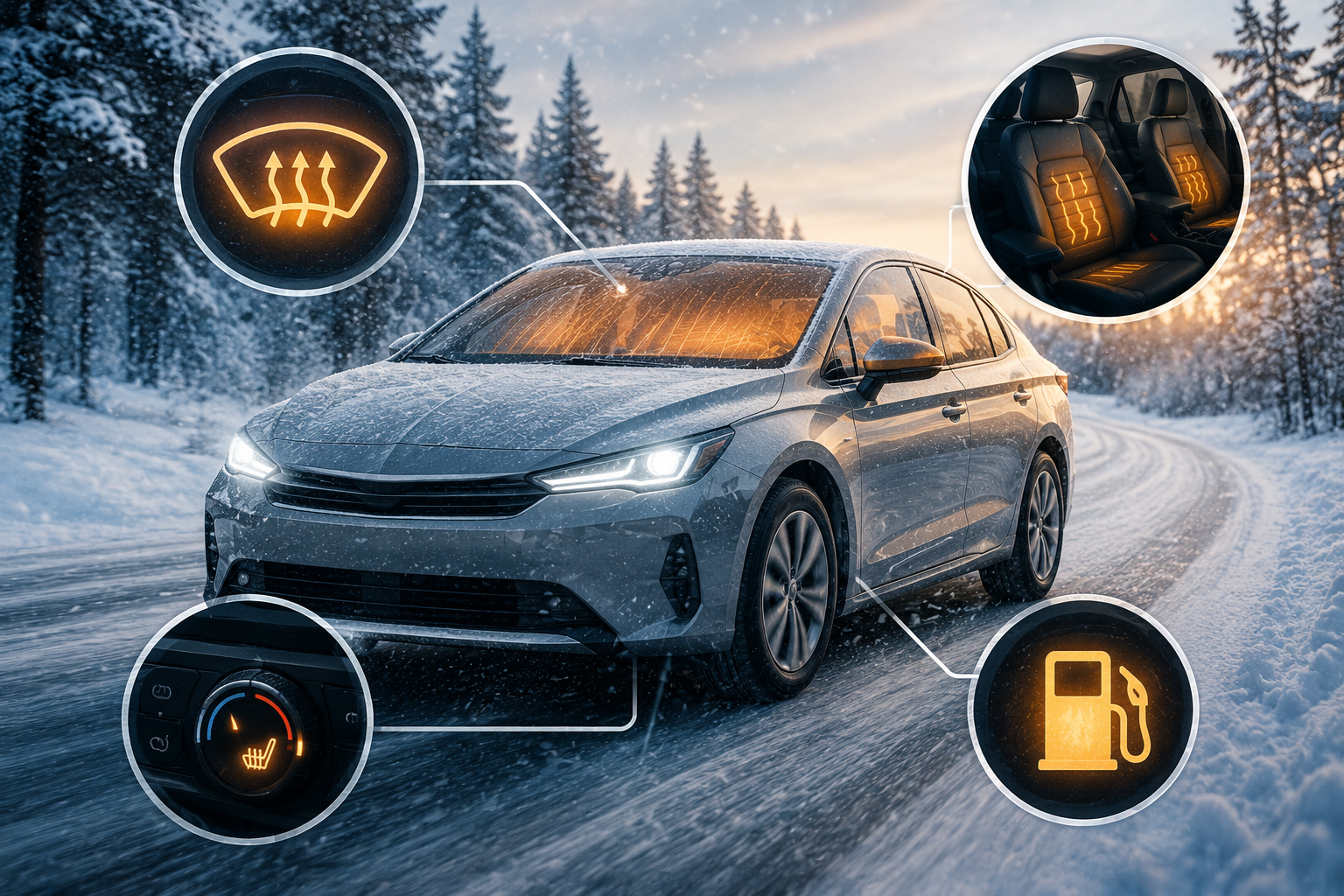
A winter morning. It is freezing outside, the windscreen is fogged or covered in ice, the mirrors are damp, the cabin is cold, and the steering wheel and seat feel almost frozen. The driver starts the car and switches on the blower, windscreen defrosting, rear-window heating, mirror heating, heated seats and sometimes the heated steering wheel almost at the same time.
This raises a logical question: how much fuel does all of this use? Should heated seats be switched off to save money? Does running the blower at maximum speed noticeably increase consumption? And why does the petrol engine in some hybrids continue running in winter even when the battery still contains energy?
The answer is not as simple as saying that every illuminated button uses fuel. Different functions use different energy sources. In a conventional petrol or diesel car, cabin heat is often taken from heat produced by the engine, while seat, window and mirror heating use electricity. In a hybrid, demand for cabin heat may cause the petrol engine to run for longer. In an electric car, cabin heating and all electrically heated features draw energy from the traction battery.
That is why the same button can have a very different effect in different vehicles. In this article, we explain without exaggeration where energy consumption actually comes from, where the effect is relatively small and where saving is not worthwhile because visibility and safety are always more important than a few saved cents.
The driver’s short takeaway right at the start: do not switch off window defrosting or heating needed for safe visibility just to save energy. The safest savings come from avoiding excessive cabin temperatures and reducing functions once they are no longer needed.
Quick answer: which winter system has the greatest effect?
The greatest effect usually comes not from one individual button, but from the total heating and electrical load.
In petrol and diesel cars, cold engines, longer warm-up times, short trips and the combined load of electrical equipment are among the main reasons for higher winter fuel consumption.
In a hybrid, cabin heating may cause the combustion engine to start or keep running for longer, reducing the amount of electric-only driving.
In an electric car, heating the whole cabin usually requires more energy than heating only the seat and steering wheel, which can warm the occupants directly.
This does not mean that the cabin should be left cold. A sensible approach is to use the necessary functions more intensively at the start, then reduce them once the windows are clear and the cabin has reached a comfortable temperature. There is no need to keep every heating function at maximum for the entire journey.
Where does the heat in a car come from?
To understand winter consumption, you first need to know where a particular vehicle gets its heat. This is where petrol, diesel, hybrid and electric cars can differ significantly.
| Vehicle type | Where does cabin heat come from? | What happens in winter? | Practical takeaway |
|---|---|---|---|
| Petrol car | Mainly from engine and coolant heat | Warm air appears gradually while the engine heats up | Begin driving gently and allow the engine to warm while moving |
| Diesel car | From engine heat, sometimes supported by an electric or fuel-powered heater | The engine may warm up more slowly under light load | Short urban journeys can be especially inefficient in winter |
| Self-charging hybrid | Depending on design, from engine heat and electric systems | Demand for heat may cause the petrol engine to run longer | A moderate cabin temperature may help maintain efficiency |
| Plug-in hybrid | From the battery, heat pump, electric heater or engine, depending on the model | Heating may reduce electric range or cause the engine to start | Preheating while connected to a charger can be especially useful |
| Electric car | From the high-voltage battery through a heat pump or electric resistance heater | Cabin heating directly reduces the energy available for driving | Targeted heating and preheating can help preserve range |
Electricity in petrol and diesel cars is not “free”
In a conventional car, heated seats, the blower, heated windows, lights and other electrical equipment receive energy from the vehicle’s electrical system. While the engine is running, electricity is mainly produced by the alternator. To generate more electricity, the alternator requires mechanical energy from the engine.
Put simply, the greater the electrical load, the more work the alternator needs to do, and part of that work is ultimately paid for with fuel. However, the effect should not be exaggerated. One heated seat on its own will not normally create a dramatic increase in fuel consumption.
The combined effect becomes more noticeable when many systems operate simultaneously: a powerful cabin blower, windscreen defrosting, rear-window heating, mirror heating, both heated seats, a heated steering wheel, headlights and other systems. On a short winter journey, this is combined with a cold engine and a battery that needs to recover the energy used during starting.
A useful way to think about it:
One small electrical device is usually not a major problem.
Many devices operating together create a greater combined load.
A cold engine, short journey and maximum electrical load are the least efficient combination.
Cabin heating: does a higher temperature mean higher consumption?
Once a petrol or diesel engine has warmed up, part of the heat used for the cabin comes from energy that would otherwise need to be removed through the cooling system. That is why it would be misleading to claim that every additional degree on the climate-control display directly equals a specific amount of fuel.
At the beginning of a cold journey, however, the situation is different. The engine has not reached operating temperature, the cabin needs heat, the windows need defrosting and some vehicles may also activate an additional electric heater. In a hybrid, demand for heat may prevent the petrol engine from switching off as often as it would in warmer weather.
In an electric car, the energy needed to heat the whole cabin comes from the battery. A very high temperature setting and prolonged use of the blower at maximum speed can therefore noticeably reduce range, particularly on short trips and in severe cold.
Practical thought: there is no need to drive in a freezing cabin, but the interior does not need to become a sauna either. A moderate temperature combined with heated seats and a heated steering wheel can often provide comfort with lower overall energy use.
Heated seats: targeted comfort with a relatively localised load
Heated seats warm the occupant directly instead of first trying to warm all the air, glass, dashboard and interior surfaces. This is why they can create a feeling of comfort very quickly.
In a petrol or diesel car, heated seats create an additional electrical load, but there is little reason to avoid using them solely for fuel economy. A more sensible approach is to use a higher setting at first, then lower or switch it off once the seat is warm.
In a hybrid or electric car, heated seats can help occupants feel warm while allowing a lower cabin temperature. This can be more energy-efficient than continuously heating the entire interior to a very high temperature.
A practical winter principle: warm the person first instead of immediately trying to heat every litre of air in the cabin.
Heated steering wheel: a small feature with a big comfort effect
A heated steering wheel follows the same general idea as heated seats. It warms the surface the driver is touching directly. When the driver’s hands are warm, the cabin can feel more comfortable even before the air temperature has fully risen.
From a practical perspective, this is not a feature that needs to be demonised. It is often more sensible to use steering-wheel heating at the beginning of a journey and keep the cabin temperature moderate than to immediately select maximum heat and blower speed.
The result naturally depends on the vehicle and the driver’s comfort preferences. Nevertheless, localised heating is often a useful efficiency tool rather than unnecessary luxury.
Rear-window and mirror heating
Rear-window heating uses electrical elements to remove fog, moisture or a thin layer of ice. In many cars, the heated exterior mirrors activate at the same time.
These functions are important for visibility. They should not be switched off while the glass or mirrors are still obscured. Once visibility has been restored, however, continued operation may no longer be necessary. Many modern vehicles switch these systems off automatically after a set period.
If your car does not switch them off automatically, develop a simple habit: after a few minutes, check the rear window and mirrors. If they are clear, the heating can be turned off. This is a sensible saving that does not compromise safety.
Important: do not switch off rear-window or mirror heating merely to save energy if full visibility has not yet been restored. Safe visibility is always more important than a small electrical saving.
Windscreen defrosting: more than just warm air
The windscreen defrosting mode normally directs a strong airflow towards the glass. Depending on the vehicle, the system may increase blower speed, activate the air-conditioning compressor to dry the air, use an auxiliary heater or activate an electrically heated windscreen.
This means that the defrosting mode can be one of the most energy-intensive short-term settings. That is not a reason to avoid using it. A fogged or icy windscreen is a direct safety risk.
The correct approach is to use the mode for as long as necessary to restore visibility, rather than leaving it at maximum throughout the journey. Once the glass is clear, the climate system can be returned to a calmer automatic or manual setting.
A safe and efficient sequence:
1. Restore full visibility first.
2. Remove snow and ice mechanically instead of relying only on heat.
3. Reduce blower intensity once the glass is clear.
4. Keep the windscreen dry with a moderate and stable airflow.
Does air conditioning increase consumption in winter?
In many vehicles, air conditioning operates in winter not to cool the cabin, but to dry the air and remove window fog more quickly. That is why the A/C indicator may be illuminated even when the outside temperature is low.
Operating the air-conditioning compressor requires energy, but switching it off automatically is not always a smart saving. If the windows begin to fog, the blower may need to work harder, visibility worsens and the journey becomes less safe.
Modern climate-control systems often decide for themselves when the compressor is actually needed. In everyday use, it is generally sensible to allow the automatic mode to work if it keeps the windows clear and the cabin comfortable. Reducing the load manually is worthwhile only when you understand how the system in your particular car behaves.
Why do car windows fog so quickly in winter?
Moisture accumulates inside the cabin from passengers’ breath, wet clothing, footwear, snow and damp floor mats. When warm, humid air meets cold glass, condensation forms. Clean windows, dry mats, fresh-air ventilation and a properly functioning climate system help reduce fogging.
Is it better to use air recirculation continuously in winter?
Temporary recirculation can help the cabin warm more quickly, but prolonged use may allow moisture to build up and cause the windows to fog. It is better to use recirculation briefly or allow the automatic climate system to manage it.
The blower: does maximum speed use a lot?
The blower motor uses electricity, and a higher speed generally means a higher electrical load. In practice, however, the greater issue is usually not a few minutes at maximum speed, but keeping several systems at maximum for the entire journey.
At the start of a journey, strong airflow may be necessary to clear the windscreen quickly. Once that has been done, the blower can be reduced. Automatic climate control often does this itself by operating intensively at first and then moving to a quieter setting.
There is little benefit in limiting blower speed at the beginning and waiting much longer for safe visibility. It is generally better to complete the necessary job quickly and then reduce the system’s intensity.
Which systems have the greatest practical effect?
| Function | Relative effect | When is it needed? | How to use it wisely |
|---|---|---|---|
| Intensive whole-cabin heating | Medium to high, especially in hybrids and EVs | For warming the cabin and keeping windows clear | Reduce temperature and blower speed after warming up |
| Windscreen defrosting | Can be high for a short time | When the glass is iced or fogged | Use fully until visibility is safe |
| Rear-window and mirror heating | Moderate electrical load | For removing moisture, frost and ice | Switch off once visibility is fully restored |
| Heated seats | Low to moderate | For rapid personal comfort | Use a higher level initially, then reduce it |
| Heated steering wheel | Relatively localised | For quickly warming the driver’s hands | Use at the beginning and reduce when no longer needed |
| Cabin blower | Depends on speed and operating time | For air circulation and keeping the windows clear | Use intensively at first, then moderately |
The effects shown in the table are relative rather than universal measurements. Exact consumption depends on the vehicle, equipment, outside temperature, journey duration, battery condition and climate-system design.
Why can one exact figure not be given in litres?
Drivers often want one simple answer, such as how many litres per 100 km heated seats or rear-window heating use. However, presenting one universal figure would not be professionally accurate.
One car may use a traditional alternator, while another has intelligent energy management that charges the battery more heavily during deceleration. In one hybrid, a demand for heat may start the engine, while another relies more heavily on an electric heater or heat pump. The efficiency of an electric car’s heat pump also changes with outside temperature.
Journey length is also extremely important. Five minutes of intensive heating on a three-kilometre trip represents a much larger share of total energy consumption than the same five minutes on a 100-kilometre journey.
A more accurate way to evaluate the effect:
Consider journey duration as well as l/100 km.
Compare the same route at a similar outside temperature.
Record which heating systems were operating.
Draw conclusions after several journeys, not one cold morning.
Practical example: two winter-morning scenarios
| Driver | What they do | Result |
|---|---|---|
| Driver A | Starts the car, idles for a long time and keeps maximum temperature, blower speed and all heating functions on throughout the journey | Greater total load, a longer inefficient warm-up phase and unnecessary operation after the cabin is already warm |
| Driver B | Removes snow and ice, uses the necessary defrosting functions, begins driving gently, uses seat heating and reduces the load once visibility is restored | Reaches an efficient operating condition sooner while maintaining visibility and comfort |
The second driver is not forced to remain cold. Each function is simply used for as long as it serves a practical purpose. This is a more professional approach than either extreme: switching everything off or leaving everything at maximum for the whole journey.
Petrol cars: what should you pay attention to?
A petrol engine generally warms up relatively quickly, but on short winter journeys it may still fail to reach its most efficient operating temperature. If a trip lasts only a few minutes, a significant share of fuel is used during the cold-start and warm-up phase.
Use cabin heating as needed, but do not assume that prolonged idling is the most efficient way to warm the whole vehicle. Once the windows are clear, it is usually more sensible to begin driving gently without placing heavy demands on the cold engine.
After the cabin and windows are comfortable, check whether rear-window heating and maximum blower speed are still necessary. This is often the point at which unnecessary load can be reduced.
Diesel cars: why can the cabin warm more slowly?
A diesel engine may produce less surplus heat under light load, so the cabin can sometimes warm more slowly than in a comparable petrol car. Some models use additional electric heaters or fuel-powered auxiliary heating systems, which improve comfort but also consume energy or fuel.
A regular pattern of short journeys can be especially inefficient for a diesel: cold start, maximum heating, a few kilometres of driving and engine shutdown before it has fully warmed. In this situation, higher consumption is caused not only by electrical systems, but by the structure of the whole journey.
When possible, combine several short tasks into one longer trip. This will usually have a greater effect than switching off heated seats for a few minutes.
Hybrids: why can heating start the petrol engine?
In winter, a hybrid driver may notice that the petrol engine operates more often even when the battery is not empty. One possible reason is the thermal demand of the cabin and the engine itself. The system may keep the engine running to provide heat or reach the required operating temperature.
A very high cabin temperature can therefore reduce the amount of time in which the hybrid can switch the engine off and rely on electric drive. Heated seats and a heated steering wheel can be especially useful here: the occupants feel warm without needing to raise the temperature of the whole cabin as much.
This does not mean that heating should be switched off in a hybrid. Comfort, clear windows and safety remain important. It is simply worth avoiding an unnecessarily high temperature and prolonged maximum operation when they are no longer needed.
A hybrid winter strategy: use cabin heating for visibility and comfort, but support it with heated seats and steering-wheel heating. After the cabin has warmed, reduce the temperature by one or two steps and observe whether the petrol engine switches off more often.
Electric cars: heating directly affects range
An electric car does not have a combustion engine producing a large amount of waste heat that can simply be redirected into the cabin. Heat has to be produced using electricity. Depending on the model, this is done with a heat pump or an electric resistance heater.
Cabin heating can therefore account for a significant share of winter energy consumption in an electric car. The effect may appear particularly large on short journeys because the cold cabin has to be heated again each time.
Preheating while the vehicle is still connected to a charger can be very useful. In that situation, part of the energy required to warm the cabin comes from the electricity supply rather than from energy stored for driving.
Once driving, a moderate cabin temperature can be combined with heated seats and steering-wheel heating. This does not mean sacrificing comfort, but using heat in a more targeted way.
Does a heat pump completely solve winter energy consumption?
No. A heat pump can generally use energy more efficiently than a simple resistance heater, but its efficiency depends on outside temperature and the design of the system. In severe cold, additional electric heating may still be required.
Mini test: are you using winter heating sensibly?
Answer these questions honestly. The aim is not to prove that heating is bad. The aim is to identify whether any system regularly operates for longer than necessary.
Winter comfort mini test:
1. Does rear-window heating remain on after the glass is already clear?
2. Do you keep the cabin temperature at maximum throughout the journey?
3. Does the blower continue operating at maximum after the windows have cleared?
4. Do you regularly idle the car for a long time before driving?
5. Are there damp mats or wet items inside the cabin that encourage window fogging?
If you answered “yes” to at least 3 questions, you may be able to reduce winter consumption without losing comfort or safe visibility.
7-day experiment: comfort without unnecessary load
To understand how your own car behaves, try a simple experiment. Do not attempt to drive in discomfort. Change only one habit per day and observe how it affects comfort, visibility and consumption.
| Day | What to try | What to record |
|---|---|---|
| Day 1 | Drive as usual | Temperature, route, consumption and active systems |
| Day 2 | Remove snow and ice more thoroughly before driving | How quickly was visibility restored? |
| Day 3 | Reduce blower speed once the windows are clear | Did the windows remain clear? |
| Day 4 | Use heated seats with a more moderate cabin temperature | Did comfort change? |
| Day 5 | Switch off rear-window heating as soon as the glass is clear | Did visibility remain good? |
| Day 6 | Combine several short journeys into one | Average consumption and engine warm-up behaviour |
| Day 7 | Compare the results with Day 1 | Which habits provided the best balance? |
Compare only similar journeys. Differences in temperature, snow, wind, traffic and route can substantially change consumption. One day is not a laboratory test, but one week can reveal highly practical habits.
The experiment’s main rule: never reduce visibility or the driver’s ability to control the vehicle safely. If the windscreen begins to fog, immediately increase airflow or activate the defrosting mode.
Myths and facts about car heating in winter
| Myth | Fact | What does it mean in practice? |
|---|---|---|
| Heated seats greatly increase fuel consumption | They create a load but are usually not the biggest source of winter consumption | Use them for comfort and reduce the level once warm |
| Cabin heat in a conventional car is completely free | Engine heat is used after warm-up, but cold starts and some systems create additional load | The effect is greatest at the beginning and on short journeys |
| Air conditioning should always be switched off in winter | It can dry the air and help clear the windows | Do not sacrifice visibility for a small saving |
| The longer the car idles to warm up, the more economical the journey will be | Idling uses fuel without increasing distance travelled | Once visibility is safe, begin driving gently |
| In an electric car, heated seats are worse than cabin heating | Localised heating can be a more efficient way to provide comfort | Combine moderate cabin heat with targeted heating |
Common winter-morning mistakes
Avoid these habits:
• expecting heating to completely replace the mechanical removal of snow and ice;
• keeping maximum defrosting mode active for the entire journey;
• using recirculation for a long time and then wondering why the windows fog;
• automatically switching off air conditioning without considering cabin humidity;
• idling for a long time even though the windows are clear and driving can begin;
• driving with inadequately cleared windows or mirrors in the name of saving energy.
A simple winter-morning action plan
A sensible sequence before driving:
1. Remove snow from the roof, windows, lights and number plates.
2. Mechanically remove as much ice as possible without damaging the glass.
3. Activate windscreen defrosting and the necessary heated-window functions.
4. Use heated seats and steering-wheel heating for rapid personal comfort.
5. Once visibility is completely safe, begin driving gently.
6. Reduce the blower and local heating after the windows and cabin have warmed.
7. Maintain a moderate temperature rather than maximum heat.
When can increased consumption indicate a technical problem?
Fuel or energy consumption naturally increases in winter, but a sudden or unusual increase should not automatically be blamed on heating. Possible causes include low tyre pressure, an ageing 12-volt battery, a thermostat fault, an engine that does not warm correctly, a malfunctioning climate system or another technical problem.
If the cabin warms unusually slowly, coolant temperature falls while driving, the windows continually fog, the blower operates weakly or electrical-system warnings appear, the vehicle should be inspected.
Unusually high winter energy consumption in a hybrid or electric car may also be linked to tyre pressure, battery temperature, climate-system operation, software settings or a technical fault. Conclusions are best made after comparing several similar journeys.
Can an ageing 12V battery affect winter comfort systems?
Yes. In cold weather, a weakened battery may struggle to provide stable power and reliable starting. The vehicle’s energy-management system may limit some comfort functions, while the alternator may need to restore more energy after the engine starts.
Conclusion: winter comfort is not the enemy when used wisely
Cabin heating, window defrosting, heated seats and a heated steering wheel are not features that should be abandoned in the name of efficiency. They improve comfort, visibility and, in some cases, safety. The problem is not switching them on, but leaving them at maximum after they have already completed their job.
In a conventional petrol or diesel car, electrical load ultimately requires energy from the engine. In a hybrid, demand for cabin heat may reduce opportunities for electric-only driving. In an electric car, heating directly uses battery energy. In every case, however, the professional approach is balance rather than an extreme.
First ensure that the windows and mirrors are completely clear. Then warm the occupants with heated seats and steering-wheel heating. Begin driving gently. Once the cabin is comfortable, reduce the temperature, blower speed and heating functions that are no longer needed. This sequence helps preserve both safety and sensible energy consumption.
The driver’s final takeaway: in winter, do not save energy at the expense of visibility. Save it by avoiding unnecessary heat and switching off functions once they have completed their job.