
 LV
 EN
 RU
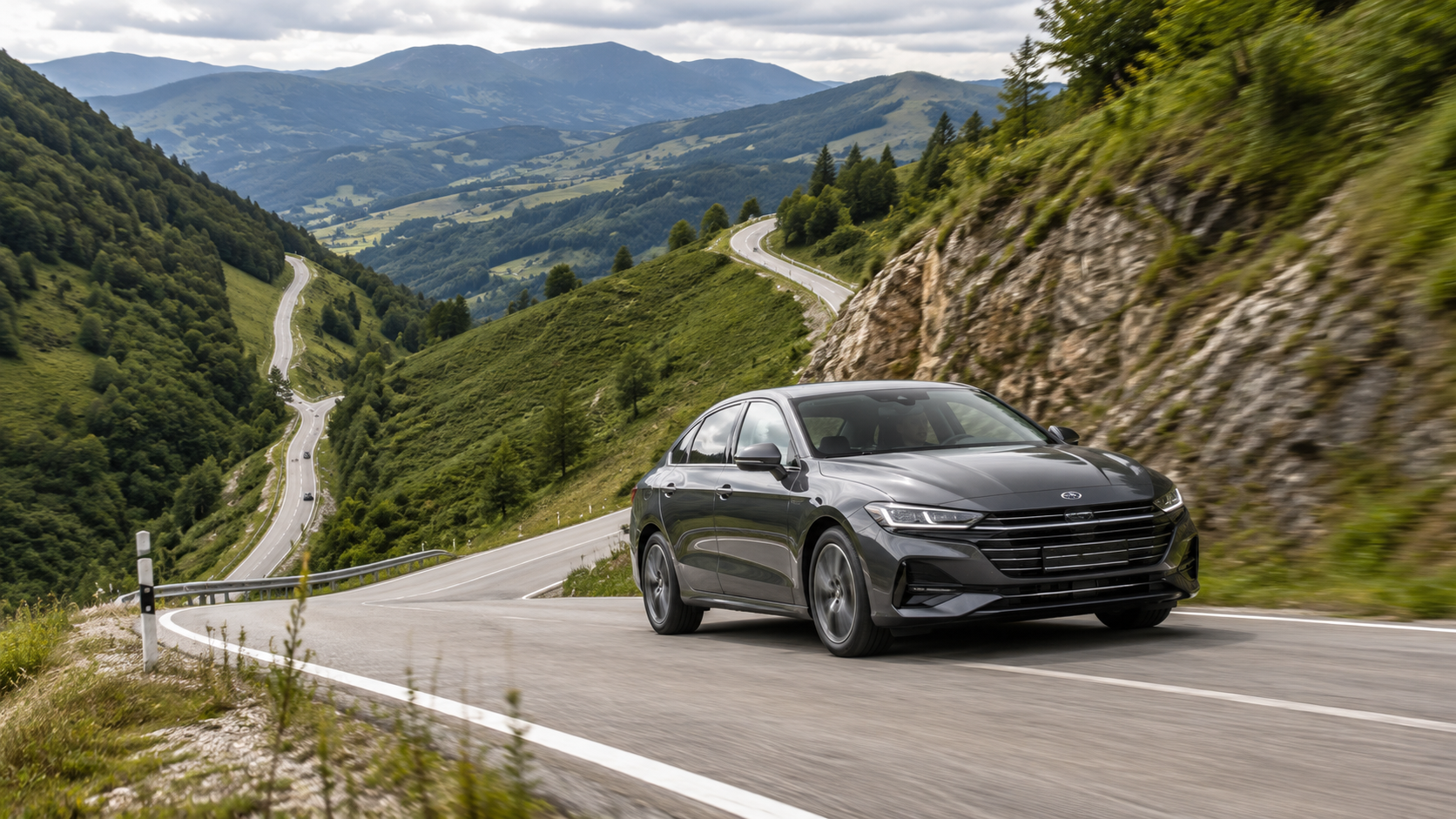
The trip computer’s instantaneous consumption display shows 18, 25 or even 30 l/100 km. The accelerator is not pressed to the floor, the vehicle is not overloaded and the speed seems perfectly normal. The only difference is that the road is heading uphill.
A few minutes later, the descent begins. Instantaneous consumption drops to zero, creating the impression that the downhill section will immediately return everything spent on the climb. Yet at the end of the journey, average consumption is still higher than on a flat route.
This is not a trip-computer trick. When travelling uphill, the vehicle needs energy to lift its mass. During the descent, part of that energy becomes motion, but not all of it can be used productively. Some is lost to aerodynamic and rolling resistance, some becomes brake heat, while hybrids and electric vehicles recover only a portion into the battery.
The effect of terrain becomes even greater when the route includes bends, speed changes, heavy cargo, a trailer, headwinds or a driver determined to maintain exactly the same speed on every climb.

The driver’s short takeaway right at the start: uphill driving is affected most by vehicle mass and elevation gain, while the result on a descent depends on how much energy can be preserved instead of converted into brake heat.
Quick answer: does a hilly road increase consumption?
Usually yes, especially on a route with many repeated climbs.
When travelling uphill, the vehicle must overcome gravity in addition to its normal resistance.
The heavier the vehicle and the greater the elevation gain, the more energy is required.
A descent does not fully compensate for the climb because energy is lost in the tyres, air, transmission and brakes.
Hybrids and electric vehicles can recover part of the energy, but regenerative braking is not perfectly efficient.
A long, moderate climb may be more economical than a shorter road containing many steep hills, bends and speed changes.
Why does uphill driving require so much energy?
On a flat motorway, the engine mainly needs to overcome aerodynamic drag, tyre rolling resistance and transmission losses. On a climb, another major opponent joins the list: gravity.
To lift a vehicle to a greater height, its potential energy must increase. The required energy depends on three values: vehicle mass, gravity and elevation gain.
Simplified physics formula:
Potential energy = mass × gravitational acceleration × elevation gain.
E = m × g × h
The heavier the vehicle and the higher the climb, the more energy must be supplied regardless of the powertrain type.
The formula applies equally to petrol, diesel, hybrid and electric vehicles. What differs is how efficiently each powertrain converts fuel or battery energy into useful motion.
What does a road gradient percentage mean?
A road sign showing 10% does not mean a 10-degree angle. The percentage indicates how many metres the road rises or falls for every 100 horizontal metres travelled.

Examples:
3% gradient = approximately 3 metres of elevation gain per 100 metres;
6% gradient = approximately 6 metres per 100 metres;
10% gradient = approximately 10 metres per 100 metres;
15% gradient = approximately 15 metres per 100 metres.
If a 10% climb continues for one horizontal kilometre, the elevation gain is approximately 100 metres. A five-kilometre climb averaging 10% would theoretically gain around 500 metres.
| Gradient | Elevation change per kilometre | How it feels to the driver | Effect on the vehicle |
|---|---|---|---|
| 2% | Approximately 20 m | A gentle climb that may be barely noticeable | A small increase in required power |
| 5% | Approximately 50 m | A clearly noticeable climb | The transmission may shift down |
| 8% | Approximately 80 m | A steep road | Noticeably higher engine load |
| 10% | Approximately 100 m | A very pronounced climb or descent | Requires a suitable gear and speed |
| 15% | Approximately 150 m | An extremely steep section | Heavy load on the engine, transmission and brakes |
Practical energy calculation: a 1,500 kg vehicle climbs 500 metres
Assume a vehicle weighs 1,500 kg including the driver and luggage and gains 500 metres of elevation during the route.
Calculation:
1,500 kg × 9.81 m/s² × 500 m = approximately 7.36 million joules.
That equals approximately 7.36 MJ or 2.04 kWh of mechanical energy.
This is only the energy required to gain elevation and does not include aerodynamic or rolling resistance.
An internal-combustion engine cannot convert all of the fuel’s energy into motion at the wheels. A large proportion becomes heat in the cooling system and exhaust, while some is lost in the transmission.
If, in a highly simplified example, one quarter of the petrol’s energy reached the wheels, gaining the elevation alone could require close to one litre of petrol. The actual result would differ according to engine efficiency, speed, gear selection, temperature and other driving conditions.
This is not a consumption promise for a specific vehicle. The calculation demonstrates the scale: lifting substantial mass by several hundred metres requires a real and measurable amount of energy.
Why does instantaneous consumption look frighteningly high uphill?
Instantaneous fuel consumption in litres per 100 kilometres shows how much fuel the vehicle would use if the current load continued for the full 100 km.
On a steep climb, the engine may use a large amount of fuel over a short period while the vehicle travels relatively slowly. The calculated litres-per-100-kilometres figure therefore looks extremely high.
This does not mean the entire fuel tank is about to disappear. If the climb is only two kilometres long, the high instantaneous reading affects only a small part of the complete route.
On a climb, look not only at instantaneous consumption but also at the journey average and the elevation gained. The instantaneous figure is a load indicator, not the final bill.
Why does the descent not return everything spent on the climb?
In theory, a vehicle descending from the same elevation loses the potential energy that it gained on the way up. In practice, that energy does not reappear inside the fuel tank.
Some is used to overcome aerodynamic drag. Some is lost through tyre deformation, bearings and the transmission. If speed becomes too high, the driver brakes and the energy becomes heat in the brake discs and pads.
A hybrid or electric vehicle can use its electric motor as a generator and return part of the energy to the battery. Losses still occur in the motor, inverter, battery and transmission.
| Where does energy go during a descent? | Internal-combustion vehicle | Hybrid or electric vehicle |
|---|---|---|
| Aerodynamic drag | Energy is dissipated into the air | Energy is dissipated into the air |
| Tyre rolling resistance | Converted mainly into heat | Converted mainly into heat |
| Mechanical brakes | Brake heat | Brake heat when regenerative braking is insufficient |
| Engine braking | Energy is used to overcome engine and pumping resistance | Can be partly replaced by electrical regeneration |
| Regenerative braking | Normally unavailable | Part of the energy reaches the battery |
| Transmission losses | Mechanical and hydraulic losses | Mechanical and electrical losses |
A descent is not a fuel refund. It is an opportunity to use as much as possible of the energy that was already purchased during the climb.
Does a 0.0 l/100 km reading mean free driving?
Many modern petrol and diesel vehicles can stop fuel injection under certain conditions while travelling in gear with the accelerator fully released.
The trip computer may then display 0.0 l/100 km. However, the vehicle is using previously gained elevation and kinetic energy. The wheels are turning the transmission and engine, while aerodynamic, tyre and mechanical resistance continue to dissipate energy.
When speed or engine revolutions become too low, fuel injection may restart. The precise control strategy depends on the vehicle, engine temperature, selected gear and other conditions.
A 0.0 l/100 km reading does not mean that the fuel spent on the climb has been recovered. It only means that the engine may not be injecting fuel at that particular moment.
Climbing in one direction and returning downhill
Assume a route from a town to a viewpoint gains 400 metres of elevation. Consumption is very high on the outward journey and unusually low on the return.
Comparing only one direction would be misleading. The true terrain effect becomes visible when the outward and return journeys are combined.
| Section | Hypothetical consumption | Distance | Fuel used |
|---|---|---|---|
| Outward journey uphill | 10.0 l/100 km | 20 km | 2.0 litres |
| Return journey downhill | 3.0 l/100 km | 20 km | 0.6 litres |
| Total | 6.5 l/100 km | 40 km | 2.6 litres |
The outward reading of 10.0 l/100 km looks alarming, but the complete journey result is much more moderate. At the same time, the descent has not completely erased the cost of the climb.
Why can many small hills be worse than one long climb?
If a road climbs steadily towards the destination, the driver can choose a stable speed and suitable gear. The engine can operate under a relatively consistent load.
On a rolling road, the vehicle repeatedly climbs, accelerates, descends, brakes and climbs again. Every reduction in speed before a bend and every subsequent acceleration creates additional losses.
If speed gained on a descent must be removed with the brakes before the next bend, part of the energy disappears as heat. It must then be produced again on the following climb.
Illustrative driver comment: “There is no single major mountain on my daily route, but the road constantly rises and falls. Consumption is higher than on a longer, flatter motorway because there is a bend after every hill and I have to accelerate again.”
Vehicle mass costs more in the hills than on a flat motorway
On a flat motorway, additional mass mainly affects acceleration and slightly increases tyre rolling resistance. In the hills, every extra kilogram must be lifted to a greater elevation.
A full luggage compartment, four passengers, roof cargo and a trailer therefore become much more important on a mountainous route than during calm driving on level ground.
| Additional load | On a flat road | On a mountainous road |
|---|---|---|
| Passengers | Most noticeable during acceleration | Additional mass must be lifted on every climb |
| Luggage | Usually a small effect at steady speed | Increases the energy required for climbing |
| Roof box | Mainly aerodynamic drag | Aerodynamic drag plus cargo mass |
| Trailer | Mass and very large aerodynamic effect | Very heavy load on the engine, transmission and brakes |
When towing through mountains, fuel consumption is not the only concern. Observe towing-weight limits, choose suitable gears and monitor brake temperature particularly carefully during descents.
How should you drive uphill with a manual transmission?
The main mistake is remaining in a high gear at all costs because low engine speed is assumed to guarantee efficiency.
If the engine begins to vibrate, growl, respond poorly to the accelerator or requires the pedal to be pressed almost completely, the selected gear may be too high. The engine is working under very heavy load without accelerating the vehicle efficiently.
It is better to select a lower gear early and allow the engine to operate smoothly. This does not mean revving it to the maximum — the objective is to use a range in which the particular engine can produce the required power without shuddering.
Manual-transmission climbing routine:
1. Assess the climb before it begins.
2. Select a suitable gear before the engine begins to struggle.
3. Maintain a steady accelerator position.
4. Allow speed to decrease slightly when it is safe.
5. Avoid unnecessary repeated upshifts and downshifts.
How should you drive uphill with an automatic transmission?
A modern automatic analyses engine load and selects a lower gear itself. The driver’s accelerator movements still determine how aggressively the transmission reacts.
When the accelerator is pressed sharply, the transmission may perform a kick-down and shift several gears lower. This may be necessary for overtaking but is not always required during a calm climb.
On a long or steep climb, Normal, mountain, towing or manual mode may help depending on the vehicle’s design. The objective is to prevent unnecessary gear hunting.
Do not apply one rule to every automatic transmission. A conventional automatic, DCT, CVT and hybrid e-CVT can behave very differently on a climb. Follow the instructions for the specific vehicle.
Does cruise control increase consumption on hills?
Cruise control’s primary job is to maintain the selected speed, not necessarily to achieve the lowest possible consumption.
When a climb begins, the system may increase accelerator input and shift down to prevent even a small loss of speed.
A driver who can see the terrain may allow speed to decrease by a few kilometres per hour on the climb and gradually recover it on the descent without exceeding the safe or legal speed.
Excessive speed variation can disrupt other road users, however. Efficiency should never turn into unpredictable driving.
Cruise control may work well on gently rolling roads, but on frequent steep climbs an experienced driver can sometimes travel more smoothly and economically.
Safe descending: why should you avoid constantly holding the brake?
During a long descent, continuous light braking may feel smooth, but the brake discs and pads remain under constant heat.
As temperature increases, braking performance can decrease. The load is particularly high with a heavy vehicle, trailer or long and steep descent.
A safer approach is to select a lower gear early, use engine braking and apply the mechanical brakes in a controlled manner to prevent excessive speed.
Do not descend in neutral. You lose engine braking, reduce control over speed and may place unnecessary strain on the brakes.
Engine braking with a manual transmission
Before the descent, select a gear that helps maintain a safe speed without continuously holding the brake pedal.
The gear must not be so low that engine revolutions exceed the permitted range. Gear changes should be smooth, particularly on wet or slippery surfaces.
Do not hold the clutch pedal down throughout the descent. Doing so disconnects the engine from the wheels and removes engine braking.
Engine braking with an automatic, CVT or hybrid
An automatic transmission may include manual mode, steering-wheel paddles, lower-gear positions or a dedicated mountain mode.
A CVT may provide B, L or simulated manual ratios, but their purpose differs between vehicles.
In a hybrid, B mode often increases deceleration and may also use the combustion engine to dissipate energy during a long descent. It is not necessarily the setting that produces maximum battery charging.
An electric vehicle may offer adjustable regeneration levels, but regenerative braking can be limited when the battery is full or very cold. The driver must always be prepared to use the mechanical brakes.
Learn the vehicle’s driving modes before a mountain journey. B, L, M and steering-wheel paddles can perform different functions in different models.
Hybrids in the mountains: where does the city advantage go?
In urban driving, a hybrid frequently recovers braking energy and can travel short distances electrically. A climb requires sustained power, so the petrol engine may need to operate much more.
If the hybrid battery has only a small usable energy reserve, it may assist only during the beginning of the climb. The combustion engine then takes over most of the work.
During the descent, the battery charges, but both its capacity and charging power are limited. On a long descent, it may reach a high state of charge, forcing the system to dissipate excess energy in another way.
Illustrative hybrid-driver comment: “During the first kilometre of the climb, the car pulled effortlessly, but then the engine became noticeably louder. On the descent, the battery filled quickly and B mode eventually used the engine as well to control speed.”
Electric vehicles in the mountains: high consumption uphill and partial recovery downhill
An electric vehicle may show very high instantaneous consumption in kWh/100 km while climbing. This is normal because the electric motor must perform the same physical work of lifting the vehicle’s mass.
During the descent, consumption may become negative as energy flows back into the battery. This does not mean that all the energy used on the climb has been recovered.
Regeneration depends on battery temperature, state of charge, descent gradient, speed and the system’s maximum power.
If the battery is nearly full at the summit, the vehicle may have insufficient capacity to store all the energy available during the descent. In some travel plans, it can therefore be beneficial not to leave a charging stop at 100% immediately before a long downhill section, provided the overall journey remains safe.
On an electric mountain journey, consider not only the distance remaining but also the destination’s elevation. Two routes of the same 100 km length may require very different amounts of energy.
Diesel, petrol and engine character on a climb
A diesel engine often develops strong torque at lower revolutions, so it may feel more relaxed while climbing. It still requires additional energy to lift the vehicle’s mass.
A small turbocharged petrol engine may increase boost pressure and fuel delivery during the climb. Although it maintains speed, instantaneous consumption can rise sharply.
A naturally aspirated petrol engine may require higher revolutions. This is not automatically harmful — what matters is that the engine operates within a suitable load and speed range.
No engine should be forced to operate for long periods in an excessively high gear with the accelerator fully pressed and engine speed extremely low.
Does a lower uphill speed always save energy?
A moderate reduction in speed normally reduces required power, particularly because aerodynamic drag decreases.
However, travelling too slowly in an unsuitable high gear can force the engine to operate inefficiently. It may be better to select a lower gear and maintain a steady speed than to make the engine struggle.
On a busy road, excessively slow driving can obstruct traffic and encourage risky overtaking. Efficiency must not come at the expense of safety.
Economical uphill driving does not mean travelling as slowly as possible. It means using a suitable gear, maintaining steady load and avoiding the urge to preserve a high speed at all costs.
The shortest route or the flattest route?
Navigation systems may offer the shortest, fastest and most economical route. In mountainous terrain, these can be three completely different roads.
A shorter route may be steeper, narrower and contain many bends. A longer route may follow a valley and allow a more stable speed.
| Hypothetical route | Distance | Average consumption | Fuel quantity | Cost at €1.70/l |
|---|---|---|---|---|
| A — shortest but steep | 70 km | 7.7 l/100 km | 5.39 litres | €9.16 |
| B — longest but flatter | 82 km | 6.4 l/100 km | 5.25 litres | €8.92 |
| C — moderate distance and terrain | 76 km | 6.7 l/100 km | 5.09 litres | €8.66 |
In this illustrative example, the route with moderate distance and terrain uses the least fuel. The shortest route is not the least expensive because it places greater load on the vehicle and includes more speed changes.
Route fuel formula:
Fuel quantity = distance × average consumption / 100.
Cost = fuel quantity × price per litre.
An important concept: total elevation gain, not only destination elevation
Two routes may begin and end at the same elevation but have very different energy requirements.
The first road may follow a valley with little elevation change. The second may repeatedly climb 100 metres and descend again. Although the final elevation difference is zero, the vehicle repeatedly gains potential energy on the second route.
Check the total elevation gain in the navigation system. The destination may be at the same elevation as the starting point while the route crosses several hills along the way.
Bends and hairpins: speed changes also increase consumption
Mountain roads are rarely perfectly straight. The driver must brake before a sharp bend and accelerate again afterwards.
If the driver accelerates hard between bends and brakes heavily again a few seconds later, consumption rises much more than on a steady climb.
A safer and more economical approach is to look far ahead, release the accelerator earlier and choose a speed that does not need to change dramatically before every bend.
Mountain-bend principles:
• brake before the bend rather than in the middle of it;
• select a suitable gear before entering the bend;
• accelerate progressively once a safe exit is visible;
• never use the opposing lane when visibility is limited.
Headwind on a climb: two major loads at the same time
On a climb, the vehicle must overcome gravity. In a headwind, it must also deal with a higher relative air speed.
This combination can create unusually high consumption, particularly in a tall SUV, van, motorhome or vehicle carrying a roof box.
If cruise control attempts to maintain a high fixed speed, the transmission may repeatedly downshift and the engine may operate under very heavy load for a long period.
A moderate reduction in speed can reduce both aerodynamic and powertrain load in this situation.
High altitude and thinner air
As elevation above sea level increases, air becomes less dense. This can slightly reduce aerodynamic drag, but it also affects engine operation.
A naturally aspirated engine may receive less oxygen at altitude and produce less power. The driver may need to press the accelerator further or select a lower gear.
A turbocharged engine can compensate for part of the power loss by increasing turbocharger activity, but thermal load may rise.
An electric motor does not require oxygen, but an electric vehicle must still lift its mass and manage battery and drivetrain temperature.
Three driver scenarios
1. The driver who maintains 100 km/h at all costs
As the climb begins, cruise control increases power. The automatic transmission shifts down by two gears, but the driver refuses to deviate from the selected speed.
The engine operates under heavy load and instantaneous consumption rises sharply. On the descent, the vehicle quickly reaches the selected speed and begins braking, dissipating part of the energy.
Result: precise speed control but a large energy flow during both the climb and descent braking.
2. The driver who allows speed to vary within sensible limits
Before the climb, the driver selects a suitable gear and allows speed to decrease gradually. On the descent, the accelerator is released early and engine braking is used.
Speed remains safe and predictable without requiring aggressive acceleration or heavy braking.
Result: smoother load, lower consumption and cooler brakes.
3. The driver who “stores free speed” on the descent
The driver allows the vehicle to accelerate downhill, hoping to carry the momentum into the next climb. Before a bend or built-up area, however, heavy braking becomes necessary.
All the “stored” kinetic energy becomes brake heat. The vehicle must then be accelerated again on the next climb.
Result: greater risk, greater brake wear and less saving than the driver expected.
Common myths about hills and consumption
| Myth | Fact | Practical takeaway |
|---|---|---|
| The descent fully compensates for the climb | Energy is lost to air, tyres, transmission and brakes | Evaluate the complete outward and return journey |
| Neutral always saves fuel downhill | It reduces control and removes engine braking | Descend in a suitable gear |
| Lower engine speed always means lower consumption | An excessively high gear can overload the engine | Use a gear in which the engine operates smoothly |
| Cruise control is always the most economical | It may maintain speed aggressively on a climb | Evaluate steep terrain yourself |
| A hybrid recovers all downhill energy | Losses occur during regeneration and battery charging | Use regeneration but do not expect 100% recovery |
| The shortest road always uses the least fuel | A steep and winding road may require more fuel | Compare distance, terrain and traffic |
| High torque means hills do not affect consumption | Overcoming gravity always requires energy | Power reserves improve the driving feel but do not cancel physics |
Are high engine revolutions always harmful on a climb?
No. An engine needs to operate within a speed range where it can produce the required power. Forcing it to work in an excessively high gear at very low revolutions may be worse. At the same time, there is no reason to hold the engine near maximum revolutions unnecessarily.
Should you use the brakes or the engine on a descent?
On a long descent, use a suitable gear and engine braking while applying the mechanical brakes as much as needed to maintain a safe speed. Engine braking does not replace the brake pedal in an emergency.
Can an electric vehicle recover more energy downhill than it used uphill?
Not over the same route with identical starting and finishing conditions. Losses occur through aerodynamics, tyres, the motor, inverter, battery and transmission. Negative instantaneous consumption indicates energy recovery, not the creation of energy from nothing.
Does B mode in a hybrid always charge the battery more?
Not necessarily. In some hybrids, B mode is mainly intended to control speed on a long descent and may use the combustion engine to dissipate energy. For normal deceleration, the manufacturer may recommend remaining in D and using the brake pedal.
Should cruise control be switched off on a hilly route?
Not always. It may work well on a gently rolling, open road. On steep terrain, the system may maintain speed aggressively, so the driver can sometimes travel more smoothly manually. Adaptive and predictive systems behave differently between vehicles.
Mini test: what is increasing consumption on your route?
Answer these questions:
1. Is the destination significantly higher than the starting point?
2. Does the route contain many repeated climbs and descents?
3. Do you frequently brake heavily before bends?
4. Do you accelerate hard after every bend?
5. Does cruise control repeatedly shift down on climbs?
6. Is the vehicle carrying passengers, heavy luggage or a trailer?
7. Do you frequently hold the brake pedal on descents?
8. Is the shortest route significantly steeper than the alternative?
The more answers are “yes”, the more likely it is that consumption is being increased not only by destination elevation but also by driving rhythm and route selection.
A 14-day terrain experiment
To understand how your vehicle responds to terrain, compare two regular routes: a shorter, hillier road and a longer, flatter alternative.
| What should you record? | Why is it needed? |
|---|---|
| Distance | To calculate actual fuel quantity rather than only l/100 km |
| Journey time | A flatter route may be longer but equally quick |
| Average consumption | The main comparison figure |
| Actual fuel used | Shows which route costs less overall |
| Total elevation gain | Reveals the effect of repeated hills |
| Average speed | Helps separate terrain from traffic effects |
| Wind and temperature | Prevents incorrect conclusions about terrain |
| Passengers and cargo | Mass is particularly important on climbs |
Use one route for seven days and the other route for the following seven days. Compare the average result from several journeys rather than one particularly good or bad day.
The key calculation: the route with the lower l/100 km figure does not necessarily use less fuel if it is substantially longer. Calculate the actual litres used on each journey.
A practical driving routine for hilly roads
Before the climb:
1. Look far ahead and assess the gradient.
2. Select a suitable gear before the engine loses too many revolutions.
3. Preserve safe momentum without exceeding the speed limit.
On the climb:
4. Maintain a steady load.
5. Allow speed to decrease slightly when it is safe.
6. Do not make the engine struggle in an excessively high gear.
Before the descent:
7. Reduce speed early.
8. Select a gear or mode that provides engine braking.
During the descent:
9. Do not allow speed to rise uncontrollably.
10. Avoid holding the brakes continuously without need.
11. In a hybrid or electric vehicle, use regenerative braking but remain ready to use the mechanical brakes.
What should be checked before a long mountain journey?
| Check | Why is it important? |
|---|---|
| Brake pads and discs | Long descents create greater thermal load |
| Brake fluid | Old or moisture-contaminated fluid handles high temperatures less effectively |
| Tyre pressure and condition | Affects grip, handling and rolling resistance |
| Coolant | The engine operates under sustained heavy load on climbs |
| Engine-oil level | Important for lubrication and heat removal |
| Transmission operation | The automatic transmission or clutch experiences greater load in the mountains |
| Trailer coupling and brakes | Safe control is required during both climbs and descents |
| Vehicle driving modes | The driver should understand M, L, B, mountain and towing modes |
If you smell overheated brakes, the pedal becomes unusually soft or braking performance decreases, stop safely in a suitable location and allow the system to cool. Do not continue descending with overheated brakes.
When is higher consumption no longer explained only by terrain?
A mountainous route naturally increases load, but the vehicle should still operate smoothly.
If temperature rises sharply on a climb, the automatic transmission begins to strike or slip, the engine loses power, warnings appear or a burning smell develops, the problem should not be dismissed as simply a steep road.
Higher consumption may also be caused by low tyre pressure, dragging brakes, a dirty air filter, an engine-management fault, a transmission problem or excessive cargo.
How can normal climbing load be distinguished from a technical problem?
Compare the vehicle’s behaviour with previous journeys under similar conditions. Higher instantaneous consumption and a lower gear on a climb are normal. Warning lights, overheating, slipping, unusual noises, smoke or sudden power loss are not normal effects of terrain.
Conclusion: a hill does not require tricks — it requires energy and anticipation
When travelling uphill, a vehicle needs additional energy to lift its mass. Eco mode, an automatic transmission, high torque or driver experience cannot remove this physical requirement.
The driver can still strongly influence how efficiently that energy is used. A suitable gear, steady load and sensible speed reduce unnecessary losses.
On the descent, the main objective is not to achieve a zero instantaneous-consumption reading. It is to maintain a safe speed, use engine braking or regeneration and prevent the mechanical brakes from overheating.
Hybrids and electric vehicles can recover part of the energy, but no regenerative system is perfectly efficient. The energy used on the climb does not return completely.
When selecting a route, consider more than kilometres. Total elevation gain, number of bends, traffic, road quality and the ability to maintain a steady speed may matter more than saving a few kilometres.
Finally, do not judge a vehicle by one uphill journey. Compare the complete route, both directions and the actual litres or kilowatt-hours used.
The driver’s final takeaway: do not try to defeat gravity on a climb by pressing the accelerator harder, or control a descent with overheated brakes. Choose the correct gear, look far ahead and allow the vehicle to preserve energy where it is safe to do so.