
 LV
 EN
 RU
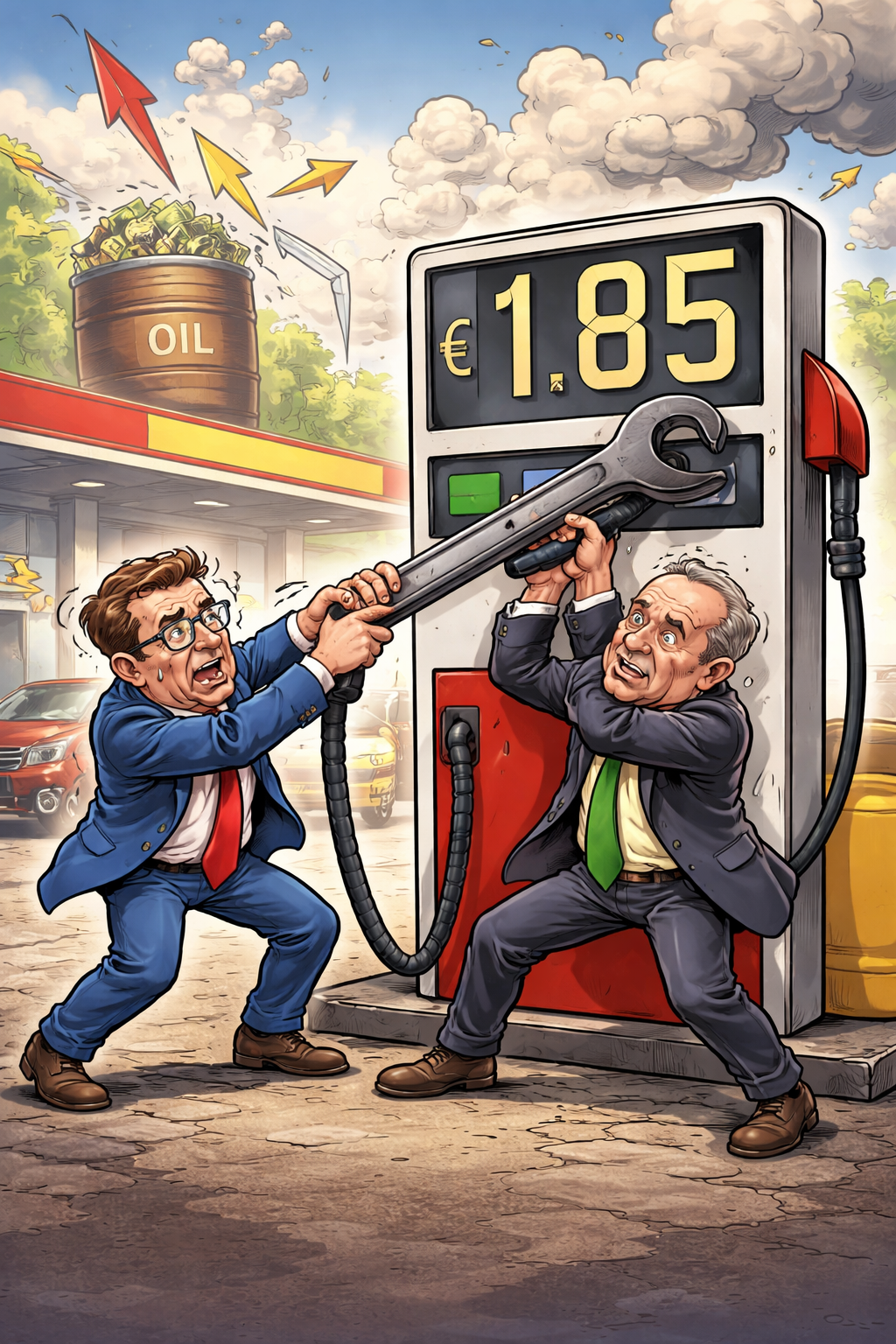
When fuel prices start hurting household budgets, one question appears very quickly: can the government actually do anything about it? At first glance, the answer seems like it should be simple. If fuel is too expensive, the government should lower the price. But in real life, it is much more complicated than that. The state can influence certain parts of the fuel price, but it cannot simply wave a hand and remove the reality of the market.
That is exactly why topics like excise-duty cuts, excess-profit oversight, and fuel-price stabilisation always become so emotional. Some people are convinced the government could reduce prices quickly if it really wanted to. Others believe government influence is almost meaningless because global markets are stronger than politics. As usual, the truth sits somewhere between those two extremes.
In this article, we will look at whether the Latvian government can realistically reduce fuel prices, what an excise-duty cut actually means in practice, why the result is not always as dramatic as people expect, and where the limits of government influence really begin.
Why people naturally expect the government to be able to lower the price
From an ordinary driver’s point of view, the logic is easy to understand. Fuel price is not made only of oil or wholesale purchase cost. It also includes taxes. And if taxes are inside the price, then the state is already part of that number. From there, the conclusion feels obvious: if the state is part of the price, then surely it can reduce the price too.
The difficulty is that fuel price is not one single switch. It is built from several layers: the purchase price of fuel, global market conditions, currency movements, logistics, reserve obligations, excise duty, VAT, and only then the retailer’s own margin. So even if the state can directly change one part of the structure, that does not mean it controls the whole structure.
This is where many people become frustrated. They assume that because politics can influence one component, it should be able to quickly and strongly change the final number. In practice, the effect is usually more limited and more gradual.
Excise duty is the main tool people talk about first
Whenever people discuss possible fuel-price relief, excise duty is usually the first thing mentioned. That is no accident. Excise duty is one of the most visible parts of the fuel price. It is also one of the few parts the government can directly influence through tax policy.
From a political point of view, this makes perfect sense. If high fuel prices are putting pressure on households, transport companies, business costs, and public mood, using excise duty as a relief tool becomes very tempting. That is why every serious period of fuel-price stress quickly leads to public discussion about lowering excise duty.
But one thing matters here: reducing excise duty does not mean the government has suddenly “taken control” of fuel pricing. It simply means that one major tax layer becomes smaller. All the other parts of the price remain in place.
What an excise-duty cut actually means in practice
In practical terms, an excise-duty cut can have a real effect. If the tax per litre becomes lower, then the tax component inside each litre also becomes lower. For drivers, that can mean a lower price at the pump and slightly less pressure every time they fill up.
But it is important not to expect magic. An excise-duty cut rarely turns expensive fuel into genuinely cheap fuel. What it usually does is soften the pressure. And the more strongly the rest of the fuel price is being driven by global oil markets, wholesale product costs, logistics, and supply conditions, the smaller that relief may feel in real life.
This is exactly why people sometimes feel disappointed even when such measures are introduced. They hear that excise duty may be reduced and imagine a dramatic price drop. In practice, what arrives may be only a few cents of relief per litre. Technically, that is still help. Emotionally, it may not feel like the rescue many people were hoping for.
Why the effect often does not look as big as people expect
Because excise duty is important, but it is not the whole price. Even when the state lowers the tax burden, the final price still includes the fuel purchase cost, VAT, logistics, reserve obligations, and the general reality of the market. If global oil and fuel-product prices are still rising, part of the relief from a tax cut can be quickly swallowed by the rest of the system.
On top of that, fuel prices do not always react instantly. There are older stocks, supply contracts, delivery timing, and pricing caution. So even a political decision does not always become a perfectly visible result on the station board the very next morning.
This is where one of the most common expectation mistakes appears: people mentally subtract the tax from the price and imagine they will see exactly that difference at the pump. But real-world fuel pricing is usually more complicated than simple arithmetic on paper.
Can the government simply order companies to sell fuel more cheaply?
In the long run, not really. The fuel market in Latvia operates under free-market conditions, which means the final retail price is set by market participants. The government can increase oversight, analyse the situation, adjust taxes, and discuss special mechanisms, but it cannot permanently replace the market with pure political instruction without creating serious side effects.
People often want to see a very direct solution: the price is too high, so the state should “break” it. But if that is done in a crude way and against the broader logic of supply and pricing, the side effects can become almost as problematic as the expensive fuel itself. In the fuel market, policy always has to balance short-term relief against long-term supply stability and economic reality.
That is why the real discussion almost always comes back not to total administrative control, but to indirect influence.
What about excess-profit control?
This is another topic that becomes popular very quickly whenever fuel is expensive. If people feel that prices are rising too fast, a natural question appears: is somebody making too much money from this? That is when public debate starts using phrases like “excess profit,” “special oversight,” and “market monitoring mechanisms.”
Politically, this is easy to understand because society wants fairness. But in practice, this is a very delicate issue. It still has to be shown that what people are seeing is truly unjustified profit rather than a very expensive market environment shaped by outside factors. Not every unpleasant price automatically means abuse.
That is why government oversight matters, but is not a magic wand. It can identify violations, discourage abuse, and make the market more transparent. But it cannot erase global energy prices or make fuel inexpensive just by changing the tone of the public debate.
Why it is difficult for governments to play with fuel taxes too freely
Because excise duty is not only a price tool. It is also part of the state budget. For the government, that means real revenue. So when the idea of reducing excise duty appears, the state has to think not only about helping drivers, but also about how to compensate for the lost income elsewhere.
This is where the real difficulty becomes visible. Politically, it is attractive to help households and businesses. Fiscally, every such relief measure has a cost. So an excise-duty cut is almost never a totally simple or “free” decision. Behind it, there is always a broader budget calculation.
That is also why even if the government conceptually supports reducing fuel-price pressure, it does not automatically mean the final measure will be large, long-lasting, or especially generous.
What this means for the ordinary driver
For an ordinary driver, it means one very important thing: the government can soften the situation, but it cannot fully remove the cause of the problem. If excise duty is reduced, the price may become more manageable. If oversight is strengthened, the market may become more transparent. If special measures are discussed, people may feel some reassurance. But none of that changes the fact that fuel prices still depend heavily on forces outside Latvia.
That is why the smartest way to look at government action is as relief, not as total salvation. This is a very important difference. People who expect a complete rescue are usually disappointed. People who understand that the aim is to soften pressure tend to see the situation more realistically.
Why this topic will always stay emotional
Because fuel affects almost everyone. It is not an abstract economic indicator. It is a daily price people can literally see with their own eyes. And when that price becomes painfully high, people want to believe there must be a simple solution somewhere. Politics is always the place where simple solutions are expected to appear.
But fuel markets rarely offer simple answers. They force people to confront an uncomfortable truth: the government really can change some things, but it can almost never completely rewrite the rules if the wider market is moving in a different direction.
Conclusion
Yes, the Latvian government can influence fuel prices — mainly through taxes such as excise duty, and also through oversight, market monitoring, and broader policy decisions. But that influence has limits. The state can soften the final price, but it cannot eliminate the role of global oil markets, logistics, wholesale costs, and the wider structure of fuel pricing.
In practice, an excise-duty cut does not mean a miracle. It means partial relief. Sometimes that relief can be very useful. Sometimes it can feel smaller than people hoped. The most honest conclusion is simple: government can help, but it cannot make fuel stop being a market price.
If you want to understand what your everyday driving really costs at different fuel-price levels, use the calculator below.