
 LV
 EN
 RU
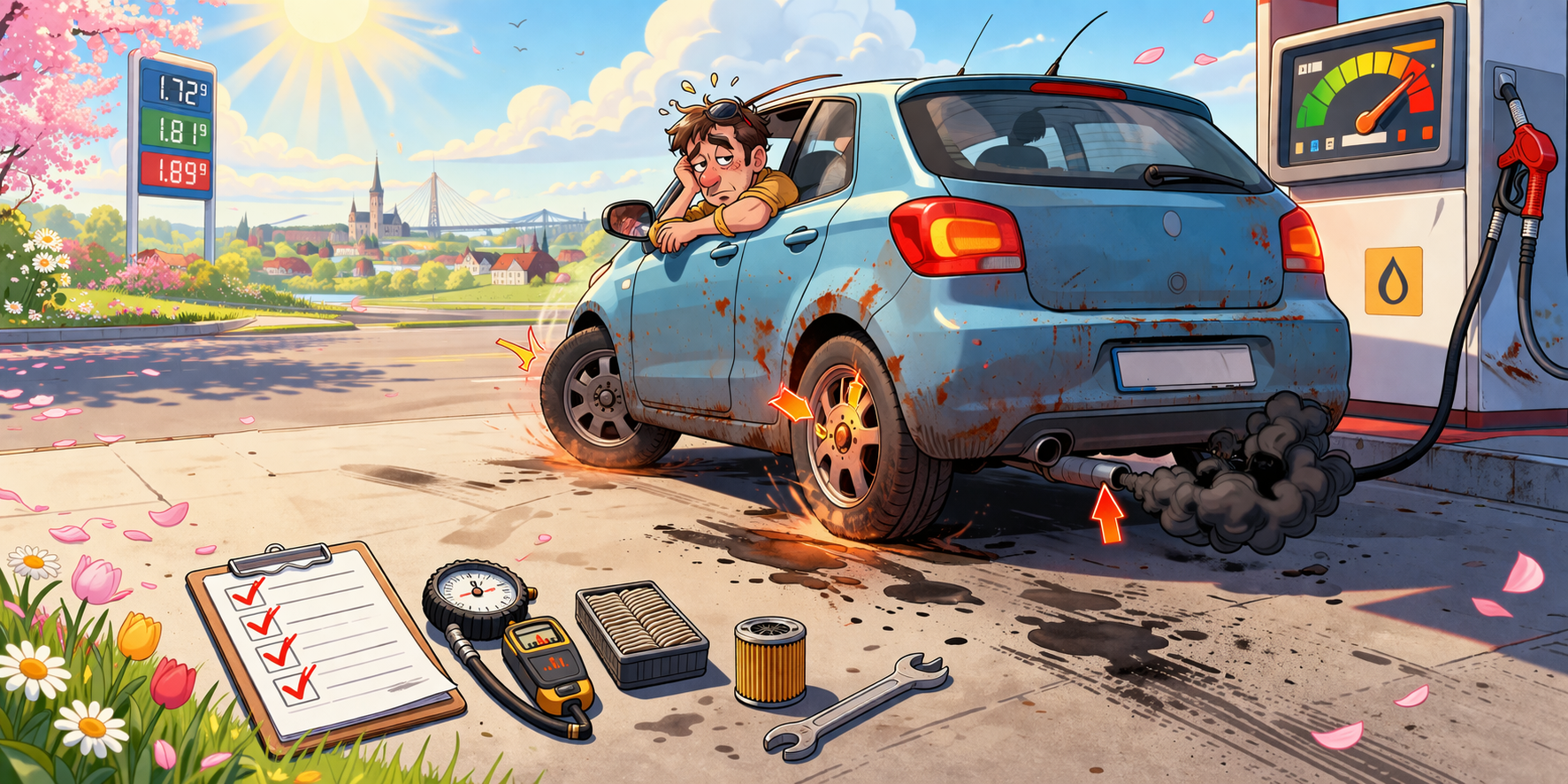
There is one very human habit that ends up costing drivers more than they like to admit. A person starts to feel that the car no longer moves as lightly as it used to. Something feels a little heavier. Fuel consumption seems to have crept up. The car no longer responds with the same ease. Sometimes the engine feels lazier, sometimes the whole car feels like it rolls with more resistance. But instead of immediately thinking about the car’s technical condition, many drivers reach for a different explanation first: fuel is probably just more expensive now, traffic is worse, maybe this is simply how it is.
And this is where things become really interesting. Because poor technical condition very rarely begins with one dramatic, unmistakable failure. Much more often it begins with small things. Tyres are not at the right pressure. Wheel alignment is no longer perfect. A filter is not as clean as it should be. The oil is no longer at its best. The brakes drag just a little. Somewhere, a sensor is no longer working as precisely as intended. None of this looks catastrophic at first. But together, these details can quietly turn into a very unpleasant increase in everyday running costs.
That is exactly why this topic matters. Many people look for ways to save fuel by thinking about filling stations, loyalty cards, driving style, or even buying a different car, while completely missing one uncomfortable fact: their own car may already be more expensive to drive than it should be. And very often this is not because the model is bad or the engine is flawed. It is because the car’s technical condition is no longer good enough for it to operate efficiently.
This is the kind of topic where it helps to stop thinking of a car as a simple machine that either moves or does not move. A car is a system. When that system is healthy, the car feels light, economical, and predictable. When friction, wear, imbalance, and inefficiency begin to build up inside it, the car still drives — but it drives more expensively. And very often that is the most dangerous part: not the dramatic breakdown, but the slow, quiet increase in cost that the owner notices only much later, when they finally realise how much extra money has been left on the road.
The biggest problem is that poor condition rarely begins with a big drama
Drivers like clear problems. If something breaks, then it is obvious that it needs repair. If something rattles, then at least you know it is time to visit a workshop. If something stops working, the illusion disappears. But poor technical condition usually begins in a much quieter way. The car still drives. It still steers. It still starts. Nobody is left stranded. And that is exactly why it becomes so easy to ignore.
Even worse, drivers get used to it. They get used to the car no longer rolling so freely. They get used to filling up slightly more often. They get used to slower response. They get used to a steering feel that is no longer quite right. They get used to telling themselves that perhaps this model is simply like that. And this is where the most dangerous thing happens. Once a driver gets used to inefficiency, they stop seeing it as a problem. They start treating it as normal.
That is why poor condition often makes driving more expensive for longer than one large failure would. One large fault usually forces action. Ten small faults allow people to keep living inside the illusion that everything is still acceptable. Meanwhile, the car gradually becomes heavier, thirstier, and more expensive to live with.
A very typical forum thought goes something like this: “I thought the car had simply become older. After a proper service, I realised it had just been driving inefficiently for a long time.”
Tyre pressure: a small detail that makes everything more expensive far more often than people think
If one thing deserves a place near the top of the list of most underestimated car-economy factors, tyre pressure is definitely one of them. It is so simple, so ordinary, and so easy to ignore that many drivers treat it almost like a formality. In reality, tyre pressure has a very direct effect on how easily a car rolls and how much energy it needs to keep moving.
When tyre pressure is not right, the car faces more rolling resistance. That means the engine has to do more work to achieve the same result. There is nothing glamorous about that explanation, but it is brutally practical. The car does not move as freely, and fuel consumption ends up paying the price. The longer this continues, the more expensive everyday driving becomes.
What makes this even more troublesome is that tyre pressure problems rarely feel dramatic. Many cars do not show one loud, obvious symptom. You simply keep driving. And that “nothing serious has happened” feeling is exactly why people sometimes spend far too long driving with the wrong tyre pressure, without realising that they are quietly overpaying every week.
Wheel alignment and suspension: the car can literally move less freely than it should
There is another issue that directly affects running costs but that people often remember only once the problem has become obvious — wheel alignment and the general condition of the running gear. This is not only about comfort or tyre wear. It is also about how easily the car moves at all. If wheel alignment is off, or if suspension-related components are no longer working as they should, the car can begin to move with unnecessary mechanical resistance.
From the driver’s perspective, this sometimes appears as a feeling that the car is no longer light. The steering may feel slightly different. The car may not roll as beautifully when you lift off the accelerator. Everything just feels a bit heavier. People often blame the engine or the fuel, when in reality the car itself is mechanically resisting its own movement more than before.
This is exactly the point where poor condition becomes expensive: you do not need smoke or a dramatic noise for a car to become inefficient. It is enough for it to stop moving the way its design originally intended.
Filters: unexciting, but expensive when forgotten
Filters are a perfect example of how car owners often ignore precisely the things that are not exciting. Nobody wants to think about filters. They are not glamorous purchases. They do not feel satisfying. You cannot proudly show them off. But filters are among the components that help a car breathe, work cleanly, and operate efficiently. And once a filter is no longer in proper condition, the whole system begins to feel that restriction.
That can mean the engine works less freely, throttle response becomes duller, and fuel use is no longer as good as it should be. The problem is not that the car suddenly stops driving. The problem is that it keeps driving, only a little worse each day. And that “a little worse” becomes very expensive over time.
Filters are especially deceptive because people postpone them so easily. The car still drives, after all. And that is the classic mistake. Just because a car still drives does not mean it is driving economically. Many cars continue operating inefficiently for a long time because the owner confuses “it works” with “it works well.”
A familiar forum-style comment: “After changing the filters, it felt as if the car had been cleaned from the inside too — it simply started moving more freely.”
Oil: not only for engine health, but also for how smoothly everything works
Oil is usually discussed as an engine-longevity issue, and that is absolutely right. But fewer people think about oil as an everyday running-cost factor. Yet the logic here is simple. If the system is no longer in the condition it should be in, mechanical operation is no longer as smooth. And when the operation is no longer smooth, energy losses can quietly become greater than they should be.
Drivers do not always feel this immediately. Nobody wakes up one morning thinking: today my car will probably consume more because the oil is no longer fresh. It does not happen like that. It happens gradually. The car simply stops feeling as lively, as light, as pleasant. And many people confuse that gradual decline with normal ageing, even though part of it is often simply delayed maintenance.
That is why oil is not only about preventing something from breaking. It is also about preventing the car from working harder than necessary every day. And a car that works harder than necessary will always cost more.
Brake drag: one of those silent culprits owners often notice too late
Brakes are usually associated with safety, not fuel economy. And of course safety comes first. But there is another very practical side to the story. If the braking system creates unnecessary resistance, the car literally becomes harder to move. That means more energy is required to achieve the same motion. And that is a direct cost issue.
This is also one of the reasons why a driver sometimes feels that the car no longer rolls properly. They may think about tyres, the engine, or even fuel quality, when in reality the cause may be something much more mechanical — the car is subtly braking itself. There is nothing poetic about it. It is simple, brutal mechanics. If something drags, motion becomes more expensive.
The worst part is that this kind of problem can develop slowly. That means the driver adapts to it. And only after the issue is fixed do they realise how long they had been paying for unnecessary resistance.
Sensors and electronics: a car can drive “more or less normally” while still being inefficient
A modern car is no longer just mechanics. It is also a network of data and signals. That means even a relatively small sensor or electronic issue can create a situation where the car continues to drive, but no longer does so optimally. To the owner, everything still seems fine. The car starts. The engine runs. There is no disaster. But the system may be operating in a way that no longer delivers the efficiency or performance it should.
Sensor and electronics-related problems are especially deceptive because they are not always easy to feel intuitively. Sometimes nothing dramatic happens. The car is simply no longer in its best form. And that means the owner ends up living with a vehicle that asks for a little more fuel, or a little more patience, every single day than it would if everything were working precisely.
This is the point where many drivers begin to understand that poor technical condition is not only about something being broken. Very often it is about something no longer working as precisely as it should. And that lack of precision becomes expensive over time.
A car can become inefficient even while still feeling completely usable
This is probably the single most important conclusion in the whole article. A car does not have to be obviously broken in order to be expensive. It can still be perfectly drivable, perfectly usable, even visually acceptable, while already operating far less efficiently than it should. And this is exactly the zone where people lose the most money without fully realising it.
Because if a car does not drive at all, the answer is obvious — it must be repaired. But if a car drives worse, heavier, with more consumption and less ease, many drivers keep hoping that this is simply normal. And that hope is expensive. Very expensive. Because it can last for months.
That is why the smartest question is not only “is my car still drivable?” The smarter question is “is my car driving as efficiently as it should?” Those are two completely different questions. And the second one has much more to do with your wallet.
How do you know poor condition is already making your driving more expensive?
Very often, the signs are not dramatic. They are ordinary. You find yourself filling up more often than before. The car feels heavier in motion. It no longer rolls as freely. Throttle response feels duller. The steering feels a little different. Nothing appears totally broken, but the overall feeling is no longer as good as it used to be. And these are exactly the moments when a driver should not simply say: it’s probably nothing. These are the moments to think more intelligently.
Because a car almost never becomes more expensive in a single day. It becomes more expensive gradually. And that is why paying attention to technical condition in time is one of the best forms of saving available to any driver. Not only to avoid big repairs later, but also to avoid overpaying every day for a car that is no longer working in its best condition.
A very familiar forum logic: “I delayed the service because I thought I could still keep driving. In the end I realised that the delay itself was what cost me the most.”
Conclusion
Driving a car in poor technical condition becomes expensive long before something major actually breaks. It becomes expensive the moment tyre pressure is no longer right, alignment begins to resist movement, filters become clogged, oil is no longer at its best, brakes create unnecessary drag, or sensors stop working as precisely as they should. Each of these issues on its own may not look like a disaster. Together, they can quietly turn a car into an unpleasantly expensive everyday companion.
That is exactly why fuel economy is not only a question of fuel prices or driving style. It is also a question of how healthy the car itself is. And sometimes the smartest way to spend less on the road is not to search for miracles at the pump, but simply to give the car back the lightness with which it was originally meant to move.
If you want to understand how different fuel-consumption scenarios affect your real costs, use the calculator below.