 LV
 EN
 RU
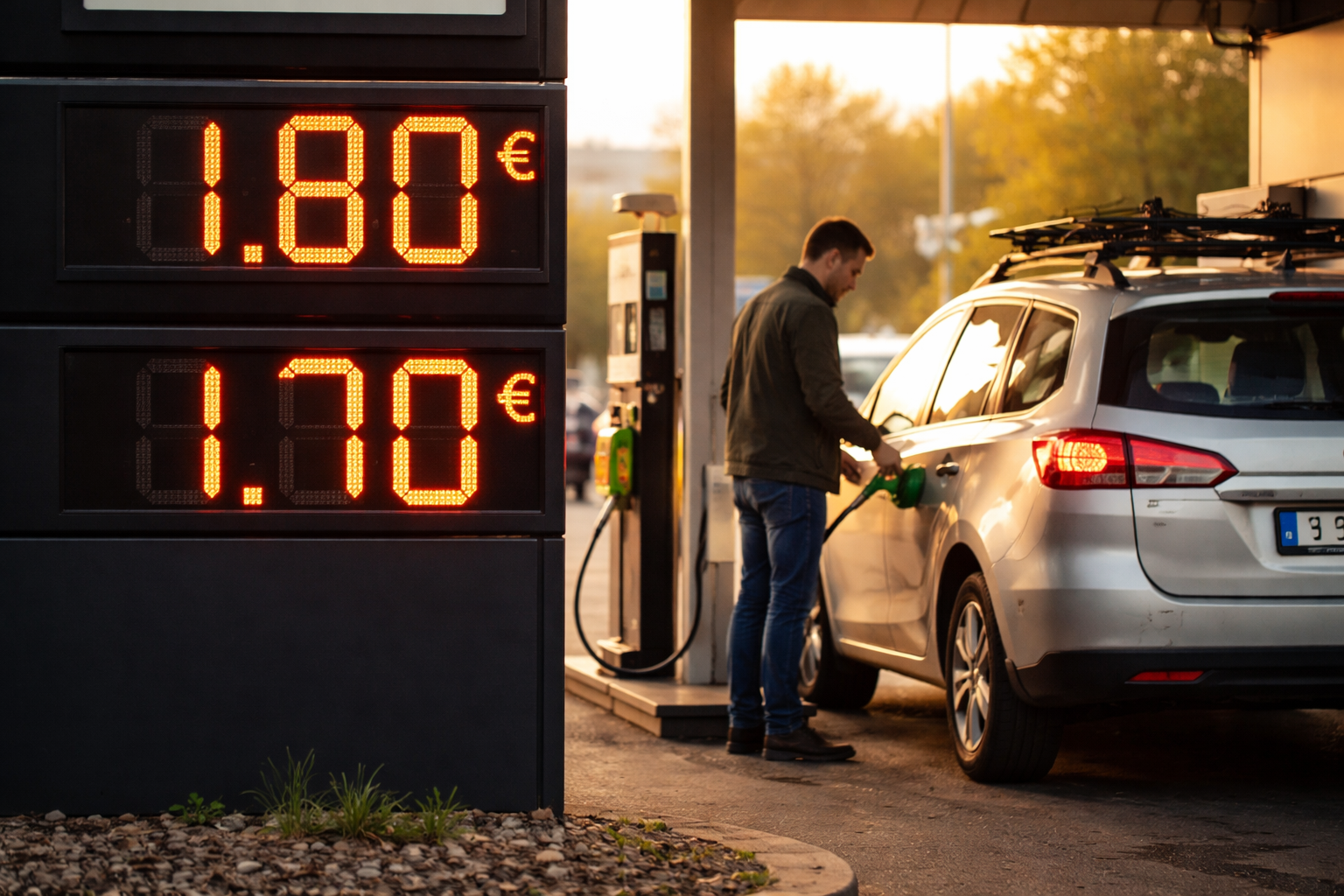
The moment fuel prices approach or exceed €1.80 per litre, it stops being just another number on a signboard. For drivers, it becomes a very real daily problem. Every trip starts costing more, every refill feels heavier on the budget, and the question is no longer only “why is this happening?” but also “what should I actually do now?”
At times like this, people usually make one of two mistakes. The first is panic — the feeling that nothing can be changed and the only option is to keep paying. The second is passivity — the hope that “it will probably go back down soon.” In reality, the smartest approach is somewhere between those two extremes. Drivers cannot control everything, but they can still review and improve a lot in their everyday routine.
In this article, we will look at a practical action plan for the situation where fuel in Latvia becomes very expensive. Not empty slogans, but real steps: what to review in your driving habits, how to reduce costs without making your life miserable, when it makes sense to change your car-use model, and how to understand whether the problem is only the market price or whether your car itself has become too expensive for daily life.
The first step: do not focus only on the fuel price board
When fuel becomes expensive, most people focus only on the price per litre. That is understandable, but it is not enough. The more important question is not just how much a litre costs, but how much your overall driving pattern costs you. Two people facing the same fuel price can live in very different financial realities.
One may have an efficient car, sensible routes, and well-planned weekly driving. Another may have a heavier car, mostly short urban trips, chaotic routes, and lots of unnecessary mileage. In that case, the problem is not just the fuel price — it is how that fuel price interacts with daily habits.
“At first I was only angry about the price. Then I sat down and realized that half of my trips were not planned sensibly at all.”
What every driver should check in the first 24 hours
If fuel prices rise sharply and your costs start feeling uncomfortable, the first move is not to immediately think about buying another car. First, check four simple things: your real fuel consumption, how often you drive unnecessary routes, your tire pressure, and whether the car’s technical condition is already increasing your costs on its own.
Many people think their car “uses a normal amount of fuel” until they actually start recording it. That is often when they discover the issue is not only the market price, but also that fuel consumption has quietly become worse than it used to be.
| What to check | Why it matters | What it gives you |
|---|---|---|
| Real fuel consumption | Shows whether the car is already using too much | A basis for smart decisions |
| Tire pressure | Affects rolling resistance and fuel use | A quick saving |
| Route habits | Many people drive unnecessary kilometers | Less waste |
| Technical condition | Filters, plugs, sensors, alignment affect cost | Lower consumption long term |
Stop paying for chaos in your daily routes
One of the biggest hidden fuel “thieves” is not the engine, but poorly planned daily travel. Separate trips for small errands, multiple outings in one day with no logic, unnecessary detours, driving in peak traffic when it could have been avoided, and the habit of “just quickly driving out for five minutes” all add up to wasted litres surprisingly fast.
If fuel becomes very expensive, route planning stops being something only very organized people do. It becomes normal financial discipline. A smart driver starts thinking in blocks: what can be combined into one trip, what can be postponed, what can be done on the way, and what does not actually require using the car at all.
“Once I grouped my weekly driving into one logical plan, I realized I was driving less without losing anything in my daily life.”
Smoother driving is not a cliché — it really works
When fuel is cheap, many drivers do not notice how much their driving style affects consumption. When prices rise, it suddenly becomes much more obvious. Hard acceleration, jerky braking, unnecessarily high revs, and aggressive movement through city traffic increase fuel use more than many people want to admit.
That does not mean you need to drive painfully slowly. It means driving more smoothly. Lifting off the accelerator earlier, anticipating traffic, accelerating more evenly, and avoiding nervous stop-start behavior. These are small habits, but together they add up very quickly.
Once fuel prices cross a psychological pain threshold, driving style is one of the first places where savings can be found.
The technical condition of the car suddenly matters much more
When fuel prices are high, it becomes even more expensive to ignore technical issues that increase consumption. A dirty air filter, low tire pressure, poor wheel alignment, worn spark plugs in a petrol engine, sensor problems, or brakes that do not fully release can all mean that you are simply overpaying week after week.
Many people treat this only as a maintenance issue. In reality, it is directly a money issue. The more expensive fuel becomes, the more expensive every small technical fault becomes if it raises fuel consumption even slightly.
Sometimes one service visit costs less than several months of quietly paying for unnecessary fuel use.
Stop carrying things you do not actually use
When people get used to their car, the trunk often turns into a storage room. Tools, boxes, sports gear, children’s items, winter things in spring, summer things in autumn — separately none of it seems like much, but together it creates extra weight that the engine is paying for.
The same applies to roof racks and roof boxes. If they are not used daily, there is no good reason to leave them on the car “just in case.” At higher speeds, aerodynamics matter a lot, and consumption can rise more than many drivers expect.
“I removed the roof box, cleaned half the trunk, and realized I had been driving around for months with extra load for no real reason.”
Compare where you refuel, not only which brand you like
When prices are high, differences between stations start to matter more. Many drivers continue filling up at the same place out of habit, even though a few extra minutes of attention can sometimes reveal a better price or a more useful loyalty program.
Of course, it makes no sense to burn extra fuel just to chase a lower price on the other side of town. But if you can compare two or three options within your usual route, that is already a rational habit. At high prices, even a small difference starts adding up over several refills.
The principle here is simple: not obsessive price-hunting, but stopping the habit of paying blindly.
When you should start thinking not about saving, but about changing the car
There comes a point where the question is no longer only about more economical driving. If you drive a lot, the car consumes too much, your routes will not change, and fuel costs are pushing on your budget every month, then you have to ask an uncomfortable but smart question — is my current car still rational for my daily life?
That does not mean everyone now needs to buy a new hybrid or a tiny low-displacement car. But it does mean that at a certain fuel-price level, an old choice may become financially heavier than it used to be. Sometimes people stay loyal for years to a car they really like, but under a new fuel-cost reality it becomes too expensive as a daily habit.
This is one of the harder decisions to make, but in some cases it becomes the most sensible one in the long run.
How to tell whether the problem is the market price or your car
The simplest test is to compare your consumption and monthly fuel spending not emotionally, but in numbers. If all drivers around you feel the same market increase but your budget suffers much more than expected, the issue may not be only the market. Maybe your car uses more than it should. Maybe you drive inefficiently. Maybe your routes are poorly structured.
You cannot change the market price, but you can change your own model. And that is exactly what a smart driver does first — separates external pressure from what is already the result of habits or of the vehicle itself.
A practical plan for the next seven days
If you want to act without overthinking everything, the plan for the next week is simple. First, record your fuel consumption. Second, check your tire pressure. Third, remove unnecessary weight from the car. Fourth, combine trips. Fifth, spend one full week driving more smoothly than usual on purpose. Sixth, ask whether fuel costs are rising partly because the car already needs diagnostics.
These steps are not dramatic or flashy, but they work. And most importantly, they help drivers regain a sense of control instead of only getting angry at the price board.
Conclusion
If fuel prices in Latvia exceed €1.80/litre, drivers do not need to become helpless victims or full-time complainers online. The smartest response is to move from emotion to action. Look at your car, your routes, your habits, and your real costs.
Part of the situation is set by the market, politics, and world events. But a surprisingly large part is also shaped by how someone uses their own vehicle. That is where smart driving really begins — not when fuel is cheap, but when it becomes expensive enough that strategy finally matters.
If you want to understand how much your daily driving really costs at different fuel price levels, use the calculator below.