
 LV
 EN
 RU
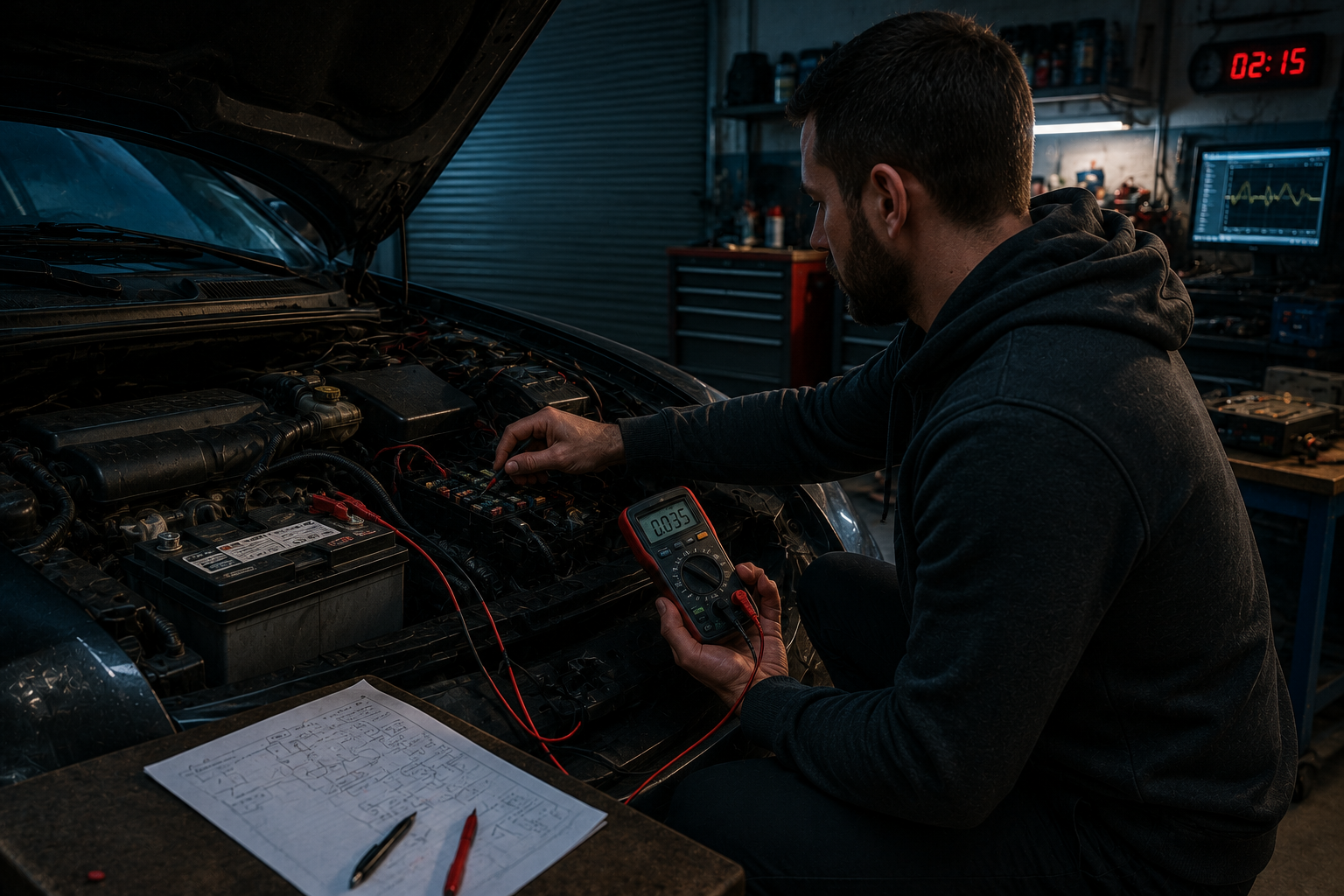
Yesterday evening, the car started without hesitation. The driver parked it outside, locked the doors and went home. In the morning, the central locking still works and the dashboard lights up, but the starter clicks only once or turns so slowly that the engine will not start.
After a jump-start, the car works again. The driver travels for twenty minutes, parks and assumes that the problem has been solved. The following morning, the same situation occurs again. A new battery is purchased, but a week later that battery is flat as well.
In this situation, the battery itself is not always to blame. It may be worn and no longer capable of storing enough energy. The alternator may not be charging it while the vehicle is being driven. It is also possible that one of the car’s devices does not switch off after locking and silently consumes electricity for several hours.
This unwanted consumption is commonly called a current leak or parasitic drain. More precisely, it can be described as excessive quiescent or parasitic current draw. Even while parked, a car needs a small amount of electricity for the clock, alarm, memory, remote communication and other systems. A problem begins when the draw is too high or control modules fail to enter their intended sleep mode.
The main principle: a repeatedly discharged battery is a symptom. Before buying another battery, three things must be checked — whether the existing battery can store energy, whether the vehicle charges it correctly and whether excessive electrical consumption remains after shutdown.
The three main scenarios
It may show an acceptable voltage but no longer have enough capacity or cold-cranking performance to start a cold engine.
A faulty alternator, belt, connection, earth cable or charging-control system fails to restore the energy used while driving.
A light, accessory, alarm or control module remains active and discharges even a healthy battery over several hours.
Sometimes several causes exist at the same time. For example, a six-year-old battery may still start the engine after a long journey, but regular short trips do not recharge it fully. A small accessory load that a new battery would tolerate may then create a problem after only one cold night.
What does a “flat battery” actually mean?
A starter battery does not store unlimited electricity. Its task is to provide a very high current briefly when starting the engine and to stabilise the vehicle’s electrical system.
When the battery is partly discharged, the lights and dashboard may still operate. The starter, however, requires far more power than an interior light or infotainment system. A situation in which “all the lights work, but the engine will not turn” can therefore still be a typical sign of an insufficiently charged battery.
Common symptoms
- the starter turns more slowly than usual;
- only one click or a series of clicks can be heard;
- the dashboard goes dark or restarts during cranking;
- the central locking operates slowly;
- the clock or stored settings have been reset;
- several system warnings appear and disappear after charging;
- the problem is worse in cold weather;
- after external charging, the vehicle works normally for some time.
How much does battery voltage tell you?
Voltage measured with a multimeter is a useful starting point, but it does not show the battery’s complete condition. A battery may have an almost normal open-circuit voltage while having very little remaining capacity or being unable to provide the required starting current.
A roughly fully charged conventional 12-volt lead-acid battery often reads approximately 12.6–12.8 volts after resting. At around 12.4 volts, it may already be only partly charged, while approximately 12.2 volts or less generally indicates significant discharge.
These figures are only approximate. The result is affected by battery type, temperature, recent charging and whether the vehicle has already activated electronic systems before the measurement.
- Switch off the engine and every possible electrical consumer.
- Close the doors and allow the battery voltage to stabilise.
- Measure directly on the battery posts, not only on dirty terminal clamps.
- Record the voltage before starting.
- Where it is safe to do so, observe the voltage while the starter is operating.
- After starting, check the operation of the charging system.
A professional battery test can additionally assess internal resistance, available cranking current and the ability to maintain voltage under load. This is considerably more useful than one open-circuit voltage figure.
Why does an old battery discharge more quickly?
As a battery ages, its actual capacity and ability to provide high cranking current decrease. The casing may still state, for example, 70 Ah and a specific cold-cranking rating, but after several years the energy genuinely available may be significantly lower.
Ageing is accelerated by deep discharges, prolonged low charge levels, heat, vibration, incorrect charging voltage and regular short journeys. Repeatedly discharging the battery until the starter no longer turns may also permanently reduce its capacity.
For this reason, an old battery does not always recover its previous performance after a parasitic drain has been repaired. The original cause may have been an electronic system, but repeated deep discharges may have damaged the battery as well.
Cold weather does not remove the energy, but makes it harder to use
At low temperatures, chemical processes inside the battery slow down, its available cranking power decreases and cold engine oil becomes thicker, requiring the starter to work harder.
A battery that seems entirely adequate during summer may therefore fail to start the engine on the first cold morning. Winter often does not create the defect; it exposes an existing loss of capacity or insufficient charging.
Short journeys can create a permanent energy deficit
Starting the engine uses a significant amount of energy. The alternator must then restore it while also powering the lights, blower, heated windows, heated seats, infotainment and other systems.
If the daily journey lasts only a few minutes, the vehicle may not have enough time to replace the energy used during starting. The battery’s state of charge becomes slightly lower each day until, one morning, it can no longer power the starter.
This may look like an overnight parasitic drain even though the main problem is insufficient charging during journeys. A full charge with a suitable charger followed by controlled observation can help distinguish between the two.
The alternator: a running engine does not guarantee correct charging
The alternator produces electricity while the engine is running and charges the 12-volt battery. If it does not work sufficiently, the vehicle continues using energy stored in the battery until the voltage becomes too low.
In an older vehicle, a relatively stable charging voltage above the battery’s resting voltage is often expected after starting. In modern vehicles, intelligent charging management deliberately changes the voltage according to battery condition, electrical load, temperature, acceleration and braking.
One voltage figure at idle does not therefore always prove an alternator fault. At certain times, the system may show a comparatively low voltage and raise it at others. A correct test must consider the charging strategy and diagnostic data for the specific vehicle.
Possible charging-system problems
- a worn alternator or voltage regulator;
- damaged alternator diodes;
- a slipping, loose or damaged drive belt;
- oxidised battery connections;
- a damaged engine or body earth cable;
- excessive voltage drop in cables and connections;
- a faulty battery-current or temperature sensor;
- a replacement battery that has not been registered correctly;
- a control-software or communication problem.
A faulty alternator diode can discharge the battery while parked
Alternator diodes help convert the generated electricity into a form usable by the vehicle and restrict unwanted current flow in the opposite direction.
If a diode is faulty, the alternator may both undercharge the battery while driving and consume electricity after the engine has been switched off. A simple voltage check does not always reveal this defect.
A workshop may test alternator AC ripple, charging current, voltage drops and changes in quiescent consumption after the alternator circuit is isolated in accordance with the correct repair procedure.
What is normal quiescent current draw?
Even a completely switched-off car is not normally electrically “dead”. The alarm, central locking, clock, control-module memory, communication module and other systems continue to use a small amount of current.
In a simple vehicle, quiescent current after every system has entered sleep mode may be only a few tens of milliamps. In a modern vehicle with keyless access, telematics, a remote app and several communication modules, the normal value may differ.
Approximately 20–50 mA is often considered a reasonable guide for many vehicles after sleep mode has been reached, but it is not a universal limit. Some models permit a higher draw temporarily, while in another vehicle even a relatively small additional load may create problems during prolonged parking.
A measurement taken immediately after locking may be misleading
After the doors are closed, control modules are still communicating, checking systems and saving data. Some vehicles enter sleep mode after only a few minutes, while others require considerably longer.
How does electrical consumption turn into a flat battery?
A simplified calculation can help explain the scale of the problem. The approximate number of amp-hours consumed is obtained by multiplying current in amps by the number of hours.
If a device continuously consumes 0.5 A after the car is locked:
Six amp-hours in one night can be very significant, especially for an old, partly charged or cold battery. The practical outcome also depends on battery health and the starter’s requirements.
A small draw may create a problem only after several weeks. A large draw may discharge the battery overnight. An intermittent fault that occurs only occasionally can be even more difficult to locate.
Common causes of hidden electrical consumption
A faulty switch or latch may leave the light illuminated even after the lid has been closed.
Parking mode without correctly configured low-voltage protection may continue operating for too long.
A cheap adapter, telematics module or tracker may consume electricity and keep the vehicle’s data network awake.
Incorrect wiring, a faulty sensor or an ageing control unit may draw more current than intended.
If the remote turn-on wire remains live, the amplifier does not switch off with the ignition.
A door lock, infotainment unit, comfort module or other device may keep the vehicle’s communication network awake.
Door, bonnet and boot switches
A modern vehicle often detects door position using a sensor built into the latch. If it incorrectly reports that a door or the boot remains open, the interior lighting may not switch off and some control modules may fail to enter sleep mode.
There will not always be an obvious dashboard warning. The signal may change intermittently because of vibration, moisture or temperature.
Signs that may indicate a latch or sensor problem
- the interior light does not switch off at the expected time;
- the dashboard occasionally shows an open door;
- the alarm activates unexpectedly;
- the central locking behaves unpredictably;
- the boot light remains warm after prolonged parking;
- the battery discharges only after a particular door or the boot has been used.
Keyless entry and a key stored too close to the vehicle
A keyless-entry system periodically searches for the key signal so that the doors can be opened and the engine started. Under normal conditions, its consumption is designed to permit prolonged parking.
Under certain circumstances, however, a key stored very close to the vehicle may encourage more frequent system activation. A faulty door-handle antenna, sensor or control module may have an even greater effect.
During diagnosis, the keys should be placed far enough away that the vehicle does not repeatedly detect them. The spare key, which may have been forgotten in the garage or an adjoining room, must also be considered.
Dashcam parking mode
A dashcam’s parking mode can be useful, but it requires electricity. If the unit is connected to a permanent power supply without a suitable protection module, it may continue operating until the battery can no longer start the engine.
Even low-voltage protection does not always guarantee a successful cold start. The cut-off threshold may be set too low, the battery may be worn and the device may detect voltage incorrectly because of losses in the wiring.
During testing, the dashcam should ideally be disconnected completely for several nights rather than merely switched off with its button. Some devices continue waiting for an impact or movement signal even when apparently switched off.
USB chargers, adapters and devices in the 12-volt socket
In some vehicles, the sockets switch off with the ignition, while in others they remain permanently live. A USB adapter without a phone connected normally consumes little, but a faulty or poor-quality unit may create an unnecessary load.
A cool box, seat heater, air purifier or other more powerful accessory may discharge the battery very quickly if the socket remains active after the vehicle has been switched off.
The infotainment system or data network does not enter sleep mode
The control modules in a modern vehicle communicate with one another over a data network. When the vehicle is locked, the systems should gradually stop active communication and enter sleep mode.
One faulty device may periodically transmit messages and “wake” the rest of the network. The device’s own consumption may be small, but it may prevent dozens of other modules from sleeping.
Possible causes
- an infotainment software fault;
- a Bluetooth or phone-connection problem;
- moisture inside a control module or connector;
- a faulty door or comfort module;
- an aftermarket head unit or adapter;
- an OBD device continuously requesting data;
- a telematics or remote-communication fault;
- incorrect software following an update or repair.
Moisture and corrosion in the electrical system
Water inside the cabin, boot or engine compartment may cause more than a direct short circuit. Damp and oxidised connections can create intermittent signals, increased resistance and repeated activation of control modules.
Battery discharge may begin only after rain, a car wash or very humid weather. This pattern is valuable diagnostic information.
Start-stop vehicles and AGM or EFB batteries
Vehicles with start-stop systems often require an AGM or EFB battery designed for more frequent starting cycles and a specialised charging strategy.
Installing the wrong battery type may reduce its lifespan and cause unpredictable system behaviour. Replacing an AGM battery with a conventional battery merely because it is cheaper may also create new problems.
In many vehicles, a replacement battery must be registered or adapted in the control system. The system must know its type, capacity and the fact that a new battery has been fitted. Otherwise, the charging strategy may remain adapted to the condition of the old battery.
The battery-current sensor
Some vehicles have a current and temperature sensor near the battery’s negative terminal. It helps the control system calculate the battery’s state of charge and determine alternator operation.
If the sensor is faulty, connected incorrectly or bypassed by an accessory earth cable, the charging calculation may become inaccurate.
Accessory earth cables should be installed in accordance with the electrical diagram for the specific vehicle, rather than simply attached to the nearest convenient bolt.
Hybrids and electric vehicles also have a 12-volt battery
A large high-voltage traction battery does not mean that a vehicle can operate without a conventional 12-volt system. This powers the control electronics, locks, lighting, safety systems and contactors that connect the high-voltage battery.
If the 12-volt battery is flat, an electric vehicle may appear completely “dead” even though the traction battery is charged. The doors may not open electrically, the dashboard may not switch on and the vehicle may fail to enter its ready mode.
In hybrids and electric vehicles, the 12-volt battery is normally charged by a DC-DC converter rather than a traditional alternator. Diagnosis should assess both battery condition and the operation of this charging system.
Do not work on high-voltage components
A 12-volt battery problem is not a reason to open the traction battery, disconnect orange cables or interfere with the high-voltage system.
How is quiescent-current draw safely diagnosed?
Measuring quiescent current appears simple, but it is easy to perform incorrectly on a modern vehicle. Opening a door, bringing the key close, changing the multimeter setting or removing a fuse may wake control modules and alter the result.
Basic stages of a professional test
- Fully charge and test the battery.
- Test the alternator or 12-volt charging converter.
- Switch off all accessories and disconnect suspicious aftermarket equipment.
- Prepare open panels so that the switches register them as closed.
- Lock the vehicle and move the keys away.
- Wait for every control module to enter sleep mode.
- Measure the current draw without waking the vehicle.
- Identify the circuit responsible for the excessive consumption.
- Locate the specific device, cable or control fault.
- After repair, repeat the full sleep-mode test.
Measuring current with a multimeter connected in series
The traditional method is to disconnect a battery cable and connect the multimeter in series between the battery and cable. All current used by the vehicle then flows through the instrument.
This method involves significant risks. If the multimeter is connected to the wrong socket or set to the wrong range, its fuse may blow. Opening a door, switching on the lights or attempting to start the engine may exceed the instrument’s permitted current and cause damage.
- start the engine;
- switch on high-powered consumers;
- open a door unless its switch has been prepared;
- change lead connections without considering the possible current;
- allow the vehicle to wake unexpectedly because of a key or app;
- perform the test without understanding the instrument’s fuse and maximum load.
Disconnecting the battery may also reset control modules, interrupt the fault and temporarily hide the real problem. Other methods are therefore often preferred for complex vehicles.
Measuring current with a clamp meter
A precise DC clamp meter allows current to be measured without disconnecting the battery cable. This reduces the risk of resetting systems or interrupting an intermittent fault.
Measuring very small currents requires a sufficiently sensitive instrument, correct zeroing and careful positioning of the cable in the centre of the clamp. Inexpensive clamps designed only for large starter currents may not be accurate in the tens-of-milliamps range.
The fuse-removal method
Once excessive consumption has been confirmed, fuse circuits are often checked one by one. If the current falls sharply after a particular fuse is removed, the suspect circuit has been identified.
Removing a fuse may itself wake control modules, interrupt communication or reset the fault. One fuse may also supply several different devices.
Professionals sometimes measure the very small voltage drop across a fuse’s test points without removing it. Using the fuse type and temperature, current in the circuit can be calculated while the vehicle remains asleep.
Why does the fault sometimes disappear at the workshop?
An intermittent electrical fault may appear only under particular conditions — after rain, during a cold night, after a phone has been connected, after the boot has been opened or following a particular journey.
When the vehicle reaches the workshop, the battery may be disconnected or charged, the doors opened repeatedly and fault codes read. These actions may restart the module that previously failed to enter sleep mode.
Long-term current and voltage logging can help in such cases. A data logger may show the exact time at which consumption increased, how long it continued and whether a module periodically woke the vehicle.
A simple home check without dismantling circuits
A driver without specialist experience can collect a great deal of useful information without disconnecting battery cables or removing fuses.
- Fully charge the battery with a suitable charger.
- Check that the terminal clamps are clean and secure.
- Disconnect the dashcam, OBD adapter and other removable accessories.
- Remove every charger from the vehicle’s sockets.
- Make sure the boot, glovebox and doors close correctly.
- Move all keys away from the vehicle.
- Record the battery voltage in the evening after it has stabilised.
- Repeat the measurement in the morning before opening the doors, where this can be done safely.
- Record the outside temperature and parking duration.
- If the problem continues, give the workshop the measurements and notes about the conditions.
This test will not identify which circuit is consuming current, but it can show whether the problem improves after accessories are disconnected and how quickly the battery condition changes.
Why is a short drive after a jump-start not a full recharge?
A jump-start provides enough energy to start the engine; it does not fully charge the discharged battery. After starting, the alternator must power the vehicle and restore the battery’s energy at the same time.
A deeply discharged battery may require several hours with a suitable charger to recover fully. A twenty-minute journey, particularly in city traffic with the heating and lights switched on, may restore only a small amount.
Placing a prolonged, very high charging load on the alternator is also not the ideal way to restore a deeply discharged battery. A controlled charger usually charges it more gently and completely.
How should a charger be selected?
The charger must be suitable for the battery voltage, type and capacity. AGM, EFB, conventional flooded and certain lithium batteries may have different charging requirements.
A modern automatic charger normally uses several charging stages and may switch to maintenance mode after the battery is full. Even an automatic charger must be used according to its instructions and the vehicle manufacturer’s guidance.
In some vehicles, the charger should be connected to designated points in the engine compartment so that the battery-management sensor records the charging correctly. Direct connection at the wrong location may bypass the current sensor.
When must a battery not be charged or jump-started?
- the battery casing is swollen, cracked or deformed;
- electrolyte leakage is visible;
- a strong chemical or rotten-egg smell is present;
- the battery is frozen or may have frozen;
- the terminals or cables are excessively hot;
- connections are damaged or visibly sparking;
- the vehicle has been flooded;
- the manufacturer’s instructions prohibit external starting in the specific situation.
Flammable gases may be released during charging. Ventilation is required, smoking is prohibited and connections should not be made in a way that creates unnecessary sparks near the battery.
Safe jump-starting
The correct jump-starting procedure should be taken from the manuals for both vehicles. In some vehicles, the battery is difficult to access and separate positive and earth connection points are provided in the engine compartment.
General safety principles
- make sure the nominal voltage of both systems is compatible;
- do not allow the vehicles to touch;
- switch off unnecessary electrical consumers;
- use the connection points specified by the manufacturer;
- do not reverse the polarity;
- do not make the final connection where battery gases may accumulate;
- keep the cables away from belts, fans and moving components;
- disconnect the cables in the order specified by the instructions.
Not every hybrid or electric vehicle is designed to jump-start another vehicle. Its 12-volt system may not be designed for a high starter load, so the instructions for the specific model must be followed.
When might the starter, rather than the battery, be responsible?
Slow cranking does not always mean that the battery is discharged. A worn starter, faulty solenoid, poor positive cable or bad earth connection may create a very large voltage drop.
If the battery is fully charged and has passed testing but the starter still turns slowly, the voltage drop in both the positive and earth circuits should be measured during cranking, together with the current used by the starter.
Battery terminals and earth cables
A dirty or loose terminal can create the impression of a flat battery. The connection may carry enough current for the dashboard, but the voltage collapses under starter load.
The visible battery clamps are not the only points that require checking. Positive distribution connections, the body earth point and the engine earth cable should also be inspected. A cable may look sound externally while being corroded beneath the insulation.
When is roadside assistance better than another jump-start?
- the battery repeatedly discharges overnight;
- the charging or battery warning light remains on while driving;
- a burning or chemical smell is present;
- battery or alternator cables become hot;
- connections are visibly damaged, sparking or melting;
- the alternator belt is damaged or missing;
- the voltage continues to fall rapidly after starting;
- the vehicle loses electrical systems while being driven;
- the battery is swollen or leaking;
- a hybrid or electric vehicle displays a high-voltage-system warning.
What does a workshop inspect?
- checking the battery’s state of charge and health;
- a cranking-current or conductance test;
- measuring starter current and circuit voltage drops;
- checking alternator voltage and current under different loads;
- testing alternator diodes and AC ripple;
- checking battery, engine and body connections;
- reading control-module faults and sleep-mode data;
- logging quiescent current over an extended period;
- checking suspect fuse circuits;
- inspecting aftermarket-equipment wiring;
- looking for moisture and corrosion;
- testing the battery sensor and energy-management system;
- checking whether a replacement battery has been registered;
- performing a control measurement after repair and sleep-mode entry.
Illustrative cost example
Assume that the vehicle no longer starts after being parked for two days. In the first scenario, the workshop finds an incorrectly connected dashcam and a faulty boot latch. In the second scenario, the driver replaces the battery twice while the underlying cause remains.
The amounts are illustrative and are not a quotation from a particular workshop. Costs depend on the vehicle, diagnostic time, battery type and faulty device.
Seven-day observation log
If the vehicle still starts, there is no burning smell or other dangerous symptom and the battery is not being allowed to reach a critically low state of charge, a short observation log may help the workshop.
- Fully charge and test the battery.
- Record the evening voltage after stabilisation.
- Record the morning voltage before starting.
- Note the parking duration and outside temperature.
- Record the distance and duration of the day’s journeys.
- Note which electrical consumers were used.
- Record whether a dashcam or OBD adapter was connected.
- Note rain, washing or very humid weather.
- Record how long the vehicle stands before the problem appears.
- If the starter begins turning slowly, stop the experiment and charge or test the battery.
What should be checked when buying a used vehicle?
A seller may charge the battery immediately before an inspection, allowing the vehicle to start perfectly once. This does not prove that the situation will be the same after two days of parking.
- the battery’s production date and type;
- whether the correct AGM, EFB or other battery type is installed;
- whether the starter turns a cold engine confidently;
- whether charging-system warnings are present;
- aftermarket alarms, audio equipment and wiring modifications;
- the dashcam and GPS tracker connections;
- signs of moisture in the cabin and boot;
- whether the seller regularly used a maintenance charger;
- whether the battery was recently replaced and registered in the system;
- an independent battery, charging-system and quiescent-current test.
Common mistakes
If the alternator or a hidden consumer is responsible, the replacement battery will soon discharge as well.
Repeated deep discharge damages the battery and may place additional strain on the vehicle’s electrical system.
A deeply discharged battery requires a much longer and more controlled charging process.
The control modules have not yet entered sleep mode, so the reading shows normal temporary activity rather than the true quiescent draw.
This may wake modules, reset the fault and create additional fault codes.
Start-stop and intelligent charging systems may operate incorrectly with an unsuitable battery.
Driver’s checklist
☐ The battery has been fully charged
☐ Battery health has been tested under load
☐ The terminals are clean and secure
☐ Engine and body earth cables have been checked
☐ Alternator or converter operation has been checked
☐ The dashcam was completely disconnected for testing
☐ OBD adapters and chargers were removed
☐ Boot and glovebox lights switch off
☐ Door and bonnet sensors operate correctly
☐ The keys were moved away from the vehicle
☐ Quiescent consumption was measured after sleep mode
☐ Alternator diode leakage was checked
☐ The battery type is correct for the vehicle
☐ The replacement battery was registered where required
☐ There are no signs of moisture or corrosion
☐ An overnight test was repeated after repair
A short self-check
The dashboard lights up, but the starter only clicks. Can the battery still be flat?
Yes. The dashboard requires far less current than the starter. The battery charge, terminals, earth cables and starter circuit should be checked.
I drove for 20 minutes after a jump-start. Is the battery now full?
Probably not. A deeply discharged battery normally requires a longer charging period with a suitable charger to recover fully.
If the replacement battery also goes flat, does that mean it is defective?
Not necessarily. The charging system, quiescent consumption, accessories and whether the correct battery was installed and registered should be checked first.
The battery discharges only after rain. What might this mean?
Moisture may be entering a connector, control module, door latch or accessory. This pattern should definitely be reported to the workshop.
Frequently asked questions
How long should a healthy battery tolerate the vehicle being parked?
It depends on battery capacity and health, the vehicle’s normal quiescent draw, temperature and initial state of charge. A technically healthy vehicle should not normally lose its ability to start after one night.
Does an alarm system always consume a lot of electricity?
A factory system is normally designed for prolonged operation with low consumption. Problems are more often caused by a faulty or incorrectly installed aftermarket alarm, sensor or communication module.
Can a phone charger left connected discharge the battery?
A good-quality adapter without a connected phone normally consumes little, but the socket may remain live and a faulty device may draw more. During diagnosis, every adapter should be removed.
Can a boot light really discharge the battery?
Yes, particularly if the battery is old or not fully charged. A faulty boot switch may also keep other control modules active.
Is disconnecting the battery’s negative terminal overnight a good test?
It may provide a rough indication of whether the vehicle contributes to the discharge, but disconnecting the battery can reset modules, create faults, disable functions and temporarily hide the defect. A controlled quiescent-current test is preferable on a modern vehicle.
Can a cheap battery purchased in summer prove too weak in winter?
Yes. If its capacity is too low, its cranking rating is insufficient or it is the wrong type, the problem becomes much more noticeable in cold weather.
Can the alternator be faulty if the battery warning light is not illuminated?
Yes. Partial charging failure, a damaged diode, cable resistance or a control problem may not immediately activate the warning light.
Should a keyless-entry key be stored farther away from the vehicle?
During diagnosis, yes. In everyday use, follow the vehicle’s security and operating guidance. If the keyless system is suspected, the location of the spare key must also be considered.
Can the large battery in an electric vehicle not charge a flat 12-volt battery?
The 12-volt system is normally charged by a converter when the vehicle is in the appropriate operating mode. If the 12-volt battery is too flat, the vehicle may be unable to activate the system that connects the traction battery.
When the battery goes flat, the cause should be found before the next cold night
Repeated jump-starting may create the impression that the problem is under control, but every deep discharge reduces battery performance. At the same time, an unresolved alternator or electrical fault may become more serious.
Correct diagnosis begins with a fully charged and tested battery. The starting circuit and charging system are then assessed. Only after that should hidden consumption be measured in sleep mode and the responsible circuit identified.
A light, dashcam or loose terminal may require a relatively simple repair. A control module that periodically wakes the entire vehicle may require longer diagnosis. In every case, however, finding the cause is more valuable than replacing another battery based on guesswork.
The main takeaway: if the battery goes flat overnight, fully charge and test it first, then test the alternator or 12-volt charging system and only afterwards look for excessive quiescent current draw. Disconnect accessories, check lights and switches, allow the vehicle to enter sleep mode and do not perform risky current measurements without suitable equipment and experience.