
 LV
 EN
 RU
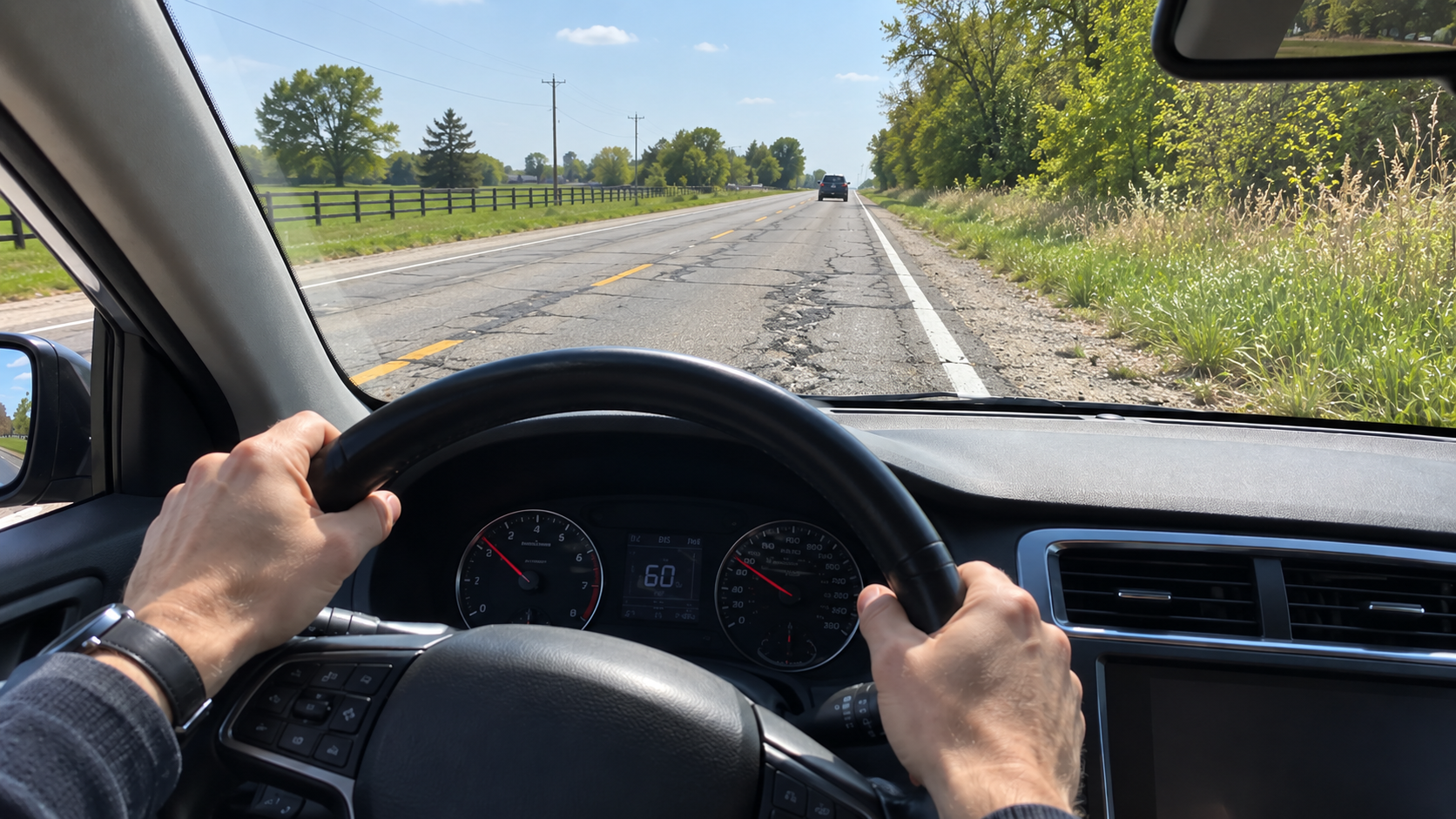
At first, it is almost impossible to notice. Around town, the car seems perfectly normal. Then you join a straighter stretch of road, increase speed and realise that the steering wheel constantly needs a small amount of pressure. If you relax that pressure, the car gradually begins moving towards the right-hand side of the road. Another car may do the opposite and keep trying to move left. The driver's first conclusion is usually immediate: “The wheel alignment needs doing.”
Sometimes that conclusion is completely correct. Incorrect wheel geometry can certainly make a car pull to one side, leave the steering wheel sitting off-centre and wear tyres unevenly. But wheel alignment is only one possible explanation.
A car can pull because one tyre is significantly underinflated. The tyre itself can create the effect even when it is brand new and looks perfect. One brake may fail to release fully and continuously drag one wheel. A pothole impact may have changed suspension geometry or bent a component. A worn bushing may allow a wheel to move under load even though the static alignment figures appear acceptable while the car is sitting on the alignment rack.
And sometimes there is nothing technically wrong with the car at all — the road's own cross slope is simply encouraging it to drift slowly towards the edge.
That is why “the car pulls to one side” is not a diagnosis. It is a symptom. Proper diagnosis begins with a much more useful question: when exactly does the car pull?
Does it happen all the time? Only while braking? Only under hard acceleration? Did it begin immediately after new tyres were fitted? Does it happen only on one particular road? Or did it start after hitting a pothole, kerb or after suspension work?
The answer to that single question is often more valuable than guessing which component should be replaced first.
Quick answer
If a car pulls to the right or left, start by checking tyre pressures and tyre condition, then pay attention to whether the pulling occurs constantly, only during braking or only while accelerating. Incorrect wheel alignment is a common cause, but a car can also pull because of tyre-generated lateral force, a dragging brake calliper, worn suspension components, geometry altered by an impact or the road's cross slope. If one brake becomes extremely hot, the car suddenly pulls hard during braking, the steering becomes unstable or the problem began after a strong impact, simply adjusting the alignment may not be enough.
The most useful diagnostic question is not “does it need alignment?”, but “under which driving conditions does the car begin pulling to one side?”
First, separate three different problems: pulling, drifting and an off-centre steering wheel
In everyday conversation, all three are often described simply as “the car pulls”. In diagnosis, however, they should be separated.
Genuine pulling to one side means that on a reasonably level surface the car requires continuous steering correction to maintain the chosen direction. The driver can feel a small but repeatable steering force.
Slow drifting can be much less pronounced. The vehicle does not sharply change direction, but over time it gradually moves towards one side of the lane. In this situation, road camber, crosswind and tyre characteristics become especially important.
An off-centre steering wheel is a different issue again. The vehicle may drive perfectly straight while the steering wheel itself is not level. This can point to incorrect toe adjustment, rear-axle thrust angle, incorrect steering-wheel centring after alignment or another geometry issue.
So “the steering wheel is crooked” and “the car pulls to the right” do not necessarily describe the same fault.
Quick diagnostic table: when does the car pull?
| Symptom | Where to look first |
|---|---|
| Pulls constantly at steady speed | Tyre pressure, tyres, road slope, alignment, suspension |
| Pulls only while braking | Brakes, calliper, brake hose, tyre grip, suspension movement |
| Pulls only under hard acceleration | Torque steer, tyre grip, driveshafts, mounts, suspension geometry |
| Started pulling immediately after tyre replacement | Tyre pressures, tyre conicity, fitting, mismatched tyres |
| Started pulling after hitting a pothole or kerb | Alignment, tyre, wheel, steering and suspension components, subframe |
| Steering wheel is off-centre but the car does not pull | Toe adjustment, steering centring, rear thrust angle |
| Pulls only on a particular road | Road crown, ruts, wind, surface differences |
| Pulls and one wheel becomes extremely hot | Dragging brake — urgent inspection required |
1. One tyre has the wrong pressure
Before booking an alignment, it is worth doing something that takes only a few minutes and costs almost nothing — measure the tyre pressures.
If the pressure in one front tyre differs significantly from the other, tyre deformation, rolling resistance, effective rolling radius and grip characteristics can all change. The result can be a tendency for the vehicle to move towards one side or at least feel noticeably less neutral.
Pressure should be compared with the tyres cold and adjusted to the vehicle manufacturer's recommendation, usually found on a label in the door opening, near the fuel filler or in the owner's manual. The maximum pressure printed on the tyre sidewall is not the normal everyday pressure recommendation for that particular vehicle.
If one tyre regularly loses pressure, repeatedly topping it up every few days is not a proper solution. The cause may be a puncture, valve problem, wheel-bead sealing issue or another leak that needs to be found.
For more on tyre pressure and its effect on vehicle behaviour and fuel use, read “How Tyre Pressure and Tyre Choice Affect Fuel Consumption”.
2. The tyre itself can be responsible — even when it is brand new
This is one of the most interesting and commonly overlooked causes. A driver fits a new set of tyres, leaves the tyre shop and immediately notices that the car now pulls to the right. The obvious conclusion is that the workshop somehow disturbed the alignment.
But a tyre itself can generate lateral force.
One phenomenon is known as tyre conicity. In very simple terms, the tyre's construction can give it a slight tendency to roll towards one side, rather like a very subtly cone-shaped object that does not naturally roll in a perfectly straight line.
This characteristic may be impossible to see. The tyre can be round, free of bulges, correctly balanced and have completely normal tread, yet still generate enough lateral force while rolling for the car to begin drifting or pulling.
Michelin tyre-diagnostic guidance notes that if tyre wear is even, alignment measurements are correct and the vehicle still pulls, changing tyre positions can help identify whether the direction of the pull changes with the tyre.
That does not mean randomly swapping wheels at home without considering the tyre design. Directional tyres must retain their correct rotation direction, asymmetric tyres must have the correct inside and outside orientation, and all-wheel-drive vehicles may have additional requirements regarding tyre size and tread-depth differences.
A very useful diagnostic clue: if the car started pulling immediately after a new set of tyres was fitted, do not automatically have the alignment adjusted three times. The tyres themselves also need to be considered.
Different tyres on the same axle can also change the way the car behaves
One new tyre paired with one heavily worn tyre, two different tyre models, significantly different tread designs or different tyre types can create different levels of grip and response. In wet conditions or during sharper manoeuvres, these differences may become much more obvious than during gentle driving.
That is why diagnosing a pull involves more than simply looking at an alignment printout. You also need to examine what is actually touching the road.
3. The wheel geometry really is incorrect
Now we reach the cause most drivers think of first — wheel alignment or wheel geometry.
In everyday language, “alignment” often refers to all wheel-geometry settings, but professional alignment work evaluates several different angles. The most important include toe, camber and caster, together with rear-axle geometry and thrust angle.
Toe
Viewed from above, toe describes whether the front edges of two wheels on the same axle point slightly towards one another or away from one another. Incorrect toe can cause rapid tyre wear and make the car feel unstable.
Camber
Viewed from the front of the car, camber describes the wheel's angle relative to vertical. Excessive deviation can affect both tyre wear and directional stability.
Caster
Caster relates to the steering-axis geometry when viewed from the side. It has a major influence on self-centring and straight-line stability. If there is a significant difference between the left and right sides, the vehicle may develop a tendency to move towards one side.
The exact interpretation of which angle causes which directional tendency on a specific car must follow the manufacturer's specifications. On some vehicles, certain geometry values are not even adjustable without replacing or modifying components.
The front axle is not the whole story
If the rear axle is not correctly aligned with the vehicle's geometric centreline, the car may effectively travel slightly sideways and require the driver to compensate with the steering wheel. That is why a proper four-wheel geometry check is often much more informative than simply adjusting the two front wheels.
Why can the car still pull after wheel alignment?
This is a common source of disagreement between drivers and workshops. The alignment has been carried out, nearly every box on the printout is green — but the car still wants to go right.
That does not automatically mean the alignment was performed badly.
An alignment machine measures wheel and suspension geometry. It does not change the internal construction of a tyre, release a seized brake calliper or restore a worn suspension bushing.
The measurement also takes place under defined static conditions. If a worn suspension component allows a wheel to move under load, the geometry while driving may differ from what the machine sees while the car is sitting still.
That is why a good workshop checks tyre pressures, tyre condition, suspension play and, where necessary, brake operation before carrying out final alignment adjustment.
If the alignment printout is “green” but the car still pulls, the diagnosis is not finished. The next suspects include tyres, dragging brakes, road conditions, suspension movement and structural damage.
4. One brake is not releasing completely
This is one cause that should not be overlooked because it is not merely a comfort or tyre-wear issue.
If the brake at one wheel fails to release fully after the pedal is released, that wheel remains slightly braked. The car then has unequal rolling resistance from side to side and may begin pulling towards one direction.
Possible causes include a sticking calliper piston, corroded slider pins, a parking-brake mechanism fault or an internally damaged brake hose that, in some cases, prevents hydraulic pressure from releasing normally.
A particularly useful clue is a significant temperature difference between wheels. If one wheel smells strongly of heat or burning after ordinary driving and is much hotter than the corresponding wheel on the other side, the brakes should be inspected immediately.
Do not touch a recently overheated brake disc or calliper with your hand. The temperature can be high enough to cause burns. If there is a strong burning smell, smoke, severe pulling or unpredictable braking, continuing to drive is not safe.
For more on squeaking brakes, vibration, a soft pedal and calliper problems, read “Brakes Squeaking, Vibrating or the Pedal Feels Soft: When Can You Drive and When Must You Stop Immediately?”.
5. The car pulls only while braking
If the vehicle drives straight at steady speed but suddenly moves towards one side when the brake pedal is pressed, the direction of diagnosis changes considerably.
You need to determine whether the two wheels on the same axle are braking with similar force. One side may have a sticking calliper, the other may be braking too weakly, a pad may be contaminated, a mechanical fault may be present or there may be a hydraulic problem.
But braking also places substantial loads on the suspension. A worn control-arm bushing or another suspension component may allow one wheel to change position under braking force. In that situation the car may pull while braking even though the brake system itself is not the only cause.
Tyre grip is another factor. One heavily worn tyre, unequal tyre pressures or very different tyre models on the same axle can create unequal braking behaviour, especially on a wet road.
6. Worn suspension or steering components change the geometry while driving
Wheel geometry is not merely a collection of numbers on a printout. Those angles are physically maintained by the parts that hold the wheel in the correct position: control arms, bushings, ball joints, tie rods, strut assemblies, the subframe and other components.
If a bushing is cracked or excessively soft, the wheel can move farther under load than the manufacturer intended. On an alignment rack, while the vehicle is standing still, the angle may appear acceptable. Under acceleration, braking or when hitting a bump, the situation changes.
That is why suspension play should be checked before final wheel-alignment adjustment. Adjusting a wheel that a worn component cannot reliably hold in position is an attempt to correct the symptom rather than the cause.
For a broader guide to clunks, wheel bearings, ball joints, bushings and other suspension symptoms, read “Car Clunking, Humming or Wandering on the Road: How to Tell Apart Shock Absorber, Bushing, Ball Joint, Tie-Rod and Wheel-Bearing Problems”.
7. A pothole, kerb impact or accident has changed more than the adjustment
There is a major difference between “the alignment has moved slightly out of specification” and “something is no longer physically located where the manufacturer intended it to be”.
A severe pothole or kerb impact can damage a tyre, bend a wheel, tie rod, control arm or another component. In a more serious case, the subframe may have shifted or the car may be showing the consequences of previous structural body damage.
If the car suddenly begins pulling after an impact and the steering wheel is no longer centred, simply asking a workshop to “adjust the alignment” is not the best first step. The system being adjusted must first be confirmed to be mechanically sound.
An alignment machine can actually become a useful diagnostic tool here. If one angle cannot be brought into the manufacturer's specification using the intended adjustments, that may be a reason to look for a bent or displaced component.
8. The car pulls only when accelerating hard
If the vehicle drives straight under gentle conditions but the steering wheel begins tugging towards one side when the accelerator is pressed hard, this is not necessarily a classic alignment fault.
Front-wheel-drive cars, especially powerful ones, can display a phenomenon known as torque steer under strong acceleration. It is influenced by drivetrain layout, driveshaft geometry, differences in tyre grip, road surface and suspension condition.
A mild amount of torque steer can be a design characteristic on some powerful front-wheel-drive vehicles. But if the car previously accelerated straight and has suddenly begun pulling the steering wheel sharply, the change should not be dismissed with “all front-wheel-drive cars do that”.
Tyres and their pressures, suspension bushings, engine and transmission mounts, driveshafts and other components that can change position under load should all be inspected.
If the pulling under acceleration is accompanied by vibration, see “Steering Wheel Vibrates at 90–120 km/h: How to Distinguish Tyre, Wheel, Balancing, Brake and Suspension Problems”.
9. The road is responsible, not the car
This is an important possibility, otherwise a perfectly healthy vehicle can be adjusted repeatedly in an attempt to eliminate something that is not actually a fault.
Many roads are not completely level from side to side. The surface is built with a slight cross slope so rainwater can drain away rather than collecting on the carriageway. In technical English, this is often referred to as the road crown.
On such a surface, even a technically healthy car may have a slight tendency to follow the road slope. In countries with right-hand traffic, this commonly means a mild tendency to drift towards the right-hand side.
Crosswinds, wheel ruts, grooves in the asphalt and different road surfaces beneath the left and right tyres can also influence vehicle direction.
For that reason, a professional road test evaluates pulling on a reasonably level and safe road, sometimes comparing the vehicle's behaviour in different directions and on different road sections.
Do not test whether the car pulls by taking both hands off the steering wheel for an extended period on a public road. The driver must remain in full control of the vehicle. The aim is to identify steering correction effort, not to see how far the car will travel without hands on the wheel.
The car pulls to the right — is that always “normal because of the road crown”?
No. That is the opposite extreme of the same myth.
A mild tendency to follow the road slope can be normal. But if the vehicle requires constant and noticeable steering effort, changes its lane position quickly, wears tyres unevenly or shows the same strong pull on a genuinely level surface, “the road is sloping” is no longer a sufficient explanation.
It is particularly suspicious when the problem appears suddenly. The road crown did not suddenly change on the same day that you hit a pothole or fitted a new set of tyres.
What can tyre wear tell you about the problem?
Tyre tread is a kind of record of how the car has been operating. It cannot tell you everything, but it sometimes leaves very useful clues.
| Wear pattern | What is worth checking |
|---|---|
| One edge of a tyre is much more worn | Camber, toe, suspension, operating conditions |
| Tread feels feathered or saw-toothed | Toe and suspension condition |
| One front tyre has worn very differently from the other | Pressure, geometry, suspension, tyre construction |
| Car begins pulling with a new set of tyres before any wear appears | Tyre lateral force/conicity, pressure, fitting |
| Visible bulge, deformation or exposed carcass | Tyre needs immediate assessment; driving on a structurally damaged tyre is unsafe |
Wheel balancing and wheel alignment are not the same thing
Another very common conversation at a workshop goes something like this:
“The car pulls to the right. The wheels need balancing.”
Wheel balancing and wheel geometry address different problems.
Balancing compensates for uneven mass distribution within the tyre-and-wheel assembly. A classic symptom of imbalance is vibration within a particular speed range.
Wheel alignment concerns the angles and position of the wheels relative to the vehicle and road. Incorrect geometry can cause pulling, an off-centre steering wheel and abnormal tyre wear.
Of course, both faults can exist on the same car at the same time. A wheel can be poorly balanced while the vehicle also has incorrect alignment. But balancing by itself is usually not the cure for a car that consistently pulls in one direction.
Can incorrect wheel alignment increase fuel consumption?
Yes, although it is important not to promise dramatic fuel savings after every alignment adjustment.
Correctly aligned wheels roll in the direction and at the angles intended by the manufacturer. If geometry is significantly incorrect, tyres may not simply roll freely but can partially scrub against the road surface, increasing tyre wear and unnecessary rolling resistance.
Continental notes that correct wheel geometry helps preserve tyre life, handling and vehicle efficiency.
But if a car's alignment was already close to specification, adjustment is not a secret way to reduce fuel consumption by a litre per 100 kilometres. The largest practical benefit is often more even tyre wear and more predictable handling.
Do you need wheel alignment after every tyre change?
Simply changing seasonal wheels does not physically alter suspension geometry. There is therefore no rule of physics saying that alignment must automatically be adjusted every time winter and summer wheels are swapped.
However, tyre replacement is an excellent opportunity to assess alignment condition, particularly if the old tyres show uneven wear, the steering wheel is not centred or the car pulls to one side.
If an expensive new set of tyres is being fitted, it can be economically sensible to confirm that poor geometry will not begin damaging them unevenly within the first few thousand kilometres.
When is wheel alignment definitely worth checking?
- The car consistently pulls left or right on a reasonably level surface.
- The steering wheel is no longer level while driving straight.
- The tyres are wearing unevenly or unusually quickly.
- The vehicle has suffered a strong pothole or kerb impact.
- Steering or suspension components that affect geometry have been replaced.
- The car no longer drives the same way after a repair.
- A new set of tyres has been fitted and you want to make sure it will not wear unevenly.
What should you tell the workshop instead of simply saying “do the alignment”?
The more precisely you describe the symptom, the more useful the diagnosis can be.
Instead of simply saying “it pulls right”, explain:
- whether it pulls at steady speed;
- whether the pull becomes stronger while braking;
- whether it appears only under acceleration;
- whether it began after tyre replacement;
- whether you recently hit a major pothole;
- whether the steering wheel sits off-centre;
- whether one tyre is wearing differently;
- whether one wheel seems unusually hot after driving.
If alignment work is carried out, it is worth asking for the before-and-after printout. This shows not only the final measurements but also what had changed before the adjustment.
Does “green” on the alignment printout always mean perfect?
Not necessarily. A green field generally means that a particular measurement falls within the manufacturer's specified tolerance. That is important information, but it is not the only information.
For example, both sides may individually fall within specification while the difference between left and right remains relevant to the diagnosis. A conventional alignment machine also cannot remove lateral force generated by a tyre.
That is why manufacturer technical procedures for pull diagnosis typically include more than geometry measurements: tyre pressure, tyre condition, a road test and, when required, evaluation of tyre influence are also part of the process.
When should you stop driving a car that pulls to one side?
A mild, long-standing tendency on a level road is very different from sudden severe pulling. In the second situation, safety becomes the priority.
It is better to stop driving, or continue only as far as a safe stopping place, if:
- the car suddenly begins pulling very strongly to one side;
- the steering becomes unstable or develops excessive free play;
- the pulling began immediately after a severe pothole or kerb impact;
- a tyre has a visible bulge, split or other deformation;
- one wheel is severely overheated, smells of burning or is producing smoke;
- the car pulls sharply during braking and can no longer be controlled predictably.
A five-minute check before visiting a workshop
You cannot accurately measure caster or rear thrust angle in your driveway, but you can collect extremely useful information before going to a workshop.
- Measure all four tyre pressures when cold.
- Inspect the tyres. Look for deformation, unusual wear and different tyre models on the same axle.
- Remember when the problem began. After a tyre change, pothole, repair or gradually?
- Identify the driving condition. Does it pull constantly, while braking or while accelerating?
- Check the steering-wheel position. Is it level while the car is travelling straight?
- After normal driving, pay attention to unusual heat or a burning smell around the wheels. Do not touch the brake discs.
- Compare the behaviour on more than one normal road section. One heavily crowned road is not enough for a diagnosis.
Mini test: what would you check first?
The car started pulling right the day after a new set of tyres was fitted
Check tyre pressures, correct fitting and the tyres themselves first. If the alignment was previously good and the symptom appeared exactly when the new tyres were installed, tyre-generated lateral force becomes a very useful diagnostic hypothesis.
The car drives straight but pulls sharply left when you press the brakes
Brake and suspension inspection should take priority over a simple alignment adjustment. Braking force may differ between the two sides, or a worn suspension component may move under braking load.
The car pulls slightly right only on one particular motorway section
Before looking for a mechanical fault, compare the vehicle's behaviour on another road that is as level as reasonably possible. Road crown and wheel ruts can create a pulling sensation even in a technically healthy vehicle.
Every value on the alignment printout is green, but the car still pulls
That does not mean the symptom is imaginary. Tyre influence, dragging brakes, suspension play and the conditions of the road test should also be checked. Wheel geometry is only one part of the complete system.
After hitting a pothole, the steering wheel became off-centre and the car started pulling
The tyre, wheel, steering and suspension should be inspected together with a geometry measurement. A strong impact can do more than simply alter adjustment — it can physically bend or move a component.
The car pulls and after ten kilometres there is a burning smell from one wheel
A dragging brake or another fault producing excessive heat is a strong possibility. This is not a symptom to solve with alignment alone. The car should be inspected before returning to normal use.
Myths and facts
| Claim | Myth or fact? | Explanation |
|---|---|---|
| If a car pulls to one side, the wheel alignment is always wrong. | Myth | Tyres, brakes, suspension, the road and other factors can also cause pulling. |
| A brand-new tyre can make a car pull to one side. | Fact | Tyre construction can generate lateral force through conicity or related effects even when no visible damage is present. |
| Green figures on the alignment printout prove that the car cannot pull. | Myth | Pulling can be caused by factors that ordinary alignment-angle measurement does not correct. |
| Road crown can cause a mild drift towards the edge of the road. | Fact | That is why professional pull diagnosis is carried out on an appropriate road and compared under different conditions. |
| Wheel balancing and wheel alignment are the same thing. | Myth | Balancing corrects uneven mass distribution; alignment concerns wheel geometry. |
| A sticking brake calliper can cause a car to pull to one side. | Fact | If one wheel is continuously being braked, unequal resistance and excessive heat can result. |
| If a car pulls only under hard acceleration, it definitely needs alignment. | Myth | Torque steer, tyre grip, driveshafts, mounts and suspension movement should also be considered. |
Frequently asked questions
Why does my car pull to the right?
Possible causes include road crown, unequal tyre pressure, tyre construction, incorrect wheel geometry, a dragging brake or suspension damage. If the pull is pronounced and repeats on a level surface, the car should be diagnosed.
Why does my car pull to the left?
The same causes can make a car pull left. The direction alone does not identify the failed component. It is more important to determine whether the symptom is constant, happens under braking or acceleration, or began after a particular repair or tyre change.
Can tyre pressure make a car pull to one side?
Yes. A significant pressure difference from side to side changes tyre deformation and rolling behaviour. Tyre pressure is therefore one of the first and easiest things to check.
Why does the car still pull after wheel alignment?
Tyres, brakes, suspension components, road crown or physical damage can all cause pulling even when geometry measurements are within specification. The before-and-after printout and a proper road test should also be considered.
Why does the car pull only when braking?
Differences in braking force, calliper operation and hydraulic function should be checked first. Suspension bushings and other components that can allow the wheel to move under braking load should also be inspected.
Why does the car pull only when accelerating?
Torque steer is possible on front-wheel-drive cars, but tyre grip and pressure differences, driveshafts, engine and transmission mounts and suspension components should also be checked.
Do I need wheel alignment after fitting new tyres?
Installing new tyres does not itself alter suspension geometry, but it is a good opportunity to check alignment, particularly if the old tyres wore unevenly, the car pulls to one side or the steering wheel is off-centre.
Can incorrect wheel alignment increase fuel consumption?
Significantly incorrect geometry can increase unnecessary tyre scrub and wear and may therefore reduce efficiency. However, dramatic fuel savings should not be expected after adjusting a vehicle whose geometry was already close to specification.
Conclusion
“The car pulls to one side” sounds like a very simple fault. That is exactly why the first proposed solution is so often equally simple: book an alignment, adjust a few settings and hope the problem disappears.
Sometimes that is exactly what happens.
The situation becomes much more interesting when the car still pulls afterwards. At that point, what seemed like one of the simplest handling problems reveals itself as the meeting point of several different systems.
Tyres are the first. One significantly underinflated tyre can alter the car's behaviour. The construction of a tyre itself can create lateral force even when the tyre is brand new. Two different tyres on the same axle can respond to the road differently.
Then comes geometry. Camber, caster, toe and rear-axle thrust angle determine how the wheels sit relative to the car and the road. A pothole impact or worn component can alter this geometry, and in some cases the relationship between the left and right sides matters just as much as the individual numbers.
Brakes add another dimension. If the car drives perfectly straight until the brake pedal is pressed, the diagnostic direction changes completely. If one wheel is extremely hot after driving, the alignment machine is no longer the first tool that should be used.
The suspension reminds us that the vehicle does not spend its life standing on an alignment rack. It brakes, accelerates, crosses potholes and experiences lateral forces. A bushing that still holds the wheel in an acceptable static position may allow far more movement once the car is actually being driven.
Finally, there is the road itself. A perfectly flat test surface is uncommon in everyday traffic. Road crown, ruts or crosswinds can create a tendency that a driver may mistake for a mechanical defect.
That is why the best diagnostic method is not to guess a failed part based on the direction of the pull. It is to observe the pattern.
Does it pull constantly? Look at tyres, the road and geometry. Does it pull while braking? Look at brakes and suspension. Does it pull only at full throttle? Think about drivetrain behaviour, tyres and dynamic suspension movement. Did it start on the exact day new tyres were fitted? The tyres become a much stronger suspect. Did it begin immediately after a pothole impact? Check whether something has been physically damaged.
Following that sequence helps avoid the most expensive form of diagnosis — replacing parts based on guesswork.
Driver's short takeaway: if the car pulls to the right or left, begin with cold tyre pressures and a tyre inspection. Then determine whether it pulls constantly, while braking or while accelerating. Wheel alignment is a common cause, but it is not the only one — tyres themselves, dragging brakes, worn suspension, impact damage or the road slope can all create the same symptom. If one wheel overheats, the car suddenly pulls hard under braking or the problem began after a major impact, the vehicle needs a mechanical inspection rather than alignment alone.
Sources and technical note
The technical information in this article was checked against Continental material on wheel geometry, camber, caster and toe, warning signs of incorrect alignment and the effects on tyre wear and handling; Michelin tyre-diagnostic recommendations covering vehicle pull and the use of tyre-position changes to identify tyre-generated lateral force; Hunter Engineering wheel-alignment material; and vehicle-manufacturer technical service information covering road crown, tyre conicity, unequal tyre condition, suspension faults and pulling during braking or acceleration. The exact interpretation of wheel-alignment measurements and available adjustment methods always depends on the specifications for the particular vehicle.