
 LV
 EN
 RU
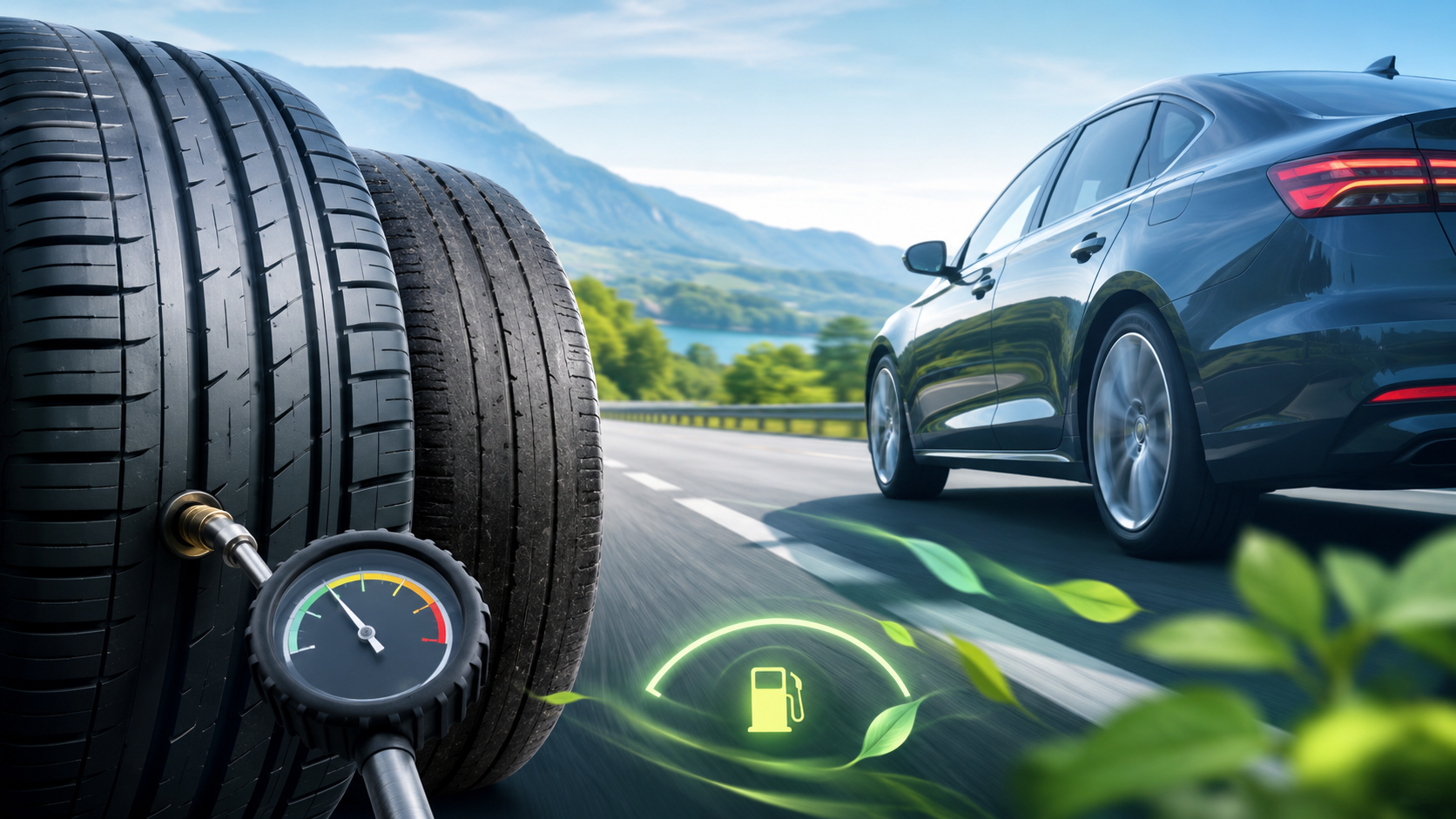
There are car-related topics drivers talk about all the time. The engine, gearbox, fuel prices, traffic jams, air conditioning, cruise control, warming up the car in winter, driving style. But there is one thing that often stays in the background, even though it literally keeps the whole car connected to the road. Tyres.
For many drivers, tyres feel like a simple and obvious part of the car. Black rubber circles that simply rotate. If they are not flat, if the tread still looks acceptable and if the car passes inspection, everything seems fine. But in reality, tyres are much more important than just “making the car move”. They affect braking, handling, comfort, road noise, safety in rain and winter conditions, and one very practical thing — fuel consumption.
And this is where the topic becomes interesting. Because the effect of tyres on fuel consumption is usually not dramatic during one single trip. You will probably not drive into a fuel station and suddenly think: “Wow, I inflated my tyres yesterday and now the car uses one litre less per 100 km.” That is not usually how it works. The effect of tyres is quieter, slower and more deceptive. It builds up every day, every kilometre, every time the car rolls on tyres that are slightly underinflated, too heavy, too wide, unsuitable for the season, badly worn or simply not the right choice for your car.
That is why this article is not only about how many bars of pressure you should put into your tyres. That would be too simple. This article is about the bigger picture: how tyres resist movement, why low tyre pressure makes the engine work harder, how tyre size can increase consumption, how summer, winter and all-season tyres differ in daily costs, how tread condition affects not only safety but also your wallet, and why “cheap tyres” are not always the cheapest solution.
A typical driver comment: “I always thought my car simply used too much fuel. Then I inflated the tyres properly, checked the wheel alignment and suddenly realised that part of the problem was not the engine — it was the tyres.”
Why do tyres affect fuel consumption at all?
To understand the impact of tyres on fuel consumption, we first need to remember one simple fact: a car never rolls without resistance. Even when the road looks smooth, the engine is constantly fighting several forces. There is air resistance, vehicle weight, acceleration, road incline, mechanical losses in the transmission and also tyre rolling resistance.
Rolling resistance is the energy the car loses because the tyre touches the road, deforms, heats up and then returns to its shape again. Every time the tyre meets the asphalt, its rubber and internal structure “work”. It is not a solid metal wheel. It is a flexible component. And this flexibility is very important for safety and comfort, but it also consumes energy.
If the tyre is correctly inflated and suitable for the car, these losses are normal. If the tyre is too soft, too wide, heavy, old, unsuitable for the season or poorly designed, rolling resistance can increase. The engine compensates for that with fuel. In other words, you pay for the fact that the car is harder to roll.
This is one of those things the driver often does not feel immediately. A soft tyre does not always make the car shake or loudly warn you that something is wrong. Sometimes the car simply becomes a little slower, a little heavier, a little more fuel-hungry. And that is exactly why the tyre effect on fuel consumption is so easy to ignore.
Low tyre pressure: the silent fuel thief
The most common problem is not complicated. It is low tyre pressure. Not necessarily a completely flat tyre. Not necessarily a dangerous situation where the car pulls strongly to one side. Often we are talking about what looks like a small difference — for example, 0.2 or 0.3 bar below the manufacturer’s recommended pressure.
From the driver’s point of view, that may seem minor. The tyre is not flat. The car drives. The warning light on the dashboard may not even come on. But physics notices it immediately. When the pressure is too low, the tyre flattens more where it meets the road. Deformation increases, heat build-up increases and rolling resistance increases. The engine has to do slightly more work to maintain the same speed.
It is similar to riding a bicycle with tyres that are not properly inflated. You can still ride. Nothing dramatic happens. But every pedal stroke requires more effort. With a car, the same thing happens, only instead of your legs doing the work, the engine does it — and that work is paid for at the fuel station.
A good mechanic’s comment: “People often start looking for problems in injectors, the turbo or electronics, but sometimes the first thing to do is simply check tyre pressure. It is the cheapest test many drivers skip.”
Of course, this does not mean that every tiny pressure drop will instantly double your fuel consumption. No. But over the long term, small losses become important. If a car is driven every day with underinflated tyres, over a month, a season or a year it means extra fuel, faster tyre wear and sometimes worse handling as well.
Why does a soft tyre use more energy?
To understand this very simply, imagine a tyre as a flexible cushion between the car and the road. If this cushion has the correct firmness, it supports the weight of the car and rolls with controlled deformation. If it is too soft, it compresses more with every rotation, bends more and heats the rubber more.
Energy does not disappear. If the tyre heats up more, that energy has come from somewhere. It has come from the work done by the engine. And the engine’s work is largely paid for with fuel. That is why a soft tyre is not only a comfort issue. It is a small but constant energy leak.
Low pressure also usually damages the tyre mechanically. It wears more on the edges, can overheat, may become less stable in corners and may react worse in sudden situations. That means you can lose twice: first in fuel, and later in tyre lifespan.
This is especially important for people who drive a lot in the city. In the city, the car often accelerates, brakes, turns, drives over potholes and hits kerbs. A soft tyre suffers more in this environment than during calm highway driving. That is why tyre pressure is not less important for city drivers — often it is even more important.
Does higher pressure always mean lower fuel consumption?
This is where an important warning is needed. If low tyre pressure increases consumption, some drivers get a tempting idea: “So I should simply inflate the tyres more, and the car will roll even more economically.” In theory, an overly hard tyre can reduce some deformation, but that does not mean it is a smart or safe choice.
The car manufacturer does not specify tyre pressure randomly. It is a compromise between fuel economy, grip, comfort, tyre wear, braking and vehicle handling. If the pressure is too high, the tyre may wear unevenly in the centre, the car may feel harsher, grip on uneven or wet roads may become worse and braking feel may become less predictable.
That is why the correct answer is not “inflate more”. The correct answer is “inflate correctly”. That means using the manufacturer’s recommended pressure for the specific car, tyre size and load. Some cars require different pressure in the front and rear tyres. Some have different values for an empty car and a fully loaded car. Some also have “eco” pressure recommendations, but even those should be used sensibly.
An experienced driver’s comment: “I used to inflate my tyres a bit more on purpose. Then I realised the car became harsh, the tyres wore in the centre and I did not feel as confident in the rain. That kind of economy is not worth it if confidence on the road disappears.”
Where can you find the correct tyre pressure?
The correct tyre pressure is not the maximum pressure written on the sidewall of the tyre. This is a very common mistake. The tyre sidewall may show the maximum permitted pressure, but that is not the everyday recommendation for your car. The correct value must be taken from the vehicle manufacturer’s information.
You can usually find the tyre pressure table in one of these places:
- on a sticker near the driver’s door frame;
- inside the fuel filler flap;
- in the vehicle owner’s manual;
- in the manufacturer’s technical documentation;
- sometimes also in the car’s multimedia system or onboard computer.
There are usually several scenarios listed. For example, pressure for normal load, pressure for full load, pressure for front and rear tyres, and sometimes different values for different tyre sizes. This matters because a car with one person inside is not the same as a car with four passengers, a full boot and a roof box.
A very practical example: if you usually drive alone in the city, standard pressure may be enough. But if you are going on a long trip with family, luggage and a heavily loaded car, the rear tyres often need higher pressure. If you do not adjust it, the car becomes heavier to roll, the tyres deform more and fuel consumption may increase.
Tyre pressure should be measured when the tyres are cold
Another thing many drivers ignore: tyre pressure should be measured when the tyres are cold. That means before a longer drive or after the car has been standing for some time. When you drive, the tyres heat up and the pressure inside them rises. If you measure pressure after active driving, the reading may be higher than the true cold pressure.
In practice, this means something simple: if possible, check your tyres in the morning or before driving, not after 50 kilometres on the highway. If the check is done at a fuel station a couple of kilometres away, that is usually not a major problem. But after a longer and faster drive, interpreting tyre pressure becomes less precise.
Season also matters. When the temperature drops, tyre pressure usually decreases. That is why in autumn and at the beginning of winter many drivers suddenly see the tyre pressure warning light on the dashboard. The tyre is not always punctured — the air simply contracts in colder weather and the pressure drops. But that does not mean the warning should be ignored. The pressure still needs to be corrected.
A very typical autumn comment: “Everything was fine in summer, but in October the tyre pressure light suddenly came on.” Often it is not a mystery. It is temperature.
How often should tyre pressure be checked?
In an ideal world, tyre pressure would be checked regularly, not only when something already looks wrong. A practical minimum for everyday drivers is once a month and before longer trips. If the car stands for long periods, drives on pothole-heavy roads, carries heavy loads or the tyres are already older, checks may be needed more often.
It is also important to check the spare wheel, if the car has one. People usually remember it only when a problem has already happened. But a flat spare wheel is almost as useless as no spare wheel at all. A repair kit or compressor should also be checked, because when the tyre is already damaged, theory no longer helps.
If one tyre keeps losing pressure regularly, that is not normal. It may be a faulty valve, a slow leak, a nail in the tread, corrosion on the rim or poor sealing between the tyre and the wheel. This should not simply be solved by inflating the tyre again and again. If a tyre loses pressure every week, it needs to be checked at a service centre.
Tyre choice: how can one tyre be more economical than another?
Now let us move to the second big topic — tyre choice. Even if the pressure is perfect, different tyres can roll differently. One tyre may be designed with sporty grip in mind. Another may focus on low noise. Another may focus on long life. Another may focus on lower rolling resistance and fuel economy. Each of these compromises gives something and takes something away.
A more economical tyre usually means lower rolling resistance. That means the car uses less energy to roll the tyre along the road. But it is important not to fall into the simple idea that low rolling resistance is always the only thing that matters. A tyre must do several jobs at the same time. It must brake in wet weather, keep the car stable in corners, offer enough stability, survive real road conditions and suit the season.
That is why good tyre choice is not only about asking: “Which tyre will save the most fuel?” A better question is: “Which tyre gives the best balance between safety, cost and fuel consumption for my driving style, routes and car?”
EU tyre label: what does it tell you about fuel economy?
When buying tyres in Europe, drivers can see a tyre label that rates several things, including fuel efficiency, wet grip and external rolling noise. The fuel efficiency rating is linked to the tyre’s rolling resistance. The lower the rolling resistance, the more the tyre can theoretically help the car use less energy.
However, this label must be read intelligently. If one tyre is very good for fuel economy but weaker in wet braking, it is not automatically the best choice for real everyday driving. We have rain, autumn leaves, temperature changes, gravel roads, potholes, snow, slush and very changeable conditions. Fuel savings are nice, but they should not come at the cost of safety.
A good practical rule: when choosing tyres, do not look only at one letter or one price. Look at the whole picture. Fuel efficiency is important, but it should come together with decent wet grip, suitable seasonal performance, a reliable manufacturer and real-world reviews or test impressions.
A good buyer’s comment: “I used to buy tyres only by price. Now I also look at the label, wet grip and noise level. Fuel economy is great, but it matters more to me that the car stops confidently in rain.”
Tyre width and size: do larger wheels increase consumption?
Many car owners like larger wheels and wider tyres. The car looks sportier, its stance becomes more aggressive and visually it may look much better. But from a fuel economy point of view, bigger and wider are not always friends.
A wider tyre often means a larger contact area with the road. That can help grip in certain conditions, but it can also increase rolling resistance and aerodynamic drag. Larger wheels are often heavier, and lower-profile tyres can be harsher, more expensive and more sensitive to potholes. In addition, a heavier wheel means more mass that must be accelerated and slowed down.
This does not mean that beautiful wheels are bad. It means they have a price. Not only at the moment of purchase, but also in everyday driving. Wider tyres may cost more, wear faster, create more noise and in some cases increase fuel consumption. If the car is used mainly for daily driving rather than sporty driving, the manufacturer’s recommended practical size is often much wiser than the largest size that “looks good”.
A very practical example: if a compact or mid-size car gets significantly larger wheels with wider tyres, it may look better. But if you drive daily on rough city roads, sit in traffic and mostly move with normal traffic flow, the benefit may be more emotional than practical. In terms of fuel consumption and comfort, it may not be the best decision.
Summer, winter and all-season tyres: where does the consumption difference hide?
Tyre season is not just a formality. It is a very practical thing. A summer tyre is designed for warmer asphalt, rain and summer temperatures. A winter tyre is designed for cold weather, snow, ice and slush. An all-season tyre tries to combine both worlds, and that is exactly why it is always a compromise.
From a fuel consumption point of view, winter tyres can often feel slightly heavier. They have a softer rubber compound, a more aggressive tread pattern and often more deformation. This is necessary for grip in cold weather, but it can increase rolling resistance. That is why many drivers notice that fuel consumption rises in winter. Of course, tyres are not the only reason — a cold engine, heating, denser air, snow, traffic jams and short trips also play a big role. But tyres are one part of the picture.
Driving on winter tyres in summer is usually not good economy. They can wear faster, become too soft, create more noise, brake worse in hot weather and increase fuel consumption. Sometimes a driver thinks: “I will finish off these winter tyres in summer and save money.” But that saving can be misleading if the tyres wear faster, the car uses more fuel and safety becomes worse.
All-season tyres can be a very reasonable solution for certain drivers — especially those who drive little, mostly in the city, do not drive aggressively and can avoid difficult winter conditions. But if you regularly drive outside the city, on poorly cleared roads or in severe cold, a good winter tyre will often be the safer choice. Fuel consumption matters, but in winter grip can sometimes matter more than a few saved euros.
Tread: safety, fuel consumption and the illusion of “still good enough”
Tread is another topic where drivers often look too superficially. If the tyre is not completely bald, it seems to still be usable. But tread depth is not just a technical inspection formality. It affects water evacuation, grip, braking, stability and the way the tyre behaves in different conditions.
In Latvia, the minimum tread depth for summer tyres on passenger cars is 1.6 mm, while during the mandatory winter tyre period winter tyres for vehicles up to 3.5 tonnes must have at least 4 mm of tread. But practical safety and the legal minimum are not the same thing. Just because a tyre still formally meets the requirement does not mean it is good in rain, on the highway or during sudden braking.
From a fuel consumption perspective, a worn tyre may sometimes seem to “roll easier” because there is less tread. But that is a very dangerous way to think about economy. If safety decreases, the risk of aquaplaning increases or braking distance in wet weather becomes longer, fuel savings are not a valid argument. The main job of a tyre is not to save the last few cents. The main job of a tyre is to keep the car on the road.
A very honest driver comment: “I used to drive tyres until the very end. Now I understand that one rainy braking moment can cost more than a new set of tyres.”
Uneven wear: when the problem is not only the tyres
If tyres wear unevenly, it often means something is not right with the car. It may be incorrect pressure, bad wheel alignment, worn suspension components, faulty shock absorbers or the wrong tyre size. This can affect not only tyre life but also fuel consumption.
For example, if wheel alignment is incorrect, the tyres may not roll smoothly but instead slightly “drag” along the road. You may feel it as the car pulling to one side, imprecise steering or uneven tyre wear. But even if the feeling is not dramatic, the car may use more fuel because movement becomes less efficient.
This is especially important after hitting potholes, kerbs, suspension repairs and tyre changes. If the car suddenly starts behaving strangely, the steering wheel is not straight or the tyres start wearing on one side, do not wait until the next season. A wheel alignment check can be much cheaper than prematurely ruining a set of tyres and burning extra fuel for months.
How much money can disappear because of tyres?
Now let us look at it practically. Suppose a car uses 7 litres per 100 km on average and drives 15,000 km per year. That means around 1,050 litres of fuel per year. If tyre pressure, tyre choice or rolling resistance together increase consumption by only 3%, that is around 31.5 extra litres per year.
If fuel costs, for example, €1.70 per litre, that is more than €50 per year. That may not sound like a huge amount. But this is only one relatively mild scenario. If the car drives more, the tyres are very unsuitable, pressure is low for a long time or bad alignment is added to the problem, the amount can be higher. And faster tyre wear must also be added.
This is where the big conclusion appears: tyre pressure and tyre choice rarely make one single trip dramatically cheaper. But they make the whole car more efficient as a system. It is the kind of saving you do not feel as one big victory, but you see it over a longer period.
Simple example:
If tyres cause the car to use only 0.2 l/100 km more, then over 15,000 km per year that is 30 extra litres. If fuel costs €1.70/l, that is €51 per year. If faster tyre wear is added, the real difference becomes even bigger.
The cheapest tyres are not always the cheapest in the long run
Buying tyres is a moment when many drivers look only at the price. That is understandable. A set of tyres is not cheap, especially if the car uses a larger size. But the problem begins when price becomes the only criterion.
A very cheap tyre may be noisier, have weaker grip, higher rolling resistance or a shorter lifespan. If it uses slightly more fuel, wears faster and behaves worse in wet weather, the initial saving may disappear. Sometimes a more expensive but higher-quality tyre is cheaper in the long run because it lasts longer, rolls more efficiently and gives a safer feeling.
This does not mean everyone must buy the most expensive tyres. No. But it is worth looking for a sensible middle ground. Good mid-range tyres from a reliable manufacturer can often be a much smarter choice than the cheapest unknown option. Especially if you drive every day, carry family members or spend a lot of time on highways.
A good tyre seller’s comment: “A person buys the cheapest set and is happy to save €80. Then for two seasons they drive with more noise, weaker grip and faster wear. It is not always a real saving.”
Are fuel-efficient tyres always the best choice?
There are tyres specifically designed for lower rolling resistance. They are often advertised as economical, efficient or more environmentally friendly. For many drivers they can be a very good choice, especially if driving is calm, daily routes are predictable and the car is not used for sporty driving.
But balance matters here as well. If an economical tyre rolls well but you need maximum wet grip, frequent highway driving or difficult winter performance, the whole package must be evaluated. Fuel economy is one criterion, not the only criterion.
Practically speaking, fuel-efficient tyres fit best for drivers who drive calmly, mostly on asphalt, keep tyre pressure correct and want to reduce everyday costs without sporty driving ambitions. But if a person drives dynamically, often on wet or poor roads, safety and grip should still come first when choosing tyres.
Tyre age: even if the tread remains, rubber gets old
Another thing often forgotten is tyre age. A tyre may look acceptable, the tread may not be completely worn, but rubber ages over time. It becomes harder, may lose elasticity, crack and provide worse grip. This is especially important for winter tyres, because rubber flexibility is very important in cold conditions.
From a fuel consumption point of view, an old and hard tyre may sometimes seem to roll more easily, but that is not healthy economy. If the tyre brakes worse, grips worse on wet or cold roads and gives less confidence, it is no longer a good tyre. Car economy without safety is not real economy.
The age of a tyre can be checked by the DOT marking on the sidewall. It usually shows the production week and year. For example, if you see a four-digit code where the last two digits indicate the year, you can understand how old the tyre is. This is especially important when buying used tyres or “new” tyres with a big discount that have actually spent several years in storage.
Driving style and tyres: one does not work without the other
Even the best tyres cannot save fuel if the driving style is aggressive. Fast starts, late braking, sharp cornering, constant speed changes and excessive highway speed will consume more fuel regardless of the tyres fitted. But tyres can make this situation better or worse.
For example, underinflated tyres deform and heat up even more during aggressive driving. Wider tyres can increase resistance at higher speeds. Winter tyres in summer can wear very quickly under dynamic driving. Incorrect alignment combined with aggressive driving can destroy the tread surprisingly fast. That is why tyres and driving habits must be viewed together.
If you really want to reduce fuel consumption, tyres should be treated as part of the system. Correct pressure, suitable tyres, good alignment, calm driving and sensible speed together give much more than one separate trick.
A practical tyre check routine for everyday drivers
To prevent tyres from becoming a hidden fuel thief, you do not need to be a mechanic. A simple routine is enough. The key is to do it regularly, not only before inspection or when the tyre already looks suspicious.
- Check tyre pressure once a month. Do it when the tyres are cold and use the manufacturer’s recommended values.
- Adjust pressure for load before longer trips. If the car will be full, check whether the manufacturer recommends higher pressure.
- Check the tread. Look not only at depth, but also at whether the tyres are wearing evenly.
- Pay attention to how the car behaves. If the car pulls to one side or the steering wheel is not straight, check wheel alignment.
- Do not drive on winter tyres in summer without a serious reason. It can be more expensive than it first seems.
- Do not buy tyres only by price. Also look at fuel efficiency, wet grip, noise level and suitability for your driving style.
- Check tyre age. Especially if you buy used tyres or tyres with a very large discount.
The short formula:
Correct pressure + suitable tyre type + healthy tread + proper alignment + calm driving = lower consumption and a safer car.
Common myths about tyres and fuel consumption
Myth No. 1: “If the tyre does not look flat, the pressure is fine.”
In reality, it is very difficult to judge pressure visually. A tyre may look normal but still be below the recommended value. Pressure should be measured with a gauge, not with your eyes.
Myth No. 2: “The more I inflate the tyres, the less fuel the car will use.”
Too much pressure can reduce grip, comfort and even tyre wear quality. The goal is not maximum pressure, but the manufacturer’s recommended pressure.
Myth No. 3: “All tyres are the same, only the price differs.”
Tyres differ greatly in construction, rubber compound, wet grip, rolling resistance, noise and lifespan. Price is only one of the criteria.
Myth No. 4: “Winter tyres in summer save money because I do not need to buy summer tyres.”
Sometimes it looks like a saving, but winter tyres in summer can wear faster, brake worse and increase fuel consumption. In the long run, it can be a poor deal.
Myth No. 5: “Tyre pressure is not important if the car has a tyre pressure monitoring system.”
The system helps, but it does not replace regular checks. In some cars, the warning appears only when the pressure drop is already significant.
How to choose tyres if you want to spend less on fuel?
If fuel economy is important to you, tyre choice should be based on five practical criteria. First, choose a manufacturer-approved size, not just the biggest option visually. Second, check the tyre label and fuel efficiency class. Third, do not ignore the wet grip rating, because that is a safety issue. Fourth, choose tyres that match the season and your real routes. Fifth, think about total cost, not only the purchase price.
A very good question to ask before buying is: “Where do I actually drive?” If you mostly drive calmly in the city and cover short distances, you need a different tyre than someone who drives on highways every day. If you often drive on regional roads where winter conditions are more difficult, an economy tyre with weaker winter performance may not be a smart choice. If you drive many kilometres per year, rolling resistance and tyre lifespan become especially important.
And one more thing: do not treat tyres as an isolated purchase. Tyres are part of the car’s cost system. They affect fuel, repairs, safety, comfort and confidence on the road. If you save in the wrong place on tyres, you may pay later somewhere else.
What if fuel consumption increased after changing tyres?
Sometimes a driver notices that after changing tyres, the car starts using more fuel. That does not always mean the tyres are bad. There can be several reasons. Maybe winter tyres were fitted and the weather became colder. Maybe the new tyres are wider. Maybe they have a more aggressive tread pattern. Maybe the pressure was not adjusted correctly. Maybe driving conditions changed at the same time — more traffic jams, shorter trips, cold starts.
The first step is always simple: check the pressure. The second — make sure the tyre size matches the car manufacturer’s recommendations. The third — see whether the tyres have a very aggressive tread that may be noisier and heavier to roll. The fourth — if the car pulls to one side after the change or the steering wheel is not straight, check wheel alignment.
It is important not to make conclusions after one day. Fuel consumption is affected by weather, wind, traffic, route, temperature, fuel quality, load and driving style. To understand the real effect of tyres, you need to look at average consumption over a longer period, not just one trip.
Conclusion: tyres are not a small detail — they are part of everyday driving costs
Tyre pressure and tyre choice are not the loudest topics in car ownership costs. People talk more about fuel prices. They talk more about engine problems. They talk more about hybrids, diesels and petrol cars. But tyres are one of those things that work in the background every single day. If they are correct, the car rolls more easily, more safely and more economically. If they are wrong, too soft, too wide, worn or unsuitable for the season, they quietly increase costs.
The biggest benefit is not that you will save a huge amount in one day. The biggest benefit is that the car becomes more efficient over the long term. Slightly lower consumption. More even tyre wear. Better handling. Less risk. Fewer unpleasant surprises. And all of that starts with something very simple — checking whether the tyres have the correct pressure and whether they truly match your car and your driving.
So if it feels like your car has recently started using more fuel, you do not immediately have to think about a major repair. Start with the simplest things. Check tyre pressure. Inspect the tread. Pay attention to tyre age. See whether the tyres are wearing evenly. Think about whether the tyre size fitted to the car is truly practical. Sometimes economy does not begin under the bonnet. Sometimes it begins right at the ground — where the tyre meets the road.
The short driver conclusion: “Fuel is not saved only by a calm right foot. Fuel is also saved by correctly inflated, properly chosen and well-maintained tyres.”