
 LV
 EN
 RU
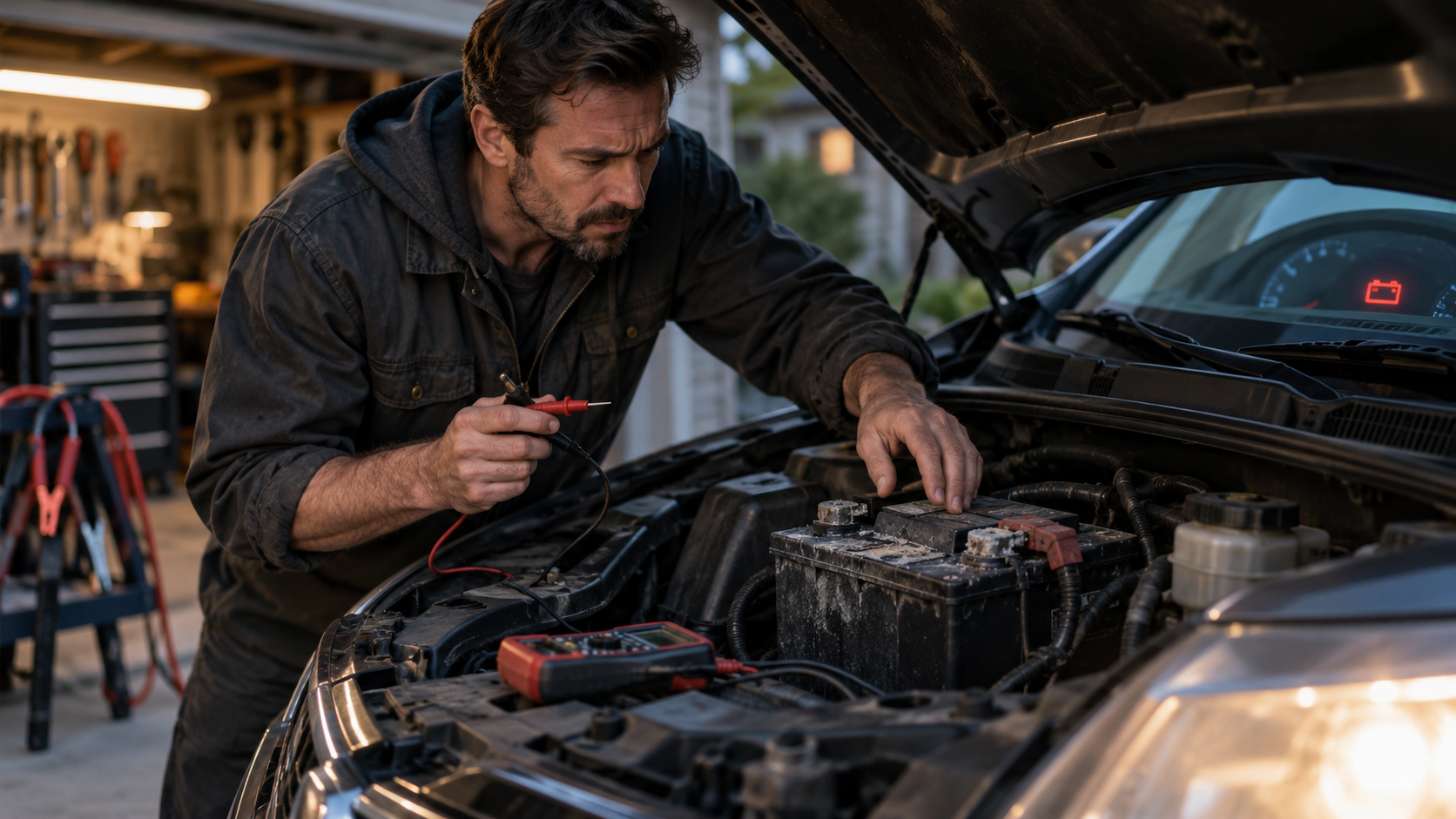
Some car parts make their wear quite obvious. Brake pads begin to squeal, a wheel bearing starts to hum, an exhaust becomes louder and worn suspension components may begin to knock. A battery can be much more deceptive. It may appear to work normally for weeks or even months until, one cold morning, the driver gets into the car, presses the start button and hears nothing but an unpleasant click instead of the familiar sound of the engine starting.
The warning signs were often there earlier. The starter turned slightly more slowly one morning. A week later, the Start-Stop system stopped switching the engine off at traffic lights. After a long weekend, the car took a little more effort to start than usual. Each symptom seemed too minor to worry about on its own. Only when the car finally refuses to start does the question arise that would have been much cheaper to ask a month earlier: how old is my battery, and how much useful life does it really have left?
Quick answer
A starter battery commonly lasts around 3–5 years, but that is not an expiry date after which the battery must automatically be replaced. Some batteries become weak sooner under difficult conditions, while others can continue working reliably for six years or longer. Age is only one factor — temperature, journey length, charging-system performance, deep discharges, Start-Stop operation and the type of battery all have a major influence on its lifespan.
The age of a battery cannot tell you the exact day it will fail. It tells you when it is sensible to stop guessing and start testing.
Does a car battery really last only 3–5 years?
The figure “3–5 years” is repeated so often in the automotive world that it can begin to sound like a strict rule. In reality, it is simply a useful guideline. A four-year-old battery is not automatically bad, and a two-year-old battery is not automatically healthy. Its condition depends not only on the calendar but also on the life it has lived.
If a car regularly makes longer journeys, the charging system works correctly and the battery has not suffered repeated deep discharges, it may last considerably longer. A city car that makes several two- or three-kilometre trips every day, uses heated windows, seats and mirrors throughout winter and occasionally sits unused for several days places the battery under a very different kind of stress.
| Battery age | Practical approach |
|---|---|
| 0–2 years | Age itself is usually not the main reason for suspicion, although even a new battery can be damaged by deep discharge, incorrect charging or an electrical fault in the vehicle. |
| 3–4 years | A good time to start paying closer attention to starting behaviour and to have the battery checked periodically, especially before winter. |
| 5 years | The battery has reached an age where a preventive health check makes good sense even if the car still starts normally. |
| 6+ years | If it still works perfectly, excellent — but before winter or a long journey, it is no longer wise to judge its condition by feel alone. |
The important thing to understand is that a battery gradually loses reserve capacity as it ages. A new and healthy battery can tolerate several unfavourable days, short journeys or one particularly cold night. An old battery may seem perfectly normal until cold weather, several short trips and a few days of standing unused all occur at the same time. That is when the remaining reserve can suddenly prove insufficient.
Why does one battery last six years while another lasts only three?
The easiest way to understand this is to compare two identical cars. The first travels 40 kilometres to work every weekday and another 40 kilometres home in the evening. The engine is started only a couple of times per day, each journey is reasonably long, and the charging system has time to restore much of the energy used during starting.
The second car lives in the city. In the morning it travels two kilometres to a nursery, then three kilometres to work, starts again at lunchtime, stops at a shop in the evening and completes another short journey home. During winter, the lights, blower, heated windows, heated seats and other electrical consumers may all be working at the same time. The daily mileage may be low, but the number of starts and the electrical demand are high.
That is why saying “but I drive the car every day” does not necessarily mean the battery is living an easy life. Sometimes a vehicle covering 25,000 kilometres per year provides a much friendlier environment for its battery than a city car travelling only 6,000 kilometres annually.
The paradox: low mileage does not always mean gentle use. For a battery, not only kilometres matter, but also the number of starts, the length of each journey and whether the energy used to start the engine is properly replenished afterwards.
Short journeys: the driving pattern that quietly eats into your battery reserve
Starting an engine requires a substantial burst of electrical current. Once the engine is running, the alternator and the vehicle's energy-management system gradually have to replace that energy. If the journey ends after only three or five minutes, particularly in cold weather with several major electrical consumers switched on, there may simply not be enough time to restore everything that was used during starting.
One such day will not destroy a battery. The problem begins when the same pattern continues for weeks or months. The battery may spend long periods in a partially charged state, and as it ages it becomes less tolerant of this lifestyle. Meanwhile, the driver may notice nothing because the car still manages to start every morning.
Why does the problem so often appear on the first really cold morning?
When a car suddenly refuses to start in December, it is tempting to say, “The frost killed the battery.” In many cases, it would be more accurate to say that the cold revealed a weakness that had already been developing for some time.
An ageing battery may still provide enough starting current in warm weather, so everything appears normal in September. As temperatures fall, the battery's ability to deliver high current decreases, while a cold engine may simultaneously require more effort to crank. The reserve that was sufficient in autumn may therefore no longer be enough on a winter morning.
Winter often does not kill a healthy battery. It exposes a battery that has already been living close to the limit of what it can provide.
Interestingly, summer is not harmless either. High temperatures can accelerate battery ageing, but the driver may not notice the consequences until several months later. The battery ages through the heat of summer, still appears normal in autumn, and then the first serious frost reveals how little reserve is actually left.
9 signs that battery replacement may be closer than you think
1. The starter turns more slowly than it used to
You can often hear this change in your own car better than anyone else. For years the engine has started in exactly the same way, but lately the starter seems to turn a little more slowly before the engine fires. Over time, the difference becomes more noticeable. That does not prove that the battery is at fault — similar symptoms can be caused by the starter motor, oxidised connections or a poor earth cable. But when this happens alongside a battery that is four, five or six years old, it should not simply be dismissed as “an old car being an old car”.
2. Starting becomes dramatically worse in cold weather
If the car starts perfectly at +15 °C, sounds noticeably more reluctant at +3 °C and then struggles obviously at −8 °C, it is a good time to have the battery tested. There is little value in waiting for the next frost simply to discover whether there will be enough reserve this time.
3. The Start-Stop system no longer activates as often
In a modern car, Start-Stop is not simply a button that must switch the engine off at every red light. The system evaluates many conditions at the same time, including available electrical reserve. If the battery's state of charge or its ability to provide sufficient reserve is inadequate, the car may decide not to switch the engine off.
That means a Start-Stop system that used to operate regularly but has become almost permanently inactive can be one reason to check the battery. It is not, however, an automatic diagnosis. Outside temperature, climate-control demand, engine temperature and other conditions can also prevent Start-Stop from operating. You can read more in our detailed guide “Start-Stop System: Does It Really Save Fuel or Damage the Battery?”.
4. The car starts much more weakly after sitting for a few days
If you park the car on Friday evening and it already cranks significantly more slowly on Monday morning, the battery may have lost part of its reserve. But this is exactly where it is important not to jump to conclusions. If even a good or recently installed battery repeatedly goes flat after one or two nights, the real problem may be excessive parasitic current draw, insufficient charging or another electrical fault.
For that situation, see our detailed guide “Car Battery Goes Flat Overnight: How to Find a Parasitic Drain and Tell Whether the Battery, Alternator or Electronics Are to Blame”.
5. The electronics behave strangely while the engine is starting
Low voltage can turn a modern car into a small light show. The instrument panel flickers, the infotainment screen restarts, several warning messages appear for a moment, the clock resets or electric windows behave strangely. That does not necessarily mean that five control modules have suddenly failed at the same time. A significant voltage drop during starting can itself cause unusual electronic behaviour.
6. Jump-starting has become a habit rather than an exception
One flat battery is not a diagnosis. Perhaps an interior light was left on, a door was not closed properly or the car had been parked for a long time. But if jump leads are becoming part of your regular Monday-morning routine, something needs investigating. The battery itself may be worn, the alternator may not be charging correctly, there may be excessive parasitic draw, or poor electrical connections may be responsible. Repeated jump-starting is not a repair — it is a way of working around the symptom.
7. The battery is already five or six years old
Age is not a fault by itself, but it provides important context. If your car still has a six-year-old battery that starts the engine perfectly, there is no need to panic. However, before winter, a long road trip or a journey to somewhere where assistance may be difficult to find, knowing the battery's actual condition makes a lot of sense. A preventive test usually costs far less than a ruined morning, recovery service and an unexpected taxi ride.
8. There is heavy corrosion on the terminals or the battery itself looks unusual
When assessing a battery, do not look only at its age. Check the connections as well. Heavy corrosion, a loose terminal, damaged cable or poor earth connection can create symptoms that look very similar to a weak battery. A swollen case, cracks or signs of leakage are more serious safety concerns.
Safety: a swollen, damaged or leaking battery should not be treated as an ordinary “weak battery”. Avoid sparks, short circuits and improvised repairs if you are not confident that you can work safely around the battery.
9. Testing shows that the battery is charged, but no longer strong
This is one of the most important points. A battery can be charged and worn out at the same time. A simple voltage measurement can help indicate state of charge, but on its own it does not tell you how well the battery can provide the high current required by the starter motor.
That is why professional battery testing usually involves a load test or an electronic conductance test. These can help answer the question a basic voltmeter cannot: can the battery still do the job that matters most in the car — start the engine confidently?
Remember: “the battery is charged” and “the battery is healthy” are not the same statement.
Can you check a car battery at home with a multimeter?
Yes, and a multimeter is a useful tool, but one number should not be used to judge the entire health of a battery. A rested and fully charged conventional 12 V lead-acid starter battery will often be around the 12.6 V range, but the reading is affected by temperature, how long the vehicle has been standing since its last journey, the type of battery and other factors.
Most importantly, an ageing battery may show an apparently healthy resting voltage and still collapse under the heavy load of the starter. That is why the conclusion “12.6 V — therefore the battery is perfect” is too simplistic.
Why can the alternator not always be judged by one voltage reading either?
With older cars, drivers often used a very simple rule: if the engine is running and the meter shows roughly 14 volts, the alternator must be working. In modern vehicles, the picture can be considerably more complicated. The energy-management system may deliberately vary charging behaviour depending on battery condition, engine load, driving conditions and other factors.
For that reason, one instantaneous voltage reading without understanding how the specific vehicle's charging system is designed does not always prove that the alternator is healthy or faulty.
The red battery warning light does not mean “buy a new battery”
This is one of the most common misunderstandings. When a red battery symbol comes on while driving, many drivers immediately assume that the battery itself has become old. In reality, the warning primarily indicates a problem with the charging system.
The cause may be the alternator, its drive system, wiring, electrical connections or the vehicle's energy-management system. If the warning remains illuminated while driving, the vehicle may continue operating for some time using energy stored in the battery, but once that reserve is exhausted the engine can stop. This is therefore not a warning that should simply be postponed until payday.
AGM, EFB or a conventional battery — why is physical size not enough?
Buying a battery used to feel simpler: find the correct dimensions and polarity, choose roughly the right capacity, install it and continue driving. On a modern vehicle with Start-Stop and sophisticated energy management, that may no longer be enough.
| Type | Where is it commonly used? | What matters when replacing it? |
|---|---|---|
| Conventional lead-acid starter battery | Simpler cars without Start-Stop systems. | It must meet the vehicle manufacturer's requirements for dimensions, starting current, capacity and other specifications. |
| EFB | Often used with simpler Start-Stop systems and greater cyclic demand. | It should not be replaced arbitrarily with a cheaper conventional starter battery. |
| AGM | Vehicles with high electrical demand, Start-Stop and more advanced energy-management functions. | If the manufacturer specifies AGM, the replacement should normally be a suitable AGM battery. |
Batteries in Start-Stop vehicles are subjected to much more intensive cycling, which is why EFB and AGM technologies are widely used. The cheapest battery that happens to fit physically into the original tray may not be the correct choice.
Important: the battery technology, dimensions, starting capability and capacity must match the requirements of the specific vehicle. The wrong type may result in shorter battery life and problems with Start-Stop or energy management.
Does a new battery need to be registered with the car after replacement?
On some modern vehicles, yes. The energy-management system may monitor battery ageing, charging history and condition over time and adjust its charging strategy accordingly. When an old battery is replaced with a new one, certain vehicles need to be told that the battery has changed.
The procedure differs between manufacturers. Some vehicles require battery registration with diagnostic equipment, while others can adapt part of their strategy automatically. That is why the universal internet advice “disconnect two terminals, install the new battery and you're done” does not apply to every modern vehicle.
Before buying, check: does your specific vehicle require battery registration, adaptation or coding after replacement?
Can a long drive bring an old battery back to life?
It is important to distinguish between two very different situations. In the first, the battery itself is healthy but simply undercharged. In the second, it has physically aged and has already lost some of its usable capacity or starting capability.
A healthy but undercharged battery can benefit greatly from being properly recharged. A longer journey, however, cannot restore material properties that an ageing battery has already lost. That is why a car may appear completely “fixed” for a few days after charging, only for the same problem to return on the next cold morning.
Is a 15- or 20-minute drive enough?
There is no universal amount of time. It depends on how discharged the battery was, its overall health, the vehicle's charging strategy, temperature and electrical demand. If the battery has only just managed to start the engine, the idea that “I'll drive for 15 minutes and it will be full again” is often far too optimistic.
If a battery is significantly discharged, an appropriate external charger is usually a much more controlled solution than hoping that a few kilometres of city driving will solve the problem.
Four mistakes drivers make that can shorten battery life
- Regularly making only very short journeys. Frequent starts combined with insufficient charging time can leave the battery undercharged for long periods.
- Ignoring repeated discharge. If the battery repeatedly goes flat, the cause needs to be found rather than simply jump-starting the car each time.
- Installing the wrong type of battery. This is particularly important on vehicles equipped with Start-Stop.
- Ignoring clear warning signs until winter arrives. A slower starter is much easier to investigate in September than on a dark, freezing December morning.
A five-minute battery check before winter
Ask yourself these questions
- Is the battery four years old or older?
- Has the starter begun turning more slowly?
- Does the problem become significantly worse in cold weather?
- Does the Start-Stop system operate much less often than it used to?
- Does starting become noticeably weaker after the car sits for several days?
- Have you needed to jump-start the car during the past year?
- Is there corrosion on the terminals or do any electrical connections look poor?
- Do you have no idea when the battery was last professionally tested?
The more times you answer “yes”, the less sense there is in waiting until the car makes the decision for you and simply refuses to start.
How can you tell a battery problem from something else?
| Symptom | What could it mean? |
|---|---|
| Starter turns very slowly | Possible weak battery, poor connections, earth-cable problem or starter-motor fault. |
| Starter cranks quickly but the engine does not start | The battery may not be the main problem. Fuel delivery, ignition, sensors, the immobiliser and other systems may need to be checked. |
| Car works after a jump-start but is flat again the next morning | Possible ageing battery, inadequate charging or excessive parasitic current draw. |
| Red battery warning light comes on while driving | Think about the charging system rather than only the age of the battery. |
If the car will not start at all and it is unclear whether the battery, starter or engine is responsible, see our detailed guide “Car Will Not Start: The Starter Does Not Crank, Cranks Slowly or the Engine Will Not Fire — How Do You Find the Real Cause?”.
What should a workshop check before you buy a new battery?
A proper battery test is about more than asking whether voltage is present. Depending on the symptoms, it is worth checking the battery's state of charge and overall health, starting capability, terminal and earth connections, charging-system performance and, where necessary, the vehicle's parasitic current draw.
This is particularly important when the battery is not very old. If a two-year-old battery repeatedly goes flat, replacing it blindly may hide the actual fault for a short time, only for the new battery to end up in exactly the same condition a few weeks later.
Should you replace a battery preventively before winter?
Not simply because it has reached its fourth or fifth birthday. A more professional approach is to test it first. If a five-year-old battery still performs well in testing, the starter turns confidently and the charging system is working correctly, there is no reason to write it off automatically.
On the other hand, a four-year-old battery that already cranks heavily in cold weather and shows substantially reduced starting performance during testing is not a good candidate for the philosophy of “it will probably survive one more winter”.
The simplest rule: age tells you when to start checking. Testing and real symptoms help you decide when to replace.
Myths and facts
| Claim | Myth or fact? | Explanation |
|---|---|---|
| A battery must always be replaced after five years. | Myth | Three to five years is a typical guideline, not a universal expiry date. Actual condition matters more. |
| Very short journeys can shorten battery life. | Fact | After starting, there may not be enough driving time to restore the energy that was used. |
| A 12.6 V multimeter reading means the battery is definitely perfect. | Myth | Voltage alone does not reveal the battery's complete starting capability or state of health. |
| A Start-Stop car can use any cheap battery that fits. | Myth | Start-Stop systems generally require the appropriate EFB or AGM battery technology specified for the vehicle. |
| The red battery warning light can indicate an alternator problem. | Fact | It is primarily a charging-system warning, not a battery-age indicator. |
| A new battery will solve every repeated-discharge problem. | Myth | If the real problem is the alternator or parasitic drain, the new battery may soon become discharged as well. |
Frequently asked questions
How many years does a car battery usually last?
A commonly used guideline is around 3–5 years, although actual battery life can be shorter or longer. Temperature, driving pattern, charging-system performance, deep discharges and battery technology all have a significant influence.
Can a six-year-old battery still be good?
Yes. However, at that age it makes sense to know its actual state of health rather than relying only on the fact that the car happened to start successfully this morning.
What is a typical first sign that a battery is becoming weak?
A very common sign is slower starter operation, particularly in cold weather. Similar symptoms can also be caused by the starter or electrical connections, so it is better to confirm the diagnosis with proper testing.
Should the battery be replaced if Start-Stop no longer works?
Not necessarily. Battery condition is only one of several factors the system evaluates. Start-Stop operation is also affected by temperature, climate-control demand, engine condition and other requirements.
Can I replace the battery in a Start-Stop car myself?
That depends on the specific model. The correct battery technology must be selected, and some vehicles require the new battery to be registered or adapted in the energy-management system after replacement. Check the manufacturer's procedure for your particular vehicle before beginning the work.
Conclusion
A healthy battery is one of those car components you barely think about in everyday life. You get in, press the button, the engine starts and the journey begins. That is exactly how it should be.
But the fact that the car started without difficulty this morning does not tell you how much reserve will be available on the next freezing morning. That is why the 3–5-year guideline should not be treated as a mandatory replacement schedule. It is better understood as the point when you should begin knowing the battery's condition rather than guessing it.
If the starter begins turning more slowly, cold weather makes the problem dramatically worse, Start-Stop almost never works, the car struggles after sitting for several days or you have already needed jump leads, have the system checked before an inconvenience becomes a breakdown.
And before buying a new battery, remember one important point: not every discharged battery is a failed battery. Sometimes the real culprit is the alternator, a poor electrical connection, parasitic current draw or simply a driving pattern that never allows the battery to recharge properly.
A professional repair begins not with buying a new part, but with making the right diagnosis.
Driver's short takeaway: once your battery approaches four or five years old, do not wait for the morning when the car simply stays silent. Have its condition checked, especially before winter. Age tells you when to start paying attention; symptoms and proper testing tell you when it is actually time to replace it.
Sources and technical note
The technical section of this article uses generally accepted information from starter-battery manufacturers and the automotive service industry regarding the typical 3–5-year battery lifespan, the effect of short journeys, AGM and EFB technologies used in Start-Stop vehicles and the need for battery registration in some modern cars. The lifespan of an individual battery cannot be determined by age alone — temperature, charging, driving pattern, the vehicle's electrical system and the battery's construction all play an important role.