
 LV
 EN
 RU
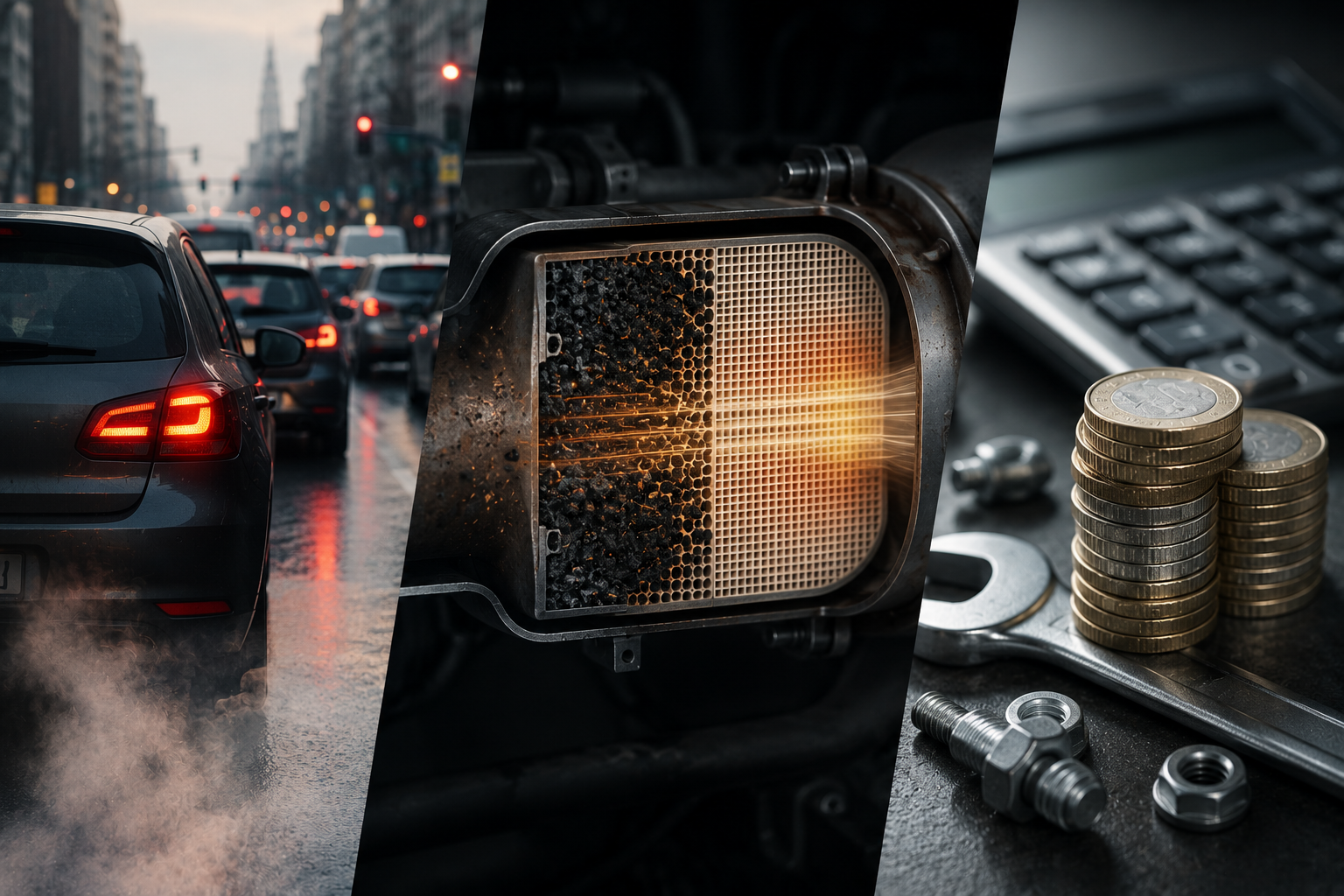
For many drivers, diesel cars are still associated with one very attractive thing — low fuel consumption. Especially on longer motorway or highway journeys, a diesel can be calm, economical and pleasant to drive. Lower engine revs, strong torque, lower consumption on long routes — everything sounds very logical.
But in the city, the diesel story becomes much more complicated. Short trips to work, the shop, kindergarten or school, traffic jams, traffic lights, a cold engine, frequent stopping and not enough time at steady speed can create conditions where a diesel no longer operates in its ideal environment. This is especially true for modern diesels equipped with a DPF, or diesel particulate filter.
So the question is not only “does diesel use less fuel than petrol?”. A much more important question is: how do you actually drive this diesel? If your daily journey is 5–8 kilometres each way, the engine may not warm up properly, the DPF may not regenerate correctly, and the car may spend its entire life in short-trip mode. In that case, the expected fuel saving can quickly turn into headaches.

Quick answer for the reader:
A diesel is best suited to drivers who regularly cover longer distances and allow the engine to reach operating temperature. If the car is used mostly for short city trips, the DPF, EGR system, battery and engine itself may suffer much more than the driver initially expects.
A typical driver thought: “I bought a diesel because I wanted to save money on fuel. After a year of city driving, I realised that a diesel does not only need fuel — it also needs the right driving pattern.”
Why does a diesel feel better on long journeys than in the city?
A diesel engine works best when it operates at stable temperature, under steady load and for a long enough period of time. That is why a highway journey is often the comfort zone of a diesel car. The engine warms up, the oil reaches operating temperature, the exhaust system becomes hot enough and the car can work efficiently.
In the city, everything happens differently. The engine is started cold, after a few minutes the car stops at a traffic light, then accelerates again, then sits in traffic, and after only a few kilometres the engine is switched off. In this pattern, a diesel often does not reach the conditions where it works most efficiently.
Short trips are especially unpleasant in winter. The engine warms up more slowly, cabin heating requires more energy, fuel consumption rises, the battery has fewer chances to recharge properly, and the DPF has more difficulty reaching the temperature needed for normal cleaning, also called regeneration.
What is a DPF and why is it so important?
A DPF, or diesel particulate filter, is a filter in the exhaust system of a diesel car. Its job is to capture soot and solid particles produced during diesel engine operation. In simple terms, the DPF prevents a large part of diesel soot from leaving the exhaust pipe.
However, the DPF is not an endless rubbish bin for soot. It collects soot, and later that soot must be burned off through a regeneration process. If this process happens normally, the filter cleans itself regularly and continues working. If regeneration does not happen properly or often enough, soot builds up, the filter becomes clogged, warnings appear, the car may lose power and repairs can become expensive.
This is where short city trips become a problem. For the DPF to clean itself properly, the exhaust system needs enough temperature and enough time. If the journey ends after only a few minutes, the process may not start or may not finish.
DPF regeneration: what does it mean in simple words?
DPF regeneration is the process in which soot stored inside the filter is burned off. You can think of it as self-cleaning. The car’s electronics monitor the filter load and, under certain conditions, try to raise the temperature in the exhaust system so the soot can burn away.
There is passive and active regeneration. Passive regeneration happens when the car drives long enough and steadily enough, for example on the highway, where exhaust temperature is higher. Active regeneration happens when the car’s control system itself tries to raise the temperature and burn off the soot.
The problem begins when active regeneration is interrupted. For example, you arrive home and switch off the engine exactly when the car was trying to clean the DPF. One time is usually not a disaster. But if it happens repeatedly, the filter may gradually become clogged.
Mini explanation:
A DPF is not a part that simply “exists or does not exist”. It is a filter that regularly needs a chance to clean itself. Short trips often mean that this chance is missing.
How do short trips damage diesel economy?
Many people buy a diesel thinking: “It uses less fuel.” But on short trips, a diesel can use much more fuel than expected. A cold engine is always less efficient. The oil is thicker, parts have not reached their optimal temperature, and the fuel injection and exhaust systems are not operating in their ideal range.
If your journey is 4 kilometres to work and 4 kilometres back, the car spends a large part of its life warming up. The trip computer may show consumption that does not look like an “economical diesel” at all. Then disappointment appears: the car is diesel, but city consumption is not as low as conversations or advertisements promised.
During regeneration, fuel consumption can also temporarily increase. The car may use extra fuel to raise exhaust temperature. The driver sees consumption suddenly rise, cooling fans running, start-stop staying inactive or idle speed behaving differently. Sometimes this is not a fault — it may be DPF regeneration.
| Driving type | Suitability for diesel | What happens to the DPF? |
|---|---|---|
| 5 km to work in the city | Poor | The filter often cannot regenerate properly. |
| 10–15 km mixed route | Medium | Depends on speed, temperature and driving frequency. |
| 30+ km on the highway several times per week | Good | The DPF usually gets better conditions for cleaning. |
| Taxi or delivery car in city traffic | Risky | Lots of idling and stop-start driving can create problems. |
Signs that the DPF may have problems
DPF problems do not always begin with a dramatic cloud of smoke. In a modern diesel, everything can happen much more quietly. At first, small signs appear, which the driver often ignores. The car becomes more sluggish, consumption rises, fans continue running after a trip, start-stop no longer activates, idle speed becomes higher or a warning appears on the dashboard.

- The DPF light appears on the dashboard. This usually means the filter needs attention and regeneration has not happened properly.
- Fuel consumption increases. The car may be trying to regenerate the filter more often or working in a less efficient mode.
- Cooling fans keep running after the trip. This can be related to higher temperatures during regeneration.
- The start-stop system does not activate. In some cars, start-stop is disabled during regeneration.
- The car becomes sluggish. A clogged filter can affect exhaust flow and engine operation.
- Limp mode appears. In more serious cases, the car may limit power to protect the system.
What should you do if the DPF light comes on?
The first and most important advice is: do not ignore it. The DPF light is not decoration. It is a sign that the filter is no longer in ideal condition or the car has not been able to complete regeneration properly. If you ignore it and keep driving only short city trips, the problem usually does not become smaller — it becomes more expensive.
In many cases, if the warning is at an early stage and there are no other serious faults, a longer steady-speed drive can help. But the owner’s manual should always be followed, because requirements differ between models. If the light does not go away, a red warning appears, the car loses power or other faults appear, it is better to go to a workshop rather than trying to “burn out” the filter blindly.
Quick action plan:
- Check the owner’s manual — what exactly does this warning mean in your car?
- If the car drives normally, give it a longer, calm drive at steady speed.
- Do not interrupt the drive after a few minutes if you feel regeneration may be happening.
- If the light does not disappear or other faults appear, go for diagnostics.
- Do not postpone the problem for months — a clogged DPF can become very expensive.
Why removing the DPF is not a smart solution
When DPF repair seems expensive, some drivers start thinking about removing the filter. It may sound like a quick and cheaper solution: no filter, no clogging, no problem. In reality, this is often short-term thinking with long-term consequences.
First, the DPF is part of the emissions control system. Removing it means the car no longer works as it was designed to work. Second, technical inspections are increasingly able to check whether a diesel car’s particulate filter is functioning properly. In Latvia, CSDD has introduced a new particulate measurement method for Euro 5 and newer diesel vehicles, and from 2026 a non-compliant result carries a more serious inspection assessment.
Third, DPF removal can create legal, technical and resale-value risks. Even if the car seems to “drive better” for a while, this solution can become a major disadvantage for buyers, technical inspection or diagnostics. It is smarter to find the real cause: is the DPF actually damaged, or is the fault caused by the fuel system, EGR, pressure sensor, wrong oil, short trips or another issue?
Mini test: is your driving profile suitable for diesel?
To keep this article practical, check yourself. Answer honestly — not how you would like to drive, but how you actually use your car every day.
Tick what applies to you:
- At least 2–3 times per week I drive 25–30 km or more in one direction.
- I regularly drive on the highway or bypass road at steady speed.
- My journeys are usually not only 5–10 minutes long.
- I follow service intervals and use the correct oil.
- If the car starts regeneration, I do not interrupt it every time after a few minutes.
If 4–5 points apply to you, a diesel can be a fairly logical choice. If only 0–2 points apply, it is worth seriously considering whether a modern diesel is really the best option for city use.
Could petrol, hybrid or electric be smarter for the city?
If most trips are short and within the city, a petrol car, hybrid or electric car can often be a simpler choice than a modern diesel. A petrol engine does not have DPF problems in the same sense as a diesel. A hybrid can use electric assistance in the city and recover energy during frequent braking. An electric car does not suffer from cold diesel-engine and DPF logic on short routes at all.
That does not mean diesel is bad. It means diesel needs suitable use. If you drive long distances every week, diesel can still be very rational. If the car’s life is only “home–shop–kindergarten–work–home”, the economic logic may look different.
| Car type | Short city trips | Long journeys |
|---|---|---|
| Diesel | Can be problematic because of the DPF. | Very suitable if the car warms up regularly. |
| Petrol | Simpler solution for short trips. | May use more fuel than diesel. |
| Hybrid | Very good in the city if the system works efficiently. | Depends on speed and model. |
| Electric car | Very suitable for city driving. | Charging and range must be planned. |
How can you help a diesel if you still drive mostly in the city?
Not everyone can change cars immediately. If you already have a diesel and your daily driving happens mostly in the city, the goal is not panic — it is adapting habits. Sometimes a few simple changes can significantly reduce the risk of DPF problems.
- Give the car a longer drive regularly. Not every day, but often enough for the engine and exhaust system to reach proper temperature.
- Do not ignore the DPF light. The earlier you react, the better the chance of avoiding an expensive repair.
- Use the correct engine oil. DPF systems require oil that meets the manufacturer’s specifications.
- Do not always drive with a very low fuel level. In some cars, this can affect active regeneration.
- Let regeneration finish when possible. If you feel the car is regenerating, it is better not to switch the engine off after one minute.
- Keep the EGR, pressure sensors and fuel system in good condition. The DPF often suffers because of other problems, not only because of itself.
Short answer: how often should you “take a diesel for a proper drive”?
There is no single formula for every car, but a diesel usually benefits from regular longer drives at steady speed, where the engine and exhaust system have time to warm up. It is important to follow the owner’s manual and not wait until the DPF light appears repeatedly.
Common mistakes with diesel cars in the city
Some DPF problems do not appear suddenly. They grow from habits repeated every day. The driver feels everything is normal, but the car’s systems do not like this operating pattern in the long run.
- The diesel is used only for 5-minute trips. The engine and DPF never get a proper working cycle.
- The DPF light is ignored. An early problem turns into an expensive repair.
- Regeneration is regularly interrupted. The car starts cleaning itself, but the driver switches the engine off.
- The wrong oil is used. This can speed up filter contamination.
- Only the DPF is replaced, but the root cause is not fixed. If the real issue is the EGR, injectors or a sensor, the new filter can also suffer quickly.
- The DPF is removed as a “quick solution”. This can create inspection, legal and resale-value risks.
Small reader challenge: 14-day DPF observation
If you own a diesel and you are not sure whether your driving pattern suits it, try observing the car for 14 days. You do not need special equipment — only a little attention.
14-day DPF observation:
- Write down how long your daily trips are.
- Notice how often the car drives for more than 20–30 minutes.
- Observe whether the fans keep running after a trip.
- Watch for consumption spikes without an obvious reason.
- Notice whether start-stop suddenly becomes inactive.
- Write down whether the car sometimes smells hot or sharp after driving.
- If you notice several signs, plan diagnostics instead of waiting for a warning light.
Is diesel in the city always a bad choice?
No, not always. If city driving is only part of everyday use and the car is regularly driven on longer routes too, diesel can be a perfectly normal choice. For example, if a person lives outside the city, drives 30–50 kilometres to work every day and only part of the route is in traffic, a diesel can work well.
The worst scenario is a modern diesel that lives only on short cold trips. That is where the difficult combination appears: the engine does not warm up, the DPF does not regenerate, consumption is not as low, the battery suffers, and after some time the owner wonders why the “economical car” needs so much attention.
That is why diesel should not be judged only by fuel consumption figures in a catalogue. It should be judged by your real driving profile. That matters much more than what a friend, seller or forum says.
Conclusion: diesel is not bad, but it needs the right rhythm of life
A diesel car can be very economical and reliable if it is used in conditions that suit it. Longer journeys, steady speed, regular warm-up, correct oil, timely maintenance and attention to DPF warnings all help a diesel work as intended.
But if a diesel is used almost only for short city trips, the economy story can look very different. Higher cold-running consumption, unfinished DPF regeneration, warning lights, possible limp mode and repair costs can eat up the money you planned to save on fuel.
So the smartest question before buying a diesel is not “how much does it use per 100 km?”. The smartest question is: “Does my driving pattern actually suit this diesel?” If the answer is yes, diesel can be an excellent ally. If the answer is no, petrol, hybrid or electric may turn out to be a cheaper and calmer solution.
Short driver conclusion: “Diesel is not the problem. The problem begins when a diesel is forced to spend its whole life doing short city trips.”