
 LV
 EN
 RU
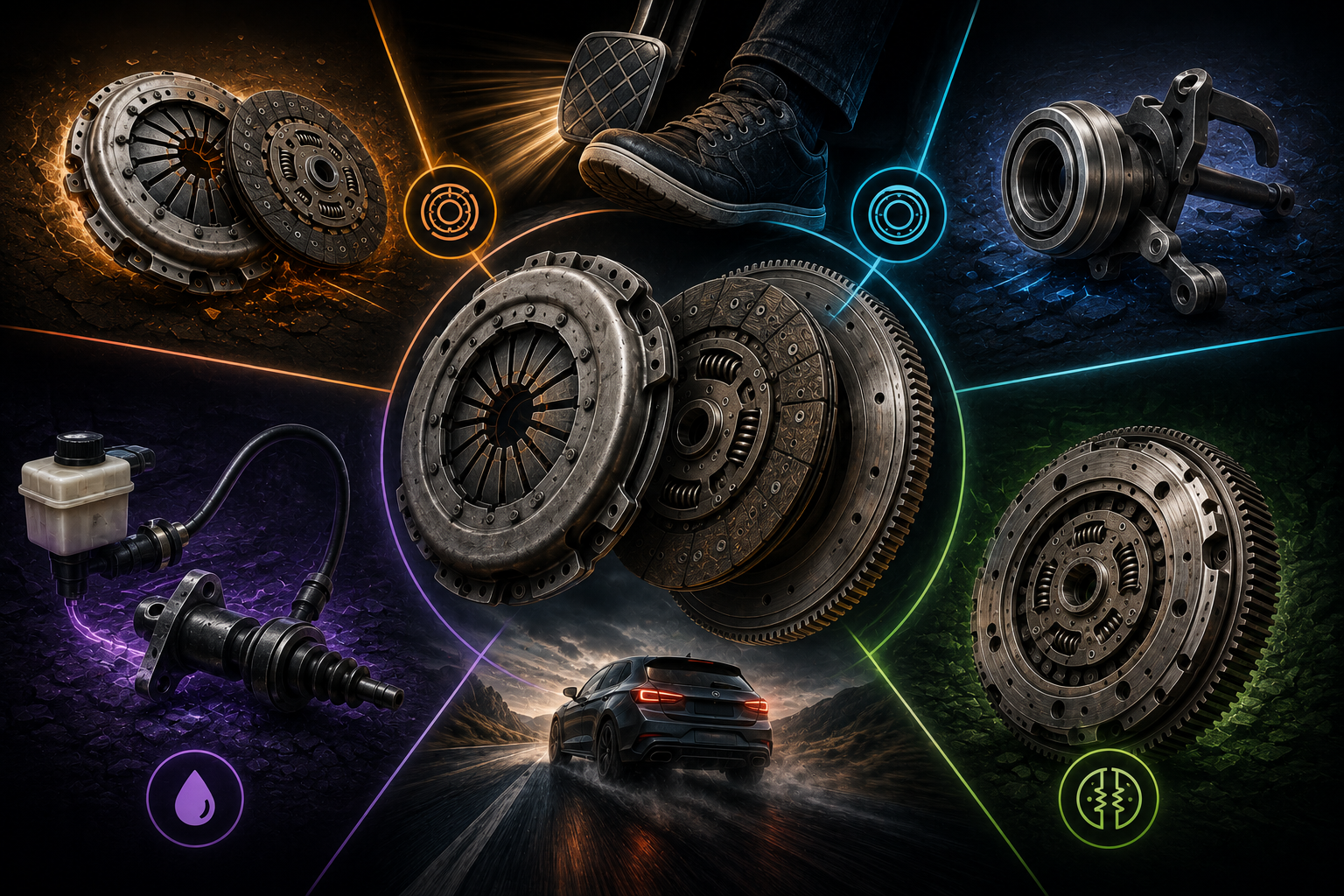
You are driving along a motorway in fifth gear, press the accelerator and the engine speed suddenly rises. The engine becomes louder and the rev counter climbs, but the car does not accelerate as strongly as it should. A moment later, the revs fall again and everything appears to return to normal.
In another vehicle, the problem appears very differently. First and reverse gear are difficult to engage in the morning, the clutch pedal occasionally remains lower than usual, and the entire body briefly shudders when moving off. The seller claims that this is simply “a diesel characteristic”. A workshop, meanwhile, mentions the clutch, release bearing and dual-mass flywheel — three terms that often sound like one expensive repair to the average driver.
In reality, the clutch system contains several components, and similar symptoms may be caused by different faults. Engine revs rising without matching acceleration are usually associated with clutch slip. Difficult gear engagement may be caused by incomplete clutch disengagement, a hydraulic fault, incorrect cable adjustment or the gearbox itself. Rattling when the engine is started or switched off may be connected with the dual-mass flywheel, engine mounts, uneven engine operation or another transmission component.
The correct question is therefore not simply “is the clutch finished?”. You need to understand exactly what the vehicle is doing, when the symptom appears and whether it depends on temperature, gear selection, engine load, pedal position or the way the vehicle is moved off.
A clutch fault does not always begin with the vehicle becoming completely undriveable. It often develops gradually — first changing the pedal feel, the way the car moves off or the relationship between engine speed and vehicle speed.
What is the purpose of the clutch?
In a vehicle with a manual gearbox, the clutch connects the engine to the transmission and allows that connection to be interrupted temporarily. When the clutch pedal is released, engine torque passes through the clutch to the gearbox and then to the wheels.
When the driver presses the pedal, the clutch disc is released from the clamping force between the flywheel and pressure plate. The direct connection between the engine and the gearbox input shaft is interrupted, allowing the vehicle to stop, another gear to be selected or the engine to be started without moving the car.
When moving off, the clutch briefly operates in a partially slipping state. This allows the rotating engine to connect smoothly with the gearbox and wheels, which are initially stationary. This short period of controlled slip is normal. A problem begins when the clutch continues slipping after the pedal has been fully released.
Drivers often speak of “pressing the clutch”. Technically, pressing the pedal reduces the clamping force on the clutch disc and disconnects the engine from the gearbox. Releasing the pedal reconnects the clutch.
What components make up the clutch system?
The disc carries the friction material. It is clamped between the flywheel and pressure plate, transferring engine torque to the gearbox.
Its diaphragm spring creates the force that presses the clutch disc against the flywheel. Wear or overheating may reduce this clamping force.
It presses on the pressure plate’s diaphragm spring when the driver operates the clutch pedal. A fault may cause noise or uneven pedal operation.
Attached to the engine crankshaft, it provides a working surface for the clutch disc and helps smooth engine rotation.
It consists of two masses that can move relative to one another, together with damping components that reduce torsional vibrations from the engine before they reach the transmission.
The clutch may be operated by a cable or a hydraulic system with master and slave cylinders. In some designs, the slave cylinder is combined with the release bearing.
Do all cars have a dual-mass flywheel?
No. Some vehicles use a solid flywheel, while others use a dual-mass design. Dual-mass flywheels are particularly common in diesel engines and modern turbocharged petrol engines that produce substantial torque at relatively low engine speeds.
The exact design should be identified using the vehicle identification number, engine code and gearbox code. Different versions of the same model may use different clutch and flywheel systems.
Quick symptom guide
A typical sign of clutch slip. The clutch disc may be worn, the pressure plate may have lost clamping force or the friction surfaces may be contaminated.
The clutch may not be disengaging completely. Possible causes include the hydraulic system, cable, clutch disc, release mechanism or gearbox.
Possible causes include uneven clutch engagement, a damaged flywheel, oil contamination, engine mounts or poor clutch control.
The release bearing, pressure plate, guide sleeve or another part of the clutch-release mechanism may be worn.
Possible causes include the dual-mass flywheel, a transmission bearing, an engine mount or uneven engine operation.
Possible causes include a hydraulic leak, failed master or slave cylinder, broken return spring, cable fault or mechanical obstruction.
These symptoms help determine the direction of the inspection, but they are not enough to order a replacement component. Vibration when moving off, for example, may be caused by the clutch assembly, an engine mount or the driver attempting to move away at excessively low engine speed.
Clutch slip: the most recognisable wear symptom
Clutch slip means that the disc can no longer transfer all of the engine’s torque to the gearbox. The engine side rotates faster, but the clutch disc and gearbox input shaft do not accelerate at the same rate.
Initially, slipping may appear only under heavy load — during strong acceleration in a higher gear, while climbing a hill, towing a trailer or carrying a heavy load. During gentle urban driving, the clutch may still appear completely normal.
- engine speed rises sharply without matching vehicle acceleration;
- slipping first appears in higher gears and under heavy load;
- the vehicle loses pulling power on a hill while the engine revs faster;
- a sharp and distinctive burning smell appears after heavy slipping;
- the clutch biting point may be higher than before;
- the problem may become more noticeable after the clutch has warmed up.
Why does a clutch begin to slip?
The most common cause is worn friction material on the clutch disc. As the material becomes thinner and the geometry of the mechanism changes, the system can no longer transfer the engine’s torque reliably.
Slip may also be caused by an overheated or damaged pressure plate, distorted friction surfaces, oil from the engine’s rear crankshaft seal or gearbox input-shaft seal, an incorrectly adjusted cable, a mechanism that does not return fully or an unsuitable clutch kit.
If the clutch has recently been replaced but already slips, the quality of the components is not the only consideration. The installation, flywheel surface, contamination, free play in the release mechanism and compatibility of the kit with the specific engine and gearbox must also be checked.
Should clutch slip be tested deliberately with full throttle?
Online advice often recommends selecting a high gear at low speed and pressing the accelerator hard. Such a test can place a heavy load on an already worn clutch, flywheel and engine. If the clutch is slipping badly, the test may overheat the friction surfaces and accelerate the failure.
A safer approach is to describe the conditions in which the symptom appears and allow a workshop technician to conduct a controlled road test. There is no reason to provoke slipping repeatedly once the mismatch between engine speed and vehicle acceleration has already been noticed.
A slipping clutch will not repair itself
Every period of slipping creates heat and causes further damage to the friction material. Continued driving under heavy load can quickly turn a usable vehicle into one that can no longer move.
The clutch does not disengage completely: why are gears difficult to select?
The opposite of clutch slip is incomplete disengagement. The driver presses the pedal fully, but the clutch disc continues transferring some engine rotation to the gearbox input shaft.
As a result, the synchronisers must work against a rotating shaft and gear selection becomes difficult. Reverse gear often reacts particularly noticeably because many gearboxes do not give it the same type of synchroniser as the forward gears.
The clutch may not be disengaging completely, although the gear-selection mechanism and gearbox must also be inspected.
If a gear is selected and the pedal is fully pressed but the vehicle still attempts to move, the clutch may not be disengaging fully.
If the gears engage easily with the engine stopped but become difficult with it running, suspicion moves more strongly towards clutch disengagement.
Common causes of incomplete disengagement
- air in the hydraulic system;
- a failed clutch master or slave cylinder;
- a fluid leak;
- a damaged or incorrectly adjusted clutch cable;
- a distorted clutch disc or one sticking on the input shaft;
- a damaged release mechanism or pressure plate;
- a failed pilot bearing in designs that use one;
- incorrectly installed or unsuitable parts.
Forcing a gear into position is not a solution. It may damage the synchronisers, gear teeth, selector forks and shift mechanism, turning a clutch repair into a gearbox repair as well.
The pedal has become soft, hard or remains on the floor
Pedal feel provides an important diagnostic clue. Normal pedal force and travel differ between vehicles, so the main warning sign is a sudden change compared with the usual operation of that particular car.
Possible causes include air in the system, a hydraulic leak, a failed cylinder or a cable fault.
A cable, release fork, release-bearing guide, pressure plate or another mechanical component may be binding.
Possible causes include major hydraulic failure, cylinder failure, a broken return spring or mechanical seizure.
If the pedal becomes temporarily firmer after being pressed several times, the system may contain air or a cylinder may be losing pressure. Pumping the pedal is not a repair — it merely changes the symptom temporarily.
Does the clutch have a separate fluid reservoir?
Some vehicles have a separate reservoir for the clutch hydraulics, while many share a reservoir with the braking system. This does not automatically mean that a clutch fault will remove braking ability, because the connections may be positioned at different levels. Any fluid leak in a shared system must nevertheless be treated seriously.
A falling fluid level should not be addressed only by topping it up. The source of the leak must be found. If the slave cylinder is located inside the gearbox bell housing and combined with the release bearing, removing the gearbox may be necessary to repair the leak.
The clutch judders or vibrates when moving off
If the vehicle moves away with repeated jolts as the clutch pedal is released, drivers commonly say that the clutch “judders”, “grabs unevenly” or “vibrates when moving off”. Technically, this means that the friction contact is not developing smoothly.
The clutch disc briefly grips, releases and grips again. These oscillations are transferred to the engine, gearbox, mounts and body.
- an unevenly worn or overheated clutch disc;
- a damaged pressure-plate or flywheel surface;
- oil or other contamination on the friction surfaces;
- excessive play or a damping fault in the dual-mass flywheel;
- damaged engine or gearbox mounts;
- uneven engine operation;
- the clutch disc not moving freely on the gearbox input shaft;
- incorrect installation or unsuitable parts.
Minor vibration may be more noticeable in cold or damp weather and may decrease after the vehicle has moved off several times. This is not enough to conclude that the behaviour is normal. If the vibration is repeated, becomes worse or is accompanied by metallic noises, the system should be inspected.
Is clutch judder always caused by the dual-mass flywheel?
No. The dual-mass flywheel is only one possible cause. Similar symptoms may be created by the clutch disc, an overheated pressure plate, engine mounts, uneven fuel delivery or the driver attempting to move away at excessively low engine speed.
A correct diagnosis normally requires a road test, an assessment of engine operation and an inspection of the clutch assembly. In some cases, a final assessment of the flywheel is possible only after the gearbox has been removed.
What does a dual-mass flywheel do?
An internal-combustion engine does not produce perfectly smooth rotation. Each combustion event briefly accelerates the crankshaft, while rotation slows slightly between power strokes. These torsional variations can be particularly noticeable in an engine that produces substantial torque at low speed.
A dual-mass flywheel divides the flywheel into primary and secondary masses. Between them are springs, sliding surfaces and other damping elements. They allow the two masses to move within a limited range relative to one another, absorbing part of the vibration before it reaches the gearbox.
This improves refinement, reduces transmission rattle and allows the engine to operate at lower speeds. The complex design also means, however, that the flywheel itself is a wear component.
Possible signs of dual-mass flywheel failure
None of these signs alone proves that the dual-mass flywheel is faulty. Similar noises may be caused by engine and gearbox mounts, an input-shaft bearing, the crankshaft pulley, uneven engine operation, the exhaust system or other components.
Why does driving at excessively low revs harm the flywheel?
If the driver selects a high gear and presses the accelerator hard at very low engine speed, the engine produces substantial torque together with pronounced torsional vibration. The dual-mass flywheel must absorb these loads.
This does not mean that the engine should be driven at unnecessarily high speed. The correct approach is to select a gear in which the engine runs smoothly, does not shudder and responds to the accelerator without heavy vibration. If strong acceleration is required, change down in good time.
The noise changes when the clutch pedal is pressed
Whether a noise appears with the pedal released or pressed is an important diagnostic clue. There is still no single universal formula that applies to every vehicle.
The release bearing, pressure-plate diaphragm, release fork and guide sleeve are commonly checked. A pilot bearing or another component may also be responsible.
Possible causes include the gearbox input-shaft bearing, dual-mass flywheel, normal or excessive transmission rattle or another rotating component.
There may be a movement problem in the release mechanism, uneven pressure-plate operation or mechanical binding.
To help the workshop reproduce the symptom, note whether the engine was cold or warm, whether a gear was selected or the gearbox was in neutral, whether the pedal was pressed fully or partially and whether the noise changed with engine speed.
Does a high biting point always mean the clutch is worn?
A high clutch biting point is often associated with disc wear, but it is not a universal diagnostic test. Pedal travel and biting-point position differ between vehicles even when they are new.
Hydraulic and self-adjusting systems may partly compensate for component wear, so the biting point does not always move in a predictable way. Incorrect cable adjustment can also change the pedal’s operating range.
It is more important to assess whether the clutch slips, disengages completely, operates smoothly and has changed noticeably in recent use.
Burning smell: when has the clutch overheated?
Overheated clutch friction material produces a sharp and persistent smell. It may appear after prolonged slipping on a steep hill, an unsuccessful manoeuvre with a trailer, repeated attempts to move off or continued use of an already slipping clutch.
A single short overheating event does not necessarily mean that the clutch must be replaced immediately. Very high temperatures can nevertheless harden the friction material, create uneven surfaces and damage the pressure plate or flywheel.
Stop applying load if there is a strong smell or visible smoke
Stop safely, allow the assembly to cool and do not repeatedly provoke further slipping. If the clutch continues slipping after cooling, the vehicle should be inspected.
When can the journey continue and when is roadside assistance required?
The biting point has changed, a light noise or minor vibration has appeared, but the clutch does not slip and all gears engage normally.
Avoid heavy loads, towing and prolonged clutch slip.
The clutch slips moderately, moving off produces strong judder or gears are difficult to select, but the vehicle can still be controlled.
Choose a short route and avoid congestion, steep hills and heavy traffic. Stop if the symptom becomes worse.
The pedal remains on the floor, gears cannot be selected or disengaged safely, the vehicle will not move, the clutch slips severely, smoke is visible or heavy metallic impacts are heard.
Have the vehicle transported to a workshop by roadside assistance or recovery truck.
A partially functioning clutch may fail completely in congestion, at a junction or on a hill. The decision should therefore consider not only whether the vehicle still moves, but also the route and the possibility of stopping safely if the system stops working.
Driving habits that shorten clutch life
Resting your foot on the clutch pedal
Even slight continuous pressure on the pedal may load the release bearing and reduce the pressure plate’s clamping force. The driver may not notice obvious slip, but components are operating when they should be fully released.
Holding the car on a hill with the clutch
If the vehicle is held stationary by partly releasing the clutch and balancing it with the accelerator, the engine’s power is converted into heat at the clutch friction surfaces. Use the service brake or parking brake to hold the car on a hill and use the clutch only to move off.
Prolonged slipping in congestion
Constantly moving a few centimetres with the clutch partially engaged generates more heat than making fewer, slightly longer movements with the pedal fully released. Where it is safe, leave sufficient distance and move forward in controlled stages.
Using too high a gear at low engine speed
This places particular stress on the dual-mass flywheel and transmission. If the engine vibrates heavily and responds sluggishly to the accelerator, select a lower gear.
Releasing the pedal abruptly
Abrupt clutch engagement sends a shock through the clutch disc’s damping springs, flywheel, driveshafts, differential and engine mounts. It may not cause immediate failure, but repeated aggressive use increases wear.
Resting your hand on the gear lever
This habit does not directly damage the clutch disc, but in some gearboxes continuous pressure on the lever may load the selector mechanism. Once the gear is selected, return your hand to the steering wheel.
How long does a clutch last?
There is no universal replacement interval. Clutch life depends much more on vehicle mass, engine torque, driving environment, driver habits, trailer use and component design than on the calendar.
In a car used mainly on motorways, the clutch may be operated only a few times during one journey. In a city vehicle, it may be used hundreds of times, often while cold, on hills and in congestion.
A clutch may therefore last a very high mileage in one car but require repair much earlier in another. Mileage alone confirms neither good nor poor condition.
What is normally replaced during a clutch repair?
Accessing the clutch assembly usually requires removal of the gearbox. This forms a significant part of the labour, so replacing only one inexpensive component while leaving other similarly aged parts may be poor value.
- the clutch disc;
- the pressure plate;
- the release bearing or concentric slave cylinder;
- the dual-mass or solid flywheel if it does not meet inspection requirements;
- the rear crankshaft seal if a leak is found;
- the gearbox input-shaft seal if necessary;
- new bolts where the manufacturer specifies single-use fasteners;
- hydraulic fluid and system bleeding;
- gearbox oil if it must be drained or its condition requires replacement.
Must the dual-mass flywheel always be replaced?
No. The dual-mass flywheel should be assessed using the relevant manufacturer’s inspection procedure, checking movement, smoothness, heat damage, grease leakage and other criteria.
Keeping an old flywheel without measuring it simply because it “has not fallen apart yet” may nevertheless be false economy. If it begins causing problems soon after the clutch replacement, the gearbox must be removed again.
Can only the clutch disc be replaced?
This may be technically possible in certain situations, but the pressure plate, release bearing, flywheel and remaining components must be assessed. If the parts have covered a similar mileage, fitting one new disc between worn surfaces may not produce the expected result.
Can a dual-mass flywheel be replaced with a solid flywheel?
Conversion kits are available that replace the dual-mass flywheel with a solid flywheel and a matching clutch disc. Such a system may be cheaper and mechanically simpler, but it changes the way transmission vibration is controlled.
After conversion, idle rattle, vibration, low-speed noise and load on gearbox components may increase. The result depends on the specific engine, transmission and quality of the conversion kit’s engineering.
Before choosing such a conversion, determine whether the kit is designed for the exact vehicle, how it affects comfort and warranty, and whether the manufacturer or a qualified component supplier supports the solution.
A cheaper kit is not automatically an equivalent solution
The dual-mass flywheel forms part of the engine and transmission vibration-control system. Replacing it changes the operation of the system rather than merely changing the material of one component.
Why can a clutch repair be expensive?
On many vehicles, the clutch kit itself is not the only major expense. Removing the gearbox may require dismantling driveshafts, the starter motor, mountings, subframe components, exhaust parts and other assemblies.
Four-wheel-drive vehicles, large diesel models and cars with restricted access may require substantially more labour. If a dual-mass flywheel, hydraulic cylinder and oil-seal repairs are also needed, the list of components expands quickly.
Assume that timely replacement of the clutch kit, release bearing and required fasteners costs €950. Continuing to drive with severe slip and vibration overheats the flywheel, creates the need for roadside assistance and adds oil-seal repairs.
The figures are illustrative and are not a quotation from a specific workshop. Actual costs depend on the vehicle, labour complexity, component manufacturer and extent of the damage.
How should the clutch be checked before buying a used car?
The clutch in a used car should not be judged only by whether the vehicle can move away. A partly worn clutch may behave acceptably during a gentle test drive but slip on a motorway, on a hill or under full load.
- whether the clutch pedal moves smoothly and returns without delay;
- whether the biting point is extremely narrow, abrupt or inconsistent;
- whether the vehicle vibrates when moving off;
- whether engine speed and road speed rise proportionally in a higher gear;
- whether first and reverse gear engage without grinding;
- whether the vehicle attempts to creep with the clutch fully pressed;
- whether there is rattling at idle that changes significantly when the pedal is pressed;
- whether heavy impacts occur when the engine is started or switched off;
- whether there is a burning smell or visible hydraulic leakage;
- whether there are records of previous clutch and flywheel replacement.
What does a seller mean by “the clutch was recently replaced”?
Ask exactly what was replaced. “The clutch” may mean only the disc, a complete disc-and-pressure-plate kit, a kit with a release bearing or the entire assembly including the dual-mass flywheel and hydraulic slave cylinder.
Request an invoice showing component numbers, vehicle mileage and the work performed. Without documentation, there is no way to know whether new parts, a used flywheel or the cheapest conversion kit were fitted.
Can the clutch be replaced at home?
Clutch replacement normally requires gearbox removal, safe support of the engine and transmission, driveshaft removal, accurate clutch-disc alignment and the correct tightening sequence for all fasteners.
Some self-adjusting pressure plates require special installation tools and procedures. Incorrect installation may damage the new component before the vehicle is driven for the first time.
The dual-mass flywheel must also be inspected according to specific criteria. Movement alone does not automatically prove a fault because a defined amount of movement is built into the design. The range and smoothness of movement, axial play, heat damage and manufacturer instructions must all be considered.
Never work under a vehicle supported only by a jack
A gearbox is heavy, and removing it changes how the vehicle’s assemblies are supported. An incorrectly supported vehicle, engine or gearbox may fall and cause severe injury.
What should you ask the workshop before the repair?
☐ What exactly is causing the symptom?
☐ Is the clutch slipping or failing to disengage fully?
☐ Has the hydraulic system been inspected?
☐ What is included in the proposed clutch kit?
☐ Will the release bearing be replaced?
☐ Is the slave cylinder combined with the bearing?
☐ How will the dual-mass flywheel be inspected?
☐ Is oil leaking onto the clutch?
☐ Are new single-use fasteners required?
☐ Will the gearbox oil be replaced?
☐ Will a road test be performed after the repair?
☐ What warranty applies to the parts and labour?
Driver’s checklist
☐ Engine revs do not rise without acceleration
☐ The clutch pedal returns normally
☐ The pedal has not suddenly become soft or heavy
☐ Gears engage without force
☐ Reverse gear does not grind
☐ The car does not creep with the clutch fully pressed
☐ Moving off does not produce severe judder
☐ There is no burning smell or smoke
☐ No new rattling is present at idle
☐ No heavy impacts occur when switching off the engine
☐ No hydraulic fluid is leaking beneath the vehicle
☐ Symptoms are not being repeatedly provoked with aggressive tests
A short self-check
The engine revs rise, but the car barely accelerates. Can I continue driving gently for several weeks?
This is a typical symptom of clutch slip. Even gentle driving creates additional heat, and the fault may progress quickly. The vehicle should be inspected as soon as possible.
The gears engage easily with the engine switched off but are difficult with it running. What does that mean?
The clutch may not be disengaging fully. The hydraulic system or cable, release mechanism and clutch assembly should be checked.
The pedal stayed on the floor, but it worked again after I lifted it with my foot. Has the problem been resolved?
No. A hydraulic-cylinder fault, fluid leak, return-spring problem or mechanical issue may be present. The failure may return without warning.
The car vibrates only when moving off. Is the dual-mass flywheel responsible?
It is one possible cause, but not the only one. The clutch disc, pressure plate, oil contamination, engine mounts and engine operation should also be checked.
Frequently asked questions
Does a clutch always begin slipping gradually?
Slip often first appears only under heavy load, but an oil leak, hydraulic problem or mechanical failure may cause the condition to deteriorate rapidly.
Does a high biting point mean the clutch disc is worn?
It may be a sign of wear, but it is not a reliable test for every vehicle. Slip, disengagement, pedal changes and the design of the specific system must all be considered.
Can release-bearing noise be ignored while the clutch still works?
It is not advisable. Bearing failure may progress, damage the pressure-plate diaphragm or interfere with clutch disengagement. Because the gearbox often has to be removed, the complete assembly should be inspected.
Does dual-mass flywheel rattle always mean immediate replacement?
No. The source of the noise must first be confirmed and the flywheel assessed according to the manufacturer’s criteria. Similar noise may also come from engine mounts, the gearbox or uneven engine operation.
Does a new clutch require a bedding-in period?
New friction surfaces need to establish even contact. During the initial period, avoid unnecessarily aggressive starts, towing and prolonged clutch slip. Follow the component manufacturer’s and workshop’s instructions.
Can one poor start destroy the clutch kit?
One brief mistake will not normally destroy a healthy clutch, but prolonged slipping under heavy load can overheat it severely and cause permanent damage.
Can clutch slip be fixed with an additive or adjustment?
Adjustment may help if the fault is caused by an incorrectly adjusted cable or mechanism. No additive can restore a mechanically worn or oil-contaminated clutch disc.
Do DSG and other dual-clutch gearboxes use the same type of clutch?
No. Dual-clutch automatic gearboxes may use two electronically and hydraulically controlled clutches. Their diagnostics and repair procedures differ substantially from those of a conventional manual-transmission clutch.
Clutch symptoms must be assessed as a complete system
Engine speed rising without acceleration most often indicates clutch slip. Difficult gear selection points more towards incomplete disengagement. Changes in pedal feel suggest checking the hydraulic or mechanical actuation system, while rattling and vibration require assessment of the flywheel, engine mounts and gearbox as well.
These symptoms may be interconnected. A worn or contaminated clutch system may slip, vibrate and overheat at the same time. A failed slave cylinder may prevent full disengagement while also changing the pedal feel.
Timely diagnostics make it possible to plan the repair, choose the complete set of required components and avoid removing the gearbox twice. Continued driving with a slipping or incompletely disengaging clutch may expand the damage and leave the vehicle immobilised at the most inconvenient moment.
The main takeaway: if engine revs rise without matching acceleration, the clutch is probably slipping. If gears are difficult to engage or the car creeps with the pedal pressed, the clutch may not be disengaging fully. If the pedal remains on the floor, the clutch no longer transfers drive, smoke appears or heavy metallic impacts are heard, stop driving and use roadside assistance.