 LV
 EN
 RU
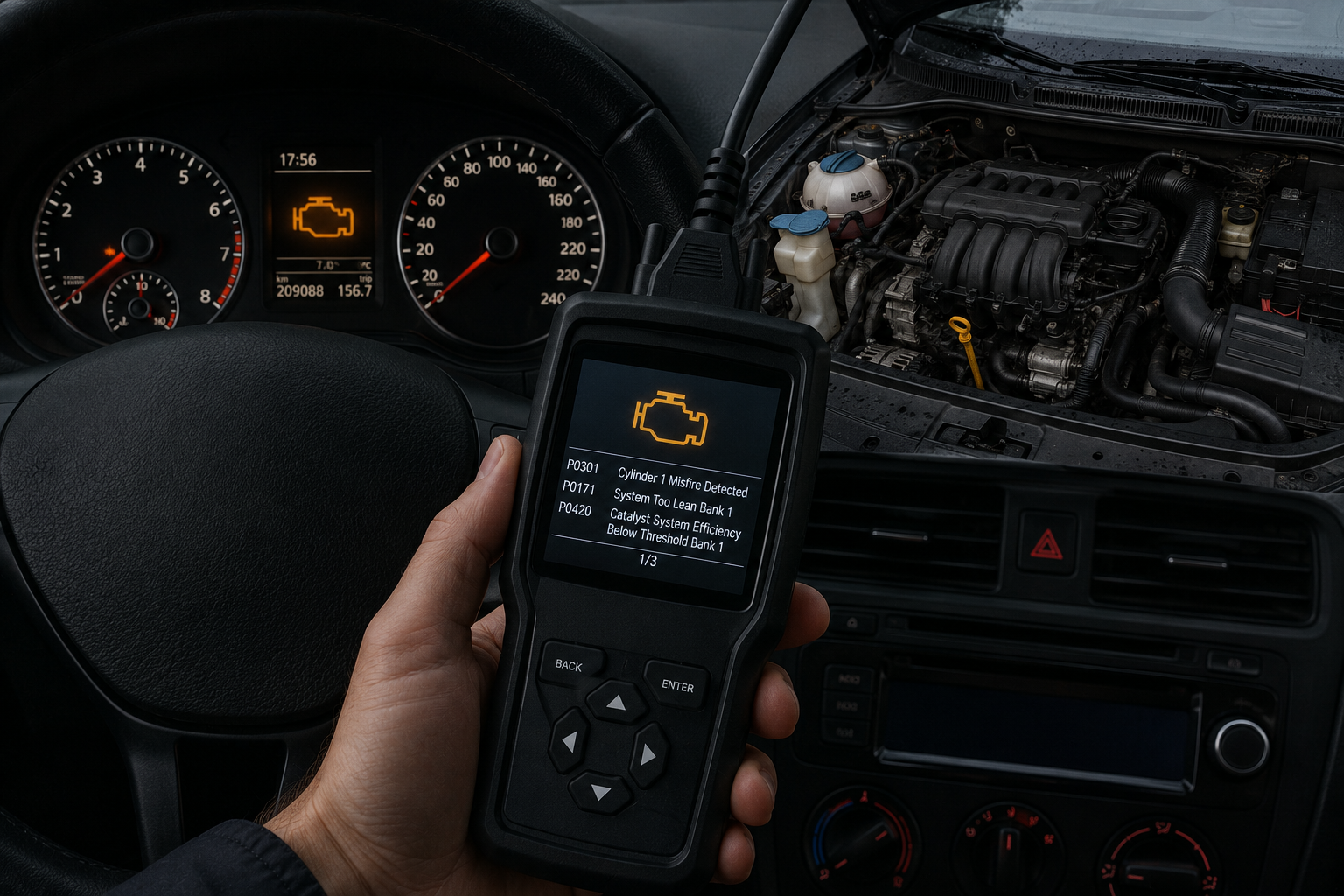
You overtake a lorry, return to your lane and notice a yellow engine symbol on the instrument panel. Nothing sounds unusual. The engine is not rattling, the temperature is normal, the car still accelerates and there are only 37 kilometres left until home.
Two opposing thoughts usually compete in your mind. One says: “If the car is still driving, it cannot be anything serious.” The other is already imagining a damaged engine, a recovery truck and a four-figure repair bill.
The truth lies somewhere in between. The Check Engine light alone does not tell you which component has failed or how expensive the repair will be. It indicates that the control unit has detected an abnormality in the engine, fuel supply, ignition, exhaust emissions or another related system.
Sometimes the cause is a loose fuel cap or a temporary sensor signal. In other cases, the car appears to drive normally while an incorrect air–fuel mixture gradually increases consumption and damages the catalytic converter. A flashing light combined with an engine that is misfiring or shaking may mean that you should not continue even as far as the nearest workshop.

The Check Engine light is not a finished diagnosis. It is a warning that the car has stored information that must be read, compared with the symptoms and only then used to decide whether it is safe to continue driving.
What does the Check Engine light actually monitor?
The technical name for the Check Engine light is the malfunction indicator lamp, or MIL. It is connected to the vehicle’s onboard diagnostics system, which monitors engine management and emissions-related systems.
The control unit continuously compares information from various sensors. It evaluates how much air enters the engine, how fuel is delivered, whether combustion is even across the cylinders, how much oxygen is present in the exhaust gases, whether the exhaust treatment system is working and whether the sensor signals are logically consistent with one another.
If a deviation exceeds the manufacturer’s specified limit or is repeated under certain driving conditions, the system stores a diagnostic trouble code. Depending on the type of fault, the light may come on immediately, after several journeys or only when the problem has become sufficiently persistent.
A “Service” message, spanner symbol or oil-change reminder usually indicates scheduled maintenance. The Check Engine light means that the control system has detected an operational abnormality. Both warnings may appear at the same time, but they do not mean the same thing.
The light comes on, stays on or flashes: three different situations
The important point is not only that the symbol is visible. You should pay attention to when it appears, whether it goes out and how the vehicle behaves at that moment.
When the ignition is switched on, the light briefly illuminates together with the other indicators. It should normally go out after the engine has started.
The control unit has stored a fault. If there are no other dangerous symptoms, it is usually possible to drive carefully to your destination or a workshop, but the problem should not be ignored.
In many vehicles, this indicates a serious misfire that can quickly overheat and damage the catalytic converter. Reduce the engine load and stop safely.
Always consider the instructions in the specific vehicle’s owner’s manual. Different manufacturers may use different supplementary messages, power restrictions and warning combinations.
The symptoms matter more than the colour of the light alone
If the engine is misfiring, power suddenly drops, smoke appears, there is a smell of fuel, metallic knocking can be heard, or a red oil-pressure or overheating warning illuminates at the same time, do not assume that a yellow light means you may continue driving.
What should you check during the first five minutes?
A driver at the roadside does not need to determine the precise diagnosis. The task is to understand whether the vehicle currently poses an immediate safety risk or a risk of expensive damage.
Check whether the light is continuously illuminated or flashing. Remember when it came on — after refuelling, acceleration, a cold start or a longer drive.
Check the temperature gauge and other warning lights. A red oil-pressure or overheating warning is far more urgent than a normal yellow Check Engine light.
Listen to the engine. Uneven idling, shaking, whistling, knocking or an unusual exhaust sound can help assess the level of risk.
Assess the power and accelerator response. If the car has entered limp mode, overtaking and joining fast-moving traffic may become unsafe.
Check for smoke or the smell of fuel, burning material or sweet-smelling coolant. If there is a leak or strong smell, switch off the engine and do not take the risk.
If the light came on shortly after refuelling with petrol, check the fuel cap. It must be closed correctly, but never open the cooling-system cap while the engine is hot.
The most common causes: from a simple cap to catalytic-converter damage
The same light can appear for dozens of different reasons. Two vehicles displaying the same fault code may also require completely different repairs.
In petrol vehicles, the control system may detect that the fuel-vapour recovery system is not airtight. The cause may be an incorrectly closed cap, a damaged seal, a hose or a valve.
The light does not always go out immediately after the cap has been closed. The system may need several driving cycles before it repeats the test.
In a petrol engine, the cause may be a spark plug, ignition coil, injector, wiring connection, air leak or a mechanical compression problem.
Typical signs include shaking, jerky acceleration, a smell of fuel and a flashing light. Continued driving can damage the catalytic converter.
The sensor helps the control unit adjust the air–fuel ratio and monitor catalytic-converter operation.
An incorrect signal can increase fuel consumption, but a similar code may also be caused by an exhaust leak, an air–fuel mixture problem or damaged wiring.
A dirty or faulty MAF or MAP sensor, a cracked intake pipe or a vacuum leak can cause an incorrect airflow calculation.
The car may lose power, idle unevenly, produce more smoke or consume more fuel.
In a diesel vehicle, the light may be caused by the EGR valve, an incomplete DPF regeneration, pressure sensors, exhaust-temperature sensors or an air-supply problem.
Repeated short journeys and ignoring the problem can lead to restricted power and more expensive cleaning or repairs.
If the control unit receives incorrect temperature information or the engine does not reach its intended operating temperature, the air–fuel mixture may remain enriched for longer than necessary.
The result may be increased fuel consumption, weaker cabin heating and emissions-system faults.
A split boost pipe, intercooler leak, vacuum-control problem or turbocharger mechanism fault can result in excessively low or high boost pressure.
A loss of power is usually noticeable, a whistling sound may be heard and the vehicle may enter limp mode.
A weak battery, a voltage drop during starting, a corroded terminal or a poor earth connection can produce several apparently unrelated fault codes.
Replacing several parts simply because they appear in a code list is therefore not a proper diagnostic method.

Can you continue driving with the light on?
There is no universal yes-or-no answer. The correct decision depends on how the warning light behaves, which other indicators are present and how the vehicle is running.
The light stays on continuously, the engine runs smoothly, the temperature is normal and there is no smoke, smell, vibration or significant loss of power.
Avoid heavy loads, high engine speeds, towing and prolonged delay. Arrange diagnostics in the near future.
There is a moderate loss of power, the vehicle has entered limp mode, the idle has become unstable or other symptoms have appeared without becoming worse.
Choose a short and safe route. If the situation deteriorates, stop and use roadside assistance.
The light is flashing, the engine shakes severely, power disappears, metallic noises are heard, smoke is visible or there is a strong smell of fuel or burning material.
Stop in a safe location, switch off the engine and contact a workshop or roadside-assistance provider.
A red oil-pressure or temperature warning changes everything
The Check Engine light must not distract you from other indicators. If a red oil-pressure warning appears at the same time, switch off the engine as soon as you can stop safely. Driving without adequate oil pressure can cause severe engine damage in a very short time.
You should not continue driving during overheating in the hope that airflow will cool the engine. Never open a hot cooling-system cap, because the system may be pressurised and contain extremely hot fluid.
An OBD code is not a verdict on a specific component
An OBD reader allows you to retrieve diagnostic trouble codes stored in the control unit. It is a valuable starting point, but the code normally describes a detected deviation or system rather than automatically identifying the defective component.
The code indicates that the control system has detected a misfire in cylinder two.
It does not mean that the second cylinder’s ignition coil should be replaced without testing. The cause may be a spark plug, coil, injector, wiring connection, compression loss, intake leak or another problem.
The code indicates that the system has assessed the catalytic converter’s efficiency as being below the expected threshold.
The cause may be a worn catalytic converter, but the oxygen sensors, exhaust leaks, air–fuel mixture and any previous misfires should be checked before it is replaced.
What do the letters and numbers in a code mean?
Many engine-management codes begin with the letter P, which identifies the powertrain system. The P0 group commonly contains standardised codes, while the P1 group may contain manufacturer-specific information. The exact interpretation should be checked against the technical documentation for the specific model.
A deviation has been detected, but the system is still assessing whether it will recur and become a confirmed fault.
The fault criteria have been met, the code has been stored and, depending on the problem, the warning light may have been activated.
In some vehicles, it remains stored until the system itself tests and confirms that the fault has genuinely been corrected.
A stored snapshot showing engine speed, load, temperature and other parameters at the moment the fault was registered.

Why should you not erase the code immediately?
Erasing the code does not repair the fault. It may turn off the light and delete information useful for diagnosis, including the conditions under which the fault occurred.
After codes have been cleared or the battery disconnected, several onboard diagnostic tests may need to be completed again. The light may remain off for some time even though the problem is still present and will return after the relevant driving cycle.
An OBD reader is a tool, not a mechanic
It can read codes and parameters, but it cannot test compression, locate an intake leak, assess fuel pressure or determine whether a sensor signal is the cause of a fault or the consequence of another problem.
What can you do with your own OBD reader?
- record all codes before clearing them;
- save screenshots of the freeze-frame data;
- check whether the fault is pending, confirmed or recurring;
- observe coolant temperature, fuel trims and other available parameters;
- give the workshop precise information about when and under which conditions the problem appeared.
When choosing a wireless adapter and app, consider the device’s quality, compatibility and the permissions requested on your phone. Do not leave an unknown low-quality adapter permanently connected unless the manufacturer has designed it for that purpose.
What does the Check Engine light mean at a vehicle inspection in Latvia?
During a vehicle inspection in Latvia, inspectors assess not only whether the light is visible, but also whether it operates correctly and, for certain vehicles, the information stored in the OBD system regarding the exhaust-emissions control system.
If the indicator does not operate correctly or indicates an exhaust-emissions control system fault, the current criteria provide for assessment category 1 — a minor defect.
Incorrect operation of the indicator, an emissions-system fault indication or a corresponding OBD fault is assessed as category 2 — a major defect requiring a repeat inspection.
The exact inspection method depends on the vehicle’s first registration date, fuel type, emissions class and technical capabilities. Clearing the fault in the car park before the inspection is therefore not a reliable solution.
If the cause has not been corrected, the code may return. After the memory has been cleared, the onboard diagnostic monitors may also not have completed their tests. The correct approach is to identify and repair the cause first and then confirm that the system operates without recurring codes.
How can the warning light be connected with higher fuel consumption?
Not every Check Engine fault increases fuel consumption, but many problems directly affect the air–fuel ratio, engine temperature or quality of combustion.
If the temperature sensor reports an excessively low temperature, the control unit may maintain an enriched mixture for longer. If an oxygen sensor supplies incorrect information, the fuel corrections may move in the wrong direction. If a cylinder is misfiring, some of the fuel does not produce useful motion.
Assume that a car normally consumes 7.0 l/100 km, but a fault increases consumption to 8.2 l/100 km. The car covers 1,500 kilometres per month.
Calculation: 1,500 km ÷ 100 × 1.2 l = 18 litres. This is an illustrative example using an assumed fuel price, not a statement of the current price.
Additional fuel expense is often not the greatest risk. If an unrepaired ignition fault damages the catalytic converter or incorrect diesel-engine operation overloads the DPF system, an initially simple repair can become considerably more expensive.
How should you prepare for a workshop visit?
A good description of the problem can save diagnostic time. The phrase “something is lit up on the dashboard” gives the workshop little information, while an accurate description of the events helps determine which checks should be carried out first.
- when the light came on and whether it stays on or flashes;
- whether the engine was cold or warm;
- the speed, engine load and approximate engine speed;
- whether the problem began after refuelling, maintenance or a repair;
- whether the power, fuel consumption, idle or exhaust smoke changed;
- which OBD codes and freeze-frame data were retrieved;
- whether the light went out by itself and after how many journeys it returned.
What should you ask after diagnostics?
Ask not only for the name of the fault code, but also how the suspected cause was tested. If the workshop recommends replacing a sensor, it should be clear whether the supply voltage, wiring, signal and the system monitored by that sensor have been checked.
In more complex cases, it is reasonable to authorise the diagnostic work first and agree on the repair only after the results are available. This reduces the risk of replacing parts on the basis of guesswork.
Driver’s checklist
Save this checklist on your phone. It can help you make a calmer decision if the light appears in an unfamiliar place or during a longer journey.
☐ Checked whether the light stays on or flashes
☐ Checked the temperature gauge
☐ No red oil-pressure warning is present
☐ The engine is running smoothly
☐ There is no smoke or strong smell
☐ There are no unusual metallic noises
☐ There is no dangerous loss of power
☐ The fuel cap has been checked where relevant
☐ The moment when the light appeared has been recorded
☐ OBD codes and screenshots have been saved
☐ The fault was not erased before the information was saved
☐ A safe route without heavy engine load has been selected
☐ Proper diagnostics have been arranged, not merely deletion of the light
A short self-check
The Check Engine light stays on, but the car runs normally. Can you continue driving for several months?
No. An immediate stop may not be necessary, but the fault should be diagnosed in the near future. Ignoring it for a long time can increase fuel consumption and cause additional damage.
The light is flashing and the engine is shaking. Can you slowly drive 20 kilometres to a workshop?
It is safer to stop and use roadside assistance. A flashing light combined with severe shaking can indicate a misfire and a risk of catalytic-converter damage.
The OBD device displays an oxygen-sensor code. Should the sensor be replaced immediately?
No. The sensor signal, wiring, exhaust-system sealing and air–fuel mixture should be checked. The code may describe the consequence of another fault.
Does erasing the fault mean that the vehicle has been repaired?
No. Erasing it only removes the stored information and turns off the light until the system detects the problem again.
Frequently asked questions
Can poor-quality fuel cause the Check Engine light to come on?
It can if the fuel quality or an unsuitable octane rating causes knocking, misfires or air–fuel mixture deviations. However, the filling station should not automatically be blamed — the codes and symptoms must be diagnosed.
Can a weak battery cause the warning light to appear?
Yes. Low voltage during starting or unstable charging can create faults in several control units. The battery, alternator and connections should be checked before components are replaced.
Can the light go out by itself?
Yes. If the deviation does not recur, the system may switch off the light after a specified number of driving cycles. The fault history may still remain stored in the control unit for some time.
Can I disconnect the battery to turn off the light?
This is not a repair and, in some vehicles, may create additional inconvenience, such as lost settings or a need to recalibrate certain systems. Valuable diagnostic information may also be lost.
Does the Check Engine light always mean a large repair bill?
No. The cause may be simple and relatively inexpensive to correct. Expensive repairs are more likely when the fault has been ignored for a long time or parts have been replaced without proper diagnosis.
Can a universal OBD reader detect every fault in a vehicle?
Usually not. A basic device often reads standardised engine and emissions codes but may not detect manufacturer-specific information or faults in the transmission, ABS, airbag or comfort systems.
Can a car pass its vehicle inspection with the light on?
It depends on the vehicle’s first registration date, the type of fault and the inspection results. For vehicles first registered from 2012, an emissions-system warning-light or OBD fault can receive a category 2 assessment, so the problem should be repaired before the inspection.
What should I do if the light comes on during a trip abroad?
Assess how the light behaves and which symptoms are present, save the fault codes and contact roadside assistance or a local workshop. Do not continue driving if the light is flashing, the engine is overheating, oil pressure is lost or the engine is running very poorly.
A small warning light that requires the right decision
The Check Engine light is not a reason to panic, but neither is it a decorative symbol that can be covered with black tape. Its greatest value is as an early warning — an opportunity to find the problem while the vehicle still drives and the repair has not become unnecessarily complicated.
A continuously illuminated light without other symptoms usually gives you time to reach your destination calmly and arrange diagnostics. A flashing light, shaking, smoke or a sudden loss of power requires far more cautious action.
The most important point is not to confuse reading a code with making a diagnosis. A good repair does not begin by ordering the first component suggested by an internet search, but by asking: why did the control unit detect this deviation?
The driver’s main takeaway: if the Check Engine light stays on and the car runs normally, drive gently and arrange diagnostics. If the light flashes, the engine shakes, smoke or a strong smell appears, or a red warning light comes on, stop safely and do not risk a much more expensive failure.