 LV
 EN
 RU
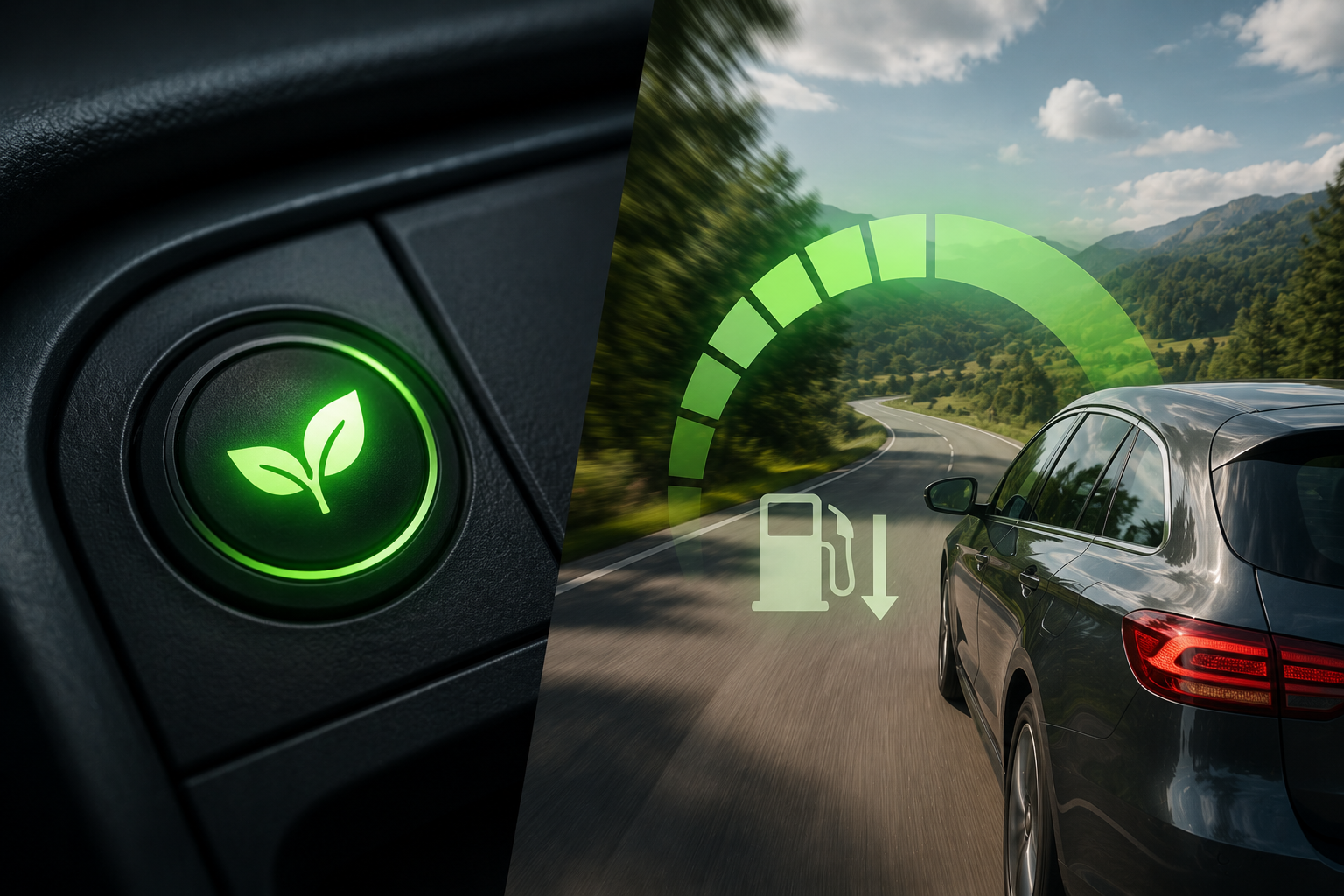
Modern cars have more and more buttons. There is Sport mode, Comfort mode, Normal mode, Snow mode, Individual mode and, of course, Eco mode. Eco mode is especially interesting for many drivers because it promises something very practical — lower fuel consumption.
On paper, it sounds very good. Press a button, the car becomes more economical, fuel consumption drops and the trip costs less. But, as often happens with car technology, reality is a little more complicated. Eco mode can help, but it is not a magic button. It cannot cancel physics, traffic, driving habits, tyre pressure, a cold engine, headwind or an aggressive right foot.
For some drivers, Eco mode really does help them drive more calmly and use less fuel. For others, it feels annoying because the car becomes sluggish, gears change too early, the air conditioning feels weaker and every overtaking manoeuvre requires more patience. Others turn Eco mode on simply because “it should be more economical”, but after a month they see no real difference in fuel receipts.
That is why in this article we will not take the easy route and say: “Eco mode always saves fuel” or “Eco mode is useless”. The correct answer is much more interesting. Eco mode is a tool. If it is used in the right conditions and together with sensible driving habits, it can help. If it is used incorrectly or expected to perform miracles, the result may be disappointing.
Quick answer for the reader:
Eco mode can reduce fuel consumption, especially in calm city and suburban driving, but it does not work like a magical economy button. It helps most when the driver is already willing to drive more smoothly, read traffic ahead and press the accelerator less aggressively.
A typical driver thought: “I switched on Eco mode and expected consumption to drop by a litre immediately. In reality, I realised the mode only helps — the main fuel saver is still me.”
What is Eco mode?
Eco mode is a vehicle driving mode designed to reduce energy consumption. In petrol and diesel cars, that means lower fuel consumption. In hybrids and electric cars, it can mean more efficient energy use and longer range. But it does not happen because the engine suddenly becomes magically more economical. The car simply changes its behaviour.
Depending on the car model, Eco mode can affect several things. It may make the accelerator pedal less sensitive, change the automatic gearbox shift logic, reduce climate control intensity, limit sharper acceleration, activate a coasting function or encourage the driver to drive more calmly. In some cars, Eco mode is very noticeable. In others, it is almost invisible.
It is important to understand that Eco mode is not the same in every car. In one car, it only makes the accelerator pedal “softer”. In another, it changes gear shifts. In a third, it affects air conditioning. In a fourth, together with navigation and adaptive cruise control, it can help the car drive more predictably. That is why people’s experience with Eco mode can be very different.
If one driver says Eco mode saves fuel and another says it is completely useless, both may be telling the truth. They simply have different cars, different routes and different driving habits.
What does Eco mode usually change in the car?
To understand whether Eco mode really helps, we first need to know what it does. Below are the main things Eco mode can affect.
| Car system | What can Eco mode change? | How can it affect consumption? |
|---|---|---|
| Accelerator pedal | Makes response calmer and less sharp. | Fewer sudden accelerations, lower consumption. |
| Automatic gearbox | Shifts earlier and keeps engine revs lower. | Can reduce consumption during calm driving. |
| Climate control | May reduce heating or cooling intensity. | Lower energy load, but sometimes less comfort. |
| Cruise control | In some cars, acceleration becomes calmer and more predictable. | Can help avoid unnecessary consumption spikes. |
| Coasting | In some cars, allows rolling with less engine braking. | Can help on longer smooth sections. |
This table shows one important thing: Eco mode usually does not save fuel directly by itself. It changes the car’s behaviour so it becomes easier for the driver to drive economically. It is a bit like a coach saying: “Slow down, do it more smoothly, do not jump straight to maximum.”
Accelerator pedal: why does the car feel slower in Eco mode?
One of the first things a driver notices in Eco mode is accelerator pedal response. The car no longer reacts as sharply. You press the pedal the same way as before, but the car accelerates more calmly. Some drivers like this, while others feel that the car has become “choked”.
In reality, the engine does not always become weaker. Often only the pedal response map changes. This means that with the same pedal movement, the car gives a less aggressive response. To get the same acceleration, the pedal must be pressed further. This is how the car tries to reduce accidental sharp acceleration, which very often increases fuel consumption in daily driving.
This is one of the biggest benefits of Eco mode. Many drivers do not even notice how often they accelerate too sharply. Not because they want to drive sportily, but because the pedal is sensitive and traffic encourages jerky driving. Eco mode reduces this sharpness and makes driving smoother.
A good driver comment: “In Eco mode, my car is not slow — it simply no longer jumps forward from every small touch of the pedal. In the city, that actually helps me drive more calmly.”
Automatic gearbox: how does Eco mode change gear shifts?
In cars with automatic transmission, Eco mode often changes the gearbox shift logic. In normal mode, the gearbox may hold a lower gear longer so the car feels more responsive. In Eco mode, it often tries to shift earlier into a higher gear so the engine works at lower revs.
During calm driving, this can help. If sharp acceleration is not needed, the engine does not need to stay at higher revs. The car moves smoothly, the gearbox shifts earlier and consumption may drop. This is especially noticeable in the city and suburbs, where the car often accelerates and slows down.
But there is another side. If Eco mode shifts up too early and the engine lacks power, the driver may start pressing the accelerator more. Then the gearbox may shift down again, the car becomes more nervous and the economy disappears. That is why Eco mode works best when the driver truly drives calmly, not when they try to drive in Eco mode as if they were in Sport mode.
Mini observation:
If you keep pressing the accelerator deeper in Eco mode to compensate for the car feeling sluggish, you may not be saving fuel — you may simply be fighting the mode.
Air conditioning and heating: economy sometimes comes at the cost of comfort
In some cars, Eco mode also affects climate control. This can mean that the air conditioning works less intensively, the fan blows more gently or the heating does not reach the desired temperature as quickly. From an energy consumption point of view, this is logical. The climate system requires energy, and if its load is reduced, the car can become more efficient.
But here an important question appears: how much comfort are you willing to give up for a small saving? On a hot summer day, weaker air conditioning can make the driver tired and irritated. In winter, weak heating can be unpleasant and may even affect window defrosting or visibility. Saving fuel must never reduce safety.
That is why climate control economy must be used sensibly. If Eco mode reduces unnecessary cooling and you still feel comfortable — great. If it starts affecting visibility, driver wellbeing or safety, it is better to choose a normal climate setting. A few cents of fuel are not worth it if driving becomes unpleasant or risky.
Where does Eco mode work best?
Eco mode works best where the driver can drive smoothly. This means calm city driving, suburban routes, longer sections without sudden overtaking and traffic where events can be anticipated ahead. If you see a red light from far away, lift off the accelerator early and let the car roll smoothly, Eco mode can support that style.
It can also work well on everyday routes where you know the traffic lights, junctions, speed limits and traffic rhythm. If you drive the same road every day, Eco mode can help make that trip calmer and more consistent. It is not only about consumption. It is also about less stress.
Eco mode works especially well for drivers who accidentally drive too nervously. Not aggressively, but jerkily. They accelerate quickly, then brake, then accelerate again. Eco mode smooths this type of driving slightly, and that is where savings can appear.
Where can Eco mode get in the way?
Eco mode is not ideal for every situation. If you need to overtake quickly, merge into busy traffic, drive in hilly areas or tow a trailer, Eco mode may feel too slow. It is not always dangerous, but it can create the feeling that the car does not react quickly enough.
For example, when pulling out from a side road into a fast traffic flow, you may want sharper pedal response. If you need to overtake a truck on the highway, Eco mode’s calm response may make the driver press the pedal deeper and longer. In these moments, Normal or Sport mode may be safer and more logical.
That is why Eco mode should not be treated as a mode that must always be on. It is a mode for calm and predictable driving. When the situation requires quick response, there is nothing wrong with switching to another mode. A smart driver is not the one who always presses Eco. A smart driver understands when Eco helps and when it gets in the way.
| Situation | Is Eco mode suitable? | Why? |
|---|---|---|
| Calm city driving | Yes | Helps reduce jerky acceleration. |
| Long highway section at steady speed | Sometimes | The benefit may be small if speed is already stable. |
| Overtaking | Better not | Response may be too slow. |
| Towing a trailer | Depends on the car | Sometimes the engine and gearbox need a more active response. |
| Very hot day with a full cabin | Use carefully | Eco may reduce climate control power. |
Does Eco mode reduce engine power?
Many drivers feel that Eco mode “cuts” the car’s power. In reality, it is not always that simple. Often the maximum power is still available, but it takes a deeper pedal press to access it. The car simply reacts more calmly at first so the driver does not accidentally use more power than needed.
It is similar to changing the sensitivity of a tool. In normal mode, the pedal may be very responsive, so a small touch gives a bigger reaction. In Eco mode, the same touch gives a calmer reaction. If you really need to accelerate, in most cars you can press the pedal further and the car will still accelerate.
However, the feeling can be very different. A driver used to sharper response may find Eco mode unpleasantly sluggish. A driver who wants calm daily driving may like exactly this slower reaction because the car becomes less nervous.
A very honest comment: “Eco mode does not make my car weak. It makes me calmer because the car no longer encourages me to press more every time.”
Mini test: is Eco mode right for you?
To keep this article practical, try a quick self-check. Answer honestly — not how you would like to drive, but how you really drive every day.
Tick what applies to you:
- I often drive in the city and wait at traffic lights.
- I do not need strong acceleration at every moment.
- I want to make my driving calmer and smoother.
- I sometimes do not notice that I drive jerkily.
- I like monitoring average consumption and improving my habits.
If 3 or more points apply to you, Eco mode is likely to be useful. If almost none apply, you may already drive economically — or Eco mode may simply feel annoying to you.
Eco mode in the city: where is the real economy?
In the city, fuel consumption is strongly affected by acceleration. Every time the car has to move from low speed or from a stop, the engine does work. If the driver accelerates hard and then soon brakes, energy is spent almost for nothing. This is where Eco mode can help the most.
It makes it harder to “jump” with the accelerator. The car becomes calmer, acceleration becomes smoother, and the automatic gearbox looks for a more economical gear sooner. If the driver adapts to this, city consumption can become lower. But if the driver keeps pressing the pedal deeper to compensate for the calmer response, the benefit becomes smaller.
In the city, Eco mode works best together with anticipation. See a red light ahead? Lift off earlier. See the queue beginning to brake? Do not accelerate again just to brake two seconds later. Eco mode cannot do these things for you, but it can help make them easier.
Eco mode on the highway: does it make sense?
On the highway, the benefit of Eco mode is often smaller than in the city. If the car is already moving at steady speed, the gear is high and the engine is operating efficiently, Eco mode does not have as much to improve. Speed, wind, tyres, vehicle load and whether you drive at 90, 100 or 120 km/h will often matter much more.
Still, in some cars Eco mode can help on the highway if it makes cruise control calmer, reduces overly sharp acceleration after a speed drop or activates coasting. But do not expect a huge difference. If the main reason for high consumption is high speed, Eco mode cannot hide that fact.
Simply put: on the highway, the best Eco mode is often a sensible speed. The button can help, but physics will win. If you drive fast, with a roof box, into headwind and with a fully loaded car, Eco mode will not turn that trip into a highly economical one.
Short comparison:
In the city, Eco mode often helps change the driving rhythm. On the highway, speed, aerodynamics and steady driving usually matter more.
Is Eco mode useful in winter?
In winter, Eco mode can be useful because calmer pedal response helps avoid too much power being sent to the wheels on slippery roads. It can make driving smoother and less nervous. But winter also has its own nuances.
A cold engine, cabin heating, window heating, thicker oil, winter tyres and worse road conditions already increase consumption by themselves. Eco mode can help you drive more calmly, but it cannot fully compensate for winter conditions. If the trip is very short, the engine does not warm up and consumption will still be higher.
In winter, it is also important not to sacrifice visibility and comfort. If Eco mode reduces climate system performance and the windows start fogging or the cabin does not warm up enough, safety should come first. Fuel economy must never be more important than clear visibility.
Is Eco mode useful in summer?
In summer, Eco mode can help if it reduces unnecessary acceleration and allows calmer driving. But in hot weather, air conditioning becomes very important. If Eco mode makes cooling weaker, the driver may feel worse, get tired faster and become less attentive.
That is why Eco mode should be used sensibly in summer. If the cabin has already cooled down and you only need to maintain temperature, Eco mode can be good. If the car has just been standing in the sun and the cabin is extremely hot, it is sometimes better to ventilate first, cool the cabin normally and only then think about maximum economy.
Summer economy is not only about the Eco button. It is also about where you park, whether you use a sunshade, whether you ventilate the cabin before switching on air conditioning and how aggressively you drive. Eco mode is only one part of the whole picture.
7-day experiment: test Eco mode in your own car
The best way to understand whether Eco mode really helps you is not to argue in forums, but to run a simple test. Every car, route and driver is different, so a personal test is often more valuable than a general opinion.
7-day Eco test:
- Choose one regular route, for example home–work–home.
- Drive 3 days in normal mode and record average consumption.
- Drive the next 3 days in Eco mode on the same route.
- Try to drive at similar times and at a similar pace.
- Do not compare just one trip — look at the average result.
- Also write down how it felt: comfort, response, air conditioning, gearbox behaviour.
- On the seventh day, compare not only litres, but also whether you enjoyed driving.
This test is not laboratory-perfect because traffic and weather change. But it will give you a much better idea than one random day. The important thing is to compare similar conditions and several trips, rather than judging from one morning when there was rain, congestion and headwind.
Why do some drivers use more fuel in Eco mode?
It sounds paradoxical, but in some cases Eco mode may not help or may even feel like it causes higher consumption. The reason is usually not the mode itself, but the driver’s reaction to it. If the car feels sluggish, the driver may start pressing the accelerator deeper and more often. As a result, the car still accelerates, but the process becomes less natural.
Another reason is the wrong route. If driving happens on hilly roads, with a trailer, with a fully loaded car or with frequent overtaking, Eco mode may not be the best choice. The gearbox may shift too early, the engine may work in an uncomfortable range and the driver may constantly compensate with the accelerator pedal.
The third reason is unrealistic expectations. If the driver expects Eco mode to reduce consumption by 20%, disappointment is almost guaranteed. The real benefit is often much more modest and appears only together with good driving habits.
A good comparison: “Eco mode is like a gym membership. It can help, but only if you actually do something right yourself.”
Eco mode and driver psychology
Interestingly, Eco mode affects not only the car, but also the driver’s mindset. When you see “Eco” on the dashboard, you subconsciously think more about consumption. You are less tempted to accelerate sharply, you look at the trip computer more often and you try to drive smoothly. For some drivers, this psychological effect is the biggest benefit.
For others, the opposite happens. They get annoyed that the car does not respond sharply, and they start fighting the mode. Then Eco mode does not calm them down — it irritates them. In that case, it may be better to drive in Normal mode and simply control the pedal more calmly yourself.
So Eco mode is not only a technical question. It is also a question of what driving style you trust. If the mode helps you become calmer, it is useful. If it annoys you and makes you press more, it may not be right for everyday use.
Eco mode in petrol, diesel, hybrid and electric cars
In petrol cars, Eco mode often helps reduce sharp acceleration and allows the automatic gearbox to shift earlier. This can be useful in the city, where a petrol engine can become quite thirsty during jerky driving.
In diesel cars, Eco mode can work well during calm driving because diesels often have good torque at lower revs. However, very short trips, a cold engine and DPF system needs are still more important than the Eco button. If a diesel is used in unsuitable conditions, Eco mode will not save it.
In hybrids, Eco mode can be very interesting because it may help the car use electric mode more often, dose power more gently and recover energy more efficiently. Still, even in a hybrid, everything depends on driving style. If you accelerate hard all the time, the hybrid cannot show its best side.
In electric cars, Eco mode often reduces power response and climate system consumption to increase range. Here it is no longer about litres, but about kilowatt-hours and kilometres. Eco mode in an electric car can be especially useful if you need to reach a charger and want to increase the remaining range reserve.
Short explanation: which cars usually benefit most from Eco mode?
It usually works best for city and suburban drivers, hybrid owners and those who tend to drive too jerkily. It changes the least for drivers who already drive very calmly or mostly travel on highways at steady speed.
Common myths about Eco mode
Myth No. 1: “Eco mode always reduces consumption.”
Not always. It helps only when driving conditions and driver habits allow smoother and calmer driving.
Myth No. 2: “Eco mode damages the engine because it drives at too low revs.”
In a properly working car, the control system will not let the engine operate dangerously incorrectly. But if the car clearly feels strained, it is better to choose a more suitable mode.
Myth No. 3: “The car becomes too weak in Eco mode.”
Often the pedal response changes rather than all power disappearing. If needed, more power is usually still available with a deeper press of the pedal.
Myth No. 4: “If I want to save fuel, Eco mode must always be on.”
No. During overtaking, in hilly areas, with a trailer or in situations where quick response is needed, another mode may be a better choice.
Myth No. 5: “Eco mode is useless because my consumption did not change.”
Maybe the benefit is truly small on your route. But maybe your driving style does not allow the mode to work. That is why a multi-day test is worth doing.
Practical tips to make Eco mode actually help
If you want Eco mode to be more than just a nice button on the dashboard, use it together with the right habits.
- Press the accelerator gently. Eco mode helps, but it cannot save you from aggressive pedal use.
- Look further ahead. Lifting off early is one of the biggest keys to economy.
- Do not treat Eco like Sport mode. If you want sharp response, switch modes.
- Track average consumption over several days. One trip can be misleading.
- Do not sacrifice visibility and comfort. If climate control is too weak in Eco mode, adjust the settings.
- Check tyre pressure. Eco mode cannot compensate for soft tyres.
- Remove unnecessary weight from the car. If the boot is always full of things you do not need, fuel disappears regardless of mode.
A small reader challenge: your next drive in Eco style
On your next drive, try not only switching Eco mode on, but also driving in a way that gives the mode a chance to help. That means: do not accelerate sharply, lift off early, do not jump on the brakes at the last moment, do not rush towards a red light and do not try to win back every second.
One-day challenge:
Choose one day, switch on Eco mode and try to drive so smoothly that a passenger almost does not feel acceleration and braking. If the drive becomes calmer and consumption drops, you have found the real meaning of Eco mode.
Is Eco mode worth using?
Eco mode is worth using if it helps you drive more calmly, predictably and economically. If it reduces jerky driving, helps the automatic gearbox work more efficiently and does not reduce comfort, it is a good tool. Even if the saving is not huge, over time it can be a pleasant bonus.
But Eco mode is not worth it if it annoys you, makes you press the accelerator deeper, gets in the way during overtaking or reduces climate comfort so much that driving becomes unpleasant. In that case, it may be better to drive in Normal mode and consciously drive calmly yourself.
The most important thing is to understand that economy is not one button. It is a driving system. Eco mode can be part of it, but it will not do everything for you. If driving style remains aggressive, even the best Eco mode will only be decoration on the dashboard.
Short answer for those who want the conclusion in 10 seconds
Eco mode is worth using in calm everyday driving, especially in the city and suburbs. It does not need to be used during overtaking, with a trailer, in hilly areas or in situations where quick response is needed. Fuel is saved most not by the button itself, but by the driver who uses that button correctly.
Conclusion: Eco mode helps only if you let it help
Eco mode really can reduce fuel consumption, but it is not a miracle solution. It cannot make a heavy car light, cannot cancel high highway speed, cannot compensate for soft tyres, a cold engine or aggressive driving. It can only change the car’s behaviour so economical driving becomes easier.
Eco mode works best in the city, suburbs and calm everyday driving. It helps reduce sharp pedal response, encourages the automatic gearbox to shift more economically and, in some cars, reduces climate system load. But it can get in the way in situations where quick response, strong acceleration or stable comfort are needed.
So the best advice is simple: use Eco mode as a helper, not as a magical solution. Try it for several days, compare consumption, evaluate the driving feel and understand whether it gives a real benefit in your car and on your route. If it does — great. If not — that does not mean Eco mode is bad. It means that in your conditions, other habits may matter more.
Fuel economy begins not with a button, but with thinking. Eco mode can support that thinking. But the main economy mode will always be in the driver’s head and right foot.
Short driver conclusion: “Eco mode is not a magic button. It is a good helper for a calm driver, but a poor saviour for someone who continues driving aggressively.”