
 LV
 EN
 RU
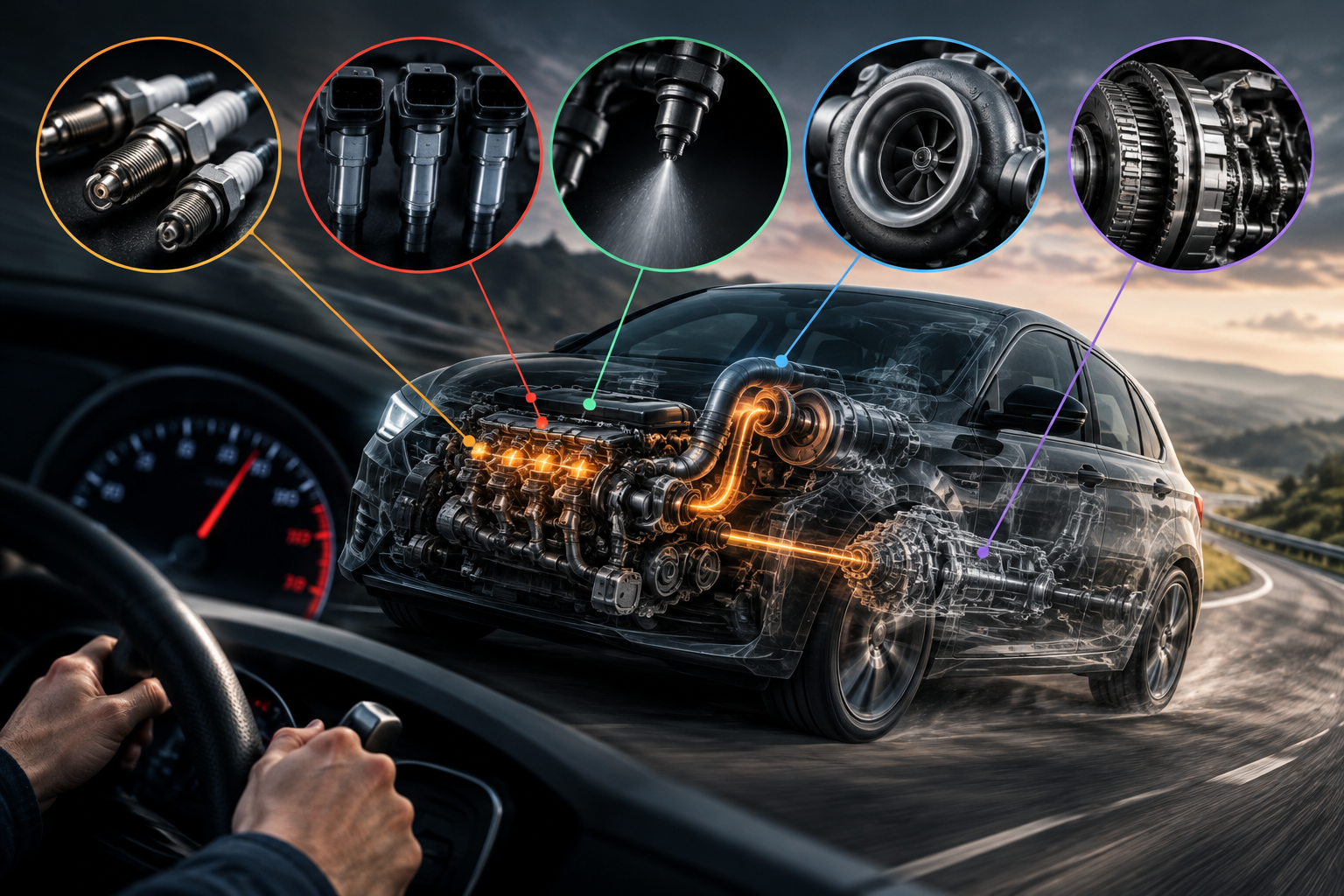
You pull onto a main road, a slower vehicle is ahead and a safe overtaking opportunity appears. You press the accelerator. The engine begins to pull, the revs rise, but at around 2,000–2,500 rpm the car suddenly jerks. It is not simply a slight loss of performance — for a fraction of a second it feels as though someone released the accelerator and immediately pressed it again. Then the car continues accelerating.
The next day, everything seems completely normal around town. The idle is smooth, the engine starts well and there are no warning lights on the dashboard. You begin to think that perhaps the road surface caused yesterday's sensation. But during the next harder acceleration, the hesitation returns — and this time the Check Engine light briefly flashes as well.
This is one of those vehicle symptoms that sounds very specific but can actually lead diagnostics in ten different directions. On a petrol engine, the cause may be a worn spark plug or ignition coil that still works during gentle driving but can no longer provide a stable spark under greater load. On a diesel, a similar sensation can come from an injector or unstable fuel pressure. On a turbocharged engine, boost leaks, MAF or MAP sensors, EGR and turbo control must also be considered. And if the jerk occurs exactly when the transmission changes gear, the fault may not be in the engine at all.
That is why asking “why does my car jerk?” is not enough for useful diagnosis. Much better questions are: when does it jerk? At what engine speed? When cold or warm? Only at full throttle, or during gentle acceleration as well? Exactly during a gear change, or regardless of the selected gear? Do the revs fall, rise or remain steady? Is there smoke, an unusual smell, a Check Engine light or a noticeable loss of power?
These details are often what turn the vague description “the car feels strange when accelerating” into a much shorter list of realistic causes.
Quick answer
If a car jerks specifically during acceleration, the first task is to establish whether the engine itself is misbehaving or whether the interruption comes from the drivetrain. On a petrol engine, spark plugs and ignition coils, fuel delivery and the intake system are common areas to investigate; on a diesel, injector behaviour, fuel pressure, EGR, DPF and boost control become particularly relevant. If the jerk happens exactly during a gear change, the automatic transmission, clutches and transmission fluid also deserve attention. A flashing Check Engine light combined with severe engine hesitation is a more serious warning — an active misfire can damage the catalytic converter, so repeated high-load acceleration should be avoided.
“The car jerks” is not a diagnosis. Diagnosis begins when you can describe exactly when the hesitation occurs and what the engine, rev counter and transmission are doing at that same moment.
First establish this: is the engine jerking, or is it the drivetrain?
This is the most important dividing line in the entire diagnostic process. From the driver's seat, both faults may feel like the same thing — a sudden jolt. But that jolt may occur because one cylinder briefly stops producing its proper share of power, or because engine torque is being transferred unevenly through the transmission and drivetrain.
If the problem comes from the engine, the driver often feels not one isolated mechanical knock but a series of short interruptions in power. The engine may seem to stumble or hesitate, its sound may change, the tachometer may behave slightly unevenly and the Check Engine light may illuminate or flash.
If the fault lies in the transmission or drivetrain, the symptom is often closely tied to a specific event: moving away from a standstill, a gear change, clutch engagement, torque-converter lock-up or the moment the accelerator is suddenly pressed or released.
| What do you feel? | Where should you look first? |
|---|---|
| Small repeated hesitations, with the engine briefly losing power | Ignition, fuel delivery, intake air, sensors, compression |
| One pronounced jolt exactly during a gear change | Automatic transmission, clutches, mechatronics, transmission fluid, adaptations |
| The car shakes or judders when moving away | Manual clutch, dual-mass flywheel, DCT clutches, engine/transmission mounts |
| Engine revs rise sharply but vehicle speed barely increases | Clutch or transmission slipping |
| A clunk when pressing or releasing the accelerator | Drivetrain free play, mounts, driveshafts/CV joints, DMF; engine-management issues are also possible |
Of course, the boundary is not always perfectly clear. A poorly running engine can make an automatic transmission shift badly, while a worn dual-mass flywheel can amplify engine irregularities. Even so, this distinction is extremely useful for deciding where diagnosis should begin.
1. Spark plugs: a problem that often appears specifically under load
On a petrol engine, a spark plug looks like a very simple component: two electrodes with a spark jumping between them. But conditions inside the cylinder are anything but simple. Under acceleration, engine load and cylinder pressure rise, and the ignition system must reliably ignite the compressed mixture exactly when the engine is being asked to produce more power.
As a spark plug wears, its electrode gap may increase, the electrodes erode or the insulator becomes contaminated with combustion deposits. The result can be an engine that appears perfectly normal at idle and during gentle cruising but begins to misfire when the accelerator is pressed harder.
That is why the situation “it drives perfectly around town but starts jerking when I overtake” is a sensible reason to inspect the ignition system on a petrol engine.
That does not mean a new set of plugs should automatically be purchased. If the plugs were replaced recently, it is also worth checking whether the correct specification was used, whether they were installed correctly, whether an ignition coil is failing, whether oil or water has entered a plug well and whether the engine itself is running excessively rich or lean.
2. Ignition coil: it may work at idle and fail only when accelerating
Many modern petrol engines use one ignition coil for each spark plug. Its job is to transform the vehicle's low electrical voltage into the tens of thousands of volts required to produce a spark.
As a coil ages, its insulation may deteriorate, internal faults may develop or high voltage can begin leaking where it should not. A very typical pattern resembles worn spark plugs: everything seems acceptable at idle, but one cylinder begins misfiring when the engine is placed under greater load.
Sometimes the problem becomes more noticeable in damp weather. That does not mean every petrol car that jerks in autumn automatically has a failed ignition coil, but moisture can expose an existing insulation or high-voltage weakness.
An important diagnostic mistake: OBD code P0302 means the engine-control system has detected a misfire on cylinder two. It does not automatically mean “replace the ignition coil on cylinder two”. The cause may be the spark plug, injector, compression, wiring or another fault. A trouble code points you in a direction; it does not automatically identify the failed component.
3. Injector problems: one cylinder simply receives the wrong amount of fuel
For an engine to produce power smoothly, every cylinder must receive the correct amount of fuel at the correct moment. If an injector becomes contaminated, mechanically worn, electrically faulty or begins metering fuel incorrectly, the power produced by one cylinder can differ from the others.
Sometimes the process begins very subtly. There may be a small vibration at idle that the driver blames on an engine mount. Fuel consumption then starts increasing. Later, the car develops slight hesitation under acceleration, and only after some time does a fault code appear.
On a common-rail diesel, injector operation is especially precise. Uneven fuel delivery may appear as poorer acceleration, rougher idle, smoke, difficult starting or uneven contribution from individual cylinders.
Here too, diagnosis should not be based on sound alone. Diesel diagnostics may involve injector correction values, return-flow testing, fuel-pressure measurements and stored fault codes, but these numbers must be interpreted according to the specifications of the particular engine.
4. Fuel pressure: the engine asks for more, but the system cannot supply it
Another interesting scenario is a car that idles perfectly and behaves normally during gentle driving. The moment the accelerator is pressed harder, however, the engine begins to hesitate or loses power.
This can happen when the fuel system is capable of supplying enough fuel at low load but cannot keep up with demand when more power is requested. Possible causes include a weak fuel pump, restricted fuel filter, pressure-regulator fault, faulty sensor, leakage or another problem within the system.
It is particularly important not to diagnose this by guesswork. Modern petrol direct-injection and common-rail diesel systems operate at very high pressures, so randomly disconnecting fuel lines “to see whether fuel comes out” is not a sensible DIY diagnostic method.
A far more useful approach is to compare requested and actual fuel pressure precisely at the moment the symptom occurs.
5. Bad fuel — or a problem that began immediately after filling up
The timing of the first symptom can be very valuable information. If a vehicle has driven perfectly for tens of thousands of kilometres and begins jerking ten minutes after refuelling, that coincidence should not be ignored.
It still does not prove that the fuel was bad. An ignition coil, sensor or pump could have failed on the same day. But fuel quality, contamination, water or even incorrect fuel being added to the tank become logical areas to investigate.
It is especially useful to remember where and what you filled up with, keep the receipt and avoid pouring random additives into the tank in an attempt to “cure” the fault. If the system really does contain incorrect fuel or contamination, continued driving can distribute it farther through the fuel system.
6. Intake leak, MAF or MAP sensor: the engine receives different air from what the ECU expects
The engine-management system needs to know how much air is entering the engine and what pressure exists inside the intake system. Depending on the design, it may use mass-airflow, manifold-pressure, temperature and other sensors to determine this.
If a sensor provides incorrect information or an air leak develops downstream of a measuring point, the engine may receive a mixture that is no longer correct for a particular operating condition. The result can be sluggish response, hesitation, rough idle or a Check Engine warning.
A turbocharged engine creates even more possibilities. A cracked boost hose, loose connection or leaking intercooler may hold pressure at low load but begin leaking once the turbocharger produces greater boost.
The driver may then notice more than just hesitation: there may also be loss of power, hissing or whistling, and on a diesel sometimes darker exhaust smoke.
If the main symptoms are loss of power, whistling, smoke or limp mode, read the more detailed guide “Car Has No Power, Whistles or Smokes: How to Tell a Turbocharger Fault from a Boost Leak, EGR, DPF or Sensor Problem”.
7. EGR and DPF: particularly relevant on a modern diesel
On a diesel engine, uneven power delivery does not automatically mean the injectors are faulty. Modern diesel operation depends on the EGR valve, DPF, turbo control, airflow measurement and many other systems working together.
If the EGR valve remains in the wrong position, the amount of fresh air entering the engine can change. If the DPF becomes heavily loaded or the vehicle repeatedly fails to complete regeneration, the control system may restrict performance. A boost-control fault can meanwhile create moments when requested and actual boost pressure differ significantly.
To the driver, all of this may be described with one very imprecise sentence: “it jerks around two thousand revs”. A workshop needs much more useful information — engine speed, load, pressure readings, DPF differential pressure, EGR command, air mass, trouble codes and other data relevant to the particular engine.
8. If the jerk happens exactly during a gear change
Now we come to a particularly important scenario. The vehicle pulls smoothly in first gear, but as the automatic transmission shifts into second there is a clear jolt. Everything then becomes smooth again until the next shift.
In that situation, there is little reason to focus immediately on spark plugs simply because the driver describes the sensation as “jerking”. The symptom is closely tied to transmission operation, so the gearbox itself needs to be considered.
A conventional torque-converter automatic, dual-clutch transmission and CVT operate differently, and their faults can feel different too. Possible causes include incorrect or low transmission-fluid level, degraded fluid, control or mechatronics problems, clutch wear, hydraulic faults, torque-converter issues or mechanical wear.
Software adaptations and engine-management faults can also influence shift quality. That is why “the automatic gearbox kicks, so the transmission is finished” is just as poor a diagnosis as “the engine jerks, so it must be the spark plugs”.
A useful distinguishing question: if you manually select a different gear, or drive in a way that prevents the transmission from shifting at that moment, does the hesitation still occur under the same engine load? If yes, suspicion moves more towards the engine. If the problem repeatedly occurs exactly during the gear change, the transmission becomes much more interesting.
9. Manual clutch: one simple clue can help separate the problem
In a manual-transmission car, clutch slip is sometimes described as “jerking”, even though the sensation is actually different. When accelerating hard in a higher gear, the engine revs suddenly rise but road speed does not increase proportionally.
That behaviour is much more suggestive of a slipping clutch than an engine misfire. The engine itself may be running completely smoothly — its power is simply no longer being transferred efficiently to the wheels.
If, on the other hand, the whole car shakes or judders specifically while moving away from a standstill, the clutch disc, flywheel, clutch actuation system and engine/transmission mounts all deserve attention.
This subject is covered in detail in the separate guide “Clutch Slipping, Juddering or Rattling: How to Tell Apart a Clutch Kit, Release Bearing, Hydraulic-System and Dual-Mass Flywheel Fault”.
10. Engine and transmission mounts: the engine may be healthy while the jolt feels severe inside the cabin
The engine and transmission are not rigidly bolted to the body with no flexibility at all. They are supported by rubber, hydraulic or sometimes electronically controlled mounts designed to limit powertrain movement and isolate vibration.
If a mount cracks or loses its damping ability, the powertrain may move too abruptly when the accelerator is pressed or released. Inside the car, this can feel like one pronounced jolt or thump.
A useful distinction from a misfire is that the engine does not necessarily stop producing power correctly. The tachometer may behave normally and the engine may sound smooth, while the entire body still feels the excessive movement of the powertrain.
Similar symptoms can also come from excessive drivetrain free play, worn inner CV joints or other driveline components, so a mechanical clunk when taking up or releasing power is a separate diagnostic direction of its own.
It only jerks when the engine is cold — what does that change?
Quite a lot. If the engine hesitates for the first five minutes but becomes completely smooth once fully warmed up, the list of likely causes changes.
During cold operation, the engine-control system uses different fuelling and ignition strategies, fuel evaporates differently, mechanical components have not yet reached stable operating temperatures and sensors are working across a wider temperature range. A small intake leak or weak ignition system may therefore become much more noticeable while the engine is cold.
On a petrol engine, attention may turn towards plugs, coils, fuel trims, intake leaks, temperature sensors and fuel delivery. On some direct-injection petrol engines, intake-valve deposits may also be relevant depending on the design and symptoms.
On a diesel, cold-running irregularities may involve the glow-plug system, injectors, compression, fuel pressure or engine-management sensors. A slightly uneven engine for a few seconds after a very cold start is one scenario; severe hesitation under load for the first ten kilometres is quite another.
It only jerks when the engine is hot — that is useful information too
Some components begin failing specifically as they heat up. Electrical resistance changes with temperature, electronic components can become unstable and an internal ignition-coil fault may appear only after the engine bay becomes thoroughly hot.
Fuel-system behaviour, transmission-fluid temperature and automatic-transmission control strategies also change after warming up. That means the statement “it drives perfectly when cold but begins jerking after 30 minutes” is far more useful to a workshop than simply saying “it jerks sometimes”.
It jerks at 1,500–2,500 rpm — does that automatically mean the turbo?
No. On many turbocharged engines, that rev range does coincide with the point where the turbocharger begins producing more significant boost, so the turbo and boost-control system are perfectly logical areas to investigate. But they are not the only possibilities.
Within the same engine-speed range, EGR operation may change, fuel demand increases, the automatic transmission may select a different gear and overall engine load changes substantially. On a petrol engine, low revs combined with high load can also expose a weak ignition system.
A much better question is therefore: does it happen at 2,000 rpm in every gear, or only, for example, in fourth gear at full throttle? Is there a whistle? Does actual boost follow requested boost? Are there trouble codes? Is the transmission changing gear at the same moment?
Flashing Check Engine light? This is no longer the time for experiments
A steadily illuminated yellow Check Engine light and a rapidly flashing one are not equivalent warnings. Many vehicle manufacturers associate a flashing engine warning with an active misfire that may allow unburned fuel to enter the exhaust system and dramatically increase catalytic-converter temperature.
That means a car that is shaking badly, losing power and flashing the Check Engine light is not suitable for the experiment “I will try full throttle a few more times so I can find out exactly which rpm it happens at”.
Reduce engine load and follow the instructions for the specific vehicle. If the engine is vibrating heavily, the warning continues flashing or other serious symptoms are present, stopping the journey and arranging proper diagnosis may be safer than continuing for tens of kilometres with an active misfire.
For a more detailed explanation of engine warnings and OBD diagnostics, read “Check Engine Light On: When Can You Keep Driving, When Should You Stop and What Does OBD Diagnostics Reveal?”.
It is better to stop driving — or at least immediately reduce load — if:
- the Check Engine light flashes rapidly and the engine is jerking heavily;
- power loss is so severe that the car can no longer safely keep up with traffic;
- there is a strong fuel smell or visible fuel leakage;
- thick or unusual exhaust smoke appears;
- an oil-pressure or overheating warning illuminates;
- a new pronounced metallic knocking or banging sound appears;
- the transmission no longer engages normally or begins slipping and jolting severely.
What can OBD diagnostics tell you — and what can it not tell you?
A basic OBD scanner can be extremely useful in this situation, but only if the codes are treated as clues rather than a ready-made shopping list for replacement parts.
P0300 generally indicates random or multiple-cylinder misfires, while P0301, P0302 and similar codes identify a particular cylinder. What the engine-control unit is effectively saying is: “I can see that this cylinder is not contributing correctly.” It is not saying: “go to the parts shop and buy this exact ignition coil”.
Likewise, an underboost fault code does not automatically mean a failed turbocharger. A boost leak may be responsible. A lean-mixture code does not automatically mean the oxygen sensor is faulty. An intake leak, insufficient fuel delivery or another problem could be responsible.
Professional diagnostics can also make good use of freeze-frame data — information about engine speed, load, temperature and other parameters at the moment the control unit stored the fault. That can sometimes reveal immediately that the fault did not occur at idle at all, but for example at 3,200 rpm under heavy load.
Why does replacing parts by guesswork become so expensive?
This is one of the classic diagnostic mistakes. The car jerks. The spark plugs are replaced. Nothing changes. Then all the ignition coils. Still nothing. Then the MAF sensor. Then the oxygen sensor. Then the fuel filter. After several hundred euros have been spent, it turns out that a cracked boost hose cost far less than all the components already replaced.
Sometimes the first suspected component really will be the faulty one. But the purpose of proper diagnosis is not to guess faster than everyone else. It is to use measurements and logic to narrow down the possibilities.
If there is a misfire on one cylinder, the ignition components, fuel delivery, wiring and mechanical condition of that cylinder are investigated. If fuel pressure is low, the question becomes where and why pressure is being lost. If actual boost does not match requested boost, leaks and control systems are checked. If the jolt occurs during a gear change, diagnostic attention shifts towards transmission data.
A good diagnostic process is not “replace a part and see what happens”. A good process is “we know what this parameter should be, we measure what it actually is, and only then investigate why the two differ”.
Symptom table: what exactly should you observe?
| Symptom | Possible directions | What helps distinguish them? |
|---|---|---|
| Petrol car jerks only under hard acceleration | Spark plugs, coils, fuel pressure, injectors, intake system | Misfire codes, affected cylinder, engine load and rpm |
| Diesel jerks and smokes during acceleration | Injectors, fuel pressure, EGR, boost pressure, MAF/MAP, DPF | Smoke colour, pressure data, injector corrections, fault codes |
| Jolt exactly during the 2→3 shift | Automatic transmission, fluid, clutches, control system | Does the engine pull smoothly in the other gears? |
| Revs rise but the car does not accelerate properly | Manual clutch or automatic-transmission slipping | Tachometer rises sharply without a proportional increase in speed |
| Jerks only when cold | Ignition, mixture, intake leak, temperature sensors, injectors, compression | Does the symptom disappear completely after warm-up? |
| Jerks only after a long drive | Heat-sensitive sensor/coil fault, fuel system, transmission | Engine and transmission temperatures when the symptom begins |
| Clunk when pressing or releasing the accelerator | Mounts, DMF, CV joints, drivetrain free play | Does the engine itself continue running smoothly? |
What can you check yourself without dismantling anything?
There is little value in attempting complicated engine or transmission diagnosis at home without the correct equipment, but you can collect extremely useful information before visiting a workshop. Sometimes that saves more diagnostic time than replacing yet another component at random.
Write down these seven things
- Cold or warm? How long had the engine been running?
- At what rpm? 1,500, 2,000, 3,000, or no clear relationship?
- How far is the accelerator pressed? Only at full load, or during gentle acceleration too?
- Which gear? Does the symptom coincide with an automatic gear change?
- What happens to the tachometer? Do the revs drop, fluctuate or suddenly rise?
- Are there other symptoms? Check Engine, smoke, smell, whistling, knocking?
- What happened immediately before the problem began? Refuelling, repair work, engine washing, battery disconnection, long-term storage?
If you have a basic OBD reader, save the fault codes before clearing them. Erasing codes simply to make the warning light disappear may remove useful diagnostic information while doing absolutely nothing to repair the actual fault.
What can you visually inspect under the bonnet?
With the engine switched off and cool, you can look for obvious issues: a disconnected intake pipe, visibly cracked hose, loose electrical connector or fresh fluid leak. If the problem began immediately after maintenance, pay particular attention to components that may have been disturbed during that work.
There is no need to start pulling wires from a running engine, loosening common-rail fuel pipes or disconnecting sensors one after another in the hope that the engine note changes. Modern engines are too complex for this kind of trial-and-error diagnosis, and fuel pressure in some systems is high enough to make such experiments genuinely dangerous.
Mini test: which direction should you investigate first?
Petrol engine idles smoothly but jerks at full throttle and the Check Engine light flashes
A load-related misfire becomes a very important diagnostic direction. Check the fault codes, spark plugs, ignition coils and fuel delivery. Because the Check Engine light is flashing, repeatedly testing the car at full throttle is not sensible.
Diesel jerks around 1,800–2,200 rpm, hisses and no longer pulls as strongly as before
Attention should turn towards the boost system, hoses, intercooler, turbo control, MAF/MAP sensors and EGR. If there is smoke or limp mode, live diagnostic data becomes particularly valuable.
The automatic transmission drives perfectly but kicks hard every time it shifts from second to third
Transmission diagnostics make far more sense here than randomly replacing ignition components. Check gearbox fault codes, fluid condition and level according to the procedure for that transmission, adaptations and control-system operation.
In a manual car, the revs jump when accelerating in fifth gear but road speed does not
This is more suggestive of clutch slip than an engine misfire. Continued slipping generates heat and accelerates clutch damage, so repeated high-load tests are unnecessary.
The car jerks only during the first five minutes after a cold start
Investigate components and control strategies strongly affected by temperature: ignition, fuel mixture corrections, intake leaks, temperature sensors, injectors and, in some cases, the mechanical condition of the engine.
The clunk occurs only when I release and then press the accelerator again
If the engine itself runs smoothly, inspect the engine and transmission mounts, dual-mass flywheel, drivetrain joints and excessive driveline free play. An engine-management issue is still possible, so the complete symptom pattern matters.
Myths and facts
| Claim | Myth or fact? | Explanation |
|---|---|---|
| If a petrol car jerks, the spark plugs are always responsible. | Myth | Spark plugs are only one possible cause. Similar misfires can be caused by a coil, injector, incorrect mixture, compression problem or wiring fault. |
| A worn spark plug can cause a misfire specifically during acceleration. | Fact | Higher engine load creates more demanding conditions for the ignition system, making weaknesses more noticeable. |
| P0302 always means the ignition coil on cylinder two is faulty. | Myth | The code identifies a misfire on a particular cylinder; it does not automatically identify the failed component. |
| If the jolt occurs only during a gear change, the transmission should also be investigated. | Fact | Harsh shifting can be associated with transmission control, clutches, hydraulics or transmission fluid. |
| A flashing Check Engine light can be ignored as long as the car still moves. | Myth | A flashing light can indicate an active misfire capable of damaging the catalytic converter. Continuing to apply heavy load is not a good idea. |
| A failed engine mount can create a jolt even when the engine itself runs normally. | Fact | A damaged mount allows excessive powertrain movement when load changes, and that movement can be felt through the vehicle body. |
Frequently asked questions
Why does my car jerk only when I press the accelerator hard?
Higher engine load can expose ignition, fuel-delivery, boost-pressure or airflow problems that are not noticeable during gentle driving. On a petrol engine, spark plugs and coils are particularly relevant, although they are far from the only possible cause.
Can I drive a jerking car to a workshop?
That depends on the severity of the symptoms and the instructions for the particular vehicle. A mild, occasional hesitation with no warning lights, overheating, fuel smell or serious loss of power is not the same as severe jerking accompanied by a flashing Check Engine light. If there are serious warnings or the vehicle can no longer be driven safely in traffic, continuing the journey is not advisable.
Does a failing ignition coil always turn on the Check Engine light?
Not necessarily immediately. At first, the misfire may occur only occasionally or under specific load conditions. Once the control system detects it clearly enough, a misfire code may be stored and the warning light may illuminate.
Why does an automatic transmission jerk only when cold?
Transmission-fluid characteristics and control strategies change with temperature, but a new or pronounced jolt should not automatically be considered normal. The particular transmission design, fluid level and condition, adaptations and fault codes all need to be considered.
Can a clogged fuel filter cause hesitation?
Yes, if the restriction is severe enough to reduce fuel delivery and the shortage becomes noticeable under greater load. However, falling fuel pressure can have many other causes, so the vehicle's maintenance history and diagnostic data should be considered before replacing a filter at random.
Can the turbocharger cause the car to jerk?
Yes, but the turbocharger itself is often not the actual cause. Similar symptoms may come from a cracked boost hose, intercooler leak, vacuum or electronic control fault, MAF/MAP sensor, EGR problem or DPF issue.
Conclusion
Jerking during acceleration is a good example of how one sensation felt by the driver can hide very different technical problems. In one car, a worn spark plug may no longer ignite the mixture reliably under high load. In another, an injector may be metering fuel unevenly. A third vehicle may have a cracked boost hose, while the engine in a fourth car may be completely healthy and the jolt is coming from the automatic transmission.
That is why the most valuable thing a driver can do before diagnosis is not to buy replacement parts. It is to describe the symptom accurately.
Does it happen when the engine is cold or warm? At 1,800 rpm or 4,000 rpm? Only at full throttle? Is the gearbox changing gear at exactly the same moment? Does the tachometer jump, fall or fluctuate? Is there smoke, whistling, a fuel smell or a Check Engine warning?
Observations like these transform the phrase “the car somehow jerks” into information that can genuinely be used for diagnosis.
The second important principle is not to treat a fault code as the name of a replacement part. A misfire on cylinder two does not automatically mean the ignition coil has failed. Low boost does not automatically mean the turbocharger is finished. Harsh shifting does not automatically mean the entire gearbox needs replacing.
Proper diagnosis compares what the system is trying to achieve with what is actually happening: spark, fuel pressure, air mass, boost pressure, cylinder contribution and transmission slip. Only then should a repair decision be made.
And finally, there is one situation where curiosity is not useful. If the engine is jerking severely and the Check Engine light is flashing, repeated full-throttle experiments can help turn a relatively straightforward ignition fault into a much more expensive catalytic-converter repair. Sometimes the best diagnostic action a driver can take is simply to stop stressing the vehicle.
Driver's short takeaway: if your car jerks during acceleration, do not begin by replacing parts — begin with the circumstances. Note engine temperature, rpm, load, gear and warning lights. On a petrol engine, spark plugs and coils are common areas to check; on a diesel, fuel delivery, injectors and the air-management system become particularly important; and a jolt exactly during a gear change points more strongly towards the transmission. If the Check Engine light is flashing and the engine is jerking badly, reduce load and do not repeat full-throttle tests.
Sources and technical note
The technical information in this article was checked against Bosch and NGK/Niterra material on spark-plug and ignition-coil operation and misfires, Delphi technical material on fuel-injection and sensor-related symptoms, ZF Aftermarket information covering clutch and transmission behaviour, and vehicle-manufacturer guidance on the meaning of a flashing engine warning light. Exact diagnosis always depends on the design of the specific vehicle, stored fault codes and measured values; one symptom by itself does not confirm failure of a particular component.