
 LV
 EN
 RU
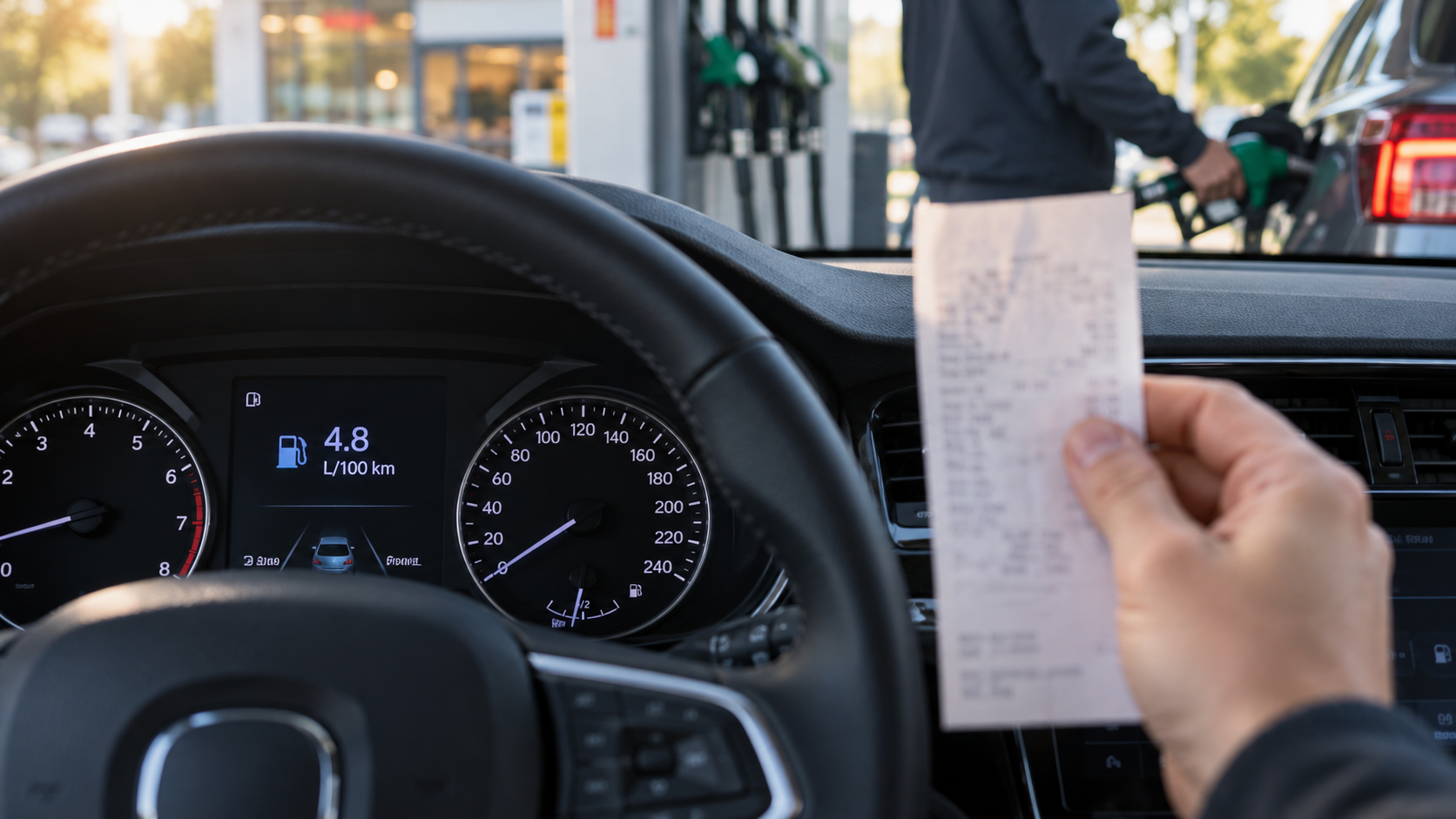
After a trip, the onboard computer shows an average fuel consumption of 6.3 l/100 km. You drive into a filling station, fill the tank, check the distance travelled and calculate the consumption yourself. The result is 6.9 l/100 km.
The next time, the same thing happens. The dashboard shows 6.4, but the calculation from the fuel receipt gives 6.8. A logical question appears: which of the two figures is correct?
Many drivers immediately conclude that the car is simply “lying”. Sometimes the trip computer can indeed show a slightly more optimistic result, but the difference is not always caused by the car. The popular full-tank method is not a laboratory measurement either.
The fuel nozzle can switch off at a slightly different point, the car may be standing at a different angle, there may be more foam in the tank, and even a small error in the amount of fuel or distance travelled can quickly become several tenths of a litre per 100 kilometres.
Quick answer
The trip computer usually calculates fuel consumption using data from the vehicle's control systems, while the full-tank method uses the amount of fuel added and the distance travelled. The two results can differ slightly. The best picture of real-world fuel consumption usually comes from averaging several full tanks rather than relying on one single refill.
If the dashboard shows 6.3 l/100 km but one fuel receipt gives 6.9 l/100 km, that alone does not prove a fault or an incorrect fuel delivery. First compare several tanks.
How does the trip computer know how much fuel the car is using?
There is no tiny person inside the car measuring every millilitre of fuel with a measuring cup. A modern vehicle's control system already manages engine operation and has access to much of the information needed to estimate fuel consumption.
Depending on the vehicle design, the control unit may have access to information such as injection duration, fuel-delivery parameters, engine speed, airflow, distance travelled and other values.
From these data, the vehicle calculates instantaneous and average fuel consumption.
Important detail: the trip computer usually does not perform the same type of measurement as the fuel pump at a filling station. It calculates consumption from vehicle-system data. That is why a small difference between the dashboard figure and the refill calculation is not surprising by itself.
Simple example: trip computer versus fuel receipt
Suppose you have driven 720 kilometres since the previous full refill.
At the next filling station, it takes 49.5 litres to fill the tank again.
Fuel-consumption formula
Litres filled ÷ kilometres travelled × 100 = l/100 km
In our example:
49.5 ÷ 720 × 100 = 6.88 l/100 km.
Rounded — 6.9 l/100 km.
But the car shows 6.4 l/100 km for the same period.
| Measurement | Result | Difference |
|---|---|---|
| Trip computer | 6.4 l/100 km | 0.5 l/100 km |
| Full-tank calculation | 6.9 l/100 km |
At first glance, it looks as though the dashboard is wrong by 0.5 l/100 km. But before drawing that conclusion, we need to look at how accurately both measurements were made.
A full tank does not always mean exactly the same fuel level
This is one of the most important reasons why one refill can produce a surprising result.
The fuel nozzle automatically shuts off when the system detects fuel and vapour at a certain point. But this can happen slightly differently every time.
The result can be affected by:
- the angle of the fuel nozzle;
- refuelling speed;
- fuel foaming;
- the angle at which the vehicle is parked;
- fuel temperature;
- the design of the tank and its ventilation system.
If the nozzle shuts off slightly earlier during one refill, but the next time you manage to add one or two litres more, that entire difference becomes part of your calculation.
That is why one tank is not a perfect experiment. The average result from three, five or even more consecutive full refills is much more useful.
Why should you not keep adding fuel after the nozzle clicks off?
Some drivers, trying to achieve a “perfectly full” tank, continue adding small amounts of fuel after the nozzle has automatically switched off.
That is not necessary for measuring fuel consumption. What matters more is using the same method at every refill.
Overfilling the tank is also not a good idea because the fuel system is designed to leave space for expansion and vapour-control processes. In petrol cars, correct operation of the evaporative-emissions or EVAP system is especially important.
A more practical rule is simple: fill the tank until the first automatic nozzle click each time and do not try to force extra fuel into the filler neck.
The distance travelled may not be absolutely exact either
The formula contains two numbers: litres and kilometres. If either value contains an error, the final result changes as well.
The vehicle calculates distance travelled using wheel movement and system calibration. The actual circumference of the tyres can affect the result.
That can be influenced by:
- a different tyre size;
- different tread depth;
- tyre pressure;
- non-standard wheels;
- the calibration of the particular vehicle.
Usually this factor should not be exaggerated, but if you are trying to explain a difference of only a few percent, the distance measurement is also part of the overall picture.
Why can the trip computer be more optimistic?
The trip computer uses a calculation model and data from the vehicle's control systems. This can be very accurate, but it is not a completely independent laboratory fuel-flow measuring device.
In an SAE-published study analysing onboard fuel-consumption monitoring in modern vehicles, the long-term fuel-quantity deviation remained below 5% during WLTC laboratory tests, while in some road conditions it slightly exceeded that level.
This demonstrates two things at the same time:
- modern vehicle electronics can estimate fuel consumption quite accurately;
- a difference of a few percent between the electronic estimate and an independent measurement is still possible.
The average fuel-consumption figure displayed to the driver is also not necessarily the same data layer used for regulatory onboard fuel-consumption monitoring. The exact implementation depends on the vehicle manufacturer and model.
Rounding also creates a difference
The dashboard usually does not display an infinitely precise number.
If the car's calculated average is, for example, 6.44 l/100 km, the display may show 6.4. If the result later becomes 6.46, it may be displayed as 6.5.
One tenth by itself is not much, but when comparing two different measurement methods, rounding also contributes to the overall difference.
Make sure you reset the trip computer correctly
Another very simple mistake is comparing two different periods.
For example:
- the trip computer has not been reset for 3,000 km;
- but the full-tank calculation covers only the last 650 km.
Of course these numbers may not match. One includes winter driving, motorway journeys, city traffic and several months. The other includes only the most recent tank.
For a fair comparison: after filling the tank, reset the trip odometer and the average fuel-consumption figure you want to compare. At the next full refill, record both values.
So which method is more accurate?
If your goal is to understand how much fuel you actually buy and use over a longer period, the multi-tank full-refill method is very useful.
But the important words here are — several tanks.
A single tank calculation can be distorted because the nozzle may have switched off earlier during the previous refill and later during the current one.
For example:
| Tank | Distance | Fuel added | Calculated consumption |
|---|---|---|---|
| 1 | 690 km | 45.8 l | 6.64 l/100 km |
| 2 | 705 km | 49.1 l | 6.96 l/100 km |
| 3 | 680 km | 45.6 l | 6.71 l/100 km |
If we look only at the second tank, it appears that the car suddenly started using almost 7 litres per 100 km. But the combined result across all three tanks is much more stable.
Total:
140.5 litres ÷ 2,075 km × 100 = approximately 6.77 l/100 km.
A longer measurement period helps smooth out individual refuelling errors.
How to measure real fuel consumption correctly
Simple full-tank method
- Fill the tank until the first automatic nozzle click.
- Reset the trip odometer.
- If you want to compare the result with the trip computer, reset the average fuel-consumption figure as well.
- Drive normally.
- At the next refill, fill the tank again until the first automatic nozzle click.
- Record the litres added and kilometres travelled.
- Calculate: litres ÷ km × 100.
- Repeat this for several tanks and compare the combined average.
If you simply want to calculate fuel consumption and driving costs, you can also use our fuel consumption calculator guide.
Do you always need to fill up at the same station?
Not necessarily, but for an experiment it can help reduce the number of variables.
If possible, use several times:
- the same type of fuel;
- the same filling station;
- a similar parking position;
- the same rule — stop at the first nozzle click.
The goal is not to prove that one particular pump is “more accurate”. The goal is simply to make your measurement conditions as consistent as possible.
What if you only add €20 or €30 of fuel?
In that case, the full-tank method cannot be used as easily for a single refill.
If you do not know the exact amount of fuel in the tank at the beginning and you do not return to the same reference level at the end, it is impossible to determine precisely how much of the added fuel was actually consumed during that period.
That is why the full-tank method works: the starting and ending fuel levels are made as similar as reasonably possible.
Can DPF regeneration increase fuel consumption?
During regeneration of a diesel particulate filter, or DPF, the engine-management system may use additional fuel to reach the required temperature in the exhaust system.
A tank during which one or more active regenerations took place can therefore produce a slightly different result from an otherwise similar driving period without regeneration.
For a modern engine-management system, this fuel use is not “invisible” in the sense that the control unit itself manages the injection. However, the way a particular manufacturer includes this information in the average consumption figure shown to the driver can differ.
An auxiliary heater can complicate the comparison
Some vehicles have a fuel-powered parking heater or auxiliary heater. It can consume fuel even when the engine itself is not running.
Depending on vehicle design, the average fuel-consumption figure visible to the driver may not always reflect fuel used by an auxiliary system in exactly the same way as the full-tank calculation does.
That is why the difference can become more noticeable in winter on some vehicles.
How large a difference is normal?
There is no useful single universal number for every vehicle.
Modern onboard fuel-monitoring systems can be quite accurate. Studies show deviations of a few percent, but the value shown on the dashboard, vehicle software and the quality of the full-tank measurement can create additional differences.
That is why it is more practical to evaluate the trend across several tanks rather than focus on one number.
| Situation | What should you do? |
|---|---|
| The difference appears during only one tank | Do not rush to conclusions. Measure several more refills. |
| The trip computer almost always shows slightly less | There may be a systematic calculation or calibration difference. Record the percentage deviation. |
| The difference is large and changes a lot | First check your refuelling method, reset period and distance data. |
| Real consumption suddenly rises significantly across several tanks | Look for a cause — season, routes, tyres, DPF operation, a technical problem or other conditions. |
How to calculate the trip computer error as a percentage
This is very useful if you want to see whether the difference repeats consistently.
Suppose:
- the trip computer shows 6.4 l/100 km;
- the multi-tank calculation shows 6.8 l/100 km.
The difference is:
6.8 − 6.4 = 0.4 l/100 km.
Compared with the 6.8 l/100 km calculated result:
0.4 ÷ 6.8 × 100 = approximately 5.9%.
So during this period, the trip computer showed roughly 6% lower consumption than the full-tank method.
Repeat the comparison several times. If a similar percentage appears each time, you already have a fairly good understanding of your car's typical behaviour.
Mini test: are you comparing fuel consumption correctly?
1. Did you reset the trip computer on the same day you filled the tank?
If not, you may be comparing two different driving periods.
2. Did you fill to a similar level both times?
The simplest method is to use the first automatic nozzle click as a repeatable reference point.
3. Are you drawing conclusions from just one tank?
One tank can be misleading. The combined result from several consecutive full tanks is much more useful.
4. Does the car have a non-standard wheel or tyre size?
This can affect the calculated distance travelled and therefore also the fuel-consumption comparison.
5. Are you comparing summer and winter tanks?
Cold weather, winter tyres, short trips, window and cabin heating and other seasonal factors can change the actual fuel consumption itself.
A 7-day test is not enough — measure three tanks instead
For this topic, one week is not always enough. Many drivers do not use a full tank in seven days, so a better experiment is three consecutive full refills.
Three-tank experiment
- Fill the tank until the first nozzle click.
- Reset the trip odometer and average fuel-consumption display.
- At the next refill, record kilometres, litres and the trip-computer result.
- Repeat this for three full tanks.
- Add together the litres from all three tanks.
- Add together the distance travelled across all three tanks.
- Calculate the overall consumption.
- Compare it with the trip-computer average.
After this experiment, you will have a much better idea whether one refill was simply an outlier or whether your car systematically shows, for example, 3%, 5% or 8% lower consumption than the full-tank calculation.
When is the difference actually worth investigating?
The most important signal is not that the trip computer and the fuel receipt differ by a few tenths.
What matters more is when the usual pattern suddenly changes.
For example, for six months your car consistently shows about 0.3 l/100 km less than the full-tank calculation. You know this and have become used to it.
Then suddenly, over several tanks, the difference grows to 1.0–1.5 l/100 km.
In that situation, it is worth checking:
- whether the refuelling method has changed;
- whether the trip computer was reset correctly;
- whether winter has started or the driving route has changed significantly;
- whether tyre pressures are correct;
- whether the vehicle has a technical problem;
- whether there is a fuel leak or fuel smell;
- whether a diesel vehicle is carrying out frequent DPF regenerations.
Safety note: if unexplained fuel-consumption increases are accompanied by a fuel smell, visible leakage, a Check Engine light, poor engine operation or other unusual symptoms, do not dismiss the problem as trip-computer inaccuracy.
Common myths
| Claim | Myth or fact? | Explanation |
|---|---|---|
| The trip computer always shows exact fuel consumption. | Myth | It is a calculated value, and deviation is possible. |
| The full-tank method is always 100% accurate. | Myth | A single refill can be affected by differences in the actual fill level. |
| The average from several tanks is more useful than one tank. | Fact | A longer period helps smooth out individual refuelling errors. |
| If the dashboard and the receipt differ, the engine definitely has a problem. | Myth | A small consistent difference does not by itself indicate a fault. |
| Long-term changes are more important to watch. | Fact | A sudden change from the usual consumption pattern is more informative than one isolated number. |
Frequently asked questions
Which figure should I trust — the trip computer or the fuel receipt?
For everyday driving, the trip computer is very convenient for following trends. For checking real long-term fuel use, a calculation across several consecutive full tanks is useful. One single refill can be misleading.
Why does my trip computer almost always show lower consumption?
A particular vehicle can have a systematic calculation or calibration difference. Before reaching that conclusion, however, compare several full tanks with the average-consumption display correctly reset.
Is a difference of 0.5 l/100 km a lot?
That depends on the overall fuel consumption and the quality of the measurement. It is better to convert the difference into a percentage and check whether it repeats across several tanks rather than judge from one refill alone.
Can I calculate fuel consumption using half a tank?
The dashboard fuel gauge is not accurate enough to use “half a tank” as an exact litre measurement. It is better to compare two full refills with a known amount of fuel added.
Do I need the fuel price to calculate l/100 km?
No. Fuel price is not required to calculate consumption in l/100 km. You only need it if you want to calculate driving costs in euros.
Conclusion
The trip computer and the full-tank calculation are looking at the same thing from two different directions.
The car calculates consumption using its electronics and engine-management data. You, on the other hand, compare the litres added at the filling station with the distance travelled.
Neither method, in everyday conditions, is a perfect laboratory measuring instrument.
That is why one tank can create a surprisingly large apparent difference. But if, across three, five or ten tanks, the vehicle consistently shows less than the refill calculations, you can determine your car's typical deviation with reasonable confidence.
Once you know that difference, the trip computer becomes even more useful. If you know that your car typically shows about 5% lower consumption, you can keep that in mind during everyday driving.
Driver's short takeaway: do not judge fuel consumption from one receipt. Fill the tank consistently, record at least three refills and only then compare the result with the trip computer. The long-term trend is much more useful than one “wrong” number.
Sources and note about accuracy
Information about the accuracy of onboard fuel-consumption monitoring was checked against SAE International research on On-Board Fuel/Energy Consumption Monitoring and the use of OBD data for determining fuel consumption. The studies show that modern systems can be quite accurate, but deviations are possible and depend on the vehicle, data source and measurement conditions. The average fuel-consumption figure shown to the driver should not be treated as a laboratory reference measurement.