 LV
 EN
 RU
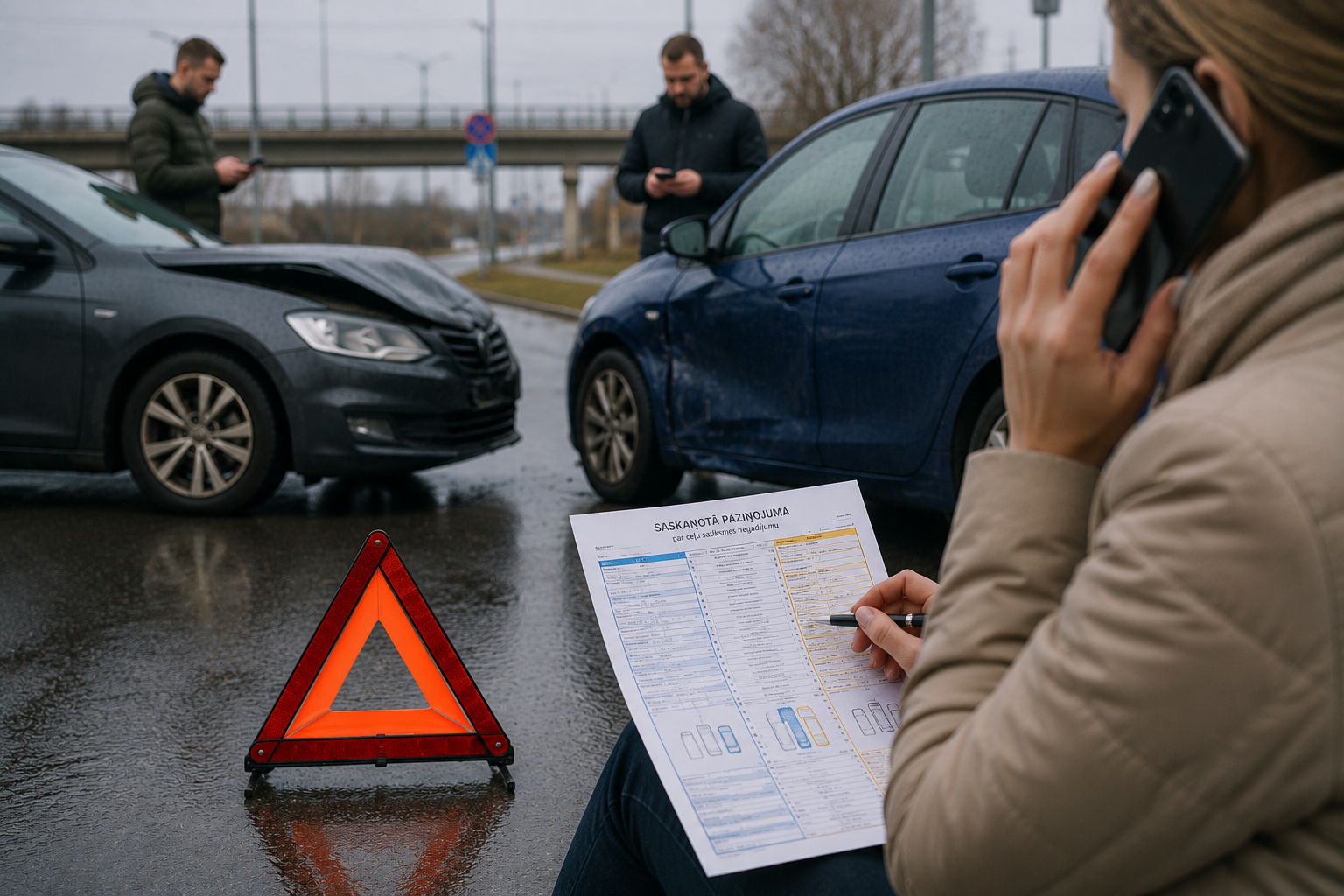
The impact is not loud. There is only a brief crack of plastic, a slight shudder through the car and a feeling that everything around you has stopped for a few seconds. You step out and see a dented corner of the bumper, but the other driver is already rushing you: “It is nothing serious. We will write that I am at fault and leave.”
A queue of vehicles begins to form behind you. Someone sounds their horn. Your phone battery is at 12%. The joint accident statement form was probably once in the glove compartment, but now there are only service receipts, sunglasses and an ice scraper.
This is exactly when drivers make mistakes that later cost not five minutes, but hundreds or even thousands of euros. Vehicles are moved before photographs are taken, an inaccurate diagram is drawn, damage is assessed only by its external appearance, or a verbal promise to pay everything without involving an insurer is accepted.
After a collision, the first task is not to identify the guilty party immediately. First, protect the people involved, prevent additional danger and preserve evidence of what actually happened.

After a collision, do not rush to prove that you are right. First, take care of the people involved, document the situation and choose the correct way to record the accident.
The first minutes after a collision
Even a minor accident causes a surge of adrenaline. Your hands may shake, your thoughts become fragmented and ordinary decisions suddenly require considerable effort. That is why it helps to remember a prepared sequence of actions.
Do not drive to the nearest car park before establishing whether the vehicles may be moved and how their original positions will be documented.
Switch on the hazard lights, place the warning triangle and put on a reflective vest before stepping onto the road.
Find out whether the drivers or passengers have pain, dizziness, bleeding, confusion or other signs of injury.
Before moving the vehicles, photograph the wider scene, vehicle positions, number plates, damage, road signs, markings and the point of impact.
“I feel fine” is not a medical diagnosis
Adrenaline can temporarily suppress symptoms of neck, back or head injuries. If someone has hit their head or feels pain, dizziness, tingling, confusion or other symptoms, call 112 and follow the dispatcher’s instructions.

When is a joint accident statement sufficient?
A joint accident statement is not a simplified solution for every minor accident. It may be used only when all the required conditions are met simultaneously.
- no one has been injured in the accident;
- exactly two vehicles are involved;
- no road infrastructure, fence, building, third parked vehicle or other third-party property has been damaged;
- both vehicles can and may continue driving;
- both drivers can agree on the material circumstances of the accident and sign one common diagram.
Agreement does not mean that someone must write: “I am at fault.” The joint accident statement should record the facts — directions of travel, manoeuvres, vehicle positions, the point of impact and visible damage. The insurer will assess liability afterwards.
When should you call 112?
A collision with a parked car
If you have struck a parked vehicle and its driver is not present, there is no one with whom you can jointly complete the accident statement. A note left under the windscreen wiper is not sufficient documentation. Photograph the location and damage, call 112 and follow the police instructions.
How to complete the joint accident statement correctly
The joint accident statement is one of the main documents the insurer uses to reconstruct the accident. If the diagram, selected circumstances and locations of the damage do not correspond with one another, a simple case can turn into a lengthy process involving explanations and additional document requests.

Paper or digital version
Write with a ballpoint pen and press firmly enough for the information to be copied onto the second sheet.
Do not make new corrections or additions after both drivers have signed the form.
The digital solution allows the information to be entered on a phone and photographs of the accident to be attached.
If electronic authentication or signing does not work, use the paper form or call 112 if the accident cannot otherwise be documented correctly.
Completion sequence
Enter the exact location, date and time of the accident. If you do not know the address, check it using navigation.
Enter the details of both drivers, vehicles and insurance policies, checking them against the documents.
Record the names and contact details of any witnesses.
For each vehicle, indicate the initial point of impact and the visible damage.
Mark the manoeuvres performed by each driver and make sure the selected boxes do not contradict one another.
Draw the vehicles in their positions at the moment of impact, not where they were parked after the accident.
Show the lanes, directions of travel, road signs, traffic lights, exits and point of impact in the diagram.
Compare the information entered on the form with the photographs you have taken.
Sign only a fully completed document and make sure you receive your own copy or digital confirmation.
How to photograph the accident scene
The purpose of the photographs is not merely to show a scratched bumper. They should allow someone who was not at the scene to understand the movement and relative positions of the vehicles, as well as the surrounding traffic layout.
Save the dashcam recording in its original quality and create a backup copy. Do not allow newer recordings to overwrite it automatically.

What does the signature confirm?
By signing the joint accident statement, the driver confirms the circumstances and diagram recorded in the document. You should therefore never sign a blank form, a document with important fields left empty or a diagram that does not correspond to what happened.
The signature itself is not the insurer’s final decision on liability. The insurer will assess all available information, including the statement, photographs, vehicle damage, explanations and other evidence.
When the information is complete, the diagram matches what happened, the damage has been recorded and both drivers will receive their own copy.
When the other party is rushing you, the diagram is incorrect, important fields remain empty or the drivers cannot agree on the material facts.
The MTPL compensation process after an accident
Documenting the accident and submitting a compensation claim are two separate stages. A completed joint accident statement does not automatically mean that the repair has been reported or approved.
Notify the insurer as soon as possible.
Make the damaged vehicle available for inspection.
Submit photographs, estimates, receipts and other evidence.
The insurer assesses liability and the amount of loss.
A repair is arranged or a cash payment is made.
Where should the claim be submitted?
As a rule, the injured party submits the claim to the insurer that provided the responsible vehicle owner’s motor third-party liability insurance. The insurer can be identified through the LTAB system using the vehicle registration number and the date of the accident.
In some cases, the claim can be handled by your own MTPL insurer under the direct claims settlement system. The applicable procedure should be checked with your insurer.
Notify your insurer even if you are not claiming compensation
A driver or vehicle owner who is not claiming compensation must submit the paper joint accident statement to their own MTPL insurer within 10 days of the accident. It is safer to do this immediately rather than wait until the deadline.
Why should you not rush to begin repairs?
The damaged vehicle must be preserved in a condition that allows the insurer to document the damage caused by the accident. The vehicle may be removed from a dangerous location, but parts should not be replaced, assemblies dismantled or debris discarded before the inspection.
The insurer must arrange an inspection of the damaged property no later than five days after receiving notification. Keep your communication with the insurer in writing so the timing of the claim and response can be demonstrated.
When must a decision be made?
When the losses can be calculated, the responsible person is known and all required documents have been submitted, the insurer must make its decision within the period prescribed by law. The process can take longer in complex cases involving a liability dispute, a foreign vehicle, personal injuries or the need for additional documents.
Repair or cash compensation?
The injured party is often offered two options: vehicle repair or compensation paid in cash. These options are not financially equivalent.
When cash compensation is chosen, the initial payment may amount to 70% of the loss estimate excluding value-added tax.
The repair is valued at €2,420, consisting of €2,000 excluding VAT and €420 in VAT.
Calculation: €2,000 × 70% = €1,400. To receive the remaining amount, the vehicle must be repaired and the relevant repair and payment documents submitted to the insurer in accordance with the applicable procedure.
If hidden damage is discovered after the vehicle is dismantled at the repair shop, notify the insurer and arrange an additional inspection or revised estimate before the additional damage is repaired.
More suitable when hidden damage may be present, the vehicle is relatively new or full repair documentation is required.
It may be convenient for minor cosmetic damage, but the payment calculation, VAT treatment and documentation requirements should be understood before making a choice.
MTPL and comprehensive insurance are not the same
MTPL insurance covers the civil liability of the vehicle owner or authorised user towards other people. If you caused the collision, your MTPL policy may cover the compensable losses suffered by the injured party, but it will not cover repairs to your own vehicle.
Covers compensable losses caused to other people by the responsible vehicle.
Depending on the specific policy conditions, it may cover damage to your own vehicle, subject to the deductible and policy exclusions.
If you have comprehensive insurance, notify your own insurer within the period specified in the contract. Before choosing how to handle the claim, check the deductible, workshop selection conditions and possible effect on future insurance pricing.
Typical situations on the road and in car parks
Two vehicles are involved, no one is injured, no other property is damaged, both vehicles can continue driving and the drivers agree on the circumstances. Photograph the situation and complete the joint accident statement.
More than two vehicles are involved, so one joint accident statement is not sufficient. Notify the police.
Road infrastructure has been damaged. Even if the damage to your own vehicle appears insignificant, the police must be notified.
An external scratch may conceal damaged mounting points, sensors, a headlamp housing or a deformed structural component. A verbal agreement does not protect you if the repair turns out to be considerably more expensive.
Seek medical attention, state that the symptoms are connected to the accident, and retain your medical documents and expense receipts.
When the responsible driver has no MTPL insurance
The injured party does not lose protection simply because the person responsible for the accident has no valid MTPL policy. In certain cases, compensable losses are covered by the Guarantee Fund administered by LTAB, after which the amount paid may be recovered from the uninsured vehicle owner or driver.
From 1 July 2026, an application falling within the responsibility of the Guarantee Fund must be submitted to the insurer with which the injured party has an MTPL contract. If there is no such contract, the application may be submitted to another MTPL insurer in accordance with the current procedure.
A vehicle registered abroad
If the accident was caused by a vehicle registered abroad, photograph its number plates, registration documents, insurance information and the driver’s details. The claim is usually submitted to the foreign insurer’s representative in Latvia or in accordance with the procedure indicated by LTAB.
The other driver leaves the scene
Do not chase the vehicle and create another dangerous situation. Write down or record the number plate, make, model, colour, direction of travel and identifying features of the driver. Look for witnesses, save your dashcam footage and call 112 immediately.
Checklist before leaving the accident scene
You can save this list on your phone or print it and keep it in the glove compartment.
☐ Everyone has been checked for injuries
☐ The hazard lights are switched on
☐ The warning triangle has been placed
☐ It has been established whether a joint statement may be used
☐ A wide photograph of the accident scene has been taken
☐ Both vehicle number plates are visible
☐ The damage has been photographed
☐ Road signs and markings have been photographed
☐ Witness contact details have been recorded
☐ The driver and vehicle details have been checked
☐ The diagram reflects the moment of impact
☐ No important fields have been left empty
☐ Both drivers have their own copy
☐ The dashcam file has been saved
☐ You know which insurer should receive the claim
A short self-check
Two vehicles are involved and no one is injured, but the drivers disagree about the traffic light. Is a joint statement sufficient?
No. If the drivers cannot agree on the material circumstances of the accident, the police must be notified.
A road sign was also struck in the collision. Can a joint statement be completed?
No. Road infrastructure has been damaged, so the police must be notified.
The other driver admits making a mistake. Are photographs still necessary?
Yes. Photographs help verify the circumstances stated in the document and whether the vehicle damage is consistent with them.
The repair excluding VAT is estimated at €2,000. What is 70%?
€1,400. Before choosing cash compensation, check all payment conditions and documentation requirements.
Frequently asked questions
May the vehicle be moved before the police arrive?
If the vehicles are obstructing traffic and moving them does not contradict police instructions, the road should be cleared after carefully photographing the original positions of the vehicles and other objects.
Must the responsible driver be identified in the joint statement?
The most important task is to record the facts accurately. The insurer will assess liability using the documents, photographs and other evidence.
What should I do if the other party refuses to sign?
Photograph the situation, record the vehicle number plate, find witnesses and call 112. You may not sign on behalf of the other driver.
Can corrections be made after the form has been signed?
Corrections should not be made to the signed form. Additional explanations, photographs and videos may be submitted separately to the insurer.
What should I do if there is almost no visible damage?
A bumper may return to its original shape even though mounting points, sensors or impact-absorbing components underneath it have been damaged. The collision should still be documented correctly.
Can towing expenses be compensated?
If the vehicle cannot safely participate in traffic after the accident, reasonable towing costs and, in some cases, parking costs may be included in the compensable losses. Keep all invoices and payment documents.
Should the police be called if a tyre is punctured?
If the vehicle cannot or may not continue driving because of the damage, a joint accident statement alone is not sufficient.
Is the insurer’s first estimate final?
No. You may request a detailed calculation and submit a repair estimate and reasoned objections if you believe that the damage or repair costs have not been assessed completely.
Prepare before an accident happens
Once a year, check more than the first-aid kit and fire extinguisher. Make sure your vehicle contains a joint accident statement form, a working pen and an easily accessible reflective vest.
Save the contact details, claims address and roadside assistance number of your MTPL and comprehensive insurers on your phone. Log in to the relevant digital tools in advance, rather than trying to do it after a collision in the rain and darkness.
After an accident, you do not have to become a lawyer or vehicle damage expert. You only need to complete several tasks in the correct order: protect the people involved, call for help when necessary, preserve evidence of what happened and complete the documentation correctly.
If someone is injured, other property has been damaged, more than two vehicles are involved, one of the vehicles cannot continue driving or the drivers cannot agree, call 112. If a joint accident statement may be used, take photographs before moving the vehicles and sign only a correctly completed document.