
 LV
 EN
 RU
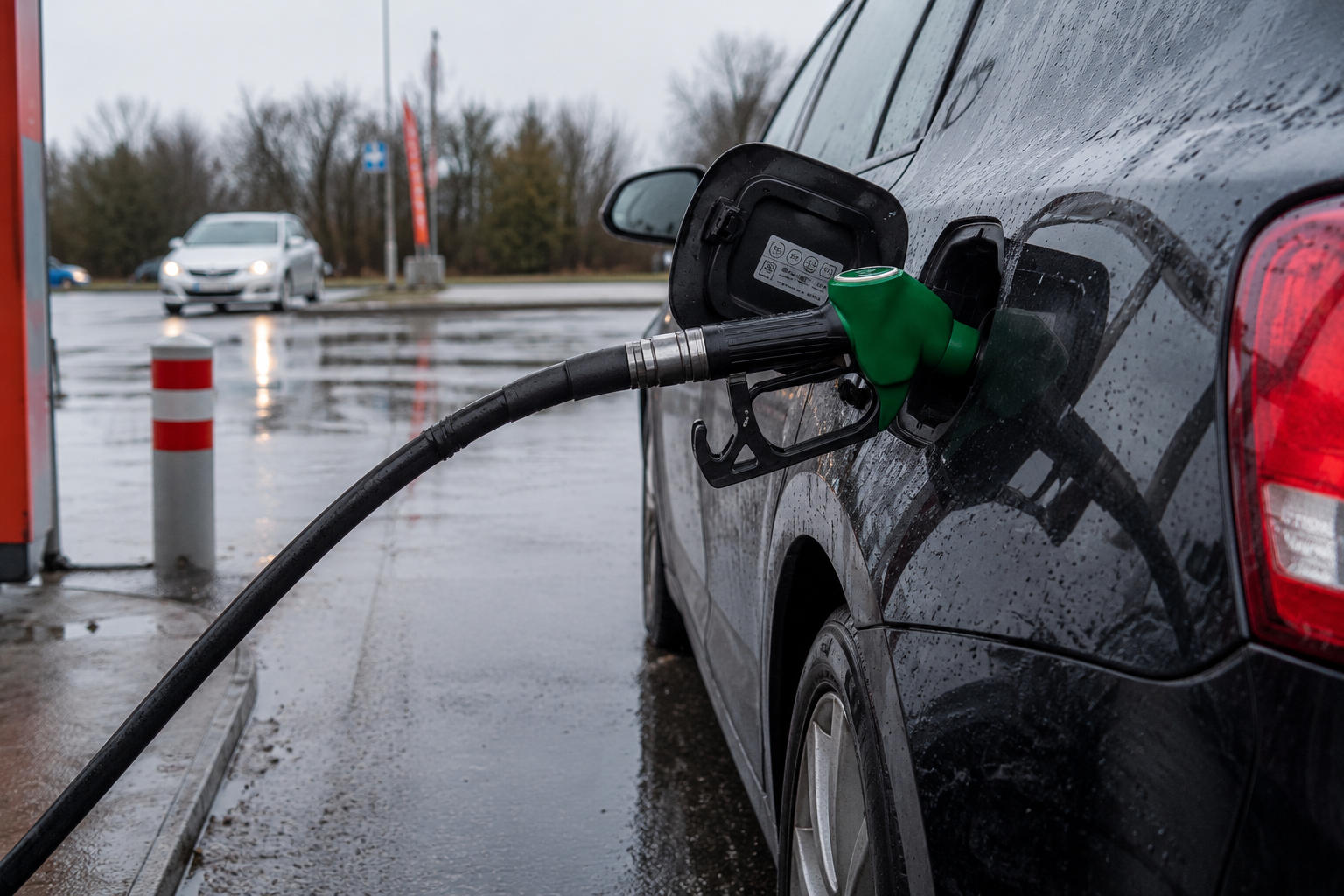
Many drivers notice that their vehicle’s average fuel consumption increases during rainy, windy or cooler weather. The journey is the same, the speed appears similar and there is no additional load in the car, yet the trip computer may show several tenths of a litre more.
This difference is not always a measurement error. A wet road creates additional rolling resistance because the tyres must deform and push water aside. A headwind increases the air speed experienced by the vehicle, while a strong crosswind can change the angle at which air flows around the body.
Rain also changes traffic conditions and driver behaviour. Vehicles move less consistently, brake more frequently and may become trapped in congestion. Windscreen wipers, lights, ventilation and window-demisting systems are also used. On some journeys, reducing speed may lower aerodynamic resistance, but repeated stopping and accelerating can completely cancel out that benefit.
There is therefore no single universal figure such as “rain always increases consumption by 10%”. Light rain on an empty road may produce an almost unnoticeable difference, while a combination of strong headwinds, standing water, low temperature and congestion can cause a substantial increase.
The driver’s short takeaway right at the start: rain itself does not consume fuel. Consumption rises because of water resistance beneath the tyres, wind acting against the vehicle, lower temperature, additional electrical systems and more uneven traffic flow.
Quick answer: does a car use more fuel in rainy weather?
Often yes, but not always by the same amount.
On a wet road, the tyres must push water away, which creates additional resistance to movement.
A headwind increases relative air speed, and aerodynamic drag rises more quickly than the wind speed itself.
Heavy rain often creates congestion, inconsistent speeds and more frequent braking.
However, when a driver reduces speed and drives smoothly in rain, lower aerodynamic resistance can partly offset the other losses.
Two identical vehicles in the same rainstorm may therefore record very different consumption. One may be travelling along an empty motorway at a reduced speed, while the other is trapped in congestion and repeatedly accelerating and braking.
Which weather conditions affect consumption?
| Condition | How does it affect the vehicle? | Possible effect on consumption |
|---|---|---|
| Light rain | A thin layer of water, windscreen wipers and lights | Usually small |
| Heavy rain | More water beneath the tyres, poor visibility and inconsistent traffic | Small to noticeable |
| Standing water | The tyres must displace a large amount of water, increasing aquaplaning risk | Can be large, but safety is the main concern |
| Headwind | Increases relative air speed and aerodynamic drag | Especially noticeable on motorways |
| Crosswind | Changes the airflow angle and requires steering corrections | Depends on vehicle shape and wind strength |
| Tailwind | Reduces relative air speed | May reduce consumption on the motorway |
| Cool air | Denser air, longer engine warm-up and lower tyre pressure | Depends on temperature and journey length |
| Rain-related congestion | Frequent stopping, acceleration and idling | Often greater than the effect of the rain itself |
1. Why does a wet road create more resistance?
On a dry road, the tyre mainly deforms within the contact patch and overcomes its normal rolling resistance. On a wet road, it must additionally remove water from beneath the tread and contact area.
Water does not disappear by itself. The tread grooves collect it, move it and discharge it to the sides. This process requires energy supplied by the vehicle.
The deeper the water layer and the higher the speed, the more water the tyre must displace within a shorter period. Resistance can therefore be much greater during heavy rain and on poorly drained roads than on slightly damp asphalt.
In simple terms:
dry road = tyre deformation and normal rolling resistance;
damp road = normal resistance plus displacement of a thin water layer;
deep water = significantly more water displacement and loss-of-grip risk;
slush = even more material that the tyres must push aside.
Does every puddle significantly increase consumption?
Briefly driving through a small puddle will not significantly change fuel consumption over a complete tank. However, travelling for a long distance along a road covered with water across the full width of the lane can create a noticeable additional load.
Fuel consumption is not the most important issue in this situation. In deeper water, a tyre may lose direct contact with the road and the vehicle may lose steering and braking ability.
A puddle may also hide a pothole, an open drain cover or another obstacle. Deep water can reach the brakes, electrical connections or the engine’s air intake.
Safety principle: do not drive through deep water simply to maintain speed or avoid braking. Reduce speed early, avoid sudden inputs and choose another route when roads are flooded.
2. Headwinds and relative air speed
The vehicle’s speed relative to the road is not the only factor that matters. Aerodynamic drag is determined by the vehicle’s speed relative to the surrounding air.
If a car travels at 90 km/h in completely calm conditions, its relative air speed is approximately 90 km/h. If a 20 km/h headwind is blowing, the vehicle aerodynamically experiences an airflow of approximately 110 km/h.
Aerodynamic drag increases in proportion to the square of relative air speed. A 20 km/h headwind at a road speed of 90 km/h therefore does not increase aerodynamic drag by only 22%. The theoretical increase is much greater.
Simplified formula:
Relative air speed = vehicle speed + headwind component.
Aerodynamic-drag ratio = new relative speed² / original speed².
Example: 110² / 90² = approximately 1.49, or 49% greater aerodynamic drag.
Important: this does not mean that total fuel consumption automatically rises by 49%. Aerodynamics is only one part of the vehicle’s overall energy demand. The engine must also overcome rolling resistance, drivetrain losses and other loads.
Theoretical effect of wind at a road speed of 90 km/h
| Wind direction and speed | Relative air speed | Theoretical aerodynamic-drag ratio | Change from calm conditions |
|---|---|---|---|
| 20 km/h tailwind | 70 km/h | 0.60 | Approximately −40% |
| 10 km/h tailwind | 80 km/h | 0.79 | Approximately −21% |
| No wind | 90 km/h | 1.00 | Reference point |
| 10 km/h headwind | 100 km/h | 1.23 | Approximately +23% |
| 20 km/h headwind | 110 km/h | 1.49 | Approximately +49% |
| 30 km/h headwind | 120 km/h | 1.78 | Approximately +78% |
The table describes only the theoretical aerodynamic-drag ratio, assuming that the wind is blowing directly against or directly with the direction of travel. It is not a table of fuel-consumption percentages.
The actual increase in consumption depends on how much of the vehicle’s total load is caused by aerodynamics at that speed. Its importance rises at higher speeds, which is why a headwind matters much more on a motorway than in slow urban traffic.
Why can a small speed reduction help in a headwind?
If a car travels at 100 km/h into a 20 km/h headwind, its relative air speed is approximately 120 km/h. Reducing the road speed to 90 km/h lowers the relative speed to approximately 110 km/h.
The difference of 10 km/h may appear small, but aerodynamic drag falls according to the square of the speed. The journey takes slightly longer, but the engine does not need to overcome such high air resistance for the entire distance.
In heavy rain, reducing speed also improves the visibility margin, lowers aquaplaning risk and reduces the amount of water that the tyres must displace.
Reducing speed in rain and headwinds is not only a fuel-saving technique. It is one of the few actions that can reduce consumption while significantly improving safety.
3. How does a crosswind affect fuel consumption?
A crosswind does not blow directly against the vehicle, so its effect cannot simply be added to the road speed. The vehicle encounters the airflow at an angle.
This angle can change how air moves along the sides of the body, around the wheels, mirrors and rear of the vehicle. Depending on body shape, total aerodynamic drag may increase.
The driver must also make small steering corrections to keep the vehicle within its lane. Strong gusts can create uneven movement, particularly on bridges, exposed roads and when leaving the shelter of a forest or buildings.
Tall vehicles, vans, motorhomes, buses and vehicles towing trailers are generally more sensitive to crosswinds than low, aerodynamic passenger cars.
Important: do not remain too close to lorries in strong crosswinds. When leaving the larger vehicle’s sheltered area, your car may suddenly be struck by a powerful gust.
4. Can a tailwind produce significant savings?
A tailwind reduces relative air speed and therefore reduces aerodynamic drag. On a long, steady motorway journey, this may be visible in the trip computer’s reading.
A tailwind does not eliminate rolling resistance, engine and drivetrain losses, or the energy required for climbs and acceleration.
Wind direction may also change along the route. A tailwind on the outward journey can become a headwind on the return journey.
Unusually low consumption in one direction should therefore not immediately be treated as proof that a repair, fuel or tyre change has produced a major efficiency improvement.
5. Why does traffic often become less efficient in rain?
Rain reduces visibility and grip, causing drivers to brake more frequently and leave larger gaps. Lane changes become slower, queues form at junctions and minor collisions or flooded sections of road can create major congestion.
This uneven movement can become the largest cause of increased consumption. Every time a vehicle accelerates again after braking, the engine must restore its kinetic energy.
In a combustion-engine vehicle, much of the energy lost during braking is converted into heat. Hybrids and electric cars can recover part of it through regenerative braking, but they do not recover everything.
Practical takeaway: a 20-minute rain-related traffic jam may increase journey consumption more than the thin layer of water on the road itself.
6. Windscreen wipers, lights and ventilation
During rain, windscreen wipers, dipped headlights, ventilation, heated windows and sometimes air conditioning are normally used. Air conditioning helps dry the cabin air and clear misted windows.
In petrol and diesel vehicles, the alternator produces electricity for these systems and the engine supplies the alternator’s load. In hybrids and electric cars, the energy comes from the battery system.
The effect of windscreen wipers and conventional lights is normally small compared with aerodynamic drag, movement through water or traffic congestion.
Heated windows, strong ventilation and the air-conditioning compressor can create a greater load, but visibility must never be reduced to save a small amount of energy.
Never save energy at the expense of visibility. Use the necessary lights, windscreen wipers and demisting systems. Poor visibility creates a much greater risk than their small energy demand.
7. Temperature and air density
Rainy weather is often cooler as well. Lower temperatures can affect consumption in several ways.
Cool air is denser, so aerodynamic drag can be slightly higher at the same relative speed. A cold engine also takes longer to reach its efficient operating temperature.
Tyre pressure falls as temperature drops. If it is not checked and corrected according to the manufacturer’s recommendations, tyre deformation and rolling resistance increase.
The increase in consumption noticed during autumn may therefore not be caused by rain alone. Temperature, tyres, traffic, journey length and the use of cabin heating all change at the same time.
8. Tyre tread and pressure in rain
Tread grooves help remove water from the tyre’s contact patch. As tread depth decreases, there is less space available to move water away.
Incorrect tyre pressure also affects the contact patch, tyre deformation, handling and the tyre’s ability to operate in wet conditions.
Pressure that is too low increases rolling resistance even in dry weather. In rain, it may additionally worsen vehicle response and increase the risk of tyre overheating and damage.
Before the rainy season, check:
• tyre pressure when the tyres are cold;
• tread depth and even wear;
• tyre age and visible cracking;
• the condition of the windscreen wipers;
• headlight operation and cleanliness;
• whether the vehicle pulls to one side or the tyres wear unevenly.
Why is there no universal consumption percentage?
The effect of rain and wind cannot be accurately described with a single number that applies to every vehicle and route.
Vehicle aerodynamics, weight, tyre width, tread pattern, engine, transmission and road speed all differ. The word “rain” may also describe anything from light drizzle to a deep layer of standing water during a heavy storm.
| Variable | Why does it matter? |
|---|---|
| Driving speed | Aerodynamics and water displacement become much more important at higher speeds |
| Wind direction | Headwinds, tailwinds and crosswinds create different loads |
| Water depth | A thin layer of moisture is not the same as standing water |
| Tyres | Width, tread, compound and pressure affect resistance and grip |
| Body shape | An SUV, van and saloon react differently to wind |
| Traffic | Congestion may matter more than the weather itself |
| Temperature | Affects engine warm-up, air density and tyre pressure |
Three driving scenarios
1. Calm driving in light rain
The driver normally travels at 100 km/h but reduces speed to 85–90 km/h in rain. The road is clear, the wind is light and the vehicle moves smoothly.
Water beneath the tyres increases rolling resistance, but the lower speed reduces aerodynamic load. Total consumption may increase only slightly or remain very close to the dry-weather result.
2. Maintaining the same speed in a strong headwind
The driver attempts to maintain 100 km/h despite a strong headwind. Cruise control increases the throttle opening, and the transmission may shift into a lower gear more frequently on inclines.
The main reason for increased consumption in this situation is aerodynamic drag rather than the rain itself. A small reduction in speed may be more effective than any other fuel-saving technique.
3. Urban congestion during a downpour
The vehicle is moving slowly, so aerodynamics is not the main problem. Traffic stops every few metres, the demisting system is operating and a journey that normally takes 20 minutes lasts 45 minutes.
Consumption rises because of the longer journey time, idling and repeated acceleration. The trip computer may show a much larger difference than during a calm journey on a wet motorway.
A practical cost example
Consider a hypothetical example. In dry weather, a vehicle averages 6.5 l/100 km, while during a rainy and windy period it averages 6.9 l/100 km on similar routes.
The difference is 0.4 litres per 100 kilometres. Over an annual distance of 15,000 km, this amounts to 60 additional litres.
| Conditions | Average consumption | Fuel over 15,000 km | Cost at €1.70/l |
|---|---|---|---|
| Mostly dry and calm weather | 6.5 l/100 km | 975 litres | €1,657.50 |
| Rainy and windy period | 6.9 l/100 km | 1,035 litres | €1,759.50 |
| Difference | +0.4 l/100 km | +60 litres | +€102.00 |
This is only an illustrative calculation. It does not mean that weather conditions will necessarily increase every vehicle’s consumption by 0.4 l/100 km.
Simple cost formula:
Additional litres = distance × consumption difference / 100.
Additional cost = additional litres × fuel price.
Which vehicles are more sensitive to wind?
| Vehicle or equipment | Sensitivity to wind | Reason |
|---|---|---|
| Low hatchback or saloon | Relatively low | Smaller frontal and side area |
| SUV or crossover | Moderate to high | Greater height and frontal area |
| Van or motorhome | High | Large frontal and side surfaces |
| Vehicle with a roof box | Increased | Additional area and disturbed airflow |
| Vehicle towing a trailer | High | Greater total area and instability in gusts |
| Motorcycle | Very high from a safety perspective | Low mass and direct crosswind effect on balance |
Roof boxes and headwinds
A roof box already increases aerodynamic drag. Its effect can become even more noticeable in a headwind because relative air speed rises.
An empty roof rack, bicycle carrier or other external equipment can also disturb airflow. Removing unused equipment is a simple way to reduce the effect of wind.
Vehicle stability must also be considered in strong crosswinds. Roof-mounted cargo increases the side area and may raise the centre of gravity.
Hybrids in rain and headwinds
A hybrid’s main advantage appears in urban and uneven traffic, where part of the braking energy can be recovered.
Regenerative braking cannot recover the energy used to overcome aerodynamic drag or to push water away from the tyres. That energy is dispersed into the air, water, tyres and road surface.
In a strong motorway headwind, a hybrid may use its combustion engine more frequently and at a greater load. Its consumption can therefore increase in a similar way to that of a conventional petrol vehicle.
Electric-car range in rain and wind
The same physical principles apply to electric cars. A wet road increases rolling resistance, while a headwind increases aerodynamic load.
The difference is that the result is shown in kWh/100 km and remaining-range estimates rather than litres per 100 kilometres.
A strong headwind can be particularly important during a long motorway journey because the vehicle must work against increased air resistance throughout the entire route. The route planner’s estimate may change if it does not fully account for actual wind conditions.
Heated windows, ventilation and lights also consume energy during rain, but speed, wind, temperature and the wet road normally remain the main factors.
For long electric-car journeys: maintain a larger charging reserve in strong headwinds, reduce speed and do not rely solely on the range estimate shown at the start.
Does cruise control help in rain and wind?
On a smooth and safe road, cruise control can help maintain a consistent speed. In a strong headwind, however, it will attempt to hold the selected speed precisely even when much more engine power is required.
On a hilly road, cruise control may apply significant power on an incline to prevent even a small reduction in speed. A driver who allows the speed to fall slightly on climbs may sometimes use less fuel.
In heavy rain, standing water, snow or other slippery conditions, cruise control should be used only when permitted by the vehicle’s manual and when conditions allow a stable speed to be maintained safely.
When frequent speed corrections are required or aquaplaning is possible, the driver should be ready to control the accelerator and speed directly.
Should cruise control be switched off in rain?
The manufacturer may permit cruise control in light rain on a safe and well-drained road. In heavy rain, standing water, slippery conditions or situations requiring frequent corrections, it is safer to control speed manually. Always follow the instructions for the specific vehicle.
Does air conditioning significantly increase consumption in rain?
The air-conditioning compressor creates an additional load, but in rain it often helps dry the cabin air and clear misted windows quickly. Visibility is more important than a small fuel saving. Once the windows are clear, the system can be used in an automatic or moderate setting.
Does a tailwind always reduce consumption?
A tailwind reduces aerodynamic drag, but traffic, terrain, speed and the wet road still affect the overall result. In urban congestion, the benefit of a tailwind may be almost unnoticeable.
Can you drive closely behind a lorry to reduce the headwind?
No. Driving too closely reduces visibility and reaction time, while in rain the vehicle ahead creates additional spray. Attempts to gain an aerodynamic benefit must never compromise a safe following distance.
Common myths about rain, wind and consumption
| Myth | Fact | Practical takeaway |
|---|---|---|
| Rain always increases consumption by a fixed percentage | The effect depends on water depth, wind, speed, traffic and temperature | Do not judge the result from one journey |
| Windscreen wipers are the main reason consumption increases | Their load is normally small compared with wind and a wet road | Use them as intensively as visibility requires |
| A headwind increases consumption directly in proportion to wind speed | Aerodynamic drag is related to the square of relative air speed | Reduce road speed in a strong headwind |
| A tailwind makes the journey almost free | It reduces only the aerodynamic part of the load | Rolling, drivetrain and terrain losses remain |
| All-wheel drive prevents aquaplaning | Aquaplaning depends on water, speed, tyres and pressure | Reduce speed and keep the tyres in good condition |
| A larger SUV is always safer in rain | Greater weight and height do not remove the tyres’ grip limits | Safety depends on tyres, speed and driver behaviour |
Mini test: what increased consumption during your rainy journey?
Answer these questions:
1. Was there a noticeable headwind during the journey?
2. Was there standing water or deep water-filled tracks on the road?
3. Was traffic slower and more uneven than usual?
4. Was the air temperature significantly lower?
5. Has tyre pressure been checked recently?
6. Were the heated windows and air conditioning operating intensively?
7. Did the journey take considerably longer than it normally does in dry weather?
The more answers are “yes”, the less likely it is that the increase was caused by only one factor.
A 14-day weather experiment
To understand how sensitive your vehicle is to weather, record consumption on the same regular route for two weeks.
| What should you record? | Why is it useful? |
|---|---|
| Journey distance and duration | Shows the effect of congestion and average speed |
| Average consumption | The main result being compared |
| Air temperature | Helps separate the effects of rain and cold weather |
| Rain intensity | Distinguishes a slightly damp road from a heavy downpour |
| Wind direction and approximate strength | Helps reveal the effect of headwinds and tailwinds |
| Tyre pressure | Prevents incorrect conclusions about weather |
| Unusual conditions | Passengers, cargo, diversions, congestion or a roof box |
After 14 days, compare the averages for similar conditions rather than the single best and worst journeys. One journey may contain too many random variables.
Experiment limitation: it is impossible to separate rain, wind, temperature and traffic completely, but keeping records helps identify which factor appears most frequently on your route.
How can you reduce consumption in rain and headwinds?
Practical action plan:
1. Reduce speed according to visibility, grip and wind conditions.
2. Increase the following distance to avoid sharp braking and acceleration.
3. Look further ahead and release the accelerator early.
4. Do not attempt to maintain the exact motorway speed at all costs in strong headwinds or on climbs.
5. Check tyre pressure and tread depth.
6. Remove roof boxes and carriers when they are not required.
7. Choose a route with good drainage and a lower risk of flooding.
8. Leave earlier so that you do not need to rush in poor visibility.
9. Use lights, windscreen wipers and demisting systems as much as safety requires.
What should you never do in the name of fuel economy?
In rain and wind, never:
• drive closely behind a lorry to use its sheltered airflow;
• switch off lights or demisting systems when visibility worsens;
• cross deep or flowing water simply because it offers a shorter route;
• drive too fast in an attempt to leave the rain area sooner;
• make sudden steering, braking or accelerator inputs;
• treat all-wheel drive, stability control or new tyres as substitutes for the laws of physics.
When can higher consumption not be explained by weather alone?
If consumption suddenly rises and remains high even in dry, calm conditions, the cause may be technical.
Check tyre pressure, brake operation, wheel alignment, the engine-temperature sensor, air filter and diagnostic fault codes. In a hybrid or electric vehicle, also consider whether regenerative braking or battery operation has changed.
A seasonal tyre change may also occur at the same time as the beginning of rainy weather. If the new tyres have greater rolling resistance, part of the increase may be caused by the tyres rather than the rain.
How can you tell whether the wind or a technical problem is responsible?
Compare consumption in both directions along the route and across several days. If consumption is very high in one direction but unusually low in the other, wind may be responsible. If it remains high in every direction and under different conditions, check the vehicle’s technical condition.
Conclusion: poor weather increases the load, but the driver still controls a great deal
Rain, wet roads and wind can increase a vehicle’s fuel or energy consumption. The tyres must push water aside, while the engine must overcome greater aerodynamic resistance.
The increase is often caused by several conditions working together: headwinds, lower temperatures, reduced tyre pressure, heated windows, uneven traffic and a longer journey time.
The most effective response in heavy rain and wind is normally not a special vehicle function. It is a moderate speed, a greater following distance, early anticipation and tyres that are in good technical condition.
One unusually high journey reading is not a reason to worry. Evaluate several similar journeys and record the weather conditions. Only then can normal physical effects be separated from a technical problem.
Most importantly, fuel economy must always come second to visibility, grip and a safe following distance in poor weather.
The driver’s final takeaway: do not chase a dry-weather fuel-consumption record in the rain. Reduce speed, increase the following distance and allow the vehicle to deal safely with the water and wind — the fuel saving will often follow naturally.