
 LV
 EN
 RU
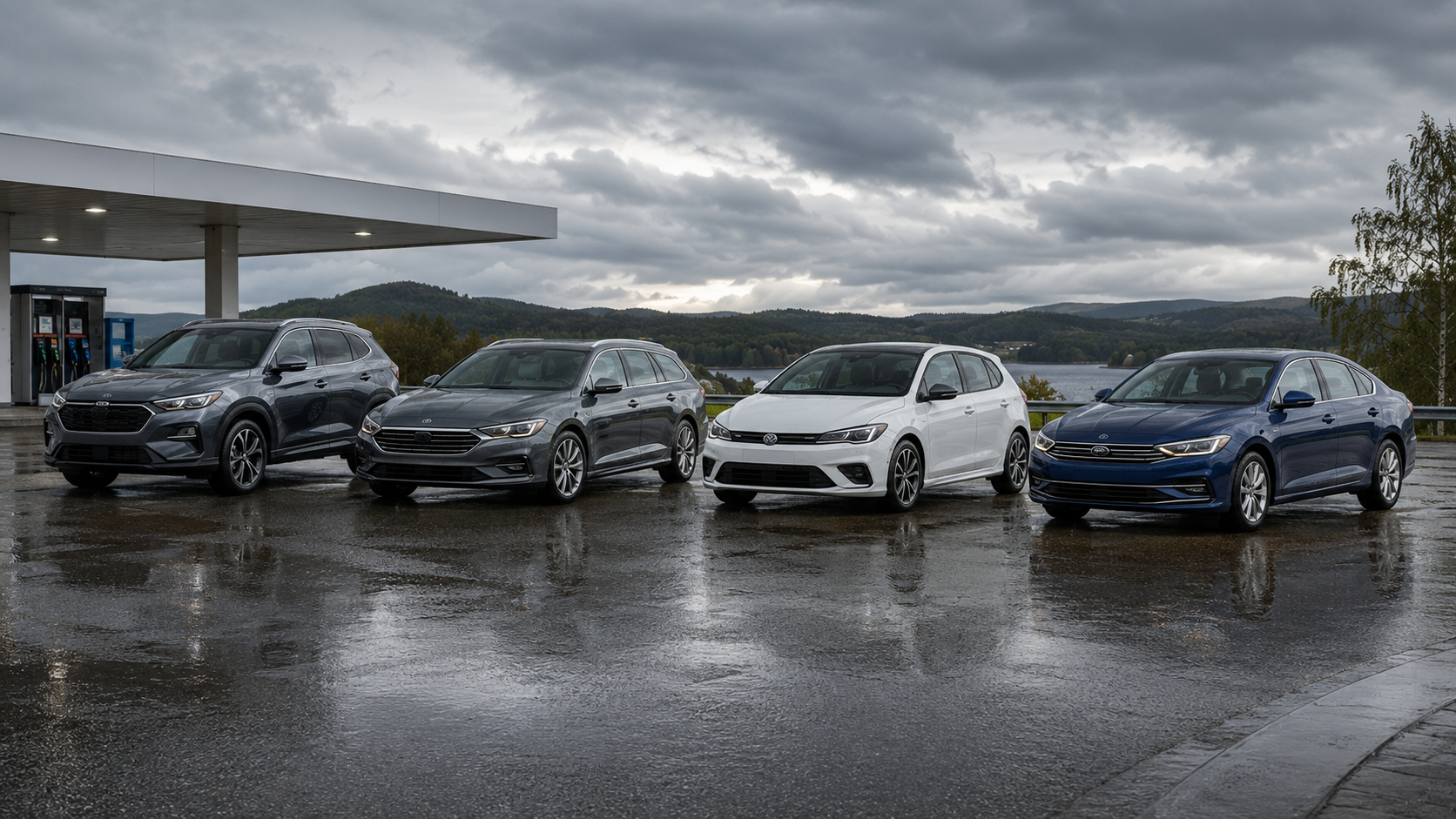
Two vehicles may use the same platform, engines with similar power and even an identical automatic transmission, yet one averages 6.0 l/100 km while the other uses 7.2 l/100 km. The difference is not always hidden under the bonnet. It is often created by the body shape, height, weight, wheels and drivetrain configuration.
A saloon is usually lower and easier for the air to pass around. An estate retains a similar front section but offers a larger luggage area. A hatchback is often shorter and lighter, while an SUV or crossover is taller, heavier and frequently fitted with wider tyres.
However, the simple rule that “an SUV always uses a lot and a saloon always uses little” would be far too basic. A modern compact hybrid crossover may use less fuel than an old saloon with a large petrol engine. For a fair comparison, the vehicles must be similar in size, age, power and technology.
The most important question is not only which body type is theoretically the most economical. It is more important to understand how much space is genuinely required, where the vehicle will be used and how much the chosen reserve of practicality will cost.


The driver’s short takeaway at the start: when vehicles with similar technology are compared, a saloon and hatchback will usually be more economical, an estate will be close behind, while an SUV will normally require more fuel in return for its additional height and size.
Quick answer: which body type usually uses the least fuel?
When the remaining technical specifications are similar, the usual order is:
• compact hatchback — light and economical in the city;
• saloon — often very efficient on the motorway;
• estate — slightly heavier but still relatively aerodynamic;
• compact crossover — taller and usually heavier;
• large SUV — usually the highest consumption because of weight, dimensions and tyres;
• MPV — may use a lot of fuel, but when carrying six or seven people it can be highly efficient per passenger.
This order is not guaranteed for every model. A small hybrid SUV may be more economical than a powerful petrol saloon, while a light front-wheel-drive crossover may use less fuel than an all-wheel-drive estate.
The body-style name alone proves nothing
The boundaries between body types have become blurred in modern marketing. Some crossovers are only slightly taller than hatchbacks. Some estates are raised, fitted with plastic wheel-arch trim and marketed as adventure-oriented models.
The term SUV can also describe either a small urban crossover with a three-cylinder engine and front-wheel drive or a seven-seat all-wheel-drive vehicle weighing more than two tonnes.
A fair comparison therefore requires vehicles with specifications that are as similar as possible:
• the same production period;
• a similarly sized passenger compartment;
• the same or a similar engine;
• the same transmission;
• the same drivetrain type;
• a similar tyre class and width;
• similar equipment and power.
Five reasons why body style changes consumption
| Factor | Why does it matter? | Where is it most noticeable? |
|---|---|---|
| Frontal area | A taller and wider vehicle must displace more air | On the motorway and in a headwind |
| Drag coefficient | Determines how smoothly air flows around the body | At higher speeds |
| Weight | A heavier vehicle needs more energy to accelerate and climb hills | In the city and on hilly roads |
| Wheels and tyres | Wider and heavier tyres increase rolling resistance | In every driving mode |
| Drivetrain and ground clearance | All-wheel drive adds components and weight, while greater ground clearance can worsen airflow beneath the vehicle | In mixed driving and on the motorway |
What is frontal area?
Frontal area can be imagined as the vehicle’s shadow when viewed directly from the front. The taller and wider the vehicle, the larger this area usually becomes.
A saloon may be long but low. An SUV may be shorter but substantially taller. The air is not particularly concerned with the length of the luggage compartment — it must first pass around the entire front projection of the vehicle.
A compact SUV can therefore create greater aerodynamic load than a longer saloon.
Cd is not everything: CdA matters more
Vehicle specifications often include the aerodynamic drag coefficient, known as Cd. A lower number generally indicates a more streamlined body shape.
However, Cd does not account for vehicle size. A large SUV may achieve a relatively good Cd figure, but its large frontal area can still produce substantial overall aerodynamic drag.
A more practical figure is the product of Cd and frontal area, known as CdA.
In simple terms:
Cd shows how effective the body shape is;
A represents the frontal area of the vehicle;
CdA shows the combined aerodynamic effect of both factors.
This explains why a large vehicle with an impressive Cd rating does not necessarily use as little energy as a smaller and lower vehicle.
Illustrative aerodynamic calculation at 100 km/h
The figures below are not manufacturer data for specific models. They are hypothetical examples showing how body height and shape can change the power required to overcome aerodynamic drag alone.
| Hypothetical body style | Cd | Frontal area | CdA | Approximate aerodynamic power at 100 km/h |
|---|---|---|---|---|
| Low saloon | 0.25 | 2.20 m² | 0.55 | Approximately 7.2 kW |
| Estate | 0.28 | 2.25 m² | 0.63 | Approximately 8.3 kW |
| Compact SUV | 0.32 | 2.60 m² | 0.83 | Approximately 10.9 kW |
| Large SUV | 0.36 | 2.90 m² | 1.04 | Approximately 13.7 kW |
The hypothetical compact SUV requires approximately half as much additional aerodynamic power as the saloon. This does not mean that its total fuel consumption will also be exactly 50% higher because the vehicle must also overcome tyre, transmission and other losses.
The example does, however, clearly show why the difference between body styles becomes particularly noticeable on the motorway.
Aerodynamic power rises extremely quickly with speed. The difference between a saloon and SUV may be small at 50 km/h but much more significant at 110–130 km/h.
Weight costs more in the city, body shape costs more on the motorway
In urban driving, the vehicle repeatedly starts moving, accelerates, brakes and accelerates again. Weight becomes especially important here.
If an SUV is 250 or 400 kilograms heavier than a similar hatchback, that additional mass must be accelerated every time the vehicle moves away. In an internal-combustion vehicle, much of this energy is lost as heat during braking.
On the motorway, speed changes less frequently, so the effect of weight decreases. However, the vehicle must continuously push air aside, making the disadvantage of the taller body much more noticeable.
| Driving environment | Most important factor | Which vehicle usually has the advantage? |
|---|---|---|
| Dense city traffic | Weight, dimensions and repeated acceleration | A light hatchback or hybrid |
| Suburban road | Weight, tyres and average speed | A saloon, hatchback or estate |
| Motorway | Aerodynamics and tyre rolling resistance | A low saloon or aerodynamic estate |
| Hilly road | Weight and total elevation gain | The lighter vehicle |
| Poor or gravel road | Ground clearance, tyres and suspension suitability | A crossover or SUV when the additional height is genuinely required |
Saloon: often the most economical choice for long journeys
A saloon has a separate boot that creates a gradual transition from the roof to the rear of the vehicle. In a well-designed model, this helps control airflow and reduce turbulence.
A saloon is also usually lower than an SUV and therefore has a smaller frontal area. This gives it an advantage on the motorway, where aerodynamic drag represents a large part of the total load.
The disadvantage is the shape of the luggage opening. Even when the volume in litres is sufficient, loading large objects may be awkward. The rear window does not lift together with the boot lid.
A saloon is particularly suitable when:
• you regularly travel on motorways;
• you do not need to transport very large items;
• low noise and stability at higher speeds are important;
• fuel or electricity efficiency is the priority.
Estate: plenty of space without the full SUV penalty
An estate generally uses a saloon or hatchback platform, but its roof continues towards the rear of the vehicle. This creates a large luggage area with convenient access through a wide tailgate.
Compared with a saloon, an estate may be slightly heavier and its rear shape may create a different airflow pattern. However, the roof height and frontal area often remain very similar to the saloon.
The consumption difference between an estate and saloon is therefore often much smaller than the difference between a saloon and an SUV of a similar size.
For a family that regularly needs room for a pushchair, bicycles, a dog crate or holiday luggage, an estate can be one of the smartest compromises.
Illustrative driver comment: “I was convinced that our family needed an SUV. After testing both, I discovered that the estate’s luggage area was longer, the pushchair was easier to load and motorway consumption was almost one litre lower.”
Hatchback: compact, light and convenient in the city
In a hatchback, the cabin and luggage area form one compartment, while the rear door lifts together with the window. This allows relatively large objects to be loaded even though the vehicle is short externally.
The shorter length and lower weight help in the city. The vehicle is easier to park, and less mass must be accelerated each time it moves away.
The short rear section of a hatchback does not always produce as little aerodynamic drag as a well-designed saloon. A larger turbulent wake may form behind the vehicle.
However, the smaller frontal area and lower weight often compensate for this difference, especially in urban and suburban driving.
Compact crossover: a popular compromise with a cost
A compact crossover often uses a hatchback platform but has a taller roof, greater ground clearance and more rugged styling.
The driver sits higher, access may be easier and there is often more headroom. These are some of the reasons why crossovers have become so popular.
However, the taller body increases frontal area. Larger wheels, wider tyres and heavier suspension components are also commonly used.
Even a front-wheel-drive crossover may use more fuel than the hatchback on which it is based. When all-wheel drive and a more powerful engine are added, the difference grows further.
A crossover is not a bad choice. It simply means that a higher seating position, additional ground clearance and styling often come with slightly higher consumption.
Large SUV: space and towing ability, but also a large appetite
A large SUV may offer seven seats, a high towing capacity, all-wheel drive and a spacious cabin. These abilities require a strong and heavy structure.
High weight, a tall body, wide tyres and a powerful engine increase consumption. The brakes, transmission and suspension are also larger and heavier.
When these capabilities are regularly used — for example, when towing a trailer, carrying seven people or driving on poor roads — an SUV may be a logical choice.
When the large vehicle carries only one person on paved city roads for 95% of the time, the driver is paying every day for abilities that are almost never used.
MPV: an unattractive fuel guzzler or a clever family vehicle?
An MPV has a tall body and therefore cannot fully compete aerodynamically with a saloon. Its weight may also be considerable.
However, an MPV often uses its interior space more effectively than an SUV of a similar external size. The floor may be lower, the roof higher and the arrangement of seats and luggage more practical.
When six people travel in one MPV, it may use less fuel than two separate crossovers. Efficiency should therefore also be evaluated according to the number of people and amount of cargo transported.
High consumption per vehicle does not always mean high consumption per passenger. A full seven-seat vehicle may be more efficient than several half-empty smaller cars.
Hypothetical annual fuel-cost comparison
Assume that all four vehicles cover 15,000 km per year and fuel costs €1.70 per litre.
| Body-style example | Average consumption | Fuel per year | Annual cost | Difference from the saloon |
|---|---|---|---|---|
| Saloon | 6.0 l/100 km | 900 litres | €1,530.00 | — |
| Estate | 6.3 l/100 km | 945 litres | €1,606.50 | +€76.50 |
| Compact SUV | 7.0 l/100 km | 1,050 litres | €1,785.00 | +€255.00 |
| Large SUV | 8.5 l/100 km | 1,275 litres | €2,167.50 | +€637.50 |
Over five years, the hypothetical large SUV would cost €3,187.50 more in fuel than the saloon. This figure does not include more expensive tyres, larger brakes, insurance or the higher purchase price.
Calculation formula:
Annual fuel = annual mileage × consumption / 100.
Annual cost = annual fuel × price per litre.
Can an estate’s luggage area be more practical than an SUV’s?
An SUV’s luggage compartment is often tall but not always particularly long. Some of the external height is occupied by greater ground clearance, a thicker floor, all-wheel-drive components or styling elements.
An estate may have a lower load floor and a luggage area that extends farther along the length of the vehicle. Pushchairs, furniture and long sports equipment may therefore be easier to load into an estate.
The luggage capacity in litres does not tell the full story. Check:
• the width and height of the opening;
• the height of the loading lip;
• the distance between the wheel arches;
• the floor length with the rear seats raised and folded;
• the space occupied by the spare wheel or battery;
• whether the rear seats create a flat load floor.
Higher seating position: genuine comfort or only a feeling?
Many buyers choose an SUV because of its higher seating position. Getting in may be easier for people with limited mobility, while the immediate surroundings may be easier to see in urban traffic.
However, when almost every vehicle becomes taller, the visibility advantage decreases. A higher body also does not allow the driver to see through a lorry or another SUV.
A higher centre of gravity must also be considered. Electronic stability systems and well-tuned suspension can provide safe handling, but the laws of physics do not disappear.
Is an SUV safer?
Safety cannot be determined only by vehicle size or seating position. The design of the specific model, safety systems, tyres, crash-test results and driver behaviour all matter.
A heavier vehicle may provide certain physical advantages to its occupants in a collision with a lighter vehicle, but the greater mass also increases the energy that must be stopped. A higher centre of gravity also affects behaviour during sudden manoeuvres.
The claim that “an SUV is automatically safer” is therefore just as inaccurate as saying that “a saloon is always unsafe”. Specific models and their safety ratings must be compared.
Wheels can increase the difference between body types
SUVs are often fitted with larger and wider wheels than saloons or hatchbacks. This improves the visual appearance but can increase rolling resistance, weight and tyre cost.
The same crossover on economical 17-inch tyres may be noticeably more efficient and comfortable than a sporty version on 20-inch wheels.
The specific wheel and tyre configuration must therefore be considered together with the body style.
Front-wheel drive or all-wheel drive?
Many saloons, hatchbacks and estates are offered with front-wheel drive, while SUVs are more commonly available with all-wheel drive.
An all-wheel-drive system adds a prop shaft, differential, clutch or other components. This increases weight and creates additional mechanical losses.
When a front-wheel-drive estate is compared with an all-wheel-drive SUV, the consumption difference is not created by the body alone. Part of it comes from the drivetrain.
Compare the same drivetrain with the same drivetrain. Otherwise, the effects of body style, transmission and weight become mixed into one figure.
In winter, the SUV advantage may be smaller than it appears
Greater ground clearance helps in deep snow, on an uncleared road or on a difficult driveway. In normal driving on cleared asphalt, however, good winter tyres matter much more.
All-wheel drive helps the vehicle move away but does not reduce braking distance by itself. A heavy SUV must stop a greater mass on a slippery surface.
When the daily route follows city streets and main roads, a front-wheel-drive estate with good tyres may be entirely sufficient.
When uncleared rural roads are used regularly, greater ground clearance and all-wheel drive may be valuable even if they result in higher fuel consumption.
A hybrid can reduce the SUV’s urban penalty
A full hybrid can recover part of the braking energy in the city and reduce idling. This partly compensates for the greater weight.
A hybrid SUV can therefore achieve surprisingly good urban fuel consumption, especially when compared with a conventional petrol version of similar power.
There are fewer opportunities for regeneration on the motorway. Aerodynamics, tyres and body dimensions then become dominant again.
A hybrid SUV’s city consumption may therefore be close to that of a saloon, while the difference can increase again at higher motorway speeds.
Plug-in hybrid: an extremely low figure or a heavy SUV?
A plug-in hybrid can complete a large proportion of daily journeys electrically. When the battery is charged regularly, fuel consumption can be extremely low.
However, the plug-in system adds a large battery, electric motor and other components. When the battery is empty, the heavy SUV must carry all that mass with it.
The economy of a plug-in SUV therefore depends completely on charging habits. A driver who never charges it may end up with a very heavy petrol vehicle.
Illustrative plug-in driver comment: “During the working week, I use almost no petrol because I charge at home. On a holiday journey with an empty battery and roof box, consumption was much higher than I expected from the advertised figure.”
Electric vehicles: body shape becomes even more visible
An electric motor converts battery energy into motion very efficiently. Aerodynamic and tyre losses therefore form a large proportion of total consumption.
A tall electric SUV may achieve a long range by using an enormous battery, but that does not mean it is more energy-efficient than a lower electric saloon.
When electric vehicles are compared, examine not only range but also consumption in kWh/100 km and usable battery capacity.
| Electric-vehicle example | Consumption | Usable battery capacity | Simplified theoretical range |
|---|---|---|---|
| Aerodynamic saloon | 16 kWh/100 km | 64 kWh | Approximately 400 km |
| Electric SUV | 21 kWh/100 km | 84 kWh | Approximately 400 km |
Both hypothetical vehicles have a similar range, but the SUV requires a battery that is 20 kWh larger. This adds cost, weight and material use.
Is a coupé always aerodynamic and economical?
A coupé’s low roofline can create good aerodynamics, but sporting models are frequently equipped with powerful engines, wide tyres, large wheels and downforce-producing elements.
A spoiler does not always reduce drag. Its purpose may be to improve stability and increase downforce even when consumption rises slightly.
A sporting shape and low body therefore do not guarantee low consumption.
Tyres, brakes and maintenance: the other side of SUV costs
Fuel is only one expense. A heavier vehicle often requires tyres with a higher load rating, larger brake discs and stronger suspension components.
SUV tyres may be wider and have a larger diameter. A set of four high-quality tyres can cost substantially more than a set for a similar hatchback.
Greater weight may increase the load on tyres, brakes and suspension, although real wear depends heavily on driving style and the specific model.
| Cost category | Hatchback or saloon | Estate | SUV |
|---|---|---|---|
| Fuel | Often lower | Slightly higher | Often higher |
| Tyres | Smaller sizes may be cheaper | Usually moderate costs | Often larger and more expensive sizes |
| Brakes | Often smaller | Similar to the saloon | May be larger and more expensive |
| Drivetrain components | Often front-wheel drive | Depends on the version | All-wheel drive is more common |
| Washing and parking | More compact dimensions | Longer vehicle | Greater width and height |
Does a larger vehicle retain its value better?
SUV popularity may support resale value, but market demand changes. Rising fuel prices, taxes and maintenance costs may reduce interest in large and inefficient models.
An economical estate or hatchback may be easier to sell to a buyer looking for lower everyday running costs.
Resale value is influenced much more by the reputation of the specific model, its technical condition, mileage and maintenance history than by body style alone.
Common myths about body styles and fuel consumption
| Myth | Reality | Practical takeaway |
|---|---|---|
| An SUV always uses twice as much fuel | The difference depends on size, engine, weight and drivetrain | Compare specific versions |
| A saloon is always more economical than a hatchback | The saloon may have better aerodynamics, but the hatchback may be lighter | Consider the driving environment |
| An estate uses as much fuel as a large SUV | An estate often retains the height and aerodynamics of a saloon | An estate may be the more economical family solution |
| A taller vehicle is automatically more spacious | Some of the height is occupied by ground clearance and structure | Measure the luggage area rather than judging by appearance |
| An SUV always has all-wheel drive | Many crossovers are front-wheel drive only | Check the specific drivetrain |
| A large battery means an efficient electric vehicle | A large battery may simply compensate for high consumption | Check kWh/100 km as well |
| A hybrid SUV is as economical everywhere as it is in the city | Aerodynamics become much more important on the motorway | Compare urban and motorway figures separately |
Does an estate always use more fuel than a saloon?
Not always. An estate may be slightly heavier and have different rear aerodynamics, but the difference in consumption may be very small in certain models. Tyre size or equipment can sometimes create a greater difference than the body style itself.
Why does an SUV use more fuel on the motorway than expected from city driving?
Aerodynamic drag rises rapidly with speed. An SUV is taller and normally has a larger frontal area, making body shape particularly important at motorway speeds.
Can a front-wheel-drive SUV be economical?
Yes. A small front-wheel-drive crossover with moderate wheels and an economical engine can achieve good consumption. A hatchback on a similar platform will often still be lighter and more aerodynamically efficient.
Does a family definitely need an SUV?
No. For many families, a hatchback, estate or MPV provides equally large or even more practical luggage space. Take the pushchair, bags or other regularly carried items with you and test whether they fit before choosing the vehicle.
Is a lower vehicle always uncomfortable?
No. Seat shape, door-opening dimensions and sill height can matter more than the overall body height. Some saloons are very easy to enter, while a sporty crossover with thick sills can be unexpectedly awkward.
Mini test: do you genuinely need an SUV?
Answer these questions:
1. Do you regularly drive on uncleared, gravel or very poor roads?
2. Do you genuinely need greater ground clearance?
3. Do you regularly use all-wheel drive rather than merely wanting it “just in case”?
4. Do you tow a heavy trailer?
5. Do you regularly use six or seven seats?
6. Is easier access necessary because of health or mobility requirements?
7. Does the required luggage genuinely not fit in an estate or MPV?
8. Are you prepared to pay more for fuel, tyres and possible all-wheel-drive maintenance?
When most answers are “no”, the SUV choice is probably driven by seating position and design rather than practical necessity. That is not wrong, but the cost of the choice should be understood.
Practical test-drive experiment
When choosing between a saloon, estate and SUV, a five-minute trip around the dealership is not enough. Create the same test route for every candidate.
| Test section | What should be checked? |
|---|---|
| City streets | Visibility, turning circle, consumption and parking |
| Uneven road | Comfort, tyre noise and suspension response |
| Motorway | Wind noise, engine revolutions and consumption at the same speed |
| Parking space | Width, camera quality and the space needed to open the doors |
| Luggage test | Load your own pushchair, suitcases, boxes or sports equipment |
| Access | Ask every family member to get in and out, not only the driver |
Reset the trip computer before each test, but do not treat one short consumption reading as absolute truth. The most important objective is to compare how the vehicles behave under the same conditions.
A simple selection process
Choose in this order:
1. Determine how many people will genuinely travel in the vehicle every day.
2. Measure the largest items transported regularly.
3. Evaluate how often you travel on poor roads or through deep snow.
4. Determine the proportion of urban and motorway kilometres.
5. Compare versions with the same engine and drivetrain.
6. Compare not only l/100 km but also tyre and maintenance costs.
7. Check the actual luggage-compartment shape rather than only its volume in litres.
8. Complete the same test route in every vehicle.
9. Choose the smallest vehicle that meets your regular requirements without compromise.
Which body style suits different drivers?
| Driver profile | Possible best choice | Why? |
|---|---|---|
| One person driving in the city | Small hatchback | Compact, light and easy to park |
| Regular long motorway journeys | Saloon | Good aerodynamics, stability and low noise |
| Family carrying substantial luggage | Estate | Large cargo area without a very tall body |
| Family of six or seven | MPV or seven-seat SUV | A compromise between passenger space and luggage capacity is required |
| Regular driving on poor rural roads | Crossover or SUV | Greater ground clearance and more suitable suspension |
| Towing a heavy trailer | Manufacturer-approved SUV or another vehicle designed for towing | Towing capacity, transmission, brakes and cooling are important |
| Lowest possible energy costs | Aerodynamic saloon or compact hatchback | Smaller frontal area and lower weight |
Conclusion: the most economical vehicle is the smallest one that genuinely meets your needs
When vehicles of similar age and technology are compared, a lower and lighter hatchback or saloon will usually use less fuel than a taller SUV.
The estate is often an unfairly overlooked compromise. It can provide a very large and practical luggage compartment while retaining saloon-like aerodynamics and moderate running costs.
A crossover offers easier access, a higher seating position and greater ground clearance, but these advantages usually come with greater weight, frontal area and tyre costs.
A large SUV becomes economically justified when its abilities are regularly used: seven seats, heavy-trailer towing, all-wheel drive or driving on poor roads.
When a vehicle is chosen only for appearance, it is easy to buy dimensions that must be paid for at every refuelling stop, tyre replacement and maintenance visit.
Before buying, compare the weight, tyres, drivetrain, urban and motorway consumption of specific versions, as well as the actual shape of the luggage area.
The driver’s final takeaway: do not buy a larger body simply because additional space might be needed one day. Choose a vehicle that suits 95% of your daily life rather than the rarest possible scenario.