 LV
 EN
 RU
Information checked on 29 July 2026. The European Union Data Act has applied since 12 September 2025. The requirement to design new connected products and related services so that their data is easily and securely accessible by default applies to products placed on the market after 12 September 2026. The precise range of data available from a particular vehicle depends on its design, connectivity, contracts and which data is readily available to the manufacturer or another data holder.
A modern vehicle is no longer only an engine, battery, wheels and passenger compartment.
It is also a mobile network of sensors and computers.
A vehicle may record its speed, location, mileage, fuel flow, battery state of charge, tyre pressure, temperatures, fault codes, door status, braking events, charging sessions and hundreds of other parameters.
Some of this information remains inside the vehicle. Some is transmitted to the manufacturer’s servers, a mobile application, a fleet platform, a leasing company or another service provider.
For a long time, drivers had no clear practical way to obtain the same information that the vehicle manufacturer could view remotely.
The EU Data Act is intended to change this balance.
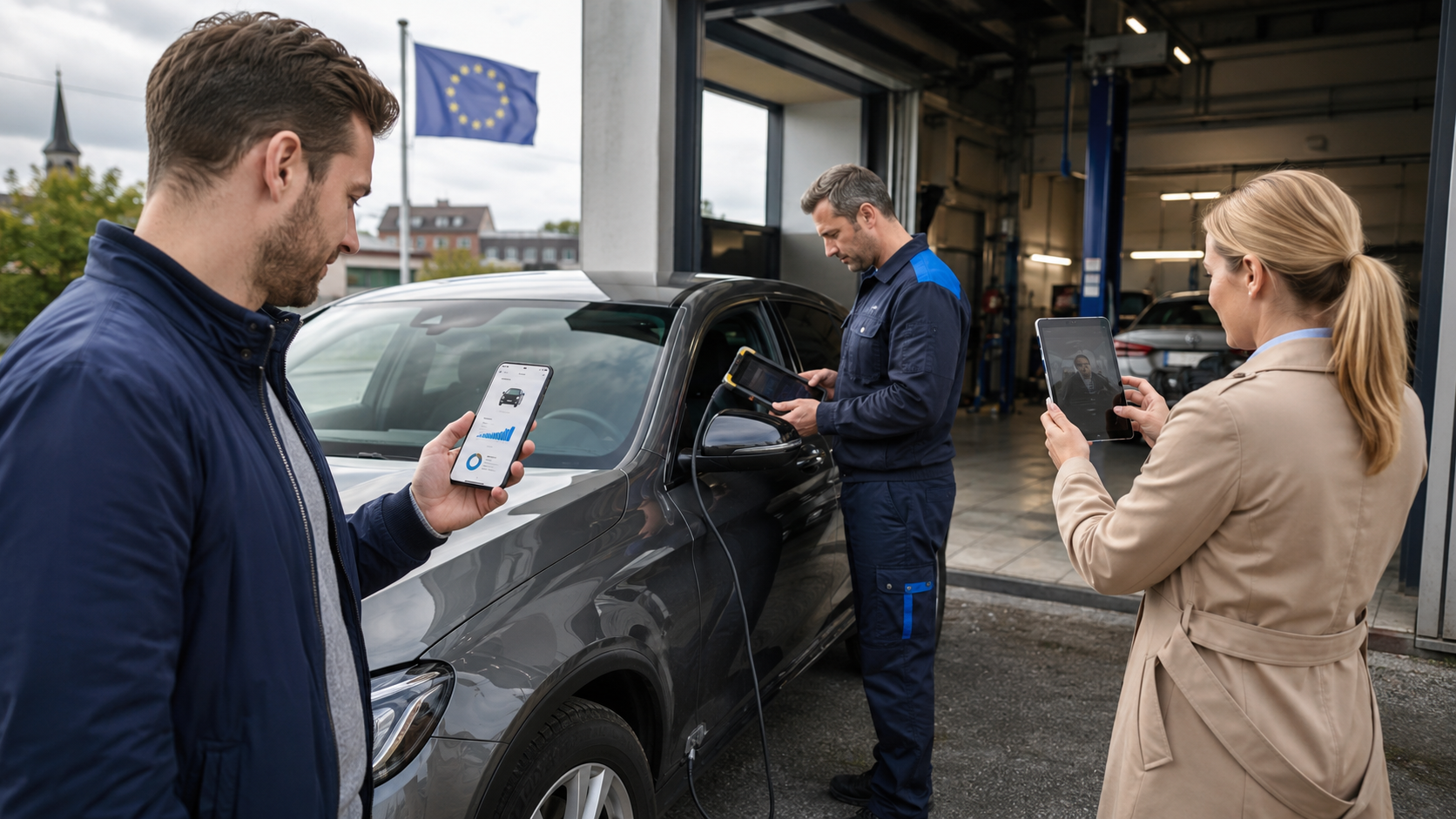
The user of a connected vehicle now has the right to request readily available data, use it personally or ask for it to be transferred to a chosen third party, such as an independent repair shop, insurer, charging-optimisation application or fleet-management platform.


The short conclusion: the Data Act does not declare the driver to be the owner of every piece of vehicle data and does not open all manufacturer software. It gives the user specific rights to access data generated during vehicle use and readily available to the data holder, as well as the right to share it with a chosen service provider.
What is the EU Data Act?
The Data Act is a European Union regulation governing fair access to and use of data.
It applies not only to vehicles but also to other devices connected to the internet or data systems:
• smart-home equipment;
• fitness and health devices;
• industrial machinery;
• agricultural equipment;
• connected vehicles;
• charging, fleet and mobility services;
• cloud-computing and data-processing services.
The main principle for the automotive sector is straightforward: when a driver or business uses a connected vehicle and data is generated as a result, the user must have a genuine opportunity to obtain and use that data.
The most important dates
| Date | What does it mean? |
|---|---|
| 11 January 2024 | The Data Act legally entered into force |
| 12 September 2025 | Most provisions of the Data Act began to apply, including users’ rights to request readily available connected-product data |
| 12 September 2025 | The European Commission published specific guidance on applying the Data Act to vehicle data |
| After 12 September 2026 | Connected products and related services placed on the market must be designed so that data is easily, securely and machine-readably accessible by default |
| 12 September 2027 | Rules on unfair business-to-business contractual terms begin to apply to certain previously concluded long-term or indefinite contracts |
The 2026 date does not mean that users of older vehicles have no rights until then. The access rights have applied since September 2025. From September 2026, a separate requirement also begins to apply, requiring new products to be designed in a way that makes data accessible by default.
Does the vehicle have to be connected to the internet?
Under the Data Act, a connected product is a device that obtains, generates or collects data through its use or surrounding environment and can communicate that data electronically.
The connection may operate in several ways:
• through a mobile-communications module built into the vehicle;
• through Wi-Fi or Bluetooth;
• through the manufacturer’s mobile application;
• through a physical diagnostic connection;
• through a fleet telematics device;
• through another data-exchange interface.
The vehicle does not necessarily have to remain online at all times. However, when data is not technically available anywhere and cannot be obtained by either the user or the manufacturer, the Data Act generally does not require the manufacturer to create an entirely new data-collection system solely in response to one request.
Who owns vehicle data?
Legally, it is more accurate not to refer to one universal owner of all vehicle data.
The Data Act mainly distributes rights and obligations between several parties.
| Role | Who can it be? | Main rights or obligations |
|---|---|---|
| User | The vehicle owner, renter, leasing user or business operating the vehicle | May request the data, use it and ask for it to be transferred to a chosen third party |
| Data holder | The vehicle manufacturer, related-service provider or another business that has access to the data | Provides access and explains in the contract how the data is used and shared |
| Data subject | An identifiable individual connected to the data, such as a driver or passenger | Retains the personal-data rights provided by the General Data Protection Regulation |
| Third party | An independent repair shop, insurer, application, fleet business or another chosen service provider | May use the data only for the purpose agreed with the user and in accordance with the law |
One person may occupy several roles at the same time.
A private vehicle owner may be both the user and the data subject. In a company fleet, the user may be the company, while the data subject may be the individual employee driving the vehicle.
Which vehicle data may be available?
The Data Act may cover raw and pre-processed data generated through the use of the vehicle or a related service and readily available to the data holder.
| Data group | Possible examples |
|---|---|
| Vehicle movement | Speed, acceleration, direction, mileage, and journey start and end times |
| Location | GNSS or GPS coordinates, route and location timestamp when such data is collected and available |
| Fuel | Fuel level, flow, average consumption, remaining range and fuel-system condition |
| Electric-vehicle battery | State of charge, temperature, voltage, current, charging power, remaining charging time and, in some cases, battery-health information |
| Charging sessions | Charging start and end, AC or DC charging, energy received, average power and connection status |
| Tyres | Tyre pressure, temperature, pressure warnings and normalised pressure readings |
| Engine and drivetrain | Engine speed, torque, coolant temperature, filter condition and system warnings |
| Diagnostics | Fault codes, warning signals, system or component condition and maintenance reminders |
| Body and passenger-compartment status | The status of doors, windows, boot, locks, lighting or climate-control systems |
| Safety systems | The operating status and events of ABS, stability control, airbags or driver-assistance systems when the data is readily available |
This list does not guarantee that every specific vehicle will provide all of the parameters mentioned.
An older vehicle may transmit only a few basic data points, while a newer electric vehicle may store detailed charging and battery information on the manufacturer’s servers.
Raw, pre-processed and derived data
| Category | Example | Is it generally covered by the Data Act? |
|---|---|---|
| Raw data | Speed, temperature, voltage or tyre pressure measured by a sensor | Yes, when it is readily available to the data holder |
| Pre-processed data | Normalised tyre pressure, average consumption or system condition after basic processing | Usually yes, when the processing has not created substantially new information |
| Derived or inferred data | A failure probability calculated by the manufacturer’s algorithm or a commercial driver-risk profile | Not always; sophisticated inferred data may fall outside the mandatory-access obligation |
A simple mathematical calculation does not automatically transform information into a protected algorithmic inference.
For example, when fuel flow and speed are used to calculate average consumption, the result may still be considered pre-processed and accessible data.
What does the Data Act not automatically open?
• the vehicle software source code;
• the manufacturer’s confidential algorithms;
• anti-theft-system security keys;
• the ability to unlock or start the vehicle remotely without authorisation;
• every repair instruction and all factory technical documentation;
• data that arises only temporarily inside the vehicle and is not accessible to any party;
• conclusions created through sophisticated commercial analysis;
• another person’s personal data without an appropriate legal basis.
The Data Act is not a universal password for all vehicle electronic systems.
Access to repair and maintenance information, security functions, anti-theft data and software reprogramming may also be regulated by other EU and Latvian legislation.
What does “readily available data” mean?
The data holder does not necessarily have to create a complicated new data-extraction system when a particular parameter is not currently stored and cannot be obtained without disproportionate technical effort.
| Situation | Possible Data Act result |
|---|---|
| Battery state-of-charge information is regularly received by the manufacturer’s server | The data is generally readily available and may fall within the access obligation |
| The data is visible in the manufacturer’s mobile application | This is a strong indication that the data holder has access to it |
| A sensor signal exists for only a few milliseconds inside a control unit and is not stored | The manufacturer may not be required to begin collecting it solely because a user requests it |
| The manufacturer can obtain the data with a simple additional operation in its system | The data may be considered readily available |
| Obtaining the information requires development of a completely new algorithm or complex analysis | The result may fall outside the mandatory-access scope |
How must users receive the data?
When data is not directly accessible through the vehicle or related service, the data holder must provide it following a simple electronic request:
• without undue delay;
• in the same quality in which it is available to the data holder;
• easily and securely;
• free of charge to the user;
• in a comprehensive and structured format;
• in a commonly used and machine-readable format;
• continuously and in real time when relevant and technically feasible.
The practical solution may be a manufacturer portal, downloadable file, application function or API connection.
The Data Act does not require every vehicle brand to use one identical website or file format.
Direct access and access through the manufacturer
| Type of access | Example | Advantage |
|---|---|---|
| Directly through the vehicle | Data is visible on a display, in an application, through a diagnostic connector or in a local file | There is no need to wait for a separate response from the manufacturer |
| Through the data holder | A server-stored data export is requested through the manufacturer’s portal | Broader historical or remotely collected information may be available |
| Directly to a third party | The user authorises the manufacturer to transfer the data to a chosen repair shop through an API | The user does not have to download and forward files personally |
Is access free of charge?
The user must be given access to data covered by the Data Act free of charge.
However, three different types of cost must be distinguished.
| Type of cost | Who may have to pay? |
|---|---|
| Receiving data as the user | It must be free of charge to the user |
| Transferring data to a business or third party | In certain cases, the data holder may request fair and reasonable compensation from the third party |
| The third party’s service | A repair shop, insurer or application may charge the customer for analysis, repairs or another service |
Free data therefore does not mean free repairs, diagnostics or insurance analysis.
Practical example: an independent repair shop
Situation: an engine warning periodically appears on the vehicle’s dashboard, but the warning disappears before the workshop appointment.
Without data access: the workshop must wait for the fault to reappear or perform a longer diagnostic procedure.
With data access: the user authorises the manufacturer to share fault codes, temperatures, mileage and system status with the repair shop.
Possible result: the workshop identifies the most likely problem before the visit, orders the required component and reduces vehicle downtime.
Limitation: the data itself does not replace a physical inspection, measurements and a mechanic’s professional diagnosis.
Will an independent workshop receive everything available to an authorised dealer?
Not necessarily.
The Data Act provides access to readily available product and related-service data in the same quality in which it is available to the data holder.
However, an authorised dealer may also have access to:
• factory repair instructions;
• parts catalogues;
• warranty procedures;
• software-reprogramming tools;
• authorisation for security functions;
• the manufacturer’s internal diagnostic analysis.
Access to these systems may be governed by other regulations, licences and security requirements.
OBD-II and the Data Act are not the same thing
| OBD-II diagnostics | Data Act access |
|---|---|
| Usually requires physical access to the vehicle | Data may be obtained remotely from the data holder |
| Mainly diagnostic and emissions parameters | May also cover location, charging, consumption, journeys and other telematics data |
| The data range depends on the vehicle and scanner | The data range depends on what is generated during use and readily available to the holder |
| May provide a current sensor reading | Historical data may also be available when it is stored |
| Requires a physical device or workshop tool | May use a portal, file or API |
Practical example: pay-as-you-drive insurance
A user may wish to provide an insurer with vehicle mileage or driving-time data to receive an individual offer.
However, consent must be understandable and the purpose must be clear.
| Question to ask before sharing data | Why is it important? |
|---|---|
| Which data will be received? | Mileage is less sensitive than precise location and every individual journey |
| How long will the data be stored? | Long-term route history may reveal a person’s home and habits |
| Will the data affect only the price or also the payment of a claim? | The customer must understand the consequences of data use |
| Can data sharing be stopped? | Data transfer should not continue without justification after the service ends |
| Will the data be shared with anyone else? | The user should know whether analytics, risk-assessment or cloud-service providers are involved |
The Data Act does not give an insurer automatic rights to receive all vehicle data. The transfer must be based on the user’s request and, when personal data is involved, an appropriate legal basis for processing that information.
Which vehicle information is personal data?
Vehicle information becomes personal data when it makes it possible to identify an individual directly or indirectly.
• precise journey routes;
• home and workplace locations;
• the vehicle identification number combined with owner information;
• a mobile-application account;
• a driver profile or digital key;
• driving style and habits;
• voice commands, contacts or message data when processed;
• information associated with a particular employee in a company fleet.
Both the Data Act and the General Data Protection Regulation apply to such information.
The Data Act does not remove requirements relating to legal basis, data minimisation, retention periods, transparency and security.
What happens when several people use the vehicle?
In a family vehicle, rental car or company vehicle, the data may relate to several people.
| Situation | Data risk | Practical action |
|---|---|---|
| Two partners use the same family vehicle | One person may receive the other person’s route history | Use separate profiles and share only the necessary amount of data |
| An employee uses a company vehicle | The employer may see location and driving habits | Clearly explain the purpose, data range and retention period to employees |
| A short-term rental vehicle | The previous customer’s contacts or routes may remain in the multimedia system | Delete the connected phone, navigation history and user profile after the rental |
| The vehicle is sold | The former owner may retain remote access | Disconnect the account and digital keys and perform a factory data reset |
Leasing, rental and company fleets
The Data Act user is not necessarily the legal owner of the vehicle.
The user may be a person or business that rents or leases the vehicle.
However, the precise rights may be affected by:
• the leasing or rental agreement;
• who is registered in the manufacturer’s application;
• whether the vehicle is used privately or for business;
• whether an individual driver can be identified from the data;
• internal fleet policies;
• the legal basis for processing personal data.
Before signing an agreement, it is worth establishing who may request the data, who receives it and what happens to the account after the agreement ends.
What does the Data Act change when buying a used vehicle?
Data access may improve the inspection of a used vehicle, but it does not replace workshop diagnostics and a history check.
| Data may help verify | Data alone does not prove |
|---|---|
| Consistency of the recorded mileage | That the vehicle has never been involved in an accident |
| Charging sessions and energy consumption | That the battery has no physical damage |
| Repeated fault codes | That the cause of a fault has been identified precisely |
| The history of system warnings when it is stored | That every repair was carried out correctly |
| Battery or drivetrain readings when available | That the manufacturer’s warranty remains valid in the particular situation |
The seller does not necessarily have to provide the buyer with their entire personal-data history.
The safest solution is to prepare a technical-data extract that excludes unnecessary precise location information and other private journey details.
What should you do before selling a vehicle?
1. Disconnect the manufacturer’s mobile application from the vehicle.
2. Delete digital keys and access provided to other drivers.
3. Delete Bluetooth and Wi-Fi devices.
4. Delete contacts, calls, addresses and navigation history.
5. Sign out of charging and parking applications.
6. Perform a factory reset of the multimedia system.
7. Inform the manufacturer or dealer about the change of ownership.
8. Check that the vehicle’s location is no longer visible after the sale.
9. Provide the buyer with a technical-data extract only after reviewing it for private information.
Does sharing data affect the warranty?
Requesting data or lawfully sharing it with an independent repair shop should not automatically invalidate the vehicle’s warranty.
However, data sharing must be distinguished from unauthorised technical intervention.
| Action | Possible warranty significance |
|---|---|
| Downloading a data file | Normally not a technical intervention in the vehicle |
| Transferring data to an independent repair shop | The data transfer itself does not invalidate the warranty |
| Appropriate diagnostics | Generally permitted when the systems are not damaged |
| Unauthorised reprogramming of a control unit | May create a warranty dispute, particularly when the modification is connected to the damage |
| Bypassing security systems | May be prohibited and create technical, safety and legal risks |
May the manufacturer use vehicle data?
The Data Act does not mean that the manufacturer is automatically prohibited from using all data.
However, the use of non-personal data must be supported by an agreement with the user, while personal data requires a legal basis compliant with the General Data Protection Regulation.
Before purchasing a vehicle or digital service, the user must receive understandable information about:
• the types of data generated;
• the approximate volume of data;
• how frequently the data is generated;
• where and for how long it is stored;
• the data holder’s intended purposes of use;
• information transferred to third parties;
• how data can be requested;
• how data sharing can be started and stopped.
Trade secrets and safety exceptions
A data holder cannot simply describe every dataset as a trade secret and refuse access.
The parties must generally first agree on proportionate confidentiality measures.
Refusal or suspension of access may be justified when:
• agreed trade-secret protection measures are not followed;
• disclosure would be highly likely to cause serious economic damage to the trade-secret holder;
• access would compromise legally required vehicle-safety requirements;
• there could be a serious adverse effect on human health, safety or security;
• the requester has no legal basis for receiving personal data contained in the dataset.
The data holder must justify such a decision and, in specified cases, notify the competent authority about the refusal.
May a third party use the data for any purpose?
No.
A repair shop, insurer or application may use the received data only for the purpose explained to and agreed with the user.
• a repair shop may not sell route history to an advertising business merely because it received diagnostic data;
• an insurer may not secretly expand the use of data beyond the purpose specified in the agreement;
• an application may not transfer the data to a designated large-platform gatekeeper when the Data Act prohibits it;
• the received data may not be used to develop a competing connected vehicle;
• after the service purpose has been achieved, the data must be deleted unless another legal basis for storage exists.
The Data Act does not, however, prohibit using data to create competing repair, insurance, energy-management or other aftermarket services.
What should you do when access is refused?
1. Retain a copy of the request and the date on which it was submitted.
2. Request a written explanation of the refusal.
3. Clarify whether the dispute concerns data unavailability, trade secrets, safety or personal data.
4. Ask which data can be provided partially.
5. Offer to reduce the scope of the request or use a secure transfer method.
6. In a personal-data matter, consider contacting the Latvian Data State Inspectorate.
7. In a consumer-contract dispute, consider contacting the Consumer Rights Protection Centre or bringing the matter before a court.
8. In a Data Act dispute, identify the current competent Latvian authority and the available out-of-court dispute-resolution procedure.
9. Do not use unauthorised access or system hacking as an alternative to a lawful request.
Responsibility may be divided between several authorities. Personal data, consumer rights, competition and technical application of the Data Act may have different supervisory bodies, so the precise type of dispute should be identified before filing a complaint.
Sample data request
Subject: request for access to connected-vehicle data
Please provide me, as the vehicle user, with access to readily available product and related-service data generated during the use of my vehicle.
Vehicle VIN: [VIN].
User account: [email address or customer number].
Requested period: [dates].
Requested data groups: mileage, fault codes, maintenance warnings, fuel or energy consumption, and battery and charging data when available.
Please provide the data in a structured and machine-readable format.
If any part of the requested data cannot be provided, please explain the specific reason in writing and indicate the available alternative.
[Name, date and contact information]
What should you check when buying a new connected vehicle?
1. Which data does the vehicle generate?
2. Which data is sent to the manufacturer’s server?
3. How long is it stored?
4. Can the user download it free of charge?
5. Is an API connection to a third party available?
6. Can data sharing be stopped at any time?
7. Will the manufacturer continue collecting data when the mobile service is not subscribed to?
8. Will remote functions require payment after the warranty expires?
9. How are the account and data transferred to the next owner?
10. Which data is available to an independent repair shop?
11. Can location history be disabled?
12. Was the vehicle placed on the market after 12 September 2026 with a data-access solution compliant with the Data Act requirements?
Common myths about vehicle data
| Myth | Reality |
|---|---|
| The Data Act makes the driver the owner of all vehicle data | The regulation mainly provides access, use and sharing rights rather than introducing a simple ownership model |
| A user can request all vehicle software | Source code, security keys and sophisticated algorithms are not automatically accessible |
| The rights apply only to vehicles manufactured after September 2026 | The access rules have applied since September 2025; the 2026 date concerns designing products for access by default |
| The manufacturer must begin collecting every sensor value requested by the driver | The obligation mainly applies to readily available data, not the creation of an entirely new collection system |
| An independent repair shop will receive every dealer password and tool | Data access is not the same as unrestricted access to security systems and factory tools |
| Receiving data always requires payment | Access must be free of charge to the user, although the third party’s service may be paid |
| An insurer will automatically see every journey | Transfer requires the user’s request and, for personal data, an appropriate legal basis |
| Selling the vehicle automatically deletes the former owner’s account | The account, digital keys and multimedia data must be deliberately disconnected and deleted |
| A data file replaces a workshop inspection | Data provides additional information but does not reveal every mechanical, bodywork or repair problem |
Mini test: have you understood the Data Act?
Answer yes or no:
1. Has the Data Act applied since 12 September 2025?
2. Can the user also be a renter or leasing user?
3. Must the user pay a mandatory manufacturer fee to receive the data?
4. Can the data be transferred to an independent repair shop?
5. Is the manufacturer’s software source code automatically included in the access rights?
6. Does the General Data Protection Regulation still apply to personal data?
7. Must the manufacturer begin collecting data that is not available to any party?
8. Can a safety risk justify restricting access?
9. Should a vehicle seller disconnect their digital account before the sale?
10. Does a data extract completely replace a used-vehicle inspection at a workshop?
Correct answers: 1 — yes; 2 — yes; 3 — no; 4 — yes; 5 — no; 6 — yes; 7 — no; 8 — yes; 9 — yes; 10 — no.
Does the Data Act apply to my 2022 vehicle?
It may apply when the vehicle is a connected product and the data holder has readily available data generated during its use. However, the range of data practically available from an older vehicle may be smaller. The specific requirement to design products for direct data access applies to products placed on the market after 12 September 2026.
Can I request an exact battery state-of-health percentage?
Only when such an indicator is generated during vehicle use, is readily available to the data holder and does not fall outside the scope as sophisticated inferred information. Individual battery parameters may be available even when the manufacturer’s commercial diagnostic conclusion is not.
Can I receive data in real time?
When real-time access is relevant and technically feasible, the Data Act also provides for continuous and real-time transfer. Older vehicles or certain systems may provide only periodic or historical exports.
Can the manufacturer require proof that I actually use the vehicle?
Yes. The data holder may verify whether the requester is the user, but it should not request more information than is necessary to confirm the person’s identity and right to use the vehicle.
Can I transfer the data to any repair shop?
In principle, the user may choose a third party, but that party must comply with Data Act, personal-data-protection, security and trade-secret requirements. Additional authorisation may be required for certain security functions.
May the repair shop retain the data after the repair?
Only for as long as necessary for the agreed service, accounting, warranty or another lawful purpose. The repair shop must explain the retention period and its processing of personal data.
Does the Data Act allow paid vehicle functions to be activated without a subscription?
No. The right to receive data is not a right to bypass software licences, subscriptions or security mechanisms, or to activate functions without the manufacturer’s permission.
Can an insurer make the transfer of my data compulsory?
The Data Act itself does not grant an insurer automatic access. An insurer may offer a data-based product, but the data transfer and personal-data processing require an appropriate legal basis and clear terms.
Does requesting data invalidate the warranty?
No. A lawful data request is not a technical modification of the vehicle. Warranty issues may arise after unauthorised modifications to software, security systems or control units, particularly when the modification caused the damage.
May the previous owner retain application access after selling the vehicle?
No, when that person no longer has the right to use the vehicle or another legal basis. The seller should disconnect the account and digital keys, while the buyer should verify that the previous access has been terminated.
A practical data-sharing formula
Before giving access to a repair shop, insurer or application, check:
the necessary service purpose
+ the minimum necessary data groups
+ the necessary data period
+ a secure transfer channel
+ a clear retention period
+ the ability to stop sharing
= proportionate and controlled use of vehicle data.
Conclusion: vehicle data is becoming a practical tool for the owner
The greatest benefit of the EU Data Act is not the ability to download an enormous and incomprehensible file of sensor readings.
The most important change is that the user can choose which service provider will work with this data.
An independent repair shop may prepare diagnostics more quickly. An electric-vehicle owner may use a charging-optimisation tool. A business may compare fleet consumption. A used-vehicle buyer may obtain additional information about mileage, faults or battery use.
At the same time, the regulation does not remove safety, trade-secret and personal-data-protection requirements.
A driver cannot request the vehicle’s source code, confidential security keys or the manufacturer’s sophisticated algorithms merely because they own the vehicle.
Not every sensor value will automatically be accessible either. The decisive question is which data is generated during vehicle use and which information is readily available to the data holder.
For connected products placed on the market from 12 September 2026, data accessibility must increasingly be built into the design. This means that requesting data from the next generations of vehicles should become simpler and more standardised.
When purchasing a new vehicle, it is now worth asking one additional question alongside power, consumption, warranty and equipment: which data is generated, who can access it and will I be able to use it with my chosen repair shop or application?
The driver’s final takeaway: connected-vehicle data is no longer merely background information on a manufacturer’s server. It may become a practical tool for cheaper repairs, smarter charging and a more transparent used-vehicle purchase — provided that access is used securely, proportionately and for a clearly defined purpose.