
 LV
 EN
 RU
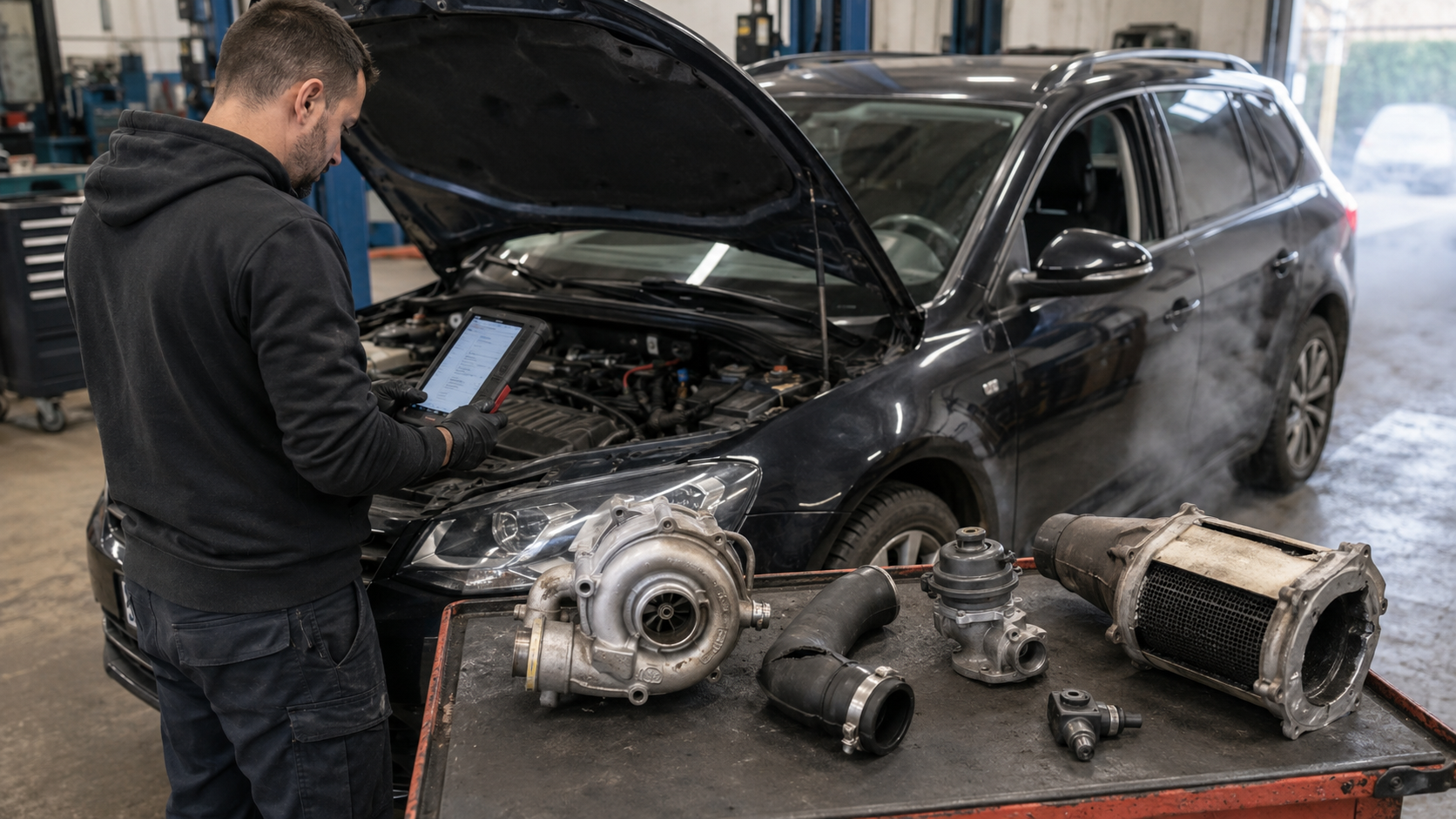
You join a motorway, select a higher gear and press the accelerator to overtake a slower vehicle. The engine becomes louder, but the car does not accelerate as it normally would. A few seconds later, the engine warning light comes on, power drops even further and the vehicle enters limp mode.
In another situation, the engine still produces power, but a new whistle can be heard from the engine compartment during acceleration. At first it may even sound sporty, but it soon becomes louder and begins to resemble a siren. After stronger acceleration, a dark cloud appears in the rear-view mirror, while the engine-oil level falls more quickly between services than it did before.
Many drivers immediately conclude that “the turbo is finished”. Sometimes they are correct. Very similar symptoms, however, may be caused by a split boost hose, a loose connection, a damaged intercooler, a vacuum leak, sticking turbocharger geometry, an EGR valve, a blocked DPF, an inaccurate mass-airflow sensor or a faulty pressure sensor.
This is why noise, smoke and a fault code are only the beginning of turbocharger diagnostics. Before ordering an expensive component, it is necessary to determine whether the turbocharger is failing to create boost, creating too much boost, allowing oil to pass through, receiving insufficient lubrication or operating correctly while pressure is being lost elsewhere in the system.
Power loss alone does not prove that the turbocharger has failed. Blue smoke, a rapidly falling oil level, loud metallic noise or an engine whose speed can no longer be controlled are symptoms with which the journey must not continue.
Turbine or turbocharger — which term is technically correct?
In everyday speech, the complete assembly is often called the turbine or simply the turbo. The technically correct name is turbocharger. The turbine is only the hot side of the assembly, which is driven by the engine’s exhaust gases.
The turbine wheel is connected by a common shaft to the compressor wheel. The compressor wheel is located on the intake side and compresses the air entering the engine. Energy from the exhaust gases is therefore used to force more air into the cylinders.
When more air enters the cylinders, the engine-management system can add more fuel and produce more power from a relatively small engine. A correctly controlled turbocharger also improves torque at lower engine speeds and can help the engine operate more efficiently under certain conditions.
It increases the amount of air available to the cylinders, but correct operation also requires the fuel-injection system, boost control, sensors, intake, exhaust and engine electronics to work together.
How does a turbocharger system work?
Exhaust gases leave the cylinders and flow through the turbine housing. The gas flow spins the turbine wheel, which rotates the compressor wheel on the intake side through a shared shaft.
The compressor draws air through the air filter and compresses it. Compression heats the air, so in many vehicles it then flows through an intercooler. The intercooler reduces the air temperature and increases its density.
From the intercooler, the air passes through boost pipes to the intake manifold and cylinders. The engine control unit compares requested and actual boost pressure using signals from the MAP sensor, MAF sensor, temperature sensors, accelerator position and other inputs.
To prevent excessive pressure, turbocharger output is regulated by an exhaust-gas bypass valve known as a wastegate, variable turbine geometry or another control mechanism. It may be operated by a vacuum diaphragm or an electric actuator.
The main parts of a turbocharger
The hot side through which exhaust gases flow. It receives energy from the engine’s exhaust stream.
The cold side that draws in and compresses air before it enters the engine.
Connects the two wheels and rotates at extremely high speed. Its operation depends critically on correct lubrication.
Engine oil lubricates and cools the bearing assembly. It must then be able to flow freely back into the engine sump.
A wastegate or variable geometry regulates how much exhaust-gas energy is used to spin the turbocharger.
A vacuum-operated or electric component that moves the wastegate or variable-geometry mechanism.
Quick symptom guide
Possible causes include underboost or overboost, a leaking hose, actuator fault, vacuum-system problem, EGR, DPF, sensor or the turbocharger itself.
Possible causes include a boost leak, loose connection, split hose, exhaust leak or a problem with the turbocharger wheel or bearings.
The engine may be receiving too little air or too much fuel. The boost system, EGR, MAF, DPF and fuel supply should be checked.
Oil is being burned in the engine or exhaust. Possible causes include the turbocharger, internal engine wear, crankcase ventilation or another oil leak.
The vehicle may have entered limp mode. Restarting does not repair the cause — fault codes and live data must be checked.
Do not continue driving until it is known where the oil is going. It may be leaking outside the engine or entering the intake and exhaust systems.
No single sign is enough to establish a diagnosis. The combination of symptoms, engine operating conditions, fault codes, live boost readings and a mechanical inspection must all be considered.
The car has no power: is the turbocharger responsible?
Power loss is one of the symptoms most commonly associated with turbocharger failure. It is also one of the least specific symptoms.
To produce the expected power, an engine requires the correct amount of air, fuel quantity, injection timing, exhaust flow and compression. A problem in any of these systems can create the impression that the turbocharger is not “coming in”.
Common causes of power loss in a turbocharged engine
- a split or disconnected boost hose;
- a damaged intercooler;
- a vacuum leak or failed control valve;
- sticking variable turbine geometry;
- an incorrectly operating wastegate actuator;
- a faulty MAP or MAF sensor;
- a sticking EGR valve;
- a blocked DPF or another exhaust restriction;
- a fuel-pressure or injector problem;
- a dirty air filter or restricted intake;
- damage to the turbocharger bearings, shaft or wheels;
- mechanical engine wear or low compression.
A turbocharger should therefore not be replaced simply because a diagnostic tool reports underboost. The fault code describes the result — pressure did not reach the requested value — but does not necessarily identify the cause.
Limp mode: why does the power disappear and return after a restart?
If the control unit detects a parameter that may endanger the engine, exhaust system or transmission, it may restrict engine output. This condition is commonly known as limp mode.
When a boost-pressure problem is detected, the control unit may restrict fuel delivery and reduce the requested boost. The vehicle becomes sluggish but can often still be driven.
After the engine is switched off and restarted, full power may temporarily return until the discrepancy is detected again. This does not mean the system has repaired itself.
Repeated restarting is not diagnostics
If power regularly disappears at a particular load or engine speed, requested and actual boost must be compared and the control system inspected. Repeatedly provoking the fault may increase the damage.
Underboost and overboost
Actual pressure does not reach the value requested by the control unit. Possible causes include a leak, control fault, exhaust leak before the turbine or mechanical turbocharger damage.
Pressure exceeds the requested value. Possible causes include sticking variable geometry, a wastegate or actuator problem, a vacuum-control fault or an inaccurate sensor signal.
Overboost does not mean that the turbocharger is working especially well. It increases the load on the engine, turbocharger and exhaust system, so the control unit will normally attempt to restrict it.
Whistling, hissing and siren-like noises
Some turbochargers normally produce a quiet and consistent whistle. It may be particularly noticeable in a quiet vehicle or after the intake system has been modified. A new noise that becomes louder and appears together with power loss, smoke or oil consumption is more likely to indicate a problem.
On some models, this may be a normal operating sound when it has not changed and no other symptoms are present.
Often indicates compressed air escaping through a hose, intercooler, connection or seal.
May indicate a bearing or wheel problem, particularly when the sound increases rapidly with engine speed.
The compressor or turbine wheel may be touching its housing. The engine should not continue to be placed under load.
An exhaust-gas leak before the turbocharger may also create whistling or ticking. Black soot marks may be visible around the manifold, gaskets or connections.
Boost pipes and the intercooler: common imitators of a failed turbocharger
Between the turbocharger, intercooler and intake manifold are hoses, pipes, connections, sealing rings and clamps. These parts are continually exposed to pressure, oil vapour, temperature changes and engine movement.
A rubber hose may split only on its underside, where the damage cannot be seen from above. A plastic pipe may crack near a connector, while a sealing ring may lose elasticity. The intercooler itself may be damaged by corrosion, vibration or impact.
Typical signs of a boost leak
- hissing or blowing noise during acceleration;
- lack of power that becomes more noticeable under load;
- black smoke from a diesel engine;
- an underboost fault code;
- oily deposits around a crack or hose connection;
- acceptable operation at low load but an inability to produce full power.
A small amount of oily moisture inside the intake pipes does not always mean the turbocharger has failed. Crankcase ventilation introduces oil vapour into the intake, which can gradually form a thin oily film. A large amount of liquid oil, rapidly falling oil level and blue smoke are more serious warning signs.
Black, blue and white smoke: what can they mean?
Black smoke
Black smoke usually means that the combustion mixture contains too much fuel or too little air. In a diesel engine, possible causes include a split boost hose, insufficient boost, a sticking EGR valve, an inaccurate MAF sensor, a fuel-injection fault or a DPF-system problem.
A visible cloud of black smoke is not normal in a vehicle with a functioning DPF. It may also indicate that the exhaust after-treatment system has been damaged, removed or is not operating correctly.
Blue or blue-grey smoke
Blue smoke normally indicates that oil is being burned. Oil may enter the intake or exhaust through the turbocharger, but other possible causes include piston rings, valve-stem seals, crankcase ventilation or an excessively high oil level.
The moment at which the smoke appears can help the diagnosis. Smoke after prolonged idling, strong acceleration or engine braking may suggest different oil-entry paths, although the exact cause cannot be established from this observation alone.
White smoke or vapour
Brief white water vapour in cold weather may be normal condensation. Thick and persistent white smoke may be connected with coolant, unburned fuel, an injection fault or another engine problem.
The turbocharger should not be the first and only conclusion whenever a vehicle smokes. The engine-oil and coolant levels, engine operation, fault codes and exhaust system must also be checked.
Oil consumption and the turbocharger
The turbocharger shaft and bearing assembly are lubricated by engine oil. Pressurised oil must reach the turbocharger, form a lubricating film and then flow freely back to the engine sump.
If the oil supply is insufficient, the bearing assembly can be damaged very quickly. If the drain pipe is blocked or distorted, or crankcase pressure is excessive, the oil may struggle to drain and can pass into the compressor or turbine side.
Why can a turbocharger pass oil?
- a worn or damaged shaft and bearing assembly;
- insufficient oil supply and overheating;
- a blocked or distorted oil-drain pipe;
- excessive crankcase pressure;
- a faulty crankcase-ventilation system;
- an excessively high engine-oil level;
- incorrect oil viscosity or specification;
- an incorrectly installed or previously damaged turbocharger.
Turbocharger oil-control seals do not operate in the same way as ordinary rubber oil seals. Their operation depends on pressure balance, bearing condition, oil drainage and crankcase ventilation. A new turbocharger may therefore continue to pass oil if the original cause has not been corrected.
A rapidly falling oil level is a reason to stop
If the oil level falls over a short period, blue smoke appears or the oil-pressure warning light comes on, the engine should not continue to be loaded. A lack of oil can damage not only the turbocharger but the entire engine.
Uncontrolled diesel-engine acceleration
In a rare but extremely dangerous situation, a diesel engine may begin using engine oil entering the intake as fuel. Engine speed rises rapidly even if the driver releases the accelerator or switches off the ignition.
This condition is commonly known as diesel runaway. It may cause extremely high engine speed, a thick cloud of smoke and catastrophic mechanical engine failure.
If the engine speed can no longer be controlled
Traffic safety is the priority. Try to stop the vehicle safely, switch off the ignition, leave the vehicle, keep other people at a safe distance and call 112 if there is heavy smoke, a fire risk or danger to traffic. Do not attempt to cover the intake with your hands or work near the engine.
Variable turbine geometry
Many diesel engines and some petrol engines use a variable-geometry turbocharger. Guide vanes inside the turbine housing alter the direction and speed of the exhaust-gas flow.
At low engine speed, the geometry helps the turbocharger spool more quickly. Under greater load, it is adjusted to prevent boost pressure from exceeding the required value.
Soot, corrosion and prolonged operation under unfavourable conditions may prevent the vanes from moving freely. If they stick in one position, both underboost and overboost may occur.
Signs of sticking variable geometry
- power disappears within a particular engine-speed range;
- the vehicle enters limp mode during strong acceleration;
- actual boost briefly exceeds or fails to reach the requested value;
- actuator movement is restricted or uneven;
- the problem may be more noticeable after prolonged gentle urban driving.
Cleaning the geometry may help in some cases, but it is not a universal solution. If the mechanism, shaft, actuator or housing is worn, removing soot alone will not restore the assembly’s mechanical condition.
Wastegate and turbocharger actuator
The wastegate is an exhaust-gas bypass valve. When turbocharger speed needs to be restricted, part of the exhaust flow is directed around the turbine wheel.
The valve is moved by an actuator. It may be pneumatic, using vacuum or pressure, or electric with a position sensor and control electronics.
A failed actuator can incorrectly control a mechanically healthy turbocharger. On some models, the actuator can be replaced or calibrated separately, while on others it must be precisely matched to the individual turbocharger.
The actuator rod should not be adjusted by feel
An incorrect actuator-rod length can cause both underboost and overboost. Adjustment must follow the manufacturer’s procedure and use the required measurements.
Vacuum-system faults
In many vehicles, the turbocharger actuator is controlled by vacuum. The system may include a vacuum pump, hoses, one-way valves, a reservoir and an electronically controlled switching valve.
A small crack in a hose can cause a boost-control problem even though the turbocharger itself is mechanically sound. Depending on the vehicle’s design, insufficient vacuum may also affect the EGR system, engine mounts or other components.
A visual inspection of the hoses is not always enough. They may be split underneath, become porous or collapse internally.
MAF and MAP sensors
MAF sensor
The mass-airflow sensor, or MAF, measures the amount of air entering the engine. The control unit uses this information to regulate fuel delivery, EGR operation and boost pressure.
An inaccurate MAF signal may cause poor performance, uneven operation, smoke and incorrect turbocharger control. The sensor may be contaminated, damaged or exposed to abnormal airflow because of an intake leak.
MAP sensor
The MAP sensor measures pressure in the intake manifold or boost system. In diesel engines, it may become contaminated by a mixture of oil vapour and soot.
If the sensor reports an inaccurate value, the control unit may conclude that boost is too low or too high even though the true mechanical pressure is different.
A sensor should not be replaced merely because the fault description mentions pressure. Its power supply, earth, signal and comparison with independent measurements should all be checked.
How EGR and DPF faults affect turbocharger operation
EGR valve
Under certain operating conditions, the EGR system directs some exhaust gas back into the intake to reduce the formation of nitrogen oxides. If the EGR valve remains too far open, less fresh air reaches the engine.
The result may be power loss, smoke, uneven running and a boost-pressure discrepancy. To the driver, this may feel like a turbocharger problem.
DPF
A blocked diesel particulate filter increases exhaust back pressure. This affects the engine’s ability to expel exhaust gases and can alter the turbocharger’s operating conditions.
If the DPF is overloaded with soot or ash, the vehicle may suffer from poor performance, frequent regeneration, increased fuel consumption and limp mode. Replacing the turbocharger will not correct such a fault.
Conversely, a damaged turbocharger that introduces oil into the intake or exhaust may contaminate the DPF and catalytic converter. The systems therefore affect one another in both directions.
Why does a turbocharger fail?
- insufficient oil supply;
- incorrect, old or contaminated engine oil;
- a blocked oil-feed or drain pipe;
- a foreign object entering the compressor or turbine side;
- a damaged or incorrectly installed air filter;
- prolonged overboost;
- excessively high exhaust-gas temperature;
- incorrect fuel delivery or ignition operation;
- a crankcase-ventilation fault;
- poor-quality previous repairs;
- incorrect turbocharger installation;
- long-term mechanical wear.
Turbocharger failure is often the result rather than the original cause. If a new unit is installed without cleaning the oil supply, repairing crankcase ventilation or correcting excessive exhaust back pressure, the replacement turbocharger may fail as well.
The importance of engine oil
The turbocharger bearing assembly operates at high speed and temperature. It is extremely sensitive to oil quality, pressure and cleanliness.
Oil used for too long may contain soot, oxidation products and deposits. An incorrect specification may fail to protect the particular engine properly or may interfere with the exhaust after-treatment system.
The correct oil filter, oil level and pressure are just as important as timely oil changes. Overfilling is not better than running with too little oil — it may increase the load on the crankcase-ventilation system and force more oil into the intake.
Can a cold turbocharged engine be loaded immediately?
After a cold start, the engine oil has not yet reached its normal operating temperature and all components have not thermally stabilised. Maximum power and high boost should therefore be avoided during the first kilometres.
This does not mean the engine should be warmed for a long time at idle. Gentle driving with moderate engine speed and load normally allows it to warm more evenly. Follow the instructions provided by the vehicle manufacturer.
Should the engine idle after every journey?
After gentle urban driving or a slow approach to a parking space, extended idling is normally unnecessary. Turbocharger load has already fallen during the final minutes of the journey.
After prolonged heavy load — such as fast motorway driving, towing, a long climb or sporty driving — it is sensible to complete the final part of the journey gently and allow temperatures to stabilise before switching off.
More important than mechanically waiting one or two minutes after every journey is the general habit of not switching off an extremely hot engine immediately after it has been heavily loaded.
Air filter and foreign-object damage
The compressor wheel rotates at extremely high speed. Even a small foreign object entering the intake can damage its blades.
Damage may be caused by an incorrectly installed air filter, a cracked air-filter housing, a forgotten tool, screw, piece of plastic or fragment from another intake component.
If the compressor blades are damaged, fitting another turbocharger is not enough. The source of the foreign object must be found and the entire intake inspected to prevent the failure from recurring.
When can you drive to a workshop and when should you stop?
A light new whistle or minor reduction in power has appeared, but there is no smoke, oil loss, warning light or uneven engine operation.
Avoid heavy load and arrange diagnostics before the symptom becomes worse.
The vehicle is in limp mode, power is significantly reduced, hissing is present or smoke appears intermittently, but the oil level is stable and there are no mechanical noises.
Choose a short route, do not overtake and avoid loading the engine. Stop if the symptom becomes worse.
There is thick blue smoke, the oil level is falling rapidly, the oil-pressure warning light is on, metallic grinding can be heard, a major oil leak is visible or the engine is accelerating uncontrollably.
Switch off the engine if it is safe to do so and have the vehicle transported to a workshop by roadside assistance.
What can the driver safely inspect?
- check the engine-oil level using the manufacturer’s procedure;
- check the coolant level only when the engine is cold;
- look for an obviously disconnected or split hose in the engine compartment;
- look for fresh oil traces without touching hot components;
- record the engine speed and load at which the symptom appears;
- record the smoke colour and sound from a safe distance;
- check whether the warning remains on after the engine starts;
- do not provoke maximum boost with repeated full-power tests.
Do not inspect the turbocharger shaft while the engine is running or hot
Rotating components, a hot exhaust system and unexpected engine starting can cause severe injury. Intake removal and mechanical inspection should be carried out only under safe conditions.
How is a turbocharger fault diagnosed professionally?
- clarifying the driver’s description and repair history;
- reading fault codes and freeze-frame data;
- comparing requested and actual boost pressure;
- checking MAF, MAP, actuator and vacuum data;
- pressure-testing the intake and boost system for leaks;
- assessing exhaust leaks and back pressure;
- checking the DPF, EGR and fuel system;
- inspecting the oil supply, drain and crankcase ventilation;
- mechanically inspecting the turbocharger wheels, shaft and actuator;
- performing a controlled road test with live-data recording.
Following the correct sequence helps prevent an expensive turbocharger from being installed while the car still lacks power because the real cause was a split intercooler or an inaccurate sensor signal.
New, remanufactured or used turbocharger?
New turbocharger
A new high-quality component normally offers the most predictable result, although its price may be high. Exact compatibility with the engine, control system and vehicle specification must be confirmed.
Professionally remanufactured turbocharger
High-quality remanufacturing may include complete disassembly, housing inspection, replacement of damaged parts, balancing of the rotating assembly, restoration of the variable geometry and actuator calibration.
The word “remanufactured” alone says nothing about the quality of the process. The components used, balancing and calibration equipment, inspection report and warranty are what matter.
Used turbocharger
A used component may be cheaper, but its mileage, lubrication history and remaining service life are often unknown. Installing a used unit without finding the cause of the previous turbocharger failure is particularly risky.
What should be done when replacing a turbocharger?
Removing the old component and simply bolting on the new one is not a complete repair. Depending on the failure, the oil-feed and drain components may need to be cleaned or replaced, while the intake, intercooler, exhaust system and crankcase ventilation must also be inspected.
- replacing the oil and oil filter;
- replacing or inspecting the oil-feed pipe;
- cleaning or replacing the oil-drain pipe;
- checking the crankcase-ventilation system;
- checking the air filter and intake housing;
- cleaning oil and debris from the intercooler and pipes;
- checking the exhaust system and DPF condition;
- using new seals and required fasteners;
- priming the turbocharger with oil before the first start;
- checking boost pressure and leaks after the repair.
If a large quantity of oil remains inside the intercooler after a failure, it may later enter the engine. Inspecting and cleaning the intake system is therefore a safety requirement rather than a cosmetic task.
Illustrative repair-cost example
Assume that the original cause of the power loss is a damaged boost hose and that diagnostics and repair cost €220. Continued driving causes prolonged smoke, places additional load on the DPF and eventually contributes to turbocharger failure because of inadequate lubrication.
The figures are illustrative and are not a quotation from a specific workshop. Costs vary significantly depending on the vehicle, component choice and extent of the damage.
How should a turbocharged engine be checked before buying a used car?
- whether unusual metallic noises are heard during a cold start;
- whether the engine idles smoothly;
- whether acceleration is consistent without a sudden loss of power;
- whether loud whistling, hissing or a siren-like noise appears under load;
- whether black or blue smoke is visible in the rear-view mirror;
- whether the engine-oil level is correct and there are no recently cleaned leak areas;
- whether boost pipes and connections are excessively oily;
- whether there are active or recently cleared boost-pressure faults;
- whether the DPF and EGR systems have been modified illegally;
- whether there are records of oil changes and turbocharger repairs;
- what exactly was replaced if the seller says that “the turbo was rebuilt”.
A short urban test drive may not reveal a fault that appears only under greater load. An independent inspection with live-data analysis is more valuable than simply clearing fault codes before purchase.
What should you ask the workshop?
☐ Which fault codes and freeze-frame data were found?
☐ How do requested and actual boost pressure differ?
☐ Has the boost system been pressure-tested for leaks?
☐ Have the intercooler and all boost pipes been checked?
☐ Does the vacuum system produce the required vacuum?
☐ Does the actuator move and is it correctly calibrated?
☐ Have the MAF and MAP signals been checked?
☐ What are the DPF back pressure and soot-loading values?
☐ Have the oil supply, drain and crankcase ventilation been checked?
☐ Why did the original turbocharger fail?
☐ What is included in the turbocharger-replacement quotation?
☐ What warranty applies to the component and labour?
Driver’s checklist
☐ Power has not suddenly decreased
☐ No new loud whistle is present
☐ There is no siren-like or metallic noise
☐ There is no thick black or blue smoke
☐ The engine-oil level is not falling rapidly
☐ The oil-pressure warning light is not on
☐ The boost pipes have not become disconnected
☐ There is no fresh oil leak
☐ The engine does not accelerate uncontrollably
☐ A cold engine is not immediately placed under maximum load
☐ A heavily loaded journey ends with a gentle driving period
☐ Fault codes are not merely cleared without investigating the cause
A short self-check
The car lacks power and hisses under load, but the oil level is stable. Must the turbocharger be replaced?
No. The boost pipes, intercooler, connections and control system should be checked first. A leak can cause very similar power loss.
Power returns after restarting the engine. Can the repair wait?
Restarting only resets limp mode until the next discrepancy is detected. The fault codes, actual boost and boost-control system must be checked.
There is a thin oily film inside the intake hose. Is the turbocharger faulty?
A small amount of oily moisture may result from crankcase-ventilation vapour. A large quantity of oil, blue smoke and rapidly falling oil level require urgent inspection.
The engine suddenly revs extremely high by itself and produces heavy smoke. What should I do?
Stop the vehicle safely, switch off the ignition, leave the vehicle and keep people at a safe distance. Call 112 if there is heavy smoke, a fire risk or a danger to traffic.
Frequently asked questions
Is a slight turbocharger whistle normal?
A quiet and unchanged whistle can be normal on some vehicles. Inspection is needed if the sound is new, becomes louder or appears together with power loss, smoke or oil consumption.
Does turbocharger shaft play always mean failure?
A certain amount of radial movement in an unpressurised bearing assembly may be normal in some designs, but the blades must not touch the housing. The unit must be assessed against its specific limits.
Can a turbocharger be repaired simply by cleaning its variable geometry?
Cleaning may help when soot is restricting geometry movement. It will not restore a worn shaft, damaged bearings, a failed actuator or distorted components.
Can a turbocharger additive repair a fault?
An additive cannot restore a mechanically damaged shaft, bearings, wheels or actuator. An unsuitable additive may also alter the oil’s properties and create additional risks.
Should the engine idle for several minutes after every journey?
Usually not after gentle driving. After heavy load, it is more important to complete the final part of the journey gently and avoid switching off a heavily loaded engine immediately.
Can higher-output engine software shorten turbocharger life?
Higher boost, increased fuel delivery and greater temperatures may reduce the safety margin. The result depends on software quality, engine condition, component limits and vehicle use.
Will a new turbocharger solve a black-smoke problem?
Only when the smoke is genuinely caused by insufficient turbocharger output. Black smoke may also result from a boost leak, EGR, MAF, injector or DPF fault.
Is a turbocharger a wear component?
It is not a routine service item with a fixed replacement interval, but its bearings, control mechanism and other components wear during use. Correct lubrication and engine condition have a major effect on service life.
“The turbo is finished” is not a diagnosis
If a car lacks power, whistles or smokes, the turbocharger is certainly one of the components that should be checked. Professional diagnostics, however, begin with understanding how the complete system is operating rather than immediately ordering a replacement.
Requested and actual boost must be compared, while the system should be checked for leaks together with the vacuum supply, actuator, sensors, EGR, DPF, oil supply and mechanical engine condition. Only then can it reasonably be concluded that the turbocharger itself has failed.
Timely inspection may lead to the replacement of one hose or sensor. Delayed repairs may involve the turbocharger, intercooler, DPF, catalytic converter and even the complete engine.
The main takeaway: power loss and whistling do not automatically mean the turbocharger must be replaced. Boost leaks, the control system, sensors, EGR and DPF should be checked first. If thick blue smoke appears, oil disappears rapidly, metallic grinding is heard or the engine begins accelerating uncontrollably, stop the journey immediately.