
 LV
 EN
 RU
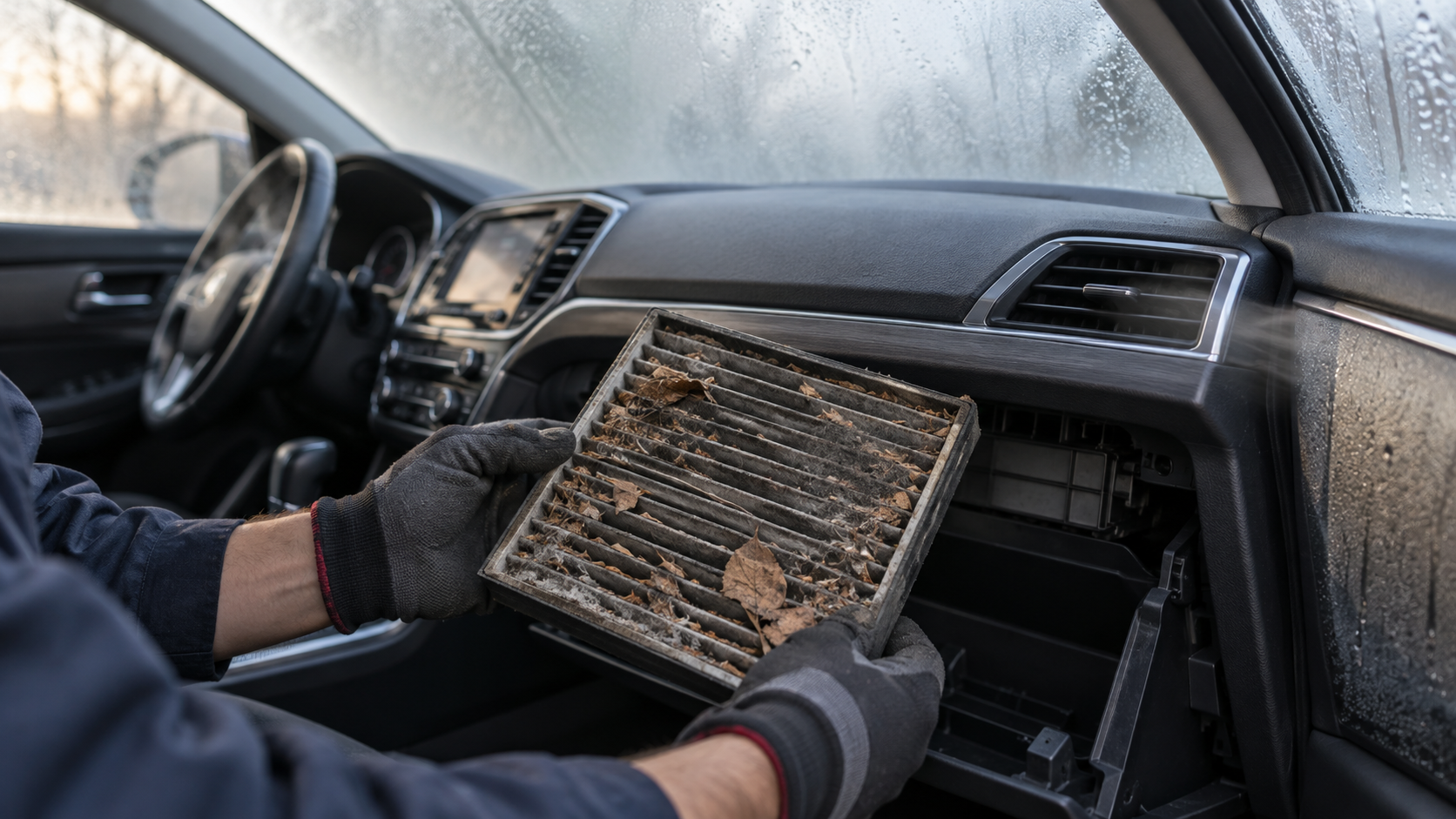
It is an autumn evening. Rain is falling outside, water is being carried onto the floor mats on wet shoes, three people are sitting in the cabin, and after a few minutes the edges of the windscreen begin to mist over. The driver turns the blower from speed two to speed four, but something feels strange: the blower motor becomes much louder, yet the airflow from the vents does not seem to increase very much. For a few seconds, there is also a faint damp, dusty smell.
The first thought is usually not the filter. Perhaps the blower motor is getting old. Maybe the air-conditioning system is low on refrigerant. Perhaps the automatic climate control has simply started behaving strangely. But sometimes the cause is a much simpler component — one that many drivers remember only when a mechanic pulls it out from beneath the dashboard and places it next to a new one.
On one side lies a clean, light-coloured filter with straight pleats. On the other is a dark-grey element with fragments of leaves, fine dust, insects and sometimes traces of moisture trapped between its folds. At that point it becomes obvious that all the air the ventilation system has tried to pull into the cabin throughout the year has first had to make its way through this layer of contamination.
A cabin air filter is not as dramatic a component as a timing belt, turbocharger or battery. If you fail to replace it at exactly 2 p.m. on a Tuesday, the car will not suddenly stop at the side of the road. That is precisely why it is so easy to ignore. Yet its condition affects something the driver uses on every journey — the air inside the cabin, ventilation airflow, windscreen demisting and the operation of the climate-control system.
Quick answer
The cabin air-filter replacement interval should first be taken from the maintenance schedule for the specific vehicle. As a general guideline, filter manufacturers often mention around 15,000 km or one replacement per year, although the real interval depends on the vehicle and its operating conditions. If you drive frequently in cities, on dusty or gravel roads, park beneath trees or are particularly sensitive to pollen, it can make sense to inspect the filter earlier. Weak airflow, windows that fog frequently and unpleasant smells are all signs that the cabin filter is one of the first things worth checking.
A cabin filter will not make your car faster. But it can directly affect how clearly you see through the windscreen and what kind of air you breathe every day.
What exactly is a cabin air filter, and why does a car need one?
While you drive, the ventilation system continuously draws in air from outside. Along with that air comes much more than oxygen: road dust, pollen, particles from tyre and brake wear, soot, insects, tiny fragments of leaves and other contamination.
Without a filter, much of this material would enter the ventilation ducts and passenger compartment. That is why a filtering element is installed between the outside-air intake and the occupants. Depending on the vehicle, it may be located beneath the glovebox, behind the dashboard, underneath the plastic trim at the base of the windscreen on the engine-bay side, or somewhere else entirely.
Unlike an engine air filter, the cabin filter does not supply air to the engine. It filters the air used by the cabin ventilation, heating and air-conditioning system. A blocked cabin filter therefore does not normally cause engine power loss or directly increase fuel consumption in the way people sometimes imagine an engine intake filter might.
What it can affect very clearly is something else: the blower continues spinning, but forcing the same volume of air through an increasingly restricted filter becomes progressively more difficult.
Imagine putting an increasingly thick blanket in front of a fan
That is the easiest way to understand the problem created by a clogged cabin filter. When the element is clean, air can pass through the large surface area of its pleats with relatively little resistance. The blower does not need to work particularly hard to provide the required volume of air inside the car.
Over time, contamination accumulates between the pleats. The filter is still doing its job — in fact, its dirty appearance partly proves that it has actually trapped something. But eventually enough material can build up to begin restricting airflow.
The driver turns the blower higher. The motor spins faster and becomes louder, yet the increase in airflow from the vents no longer matches expectations. Automatic climate control may try to compensate by increasing blower speed, but even sophisticated electronics cannot bypass a physical obstruction.
A typical clue: you can hear the blower very clearly, but you can hardly feel the airflow. That does not prove the cabin filter is responsible, but it is one of the simplest and least expensive things to check.
Why can a clogged cabin filter contribute to fogged windows?
The cabin filter itself does not create water on the glass. That distinction matters because this problem is sometimes oversimplified into: “Replace the filter and the moisture will disappear.” If there is a puddle beneath the carpet or water is genuinely leaking into the cabin, a new filter will not remove that water.
A restricted filter can, however, reduce the amount of air the climate system is able to direct towards the windscreen. And once the glass has fogged, a sufficiently strong flow of warmer, drier air is one of the most important tools for restoring visibility.
Imagine two identical cars on the same rainy morning. Both have the same cabin humidity, the same temperature and the same climate system. One has a clean filter; the other's is so clogged that airflow is substantially reduced. When both drivers select the windscreen demist mode, the second vehicle simply has less air available to solve the problem.
If your car's windows fog very heavily and repeatedly, do not stop your investigation at the filter. For more about wet carpets, recirculation, water leaks and glass freezing on the inside, see “Car Windows Fog Up or Freeze on the Inside: How to Restore Visibility Quickly and Find the Source of Moisture”.
How often should the cabin air filter actually be replaced?
It is very easy to find one supposedly “correct” number online and begin applying it to every vehicle. But the best reference is always the maintenance schedule for the specific car.
As a broad practical guideline, filter manufacturers such as Bosch and MANN-FILTER commonly recommend checking the cabin filter and generally replacing it at around 15,000 kilometres or at least once per year. However, the manufacturer of your particular vehicle may specify a different interval, so a universal figure should never take priority over the vehicle's own service schedule.
And 15,000 kilometres are not always the same 15,000 kilometres. The life of a cabin filter is not determined only by the number on the odometer. What matters enormously is where those kilometres were driven.
| Operating conditions | What does this mean for the cabin filter? |
|---|---|
| Mainly clean paved roads | Following the vehicle manufacturer's intended service interval is normally sufficient. |
| A lot of city driving | The filter regularly operates in an environment containing traffic-related dust, soot and other particles. |
| Regular gravel-road driving | Dust loading can be much higher, so earlier inspection may be worthwhile. |
| The car is often parked beneath trees | Leaves, seeds and other organic debris can accumulate around the outside-air intake. |
| Heavy pollen season or pollen sensitivity | Filter quality and timely replacement may have greater practical importance for passenger comfort. |
Is it better to replace the filter in spring or autumn?
If the service schedule effectively calls for one replacement per year, a logical question follows: which season is best? There is no single perfect answer because the choice depends on what matters most to the driver.
Spring is a logical time if you want to begin the main pollen season with a fresh filter. That may be particularly relevant for people with allergies. Autumn, on the other hand, is an excellent time if your priority is having the best possible ventilation and windscreen-demisting performance before the cold, damp part of the year begins.
But the calendar is never more important than the actual condition of the filter. If you remove it in August after months of gravel-road driving and discover that it is packed with dust, there is little sense in saying: “I only replace mine in November.”
A good maintenance interval is not a sacred date on the calendar. It is a combination of the manufacturer's requirements, mileage and real operating conditions.
Standard filter, activated-carbon filter or “premium” filter — which should you choose?
When replacement time arrives, the parts catalogue often offers not one option but three or four. The cheapest may look like a simple pale filter. A more expensive one is darker and mentions activated carbon in the description. Another may promise additional protection from allergens, fine particles or microbial growth.
In simple terms, they can be divided into three main groups.
| Filter type | What does it mainly do? | Who might particularly benefit? |
|---|---|---|
| Standard particle / dust filter | Captures dust, pollen and other solid particles according to the design and efficiency of the specific filter. | Drivers who want a quality standard solution when the vehicle manufacturer does not specify anything more specialised. |
| Activated-carbon filter | In addition to particle filtration, an activated-carbon layer helps reduce certain smells and gaseous pollutants. | Particularly useful for city driving, traffic jams and drivers who are sensitive to exhaust smells. |
| Multilayer / allergen and fine-particle filter | Depending on the product, additional layers may target allergens, finer particles, smells or microbial growth. | People with allergies or drivers who want a higher level of cabin-air filtration. |
There is one important condition, however: more expensive does not automatically mean better for your particular car. The filter must match the dimensions, airflow requirements and installation position precisely. A good standard filter that seals perfectly inside its housing is far better than an incorrectly sized “premium” filter with impressive marketing claims.
Does an activated-carbon filter really remove smells?
It can help, but there is no magic involved. The activated-carbon layer can adsorb some gaseous pollutants and odour molecules. That means the effect of a quality carbon filter may be noticeable when following a smoky bus or sitting in dense traffic.
But if the cabin smells of mould every time the ventilation is switched on, a new activated-carbon filter may only reduce the symptom temporarily. The source could be inside the ventilation ducts, on the air-conditioning evaporator, in the drainage system or in damp interior trim.
This is an important principle throughout the subject: the filter cleans incoming air, but it cannot repair a dirty or permanently damp climate-control system.
7 signs that your cabin filter deserves attention
1. The blower is loud, but airflow is weak
This is one of the classic symptoms. On the first blower setting everything seems normal, but once you switch to the third or fourth setting, noise increases significantly while airflow rises much less than expected.
That does not mean the filter is the only possible culprit. There may be a problem with the blower motor, airflow-control flaps or ducting. But the cabin filter is a simple first place to look.
2. The windscreen takes longer to demist
If the windscreen mode used to clear the glass relatively quickly but now needs much longer, check the airflow. This is especially relevant if the blower sounds powerful while very little air actually reaches the glass.
3. A dusty or damp smell appears when ventilation is switched on
An old filter containing months of accumulated dust and organic material can contribute to unpleasant smells. If the filter has also been damp, the problem can become even more noticeable.
A strong mouldy smell can, however, also point to a contaminated evaporator or another moisture problem, so replacing the filter is not a universal cure for every odour.
4. The A/C seems cold, but there is not enough air in the cabin
The air-conditioning system may still be producing cold air correctly, but if the filter is severely restricting airflow, that cold air reaches the occupants too slowly. The driver may then feel that the air conditioning “is not as good as it used to be”.
This is a good example of why it can be sensible to begin with a basic airflow check before paying for more expensive air-conditioning diagnostics.
5. The replacement history is unknown
This is extremely common with used cars. The previous owner may have carefully kept every receipt for engine-oil changes, but that does not mean the cabin filter has not been forgotten for three years.
If you do not know when it was last changed, an inspection is usually the simplest answer.
6. You drive frequently on dusty roads
Cabin-filter loading is not determined by mileage alone. Ten kilometres behind another vehicle on a dry gravel road may expose the filter to more dust than a much longer journey on a clean motorway.
7. Pollen season is particularly noticeable inside the car
If you or your passengers suffer from allergies, filter quality and condition can become particularly relevant. A car is obviously not a sealed laboratory and doors still have to be opened, but effective filtration can reduce some of the particles entering through the ventilation system.
Can a very dirty filter damage the blower motor?
There is no reason to exaggerate and claim that every overdue filter will immediately burn out the blower motor. But a badly restricted filter changes airflow through the system and may cause the climate-control system to spend longer using higher blower speeds to achieve the desired result.
Ventilation-system designs differ between vehicles, so it would be misleading to promise identical technical consequences for every model. The basic argument is simpler: if a system was designed to operate within a particular airflow range, there is little sense in forcing it to work for years through an element that has clearly become an obstruction.
Does the cabin filter affect fuel consumption?
After discussing the engine air filter, it is natural to wonder about fuel consumption here as well. But with a cabin filter, the connection is even more indirect.
The cabin filter is not part of the engine intake. It does not restrict the air entering the cylinders and does not take part in forming the air-fuel mixture. A claim such as “I changed the cabin filter and saved one litre per 100 km” is therefore not technically credible as a direct effect of the filter itself.
The blower and climate-control system obviously consume energy, and every electrical load in a combustion-engined car ultimately contributes indirectly to alternator load. But the cabin filter should be replaced to restore the intended airflow and filtration, not as a fuel-saving trick.
In simple terms: the engine air filter works for the engine. The cabin filter works for the occupants and the climate-control system. They are two different components with two different jobs.
Can you blow the cabin filter clean and put it back?
The garage logic is tempting here too. The filter looks dusty, so remove it, shake it out, blast it with compressed air and reinstall it. Visually it becomes cleaner, and it feels as though money has been saved.
But a disposable filter element is not designed to be restored indefinitely. A strong jet of compressed air can damage the material or alter its structure, while simply shaking it removes mainly the larger surface debris rather than the fine particles already embedded inside the filter medium.
There is even less point trying to “restore” an activated-carbon filter. The carbon layer's ability to adsorb certain pollutants is not something that can be renewed at home simply by blowing dust out of the element.
Practical approach: if the filter is a disposable element and has reached its replacement interval, replace it. There is little value in experimenting with cleaning a component whose purpose is specifically to collect contamination.
What happens if the filter is installed backwards?
Many cabin filters have an arrow printed on the edge. This is where one of the most common DIY mistakes begins: someone sees the words AIR FLOW and automatically assumes that the arrow must point upwards.
In reality, an AIR FLOW arrow normally indicates the direction in which air passes through the filter, not which side is “up”. In one vehicle, air may flow from top to bottom; in another, the arrangement may be different. Some filters also use different markings, such as a specific indication showing which side should face upwards.
Before removing the old filter, it is therefore worth noting its orientation and checking the instructions supplied by the new filter manufacturer. Correct installation direction can be particularly important with multilayer and activated-carbon elements.
Why are there sometimes leaves and pine needles inside the filter housing?
On many cars, the outside-air intake is located near the lower edge of the windscreen. If the vehicle is often parked beneath trees, leaves, flowers, seeds and other debris can collect in this area. External grilles catch some of it, but smaller material may still reach the cabin-filter housing.
That is why replacing the filter should involve more than pulling the old element out and immediately pushing a new one in. Inspect the housing and, where safe access is possible, remove larger debris without pushing it farther into the ventilation system.
If the drainage channels around the outside-air intake are packed with leaves, some vehicles can also develop water-drainage problems. At that point, the issue is no longer just cabin-filter maintenance.
The filter is new but the smell remains — what is causing it?
This is a very common disappointment. The driver notices an unpleasant smell, buys an expensive activated-carbon filter, replaces it and for the first day everything seems better. A week later, the damp odour is back.
That suggests the filter was probably not the only source. The air-conditioning evaporator becomes cold during operation, causing moisture to condense on its surface. Under normal conditions, that water drains out of the vehicle. But if moisture and contamination remain in the system for long periods, conditions can develop that produce unpleasant smells.
Other possible causes include a blocked drain, damp interior trim, a water leak, contaminated ventilation ducts or even organic material trapped near the outside-air intake.
The cabin filter is therefore a first step, not a universal answer to every smell coming from the ventilation system.
Can the cabin filter be changed in five minutes on every car?
Unfortunately not. Some vehicles have an excellent design: open the glovebox, remove a small cover and the filter is immediately accessible. On other models, trim panels have to be removed, the glovebox must be released, the work has to be done in a painfully awkward position or the filter needs to be bent in a specific way simply to fit through the opening.
Some cars also use two-piece cabin filters, with two separate elements inserted into the housing one after another. If you do not know that, it is theoretically possible to replace only half of the complete filter assembly.
Before attempting the job yourself, check the procedure for your specific model. If access requires significant dashboard disassembly or there is a realistic chance of breaking fragile clips, allowing a workshop to do the job may be the easier option.
6 common mistakes when replacing a cabin filter yourself
- The filter is installed in the wrong direction. The AIR FLOW arrow is confused with an “up” marking.
- The wrong filter is purchased. The dimensions look similar, but the frame does not seal the housing properly or the element sits crooked.
- Dirt from the old filter falls into the ventilation duct. The element is pulled out too quickly and accumulated debris drops into the system.
- The new filter is crushed. To force it through a narrow opening, it is bent much more than the design allows.
- The filter cover is not properly refitted. Part of the airflow may bypass the filter or additional noise may appear.
- The new filter is expected to cure every smell and moisture problem. If the real source is the evaporator or a water leak, the problem will remain.
A five-minute check before autumn and winter
Ask yourself these questions
- Do you know when the cabin filter was last replaced?
- Has roughly a year passed, or has the manufacturer's specified interval been reached?
- Has the blower recently become louder while airflow has become weaker?
- Does the windscreen take longer to clear in damp weather than it used to?
- Is there a dusty or damp smell after switching on the ventilation?
- Does the car regularly use gravel roads or spend a lot of time parked beneath trees?
- Are you or your passengers particularly sensitive to pollen?
One “yes” answer does not mean the filter needs to be thrown away immediately. But if several of these points apply and the replacement history is unknown, an inspection is a very logical next step.
Mini test: replace it now or leave it for longer?
The filter is 10 months old and has covered only 8,000 km
If operating conditions are normal and the vehicle manufacturer specifies a longer interval, automatic replacement based only on mileage may not be necessary. Check the maintenance schedule and inspect the filter's actual condition.
The filter has covered only 7,000 km, but the car spent all summer on gravel roads
Mileage alone tells you very little here. Dusty operating conditions are a good reason to inspect the filter before the normal interval.
Airflow is weak, but the cabin filter is brand new
Check that the filter is correct for the car, installed in the proper direction and not distorted. If everything is correct, another ventilation-system problem should be investigated — the blower motor, airflow flaps, evaporator or ducting.
I changed the filter, but the mouldy smell remains
The filter was probably not the only cause. The evaporator area, condensation drain, cleanliness of the ventilation system and possible sources of moisture inside the cabin should be checked.
I do not even know whether my car has a cabin filter
Check the equipment specification and parts catalogue for your particular model. Most modern cars have one, but the design may differ on older vehicles and certain equipment versions.
Myths and facts
| Claim | Myth or fact? | Explanation |
|---|---|---|
| The cabin filter and engine air filter are the same thing. | Myth | The engine filter cleans intake air for the engine; the cabin filter cleans ventilation air for the occupants. |
| A clogged cabin filter can reduce ventilation airflow. | Fact | Accumulated contamination increases resistance to airflow. |
| A new cabin filter will always stop the windows fogging. | Myth | A new filter may improve airflow, but excess cabin moisture may still come from wet carpets, water leaks or incorrect use of recirculation mode. |
| An activated-carbon filter can reduce certain smells and gaseous pollutants. | Fact | The activated-carbon layer provides additional adsorption rather than only filtering solid particles. |
| The darker the filter, the more dangerous it automatically is. | Myth | Colour alone does not tell you the filter's airflow resistance or remaining capacity. |
| The filter may need to be replaced earlier in dusty conditions. | Fact | Real contamination loading can be much greater than under normal operating conditions. |
Frequently asked questions
How often should a cabin air filter be changed?
The exact interval should come from the vehicle manufacturer's maintenance schedule. Around 15,000 km or one replacement per year is often mentioned as a general guideline, although inspection may be needed sooner in dusty conditions.
Can a dirty cabin filter cause fogged windows?
It can contribute by reducing airflow towards the glass, but it is not the only possible cause. Cabin humidity, use of recirculation mode, air-conditioning performance and possible water leaks should also be considered.
Is an activated-carbon cabin filter better than a standard one?
It adds the ability to reduce certain smells and gaseous pollutants, which can be useful in urban traffic. However, filter quality and exact compatibility with the specific vehicle are more important than price alone.
Does the cabin filter affect air-conditioning performance?
A clogged filter can reduce airflow through the climate system, meaning less warm or cold air reaches the cabin. That does not automatically mean the A/C compressor itself is faulty.
Can you clean a cabin filter with compressed air?
A disposable filter is normally better replaced according to the manufacturer's requirements. Aggressive compressed-air cleaning can damage the filter medium, and it cannot restore the adsorption capacity of an activated-carbon layer.
Why does the ventilation still smell after fitting a new filter?
The source may be the air-conditioning evaporator, ventilation ducts, damp interior trim or the condensation-drain system. The cabin filter is only one possible source of odour.
Conclusion
The cabin filter is one of those components whose importance becomes most obvious only when it stops doing its job as effectively as before. As long as the blower works well, the windows demist quickly and there are no strange smells inside the car, the filter remains almost invisible. It simply works quietly somewhere behind the dashboard.
Yet on every journey it captures some of the material that might otherwise enter the ventilation system and passenger compartment: dust, pollen, soot, fragments of leaves and other contamination. That is exactly what it is supposed to do, and exactly why the filter becomes dirty with time.
The right approach is not to replace the filter every time it stops looking perfectly white, but neither should you wait until the blower at maximum speed can barely move a paper receipt sitting on the dashboard. Start with the maintenance schedule for your particular car, consider where you drive and pay attention to airflow.
If you regularly drive on dusty roads, inspect the filter more frequently. If allergies are an issue, consider a quality filter with an appropriate level of filtration. If most of your driving is in urban traffic and you dislike exhaust smells, an activated-carbon filter may be a practical upgrade.
Most importantly, do not treat the cabin filter as a universal cure for every climate-system problem. If a new filter does not improve airflow, the ventilation system needs further investigation. If a mouldy smell remains after replacement, the evaporator and sources of moisture should be checked. If the windows continue fogging constantly, you need to find where the water inside the cabin is coming from.
Good maintenance begins with exactly this kind of thinking: replace a simple service item when it genuinely needs replacing, but do not blame it for problems it is physically incapable of solving.
Driver's short takeaway: check the cabin-filter interval specified by your vehicle manufacturer; around 15,000 km or one replacement per year is often used as a general guideline. If the blower becomes louder, airflow weakens, the windscreen takes longer to demist or an unpleasant smell appears, the filter is one of the first things worth checking. But if the problem remains after fitting a new filter, continue looking — the cause may be elsewhere in the climate system or inside the cabin.
Sources and technical note
The technical information in this article was checked against Bosch Aftermarket and MANN-FILTER material covering cabin-filter function, replacement intervals, the effects of restriction on airflow, windscreen demisting and climate-control operation, as well as the differences between standard particle filters, activated-carbon filters and multilayer cabin filters. Bosch and MANN-FILTER use approximately 15,000 km or one replacement per year as a general guideline, but the maintenance schedule for the specific vehicle should always take priority.