
 LV
 EN
 RU
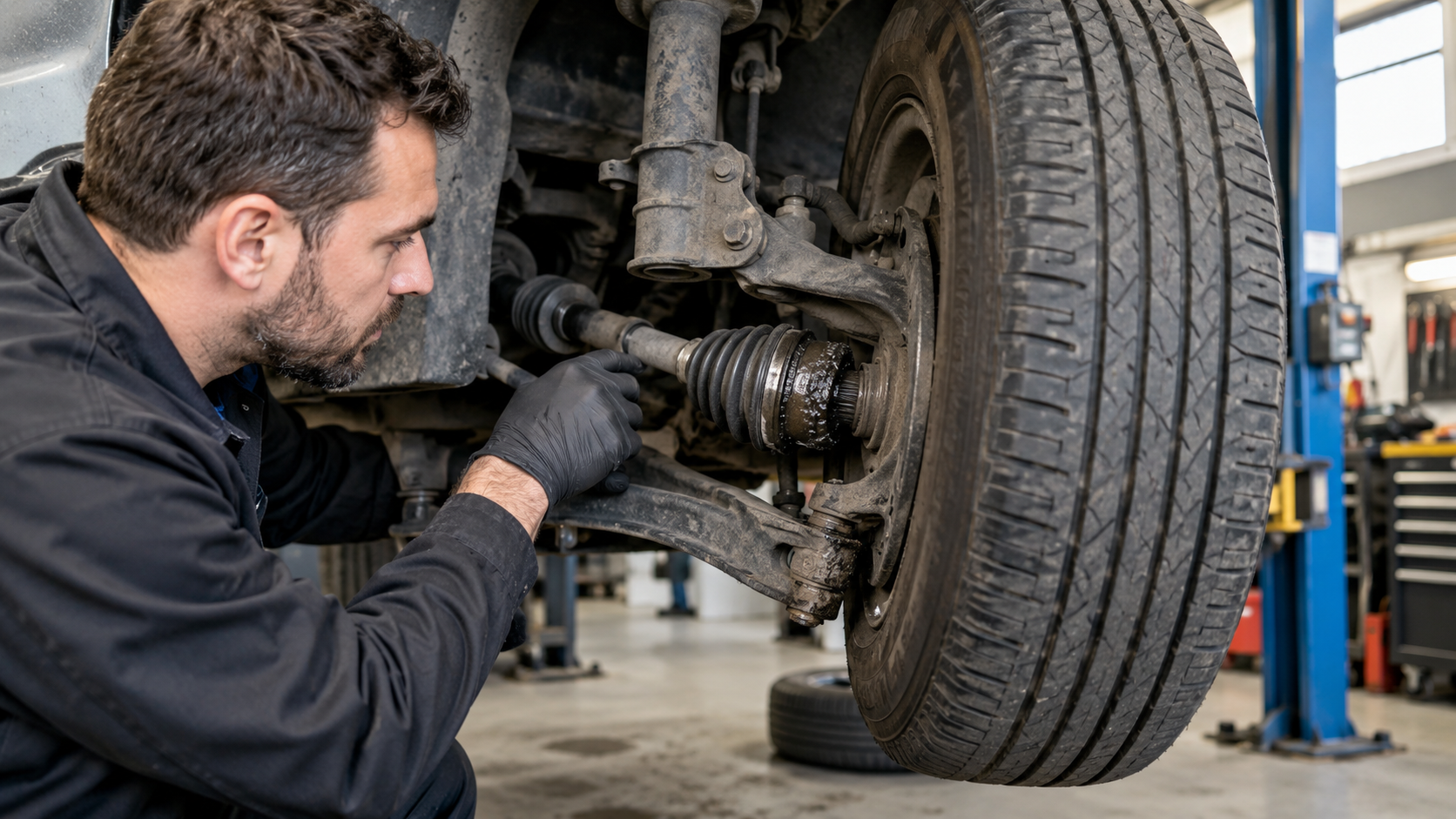
At first, the noise appears only in one very specific situation. You slowly pull out of a parking space, turn the steering wheel almost to full lock, gently press the accelerator and hear a rhythmic “click-click-click-click” from somewhere near one front wheel. As soon as you straighten the steering wheel, the sound disappears. On the motorway nothing hums, the steering wheel does not vibrate and the car feels completely normal.
A few weeks later the clicking becomes louder. Now you can hear it not only in a car park but also when turning through an intersection. It becomes especially noticeable if you apply a little more throttle while turning.
Online, the diagnosis seems almost unanimous: “The CV joint is finished.”
In everyday language, drivers may refer to the CV joint simply as the “joint”, while some languages use nicknames such as “grenade”. Technically, it is a constant-velocity joint, and rhythmic clicking while turning really is one of the classic symptoms of wear in an outer CV joint.
But “classic” does not mean “the only possible cause”.
A similar sound can come from a ball joint. A tie-rod end. A strut-top mount. A strut bearing. A wheel bearing usually hums rather than clicks, but a badly worn assembly can create other noises as well. A brake dust shield can touch the disc. A small stone can become trapped between the shield and the rotor. Meanwhile, a loud clunk when applying and releasing the accelerator may come not from the outer CV joint at all but from the inner joint, an engine mount or excessive driveline play.
There is one more very important detail that is often ignored: does the noise appear only while the car is moving, or can you reproduce it while the car is stationary simply by turning the steering wheel?
A CV joint transmits torque and rotates together with the driveshaft. If the vehicle is standing still and the wheels are not rotating, repeated cracking or popping while you only turn the steering wheel is much less typical of the CV joint itself. In that situation the strut-top bearing, spring, ball joint, tie-rod end and steering mechanism become much more interesting.
This is therefore one of those symptoms that can be diagnosed surprisingly logically if every sound is not automatically given the same name.
Quick answer
A repeated rhythmic click or crack that becomes more obvious during a slow turn while power is being applied very often points towards the outer CV joint. By contrast, vibration or shaking specifically under acceleration, especially while travelling straight, can more often involve the inner CV joint. A humming or growling noise that increases with road speed and changes while cornering is more typical of a wheel bearing. If the noise can also be reproduced while the vehicle is stationary and you simply turn the steering wheel, check the strut-top mount and bearing, spring, ball joints, tie-rod ends and steering mechanism as well. A torn CV boot does not automatically mean the joint is already ruined — if the damage is found before the joint begins clicking and contamination has not damaged its working surfaces, replacing the boot and lubricant in time may still save the joint.
The most useful diagnostic question is not “is it the CV joint?”, but “exactly when does the noise appear — while turning, accelerating, lifting off the throttle, driving over bumps or turning the steering wheel while stationary?”.
What exactly are a driveshaft and a CV joint?
In everyday conversation, “driveshaft”, “CV”, “joint” and similar terms are sometimes used almost interchangeably, although technically they do not describe exactly the same thing.
The driveshaft transfers torque from the transmission or differential to the wheel. On many vehicles with independent suspension, CV joints are installed at the ends of the driveshaft so torque can still be transmitted while the wheel angle and suspension position change.
On a front-wheel-drive car, each front driveshaft will typically have an inner and an outer joint. Four-wheel-drive vehicles and cars with driven independent rear suspension can also use CV joints at the rear.
GKN Automotive explains that the inner CV joint in many designs is a so-called plunge joint, allowing axial movement so the effective driveshaft length can change as the suspension moves up and down. The outer joint on a steered axle, meanwhile, must transmit torque at a much larger operating angle because it turns together with the wheel.
This difference is the main reason outer and inner CV-joint faults often produce different symptoms.
Outer versus inner CV joint — the symptoms are not the same
| Symptom | What it more often suggests checking |
|---|---|
| Repeated “click-click-click” in a slow turn under power | Outer CV joint |
| Shaking or vibration specifically while accelerating | Inner CV/plunge joint, although engine mounts and other driveline components also need to be ruled out |
| One clunk when applying or releasing the accelerator | Inner-joint play, driveline backlash, engine/transmission mounts |
| Humming or growling that increases with vehicle speed | More often wheel bearing, tyre or another rotating component |
| Cracking while the vehicle is stationary and only the steering wheel is being turned | Strut-top mount/bearing, spring, ball joint, tie-rod end or steering mechanism |
| Grease thrown around the inside of the wheel | Torn or loose CV boot — inspect immediately |
| Vibration only at 90–120 km/h regardless of throttle | Far more often tyres, wheels or balancing than a CV joint |
1. Worn outer CV joint — the classic “click-click-click” sound
If there were one symptom most strongly associated with a CV joint, it would be rhythmic clicking while turning.
The outer joint sits close to the wheel and, on a front-wheel-drive car, operates at a large angle while the wheels are turned. Once the joint's internal running surfaces wear, the balls and their tracks no longer transmit load perfectly smoothly. Under torque, a repeating mechanical noise can develop, with its frequency increasing as the wheel rotates faster.
That creates a very typical pattern: the steering wheel is turned, the vehicle is moving slowly, the accelerator is slightly pressed and a regular “click-click-click” comes from the wheel area.
The greater the operating angle and the driveline load, the more obvious the noise may become.
TrakMotive technical guidance specifically associates repeated clicking or popping while turning with a worn or damaged outer CV joint.
However, it should not be turned into an absolute rule. Before ordering parts, inspect the boot, assess play and check the surrounding suspension components to make sure the sound really comes from the joint.
Can you identify the failed side from the direction of the turn?
Online advice often presents simple rules: if it clicks while turning left, the right side is bad; if it clicks while turning right, the left side is bad. In reality, load distribution, driveshaft geometry, suspension design and the way sound travels through the body can make the situation less straightforward.
The direction of the turn is therefore a clue, not enough evidence by itself to order a driveshaft for one particular side.
2. Torn CV boot — the moment when the joint may still be saved
The working surfaces of a CV joint operate in special grease and are protected by a flexible rubber or thermoplastic boot. This apparently simple component performs two extremely important jobs: it keeps the lubricant inside and keeps water, sand, dust and road salt outside.
GKN Automotive describes the sealing system as a critical part of overall driveshaft service life.
The boot flexes constantly. The outer boot is additionally deformed every time the steering angle changes. Over the years the material ages and can crack, while stones, installation errors or other mechanical damage can also split it.
Once the boot tears, centrifugal force begins throwing grease onto the wheel arch, strut, suspension and inner surface of the wheel. At the same time, water and abrasive contamination can enter the joint.
And this is where there can be a major financial difference.
If the torn boot is discovered early, the joint is still quiet, there is no significant play and the internal running surfaces have not been damaged, it may be possible in many cases to clean the joint properly, refill it with the correct grease and install a new boot.
If it has already been driven for months nearly dry and full of dirt, and it now clicks loudly in turns, a new boot cannot restore worn metal working surfaces.
A CV boot is inexpensive compared with a complete driveshaft — but only if the damage is found before the joint itself is destroyed.
3. Worn inner CV joint — more likely to vibrate than click in a turn
This is where one of the most valuable diagnostic distinctions begins.
The inner CV joint sits closer to the gearbox or differential. In many front-wheel-drive layouts it is an axially sliding or plunge-type joint that compensates for effective driveshaft-length changes as the suspension moves.
When wear develops in this joint, a much more typical symptom can be shaking or vibration at the moment the engine is asked to transmit substantial torque.
For example, at 70 km/h the car rolls perfectly smoothly. Then you press the accelerator to increase speed to 100 km/h and a strong vibration begins through the body. As soon as you release the accelerator, it almost disappears.
That is a very different pattern from an imbalanced wheel, where the vibration is usually linked more closely to a particular road-speed range regardless of whether the engine is pulling strongly at that moment.
TrakMotive notes that play in CV joints can cause vibration under acceleration, with the inner plunge joint being particularly relevant. Similar symptoms can also be caused by an intermediate-shaft bearing and engine mounts.
Therefore, one of the key questions when diagnosing an inner CV joint is: is the vibration controlled by road speed or by driveline load?
If the car actually jerks, hesitates or loses power during acceleration, engine and transmission causes also need to be considered. For those, see “Car Jerks When Accelerating: How to Tell Whether the Problem Is Spark Plugs, Coils, Injectors, Turbo or Transmission”.
4. Intermediate shaft, its bearing or connection
Not every front-wheel-drive layout simply uses two identical short driveshafts running directly from the transmission to the wheels. Some cars use an intermediate shaft and support bearing on one side.
If the bearing, connection or splines in this assembly wear, the result can be clunks, vibration or driveline play that is easily blamed on the driveshaft itself.
This becomes especially interesting when vibration appears under acceleration or a clunk occurs during load changes, while the outer CV joint remains quiet during turns.
TrakMotive technical information separately identifies the intermediate-shaft bearing as a possible source of noise and vibration that can be confused with CV-joint problems.
So sometimes the complete driveshaft is not the part that needs replacing. The specific component with play needs to be identified first.
5. Wheel bearing — more likely to hum or growl than click rhythmically
A wheel bearing is one of the most common “CV-joint lookalikes”, but mainly when the driver describes every wheel-area sound using one general word.
A worn wheel bearing more typically produces a hum, growl or steady roaring sound that changes with vehicle speed. The noise can also change through corners because bearing load changes.
MOOG lists humming, rumbling or growling that increases with acceleration or changes while turning among typical worn wheel-bearing symptoms, along with vibration, looseness and in some cases ABS-related problems.
That is very different from the outer CV joint's repeated “click-click-click” under load at a large steering angle.
However, sound transmission through a vehicle body can be misleading. The driver may be convinced that the right-front wheel is humming, only for the workshop to find that the left or even a rear bearing is actually responsible.
For that reason, the rule “I turned left and it became louder, therefore the right bearing is definitely bad” should not be treated as absolute proof.
For more on wheel bearings and other running-gear noises, see “Car Clunking, Humming or Wandering on the Road: How to Tell Apart Shock Absorber, Bushing, Ball Joint, Tie-Rod and Wheel-Bearing Problems”.
6. A ball joint or tie-rod end can also clunk while turning
The front suspension and steering system move in several directions at the same time. The ball joint allows the steering knuckle to move with both suspension travel and steering input, while the tie-rod end transfers steering-rack movement to the wheel.
If excessive play develops in either connection, the noise may be a short clunk or knock, particularly when load changes, the wheel is steered or the suspension travels over an uneven surface.
MOOG lists clunking or squeaking, less precise steering and uneven tyre wear among possible symptoms of a worn ball joint.
One useful distinction is that a CV joint often creates a repeated rhythmic sound with every wheel revolution, while a ball joint or steering joint more often gives an individual clunk, crack or squeak during a particular suspension or steering movement.
Significant ball-joint play is also a safety issue rather than merely an annoying noise. A sound accompanied by steering play, wandering or unusual tyre wear should therefore not be ignored.
7. Strut-top mount or bearing — especially if it cracks while stationary
On many MacPherson-type front suspensions, the strut assembly turns together with the steered wheel. The upper mount includes components that allow this movement to happen smoothly.
If the upper bearing begins to bind, the spring can twist as the steering is turned and then release suddenly. The driver may hear a crack, pop or snap and sometimes feel a small kick through the steering wheel.
This creates a very useful difference from a typical CV-joint fault: the noise can be present even when the vehicle is completely stationary and the steering wheel is simply turned from side to side.
At that moment the CV joint is not rotating as it does when the vehicle is moving, so repeated cracking while stationary shifts attention much more strongly towards steering and suspension components.
8. Brake dust shield, trapped stone or another brake component
Not every metallic click near a wheel means an expensive driveline repair.
A thin dust shield sits behind the brake disc. After an impact, previous repair or corrosion, it can become slightly bent and begin touching the rotor only at certain wheel or steering positions.
A small stone can also become trapped between the disc and shield. This may produce a scraping, chirping or periodic metallic sound that changes while turning.
A brake component that is not secured correctly can also make a clunk when the direction of travel changes or the brakes are applied.
The timing is particularly useful if the sound began immediately after brake, wheel-bearing, driveshaft or suspension work. That does not automatically prove an installation error, but the workshop should definitely know about the timing.
9. Engine/transmission mount or driveline play — one clunk rather than a whole series of clicks
Sometimes a driver says “the driveshaft is clicking”, but in reality the sound occurs only once — at the moment the accelerator is pressed, released or the transmission is shifted from R to D.
That is a different symptom.
Excessive play in an inner CV joint can cause such a clunk, but engine and transmission mounts, differential play and other driveline connections also need to be considered.
If an engine mount is badly softened or torn, the powertrain can move more than intended when torque changes and create a noticeable knock. This also changes driveshaft working angles and, in some designs, can worsen an existing inner-CV vibration.
A single “clunk” during a load change and a rhythmic “click-click-click” while driving in a circle are therefore not the same diagnostic story.
Why does an outer CV joint click specifically while turning?
While travelling straight, the outer CV joint generally works at a relatively small angle. Turn the steering wheel and that angle increases. If its internal tracks are already worn, the balls are loaded more heavily in areas where the wear becomes much more noticeable.
That is why a joint can remain completely quiet for a long time on the motorway yet click loudly while manoeuvring in a car park.
It also explains why the sound often becomes more obvious when the car is gently accelerated through the turn. The larger joint angle is now combined with higher torque.
Why does a CV joint wear out in the first place?
A CV joint can last a very long time under normal operating conditions. One of its greatest enemies is not simply mileage but lubricant loss and contamination.
The boot tears. Grease is thrown out. Sand, water and road debris enter. Metal surfaces that should operate inside a thick protective lubricant begin working with abrasive contamination.
NAPA explains that once a boot is damaged, grease loss is followed by moisture and dirt entering the joint, accelerating wear considerably. TrakMotive likewise notes that CV running-surface wear is often related to grease loss from a damaged boot or debris entering the joint.
CV joints can also be damaged by very aggressive driving, altered suspension geometry, an incorrect driveshaft, poor installation or other conditions that force the shaft to operate outside its intended angle or plunge range.
Can you replace only the CV joint, or does the whole driveshaft need replacing?
There is no single answer for every vehicle.
For some models, high-quality outer and inner CV joints are available separately together with boot kits and the required hardware. In other situations, replacing the complete driveshaft assembly may be more economical or technically practical.
The decision depends on parts availability, the condition of the shaft itself, labour cost, the condition of the second boot, play in the other joint and the quality of replacement parts available.
If the only fault is a recently cracked boot and the joint itself is in excellent condition, replacing the complete shaft may be unnecessary.
If the joint is already clicking loudly, simply installing a new boot and grease will usually not restore worn internal surfaces.
Can you just add more grease?
If the joint has not yet been damaged and the problem is a boot caught early enough, a proper repair can involve removing contaminated old grease, inspecting and cleaning the joint, then filling it with the correct lubricant before installing a new boot.
But “inject some grease through the split” is not the same repair.
Once the boot is open, lubricant quantity is no longer the only issue. The joint is no longer sealed and continues to take in water and dirt.
And if the joint is already clicking because its tracks are worn, even perfect fresh grease cannot rebuild missing metal.
Does vibration at 100 km/h mean the driveshaft is faulty?
Not necessarily — and quite often, no.
If vibration begins within a particular road-speed range, such as 90–110 km/h, and remains almost unchanged whether you accelerate, coast or lightly lift off the throttle, much more typical causes are wheel imbalance, a deformed tyre or a bent wheel.
TrakMotive specifically notes that vibration which simply increases with vehicle speed is rarely caused by a CV-joint problem; tyres and wheels are more common suspects.
A CV joint becomes far more interesting when the vibration is closely connected with torque: press the accelerator and it shakes; release it and the vibration decreases substantially.
For more on speed-related vibration, see “Steering Wheel Vibrates at 90–120 km/h: How to Distinguish Tyre, Wheel, Balancing, Brake and Suspension Problems”.
What can you check yourself without taking the car apart?
- Notice whether the noise appears only while moving. If it also cracks while the car is stationary and you only turn the steering wheel, the outer CV joint is no longer the only or even the leading suspect.
- Notice whether the sound is rhythmic. A repeated “click-click-click” linked to wheel rotation is more typical of a CV joint than one isolated knock.
- Compare acceleration with coasting. Does the noise or vibration become much stronger precisely when the driveshaft is transmitting torque?
- Inspect the CV boots. Look for cracks, splits, loose clamps and fresh grease around the boot.
- Inspect the inside of the wheel and wheel arch. Dark grease thrown outward in a radial pattern is a strong clue that a rotating CV boot has failed.
- Listen for humming. A steady growl that increases with speed makes a wheel bearing a serious suspect.
- Think about recent repairs. If the symptom began after wheel-bearing, driveshaft, brake or suspension work, tell the workshop.
- Never crawl under a car supported only by a jack. Physical play checks underneath a raised vehicle require secure support and appropriate knowledge.
Should you deliberately drive in circles to test a CV joint?
Workshops often evaluate an outer CV joint by performing low-speed manoeuvres with the wheels turned and listening to how the noise changes under light load.
But this should not be turned into an aggressive “test” in a public car park with full steering lock and heavy throttle.
If the joint is already badly worn, additional load does not help it. More importantly, safe diagnosis matters far more than producing the loudest possible click.
If you need to reproduce the symptom, do so only at very low speed in a safe empty area — or allow the workshop to perform the test.
Can you keep driving with a clicking CV joint?
There is no responsible formula such as “it will definitely be safe for another 5,000 km”.
Clicking means the joint's working surfaces already have wear or damage. It may continue functioning for some time, but the rate at which the problem develops depends on the level of wear, lubricant condition, amount of contamination, driving style, load and the design of the particular joint.
If a driveshaft joint or shaft fails completely, the vehicle can lose the ability to transmit torque to the affected driven wheel and may become undriveable. In some failures, the damaged assembly may also harm nearby components.
An early quiet click is therefore not automatically the same emergency as losing braking or having a wheel attachment fail, but it should not be postponed until the next inspection six months later.
In practical terms: if the CV joint is already clicking, arrange diagnosis and repair soon. Until then, avoid aggressive acceleration with the steering on full lock, hard launches and unnecessary driveline load.
When should you stop driving?
Stop and do not treat the problem as “just a little clicking” if:
- the clicking suddenly becomes extremely loud or turns into heavy metallic banging;
- severe vibration appears or the vehicle begins shaking even at low speed;
- there is a loud clunk when accelerating and the vehicle no longer accelerates normally;
- noticeable wheel or steering play appears;
- the driveshaft assembly is visibly damaged, displaced or partly disconnected;
- strong noise, vibration or an ABS warning appears immediately after repair work;
- there is reason to suspect a dangerously worn ball joint, wheel bearing or another component responsible for keeping the wheel in its intended position.
It is particularly important not to label every noise as a CV-joint problem. If the real cause is a severely worn ball joint or wheel bearing, the safety implications may be different and potentially much more urgent.
How should a workshop diagnose clicking from the driveshaft area?
A good workshop begins with the driver's description.
Does it click only in a turn? In which direction? Only under throttle? Does it also click while coasting? Does the vibration appear only under acceleration? Can the car make the noise while stationary and the steering wheel is turned? Is there grease visible on the inside of the wheel?
The symptom can then be reproduced safely during a road test.
On a lift, the technician inspects both inner and outer boots, clamps, lubricant loss and mechanical damage. Joint play is evaluated, but the wheel bearing, ball joints, steering connections, strut mounts and nearby components should also be checked.
If the complaint is vibration under acceleration, the inner joints, intermediate-shaft bearing and engine/transmission mounts also deserve attention.
If the problem appeared immediately after driveshaft replacement, the fitment and quality of the replacement part, driveshaft length, splines, fastener torque and installation should also be considered.
That is much safer than automatically ordering a CV joint after hearing the first click.
Mini test: which component seems most likely?
While pulling out of a parking space with the steering heavily turned and light throttle applied, the front of the car produces a rhythmic “click-click-click”. It is silent when travelling straight.
The outer CV joint is one of the first and most likely components to inspect. Its boot, grease loss and the driveshaft itself should also be checked before ordering parts.
At 80 km/h the car is smooth. Press the accelerator and the whole body starts vibrating. Release the accelerator and the vibration almost disappears.
The inner CV/plunge joint, intermediate-shaft bearing and engine or transmission mounts become particularly interesting. Wheel imbalance is usually not so closely linked to accelerator position.
The inside of the wheel is covered with dark sticky grease, but there is still no clicking while turning.
A damaged boot or boot clamp is highly likely. This is exactly the time to act because the joint itself may still be healthy. The longer it operates with grease loss and contamination, the less likely it is that boot replacement alone will be enough.
A steady humming begins at 70 km/h, gets louder with speed and changes tone in corners.
A wheel bearing is much more interesting than a classic outer-CV fault. Tyre noise and other rotating components should also be checked.
The car is completely stationary, but while turning the steering wheel from lock to lock you hear cracking from the front and the spring seems to “jump”.
The strut-top mount/bearing and spring seat become much more likely than a CV joint. Ball joints and steering connections should also be inspected.
One loud clunk occurs after shifting from R to D, but there is no rhythmic clicking in turns.
Check inner-joint and overall driveline play, together with engine and transmission mounts. This is not the classic outer-CV sound pattern.
Myths and facts
| Claim | Myth or fact? | Explanation |
|---|---|---|
| Rhythmic clicking while turning often points towards an outer CV joint. | Fact | Especially when the sound becomes more obvious at a large steering angle and under driveline load. |
| Any cracking sound while turning the steering wheel means the CV joint is bad. | Myth | Similar noises can come from strut mounts, ball joints, steering joints, brake components and other parts. |
| If it cracks while the vehicle is stationary, a CV-joint fault becomes less likely. | Fact | The CV joint is not rotating as it does while driving, so steering and suspension components deserve more attention. |
| A torn CV boot automatically means the complete driveshaft must be replaced. | Myth | If the damage is caught early and the joint has not worn or become badly contaminated, a boot and grease service may be sufficient. |
| If the joint already clicks loudly, new grease will repair it. | Myth | Grease cannot restore worn tracks, balls or other metal working surfaces. |
| Vibration under acceleration can come from the inner CV joint. | Fact | Especially when vibration is strongest under torque and decreases substantially as soon as the accelerator is released. |
| Vibration at 100 km/h always means a driveshaft problem. | Myth | Tyres, wheels and wheel balancing are much more common causes of vibration linked mainly to road speed. |
Frequently asked questions
What does a bad outer CV joint sound like?
A classic symptom is repeated rhythmic clicking or cracking during a slow turn, especially with the wheels heavily turned while the car is also accelerating. The suspension, wheel bearing and CV boot should still be checked before replacing parts.
What does a bad inner CV joint sound or feel like?
An inner joint more often causes vibration or shaking under acceleration and sometimes a clunk as driveline load changes rather than classic rhythmic clicking in a turn. Engine/transmission mounts and intermediate-shaft bearings can create similar symptoms.
Can I drive with a clicking CV joint?
Clicking already indicates wear, so there is no universal mileage that can be guaranteed safe. With a mild early symptom, it may usually be possible to drive carefully to a workshop, but the repair should not be postponed for a long time. If the sound suddenly becomes very loud, severe vibration appears or normal drive is lost, stop driving.
Does a torn CV boot mean the whole joint must be replaced?
Not necessarily. If the boot was damaged recently, the joint is still quiet and its working surfaces have not become contaminated or worn, professional cleaning, fresh grease of the correct type and a new boot may be enough. Once the joint begins clicking, the damage is usually further advanced.
Can a wheel bearing sound like a CV joint?
Both sounds can seem to come from the same wheel area, but a wheel bearing more typically produces humming, growling or roaring that changes with speed and cornering load. An outer CV joint more typically produces repeated clicking while turning under power.
Why do I hear cracking while turning the steering wheel with the car stationary?
If the vehicle is not moving, consider the strut-top mount and bearing, spring, ball joint, tie-rod end or another steering/suspension component. That pattern is less typical of a classic outer CV-joint fault.
Do you need a wheel alignment after replacing a CV joint or driveshaft?
It depends on the vehicle and which suspension or steering components had to be disconnected during the repair. Replacing a driveshaft alone does not necessarily alter wheel geometry, but if alignment-related joints were disturbed or the car already had uneven tyre wear or handling problems, checking alignment can be sensible.
Do four-wheel-drive cars also use CV joints?
Yes. CV joints are not limited to front-wheel-drive vehicles. They are also used in four-wheel-drive systems and driven independent rear suspension where torque has to be transmitted while suspension and wheel positions continue to change.
Conclusion
Rhythmic clicking while turning is one of those car symptoms where popular garage diagnosis is surprisingly often pointed in the right direction.
Yes — if the car is moving, the wheels are heavily turned, torque is being applied and a repeated “click-click-click” comes from the wheel area, the outer CV joint really is one of the first components to inspect.
But proper diagnosis begins after that conclusion rather than ending with it.
Outer and inner CV joints perform different jobs, and they therefore tend to announce wear differently. An outer joint typically clicks at a large steering angle. An inner joint more often creates vibration under load or a clunk when torque changes.
If the vehicle simply hums more loudly as road speed increases, the wheel bearing becomes more interesting. If it cracks while stationary and you only turn the steering wheel, attention moves towards the strut-top mount, spring, ball joint and steering connections. If there is one clunk while shifting from R to D, driveline play and powertrain mounts need to be checked.
It is also extremely important to look at the CV boot.
In fact, this is often the most financially valuable moment in the entire life of the joint. If you see a crack or grease on the inside of the wheel but the joint has not yet started clicking, the fault may have been found early enough to save the more expensive component.
Ignore that stage and the grease leaves while water, dust and sand enter. The internal running surfaces then begin to wear, and eventually the familiar clicking appears.
At that point a new boot is no longer a time machine. It can seal the joint again, but it cannot restore metal that has already worn away.
That is why one of the cheapest parts in a CV-joint assembly can sometimes be the most important: the boot found and replaced in time.
Another important principle is not to wait until clicking becomes heavy banging. There is no universal figure for how many thousands of kilometres a worn joint will still survive. One may remain noisy for a long time, while another progresses much more quickly after grease loss and contamination.
If the symptom is mild, the vehicle usually does not have to be abandoned at the roadside after the first quiet click, but diagnosis should not be postponed. The earlier the exact source is identified, the better the chance of avoiding both a more expensive chain of repairs and a situation in which the vehicle can no longer continue its journey.
So the next time you hear “click-click-click” while leaving a parking space, listen to more than the sound itself. Notice the steering angle. Is the accelerator pressed? Does the noise repeat with wheel rotation? Does it disappear while driving straight? Is vibration present only under load? Is grease visible around the wheel?
Those few details often reveal far more about the fault than the word “clicking” alone.
Driver's short takeaway: rhythmic clicking in a slow turn under throttle often points towards the outer CV joint. Vibration that appears specifically under acceleration and largely disappears when the accelerator is released makes the inner CV joint, intermediate-shaft bearing and powertrain mounts more interesting. Humming that increases with road speed is more typical of a wheel bearing, while cracking that can be reproduced with the car stationary simply by turning the steering wheel points more towards the strut-top mount, spring or steering/suspension joints. If you see CV grease on the inside of the wheel, do not delay inspecting the boot: before the joint begins clicking, it may still be possible to save it. Once a joint is already clicking loudly, fresh grease cannot repair worn metal. Rapidly increasing noise, severe vibration, major play or loss of drive are reasons to stop driving.
Sources and technical note
The technical information in this article was checked against GKN Automotive material covering outer and inner CV-joint design, plunge-joint function and the importance of CV boots; TrakMotive technical information covering outer-joint clicking in turns, inner-joint clunks and acceleration-related vibration, intermediate-shaft bearings and the distinction between driveline and wheel-speed vibration; NAPA technical information covering CV-boot damage, grease loss and contamination-related wear; and MOOG material covering wheel-bearing, ball-joint and steering/suspension noises. The exact joint design, acceptable play, required lubricant, driveshaft fastener torque and repair procedure must always be taken from the technical documentation for the specific vehicle.