
 LV
 EN
 RU
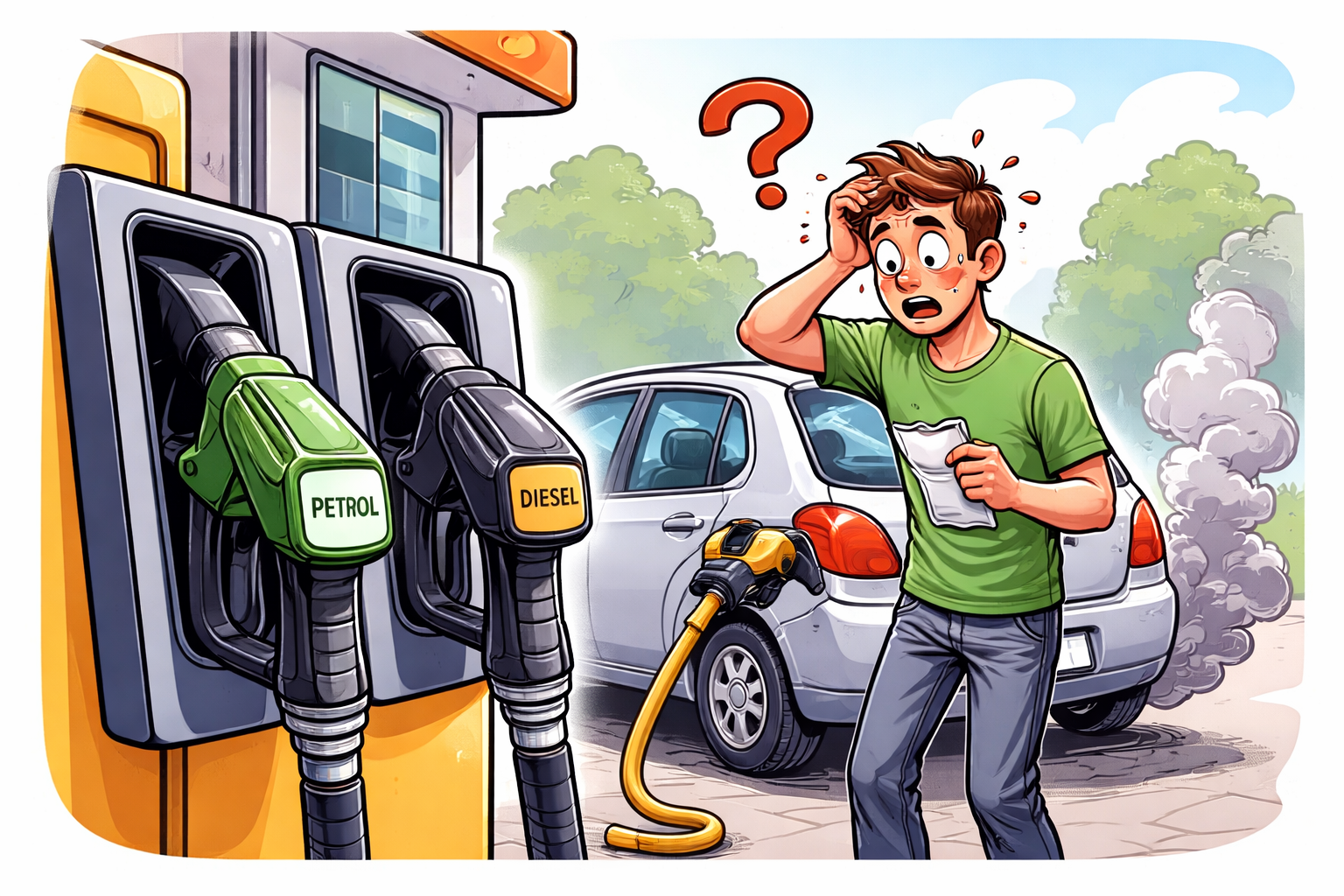
Putting the wrong fuel in a car is one of those mistakes that many drivers think would never happen to them — until it actually does. In most cases, it happens because of stress, fatigue, habit, distraction, or simply because someone is driving an unfamiliar car. One moment everything seems normal, and the next moment panic sets in: what now, and how much is this going to cost?
This mistake is actually more common than many people think. It happens to experienced drivers, new drivers, people using rental cars, and families with multiple vehicles that use different types of fuel. It is exactly the kind of error that can happen in just a few seconds.
The most important thing in this situation is not panic, but the correct reaction. The first few minutes after the mistake often determine whether the problem ends with a fuel drain and a system flush, or with an expensive repair involving the fuel system and, in the worst cases, the engine itself.
In this article, we will look at what happens if diesel is put into a petrol car, what happens if petrol is put into a diesel car, what to do immediately, what you should never do, what kind of damage may happen, and how repair shops usually handle this kind of situation.
Why the wrong fuel can be so dangerous
At first glance, fuel may seem like just a liquid that “feeds” the engine, but petrol and diesel are very different in how they behave. Each engine is designed for a specific type of fuel, and the entire system — from the fuel pump to the injectors and the combustion process inside the cylinders — is built around those exact properties.
A petrol engine relies on a spark from the spark plugs, while a diesel engine depends on compression and heat to ignite the fuel. That means the wrong fuel does not just reduce efficiency — it can interfere with the basic operating principle of the engine.
Modern fuel systems are also far more precise and sensitive than many drivers realise. This is especially true for modern diesel engines with common rail systems, where injection components operate under extremely high pressure and very tight tolerances. Because of that, one simple fueling mistake can sometimes cause damage that older cars might have tolerated much better.
What happens if you put diesel in a petrol car
If diesel is put into a petrol car, the situation is unpleasant, but in some cases it can be a little less destructive than the opposite mistake. Diesel is heavier, oilier, and burns differently from petrol. A petrol engine is simply not designed to run on it.
If the wrong fuel has been added but the engine has not yet been started, the situation can often be solved relatively simply by draining the tank and cleaning the system. In this case, the most important rule is not to turn the key further, not to press the start button, and not to try “just for a second” to see whether the car still runs.
If the engine is started, diesel begins moving through the fuel system and into the combustion process. The car may then become difficult to start, run unevenly, shake, produce smoke, lose power, or stall altogether. In some cases the result is limited to draining and cleaning the system, but in other cases spark plugs, the catalytic converter and parts of the fuel system may also be affected.
One Toyota petrol car owner said: “I grabbed the black nozzle instead of the green one because I was in a hurry. After a few kilometers the car started vibrating strangely and losing power. The repair shop said I was lucky the engine was not seriously damaged.”
The more diesel that was added and the longer the car has been driven, the greater the chance that the repair will become more expensive. If the tank already had a lot of petrol in it and only a small amount of diesel was added, the consequences can sometimes be milder, but that is still not a reason to take the risk and keep driving.
What happens if you put petrol in a diesel car
This is usually considered the more dangerous mistake. Diesel fuel does not only burn — it also lubricates parts of the fuel system. Petrol does not provide that kind of lubrication, and that is where the biggest problem begins.
If petrol enters a diesel fuel system, especially in a modern common rail engine, it can reduce lubrication inside the high-pressure fuel pump and injectors. As a result, those components start rubbing and wearing much faster than they should. If the engine is started and the car is driven, the damage can become extremely expensive.
At first, the symptoms may be subtle — rougher engine sound, hesitation, reduced pulling power, warning lights, or uneven running. But after that, the fuel pump may fail, the injectors may be damaged, and metal particles may contaminate the entire fuel system, which is exactly the kind of scenario that turns a simple mistake into a major repair bill.
A service advisor once explained: “If petrol is put into a diesel car and the driver keeps going, the cost can become very unpleasant. Sometimes it ends with draining the tank, but sometimes the pump, injectors and the entire fuel system need to be cleaned or replaced.”
That is why, if there is any suspicion that petrol has been put into a diesel car, the safest option is not to start the engine at all. If the engine has already been started, it is best to shut it off as soon as possible and call roadside assistance or a repair shop.
What happens if you notice the mistake immediately at the pump
This is the best possible scenario. If the driver notices the mistake immediately, while still refueling or right after refueling, and the engine has not been started, the situation can often be resolved without serious consequences.
At that point, the most important thing is not to switch on the ignition. In many cars, even turning the ignition on without starting the engine can activate the fuel pump and begin circulating the fuel through the system. The less time the wrong fuel has had to move beyond the tank, the better.
In most of these cases, the usual solution is to drain the tank, sometimes flush the system as a precaution, and then refill with the correct fuel. Compared with major fuel system repairs, this is much cheaper and much simpler.
What happens if the engine has already been started and the car has been driven
Once the engine has been started, the situation becomes much riskier. The wrong fuel no longer stays only in the tank — it begins moving through the fuel lines, the pump, the filter, the injectors, and eventually into the engine itself. That means the potential for damage becomes much broader.
Sometimes the car starts behaving strangely almost immediately — loss of power, vibration, smoke, rough running or unusual engine noise. In other cases, the driver may still manage to drive for several kilometers before realising something is wrong. Unfortunately, those “just a few extra kilometers” are often what make the repair much more expensive.
If the car has already started moving with the wrong fuel, the safest action is to stop, switch the engine off, and not restart it. The idea of “maybe I can make it to the workshop myself” often sounds cheaper, but in reality it can make the final repair bill far worse.
What you should never do
One of the most common mistakes is to panic and think: “I’ll just dilute it with the correct fuel and it will be fine.” With some older cars and simpler fuel systems, people sometimes share lucky stories online, but with modern vehicles this can be a very risky gamble.
You should also be careful with random advice from the internet if it does not take into account your exact engine type and fuel system. What ended without major damage for one driver may cost another one thousands.
- do not start the engine if you noticed the mistake immediately
- do not try to “dilute” the wrong fuel with the correct one
- do not keep driving and hope the problem will disappear
- do not ignore the first warning signs if the car starts running badly
What a repair shop usually does
Repair shops usually approach the situation based on two main factors — whether the engine has been started, and which type of wrong fuel was added. If the engine has not been run, draining the tank and cleaning the system is often enough.
If the car has already been driven, the work becomes more serious. The tank may need to be drained, the fuel lines and filter may need cleaning, the system may need flushing, and in some cases the pump and injectors may need to be tested or replaced.
In the worst cases — especially in modern diesel vehicles — the damage can require a very extensive repair. If a high-pressure pump has failed and metal particles have spread through the system, the cost can rise dramatically.
| Situation | Possible solution | Cost level |
|---|---|---|
| Wrong fuel added, engine not started | Drain tank and clean system | Relatively low |
| Engine started, car driven briefly | Drain tank, flush system, replace filter | Medium |
| Diesel car driven longer with petrol | Major fuel system repair | High |
Real-life stories and common situations
Many stories begin in a very similar way — the driver is in a hurry, thinking about work, talking on the phone, refueling an unfamiliar car, or simply picking up the wrong nozzle out of habit. Routine is often the real enemy in situations like this.
Kristaps: “I was driving my wife’s petrol car, but my own everyday car is a diesel. At the fuel station I picked the wrong nozzle automatically. Luckily, I noticed before starting the engine, and the whole thing ended with just draining the tank.”
Andra: “I was abroad with a rental car, tired, late at night, at an unfamiliar fuel station. I put petrol into a diesel car. I drove a few kilometers before the car started jerking. After that, it was a tow truck and a very unpleasant bill.”
These examples show something important: this is not a “stupid mistake that only happens to careless people.” It is a very human error, which is exactly why it helps to know how to react correctly.
How to avoid making this mistake in the future
The simplest way is to create a conscious pause before picking up the fuel nozzle. Even if the car is familiar, one second spent checking the label on the fuel cap or in the dashboard area can save a lot of money and stress.
If your household has multiple cars with different fuel types, it is worth being especially careful. The same applies to rental cars, company vehicles, and any situation where you are driving a car you do not normally use.
Some drivers place a small reminder near the fuel cap or inside the car. It may sound simple, but small habits often prevent expensive mistakes.
Conclusion
If the wrong fuel has been put into a car, the most important thing is not panic, but the right response. If the mistake is caught immediately and the engine has not been started, the consequences can often be kept to a minimum. If the car has already been driven, the risk becomes much greater, especially in diesel vehicles.
The main rule is simple: do not start the engine, do not keep driving, and get professional help as quickly as possible. In these situations, just a few minutes of correct action can mean saving hundreds or even thousands of euros.
If you want to better plan your everyday fuel costs and trips, use the fuel calculator below.