
 LV
 EN
 RU
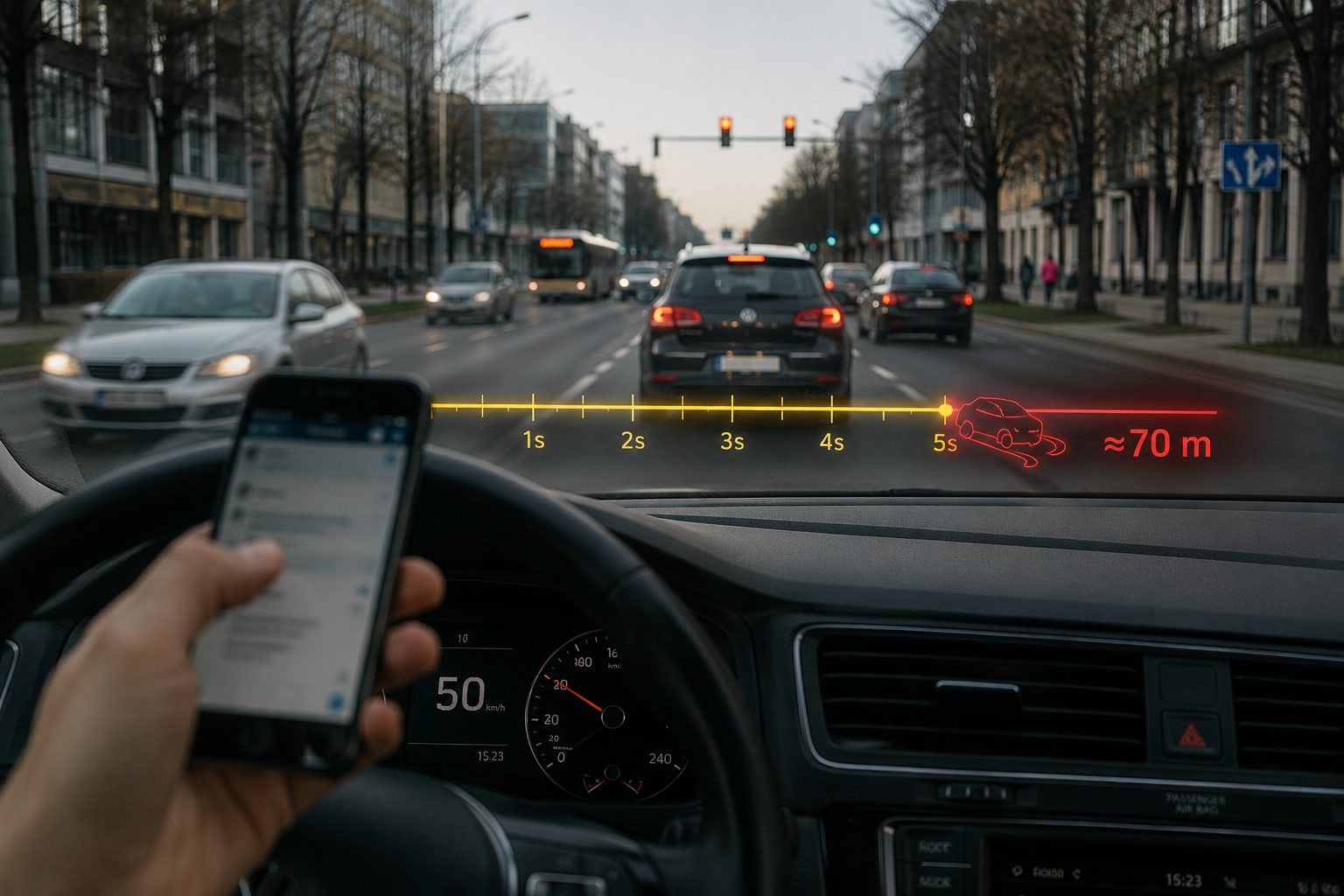
The phone beeps at exactly the moment when the journey feels most uneventful.
The road ahead is straight, traffic is flowing smoothly, both hands are on the steering wheel and nothing appears dangerous. Only a few words appear on the screen. The driver thinks: “I will just take a quick look.”
The driver’s eyes drop towards the phone. One second to see who sent the message. Another to read it. A third to realise that the text continues. A fourth to tap the notification. A fifth to return their eyes to the road.
To the driver, it feels like a moment.
To the car, it is not a moment.
At 50 km/h, it travels almost 70 metres during those five seconds. At 90 km/h, it covers 125 metres. At 110 km/h, approximately 153 metres.
Within that distance, a pedestrian may appear, the car ahead may stop, a cyclist may emerge from a driveway, an animal may run onto the road or an oncoming vehicle may begin turning across the lane.
Most importantly, the driver travels through that entire section of road without fully seeing it.
The driver’s brief conclusion: the most dangerous thing about a phone is not that it occupies one hand. The real danger is that, for several seconds, it takes away your eyes, your thoughts and your ability to understand what is happening on the road in time.
One second is not “nothing”
In everyday life, one second feels almost impossible to measure. We do not experience it as a period in which anything significant could happen.
Inside a moving car, time becomes distance.
13.9 m
in one second at 50 km/h
25 m
in one second at 90 km/h
30.6 m
in one second at 110 km/h
Even the single second needed to check who is calling represents 25 metres at 90 km/h.
Three seconds represent 75 metres. Five seconds represent 125 metres.
Looking at the phone is not the only time that is lost. After returning their eyes to the road, the driver’s brain still has to understand what has changed, identify any danger and choose an appropriate response.
A five-second distraction therefore does not necessarily mean that the driver is fully in control again during the sixth second.
Attention can be lost in four different ways
When people discuss phone use behind the wheel, they often think only about the hands. If both hands are on the steering wheel, everything may appear to be fine.
In reality, distraction can be visual, physical, cognitive or auditory.
Visual distraction
The eyes are looking at a screen, navigation, a passenger or the vehicle’s controls rather than the road.
Physical distraction
A hand leaves the steering wheel to pick up a phone, cup, cable, bag or another object.
Cognitive distraction
The eyes may be on the road, but the mind is occupied by a conversation, argument, work problem or received message.
Auditory distraction
A loud conversation, headphones or audio content may mask sirens, horns and vehicle warnings.
A written phone message often combines at least three forms of distraction at the same time: the eyes are not on the road, one hand is not on the wheel and the mind is focused on the text.
This is why reading a message is considerably more dangerous than pressing a single familiar button to activate a function that has already been prepared.
What does Latvian law prohibit?
In Latvia, a driver is prohibited from using a phone, tablet, laptop or another smart device while the vehicle is moving, except in hands-free mode.
The restriction does not apply only to holding a phone against the ear. Writing messages, checking social media, watching videos, holding the phone for navigation or performing other actions with a device while moving may also constitute an offence.
A car driver may receive a fine of between EUR 25 and EUR 100 and one penalty point for this offence.
An important distinction: the direct wording of the law applies while the vehicle is moving.
That does not mean using a phone at a red light is a good idea. As soon as the queue begins moving while the phone is still in the driver’s hand, the vehicle is already in motion. A delayed start and a pedestrian who goes unnoticed can create a dangerous situation even at a low speed.
The safest legal and practical boundary is simple: when the phone must be held, find a suitable place to stop safely and complete the required task.
A traffic jam, a slowly moving queue or waiting in a line at an intersection is not the same as being safely parked.
Hands-free is more legal, not automatically safe
When the phone is in a holder and the conversation takes place through the vehicle’s speakers, physical and visual distraction is generally reduced.
The conversation still occupies part of the driver’s mental attention.
Conversations that require a decision, remembering details, arguing, explaining a complicated problem or reacting emotionally can be particularly distracting.
A driver may look directly at the vehicle ahead without noticing that it has begun braking. They may see a pedestrian crossing but fail to process that a person is already stepping onto the road.
This happens because seeing something and consciously understanding it are not the same thing.
A useful practical rule:
• a calm, brief call may be accepted in hands-free mode when traffic conditions are simple;
• a complex conversation should be postponed;
• the call should be ended in heavy traffic, at intersections, while overtaking or in poor visibility.
A passenger inside the car can see the traffic and will usually become quiet when the situation becomes complicated. The person at the other end of a phone call cannot see the road and may continue asking questions during the most dangerous moment.
Why is a notification so difficult to resist?
A phone creates the impression that every notification is urgent.
The message may be from a family member, employer, bank, customer or friend. Until it is opened, the brain attempts to fill in the unknown and creates an urge to check it.
The driver does not always pick up the phone because the message is genuinely important. It is often an automatic movement trained over many years.
The phone beeps. The hand reaches out. The screen lights up. The eyes drop towards it.
This habit becomes particularly dangerous on familiar roads because the driver believes they already know what lies beyond the next bend or intersection.
A familiar road does not mean predictable traffic.
What do three seconds do to the stopping distance?
Imagine a vehicle travelling at 90 km/h on a dry, level road.
An obstacle appears on the road. A fully attentive driver notices it, reacts in approximately one second and begins braking firmly.
In this illustrative example, the vehicle travels approximately 25 metres during the reaction time, while braking under good-grip conditions requires another 45 metres. The total stopping distance is around 70 metres.
Now suppose that the driver is reading a notification for three seconds when the obstacle appears.
During those three seconds, the vehicle travels 75 metres. The driver then still has to understand the situation, react and only afterwards begin braking.
Instead of stopping in approximately 70 metres, the vehicle may require around 145 metres.
An even more sobering way to view it is this: the attentive driver would already have stopped, while the driver looking at the phone would only just be beginning to understand what had happened at the same location.
Navigation is useful, but adjusting it while driving is not harmless
Many drivers do not use a phone behind the wheel for messaging. They only check the map, look for the next turn or attempt to change the route.
The problem is that operating navigation often requires several steps: looking at the screen, finding a button, moving the map, entering an address, selecting a result and confirming the route.
That is not a single tap. It can become a sequence of tasks lasting ten or twenty seconds.
A safer navigation routine:
1. Enter the destination before beginning to move.
2. Place the phone in a stable holder that does not obstruct visibility.
3. Enable voice instructions at an appropriate volume.
4. Stop safely if the route must be changed manually.
5. Ask a passenger to operate the screen when travelling with someone else.
Missing a turn is not an emergency. Navigation will almost always create an alternative route.
Attempting to change lanes at the final moment while looking at the map is a much more expensive risk than driving an additional two kilometres.
A large vehicle screen can become a phone mounted on the dashboard
In a modern vehicle, temperature settings, heated seats, driving modes, radio, navigation and sometimes even the direction of the ventilation airflow are controlled through a single touchscreen.
A driver may therefore fully comply with the rule against holding a phone while still spending several seconds looking at the central display.
From a road-safety perspective, the eyes do not care whether they are distracted by a phone or by the vehicle’s own screen.
The safest approach is to use physical buttons, steering-wheel controls, voice commands and prepared settings whenever possible.
If a function requires moving through several menus, it is better to change it while the vehicle is safely stopped.
A voice assistant reduces screen time but does not eliminate thinking
A voice command can be a useful alternative to typing an address or searching for a contact.
Voice systems may still misunderstand words, offer several results or request additional confirmation.
The driver begins listening to whether the system understood correctly, thinks about the next command and sometimes looks at the screen anyway.
Voice control is therefore a safer tool only when the task is brief and the driver is prepared to abandon it if the traffic situation becomes complicated.
The vehicle does not have to complete the command on the first attempt. The driver must always remain focused on the road.
The phone is not the only thief of attention
A coffee cup, food, a dropped object, a loud conversation, a child in the rear seat, a pet, make-up, a cigarette or even a complicated radio discussion can distract the driver.
The difference is that a phone combines almost every possible distraction within one device.
It can ring, vibrate, flash and display text, video, maps, work correspondence and emotionally charged notifications.
It is also almost always within arm’s reach.
A passenger can help — or become another screen
A helpful passenger can find an address, reply to a message, adjust the temperature and warn the driver about a complicated situation.
A passenger can also show the driver a video, demand that they look at a photograph immediately or involve them in an emotional argument.
A simple rule among family members or friends can be extremely valuable: do not show a screen to someone who is driving.
When the information is important, the passenger can describe it verbally or ask the driver to stop safely.
A child in the car: when stopping is the only correct choice
A crying child in the rear seat can distract a driver much more strongly than a phone.
The driver may attempt to look backwards, hand over a toy, find a bottle or replace a fallen blanket.
Some of these actions simply cannot be performed safely while driving.
The best solution is not to attempt to become a better driver and a better parent simultaneously. The best solution is to stop safely and resolve the situation.
The speed is lower in the city, but there are more surprises
At 30 or 50 km/h, a car travels a shorter distance in several seconds than it does on a motorway.
Cities, however, contain many more pedestrians, cyclists, scooters, buses, traffic lights, driveways and sudden lane changes.
A pedestrian can emerge from behind a parked vehicle only a few metres ahead.
The statement “I was only driving at thirty” is therefore not a safety guarantee.
The road may feel calmer on a motorway, but the consequences become greater
On a motorway or main road, a driver may remain in the same lane for a long time and feel as though nothing is happening.
This monotony creates the temptation to check the phone, change a song or answer a message.
At 90 km/h, however, the vehicle travels 25 metres every second. At 110 km/h, it travels more than 30 metres.
When the vehicle ahead brakes suddenly, an oncoming car enters the lane or an animal steps onto the road, there may no longer be enough distance to recover the lost seconds.
A dangerous situation rarely begins with one major mistake
A collision is often created by a chain of several small circumstances.
The driver is following slightly too closely.
The speed is ten kilometres per hour higher than would be safe in the circumstances.
The tyres are partly worn.
The road is wet.
The phone beeps.
The driver looks away for only two seconds.
None of these factors necessarily causes a crash by itself.
Together, they remove distance, visibility, reaction time and grip at exactly the same moment.
Myths that make phone use more dangerous
“I am only looking, not typing.”
Looking still removes visual attention. Reading information on the screen requires both time and mental processing.
“I know this road well.”
You know the road, but not the next pedestrian, dog, pothole or mistake made by another driver.
“My car has automatic emergency braking.”
AEB may help, but its capabilities depend on speed, sensors, weather and the type of obstacle. It is not permission to stop watching the road.
“I am good at multitasking.”
The brain often does not perform everything simultaneously. It switches rapidly between tasks, losing part of its attention during every switch.
“Nothing can happen at a red light.”
The light may turn green, the queue may begin moving, a pedestrian may appear or an emergency vehicle may approach. The driver returns to traffic with a delayed and incomplete understanding of the situation.
Seven-day experiment: how often does your phone really call for attention?
For one week, enable “Do Not Disturb While Driving” before every journey and place the phone so that its screen is not visible.
After each journey, check how many notifications arrived and how many genuinely required an immediate response.
Many drivers discover that almost every message could have waited for ten, twenty or forty minutes.
The purpose of the experiment is not to prove that the phone is unnecessary. It is to distinguish genuine urgency from the habit of responding immediately to every sound.
Mini test: how much road do you lose?
Answer before checking the correct responses:
1. How many metres does a car travel in one second at 90 km/h?
2. How many metres does it travel in five seconds at 50 km/h?
3. Does a hands-free conversation completely eliminate distraction?
4. May you hold a phone while the car is slowly moving in a traffic jam?
5. Does automatic emergency braking guarantee that a collision will be avoided?
6. Which is safer — missing a turn or moving the map while driving?
7. Can a loud, emotional conversation distract a driver even when both hands are on the wheel?
8. What is the potential fine for using a smart device while moving?
Correct answers: 1 — 25 metres; 2 — approximately 69 metres; 3 — no; 4 — no, because the vehicle is moving; 5 — no; 6 — missing the turn; 7 — yes; 8 — between EUR 25 and EUR 100 and one penalty point.
A twenty-second ritual before driving
Safe phone use begins not during the journey but a few seconds before it.
1. Route
Enter the address and review the first turns.
2. Phone position
Place it in a holder or somewhere outside easy reach.
3. Notifications
Enable driving mode or Do Not Disturb.
4. Audio
Choose music or a podcast before beginning to move.
When the phone is inside a pocket, bag or dedicated compartment, the decision to pick it up becomes more deliberate.
When the screen is directly visible and every notification lights up, the driver must make a new decision almost every time a message arrives.
The safest habit is to create an environment in which there is no need to fight temptation continuously.
What should you do when the call really is urgent?
Not every call can wait until the destination.
Using hands-free mode, briefly explain that you are driving and will call back when you can stop safely.
When the conversation concerns a health problem, a child, a collision or another emergency, find a safe place to stop.
Hazard warning lights do not make stopping in a prohibited or dangerous location safe. Leave the active carriageway and choose a car park, petrol station or another suitable location.
A silent phone does not mean wasted time
Many people use the car as a transition between work and home.
When the journey is filled with calls, voice messages and correspondence, the brain receives no opportunity to switch from one part of the day to the next.
Putting the phone away may not only improve safety but also make the journey calmer.
Sometimes twenty minutes without notifications is more valuable than one more hurried reply.
May I use a phone when it is mounted in a holder?
A holder removes the need to hold the phone, but it does not make prolonged typing, moving the map or searching through menus safe. Listening to prepared voice directions is very different from actively operating the screen.
May I write a message at a red light?
The direct prohibition in the Latvian Road Traffic Law is worded in relation to a vehicle that is moving. However, using a phone at traffic lights creates delayed reactions and the risk of continuing the activity when the vehicle begins moving. It is safer to postpone the message or stop in a suitable location.
Is checking a smartwatch safer?
A smartwatch may require a shorter glance, but the driver still has to move their eyes, turn their wrist and read a small screen. This may be especially awkward and dangerous during a manoeuvre.
Is a single screen tap always dangerous?
The risk depends on traffic conditions, the location of the control and the duration of the glance. Pressing one familiar physical button is not the same as searching for a small icon in a menu. The less time the eyes spend away from the road, the better.
Are headphones a good idea while driving?
Headphones may reduce the ability to hear sirens, horns and noises produced by the vehicle. Even when a particular use is not directly prohibited, using the vehicle’s speakers at a sensible volume is safer.
Can the police issue a fine for holding a phone when I am not writing a message?
The prohibition concerns using a phone or smart device while moving, not only using a specific application. Claiming that the driver was merely checking the time or holding the device does not automatically exclude an offence.
Will automatic emergency braking protect me if I am looking at my phone?
It may reduce the collision risk or impact force, but it does not recognise every obstacle under every condition and cannot always stop the vehicle completely. The system is an additional safety reserve, not a replacement for the driver’s attention.
Can I set up an automatic reply for callers?
Yes. Many phones offer a driving mode that silences notifications and sends an automatic reply explaining that you are currently driving. It should be configured before the journey.
Is briefly checking the phone in a traffic jam really dangerous?
Speeds are lower in a traffic jam, but vehicles frequently stop and begin moving suddenly. A driver may hit the vehicle ahead, fail to notice a motorcycle moving between lanes or continue using the phone after the queue begins moving.
What is the easiest way to stop using a phone behind the wheel?
Do not rely entirely on self-control. Enable driving mode, hide notifications, enter the route in advance and place the phone somewhere that cannot be reached easily. Changing the environment often changes the habit more effectively than promising yourself, “I will not look this time.”
Conclusion: the message can wait, but the road may not
Phone use behind the wheel appears harmless precisely because nothing bad happens on most occasions.
The driver reads a message, changes a song, checks the map and successfully continues the journey.
These successful experiences create false confidence that the skill is sufficient and the risk is under control.
The traffic situation in which that one lost second is needed does not announce itself in advance.
In five seconds, a car may travel an entire city block at urban speeds and more than the length of a football pitch on a main road.
A notification that appeared urgent will often seem completely ordinary ten minutes later. A pedestrian, braking vehicle or obstacle on the road cannot wait.
The safest driver is therefore not the person who is best at steering and using a phone simultaneously. It is the person who has developed the habit of never picking up the phone while driving.
The main conclusion for drivers: at 90 km/h, one second represents 25 metres and five seconds represent 125 metres of road travelled without the driver’s full attention. No message is important enough to justify covering that distance while looking at a screen.