
 LV
 EN
 RU
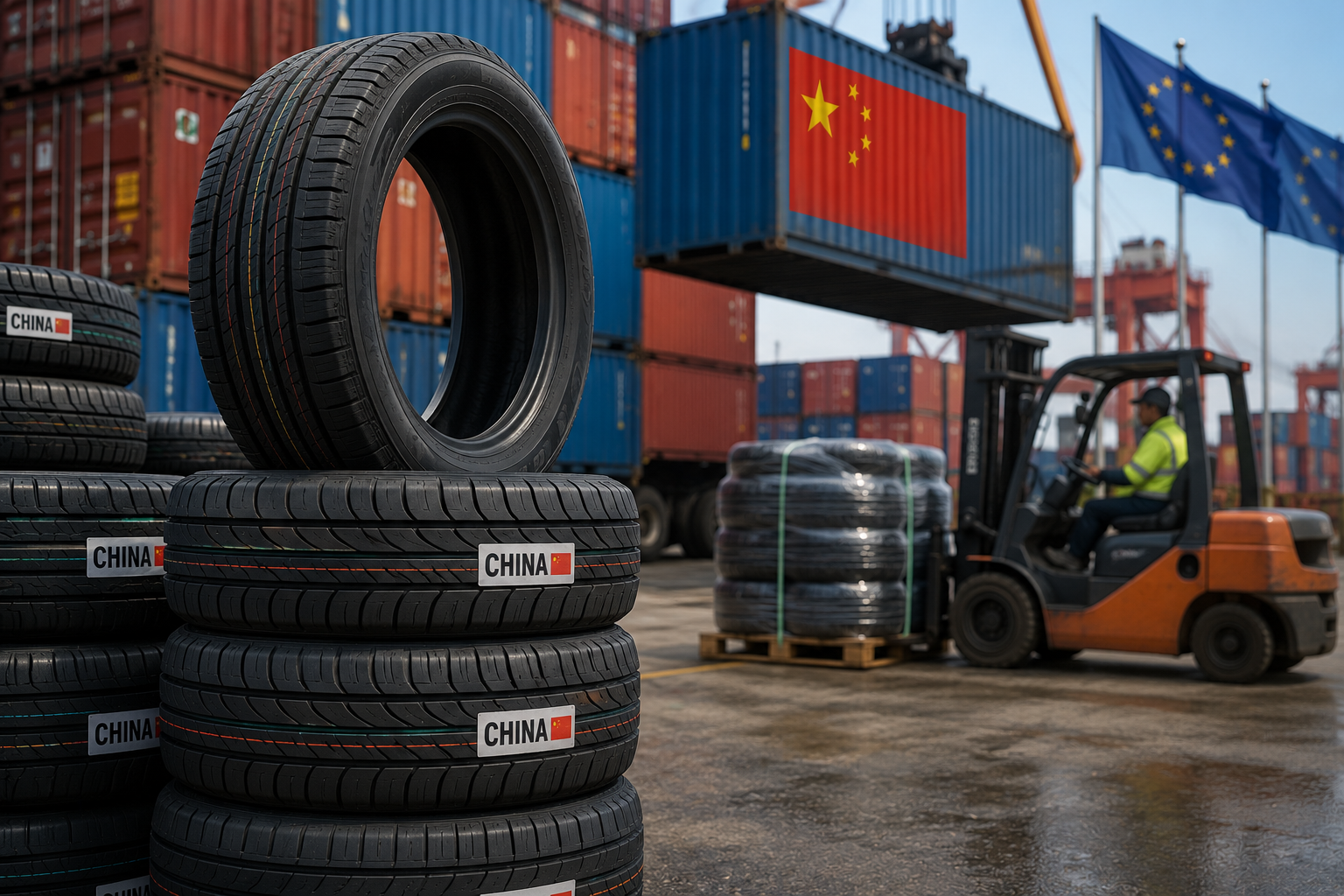
Information checked on 29 July 2026. Since 7 July 2026, definitive EU anti-dumping duties have been in force on new passenger-car and light-commercial-vehicle tyres originating in China. A separate anti-subsidy investigation is continuing and may change the overall level of trade-defence measures. Before importing tyres directly, check the current TARIC code, the specific manufacturer and the required customs documentation.
The news sounds alarming: the European Union has imposed anti-dumping duties of up to 45.3% on Chinese tyres.
A driver who previously paid €250 or €350 for a budget set of tyres may reasonably ask whether the same set will cost €100 or even €200 more next season.
It is not quite that simple.
The anti-dumping duty is calculated from the tyre’s customs value at the European Union border, not from the final price displayed by a Latvian online retailer or tyre workshop. The rate is also not identical for every manufacturer.
One group of Chinese factories faces a rate of 4.3%, many cooperating manufacturers face 24.4%, while the highest rate is 45.3%.
The words “Made in China” do not reveal the entire picture either. A tyre from an international brand may be produced in China, Europe, Korea, Türkiye or another country. Two tyres of the same brand and size may come from different factories and have different customs treatment.

The short conclusion: prices of China-made tyres in Latvia may increase, but not necessarily by 45.3%. The increase may be small for some tyres, seasonal discounts may disappear for others, while complete cost pass-through in the highest-rate category could be very noticeable.
What exactly is an anti-dumping duty?
An anti-dumping duty is not a penalty simply because a tyre was made in China, and it is not an ordinary consumption tax.
In trade law, dumping means that a product is exported to another market at a price below its comparable normal value.
The European Commission’s investigation concluded that tyres originating in China were being sold in the European Union at dumped prices and were causing injury to the EU tyre industry.
| Type of charge | What does it mean? |
|---|---|
| Standard import duty | The EU common customs tariff charged when a product is imported from a non-EU country |
| Anti-dumping duty | An additional trade-defence measure intended to offset the price advantage created by dumping |
| Countervailing or anti-subsidy duty | A measure that may be imposed when imported goods gain an unfair advantage from foreign subsidies |
| VAT | A consumption tax; imports into Latvia are generally subject to 21% |
It is important to understand that the anti-dumping duty is added to other import costs. It is also included in the amount used to calculate import VAT.
What rates are currently in force?
| Manufacturer or group | Definitive anti-dumping duty | Practical meaning |
|---|---|---|
| Hankook group — specific Chinese factories | 4.3% | The lowest individual rate; it does not apply to every Hankook tyre regardless of origin |
| Other cooperating manufacturers listed in the regulation | 24.4% | The rate may be applied only when the correct manufacturer, additional TARIC code and valid invoice are provided |
| Shandong Yongsheng Rubber Group | 45.3% | The highest individual rate |
| All other imports originating in China | 45.3% | Applied when the manufacturer does not qualify for a lower individual or cooperating-company rate |
Documentation risk: when an importer cannot prove that the tyres were produced by a company qualifying for the 4.3% or 24.4% rate, customs may apply the 45.3% rate.
Which tyres are affected by the new duties?
The regulation applies to new pneumatic rubber tyres intended for:
• passenger cars, including estate cars and sports cars;
• buses;
• lorries when the tyre’s load index does not exceed 121.
The products currently fall under Combined Nomenclature codes 4011 10 00 and 4011 20 10.
| Tyre type | Does the new duty normally apply? |
|---|---|
| New China-origin passenger-car summer tyre | Yes |
| New China-origin winter tyre | Yes |
| New China-origin all-season tyre | Yes |
| Light-commercial-vehicle tyre with a load index of up to 121 | Yes |
| Used tyre | Not within the normal scope of this regulation |
| Retreaded tyre | Not within the scope of this new regulation |
| Heavy-lorry tyre with a load index above 121 | Not within the scope of this regulation |
| Motorcycle or bicycle tyre | Not within the scope of this regulation |
Heavy-bus and heavy-lorry tyres with a load index above 121 are already covered by a separate EU anti-dumping regime. The two sets of rules should therefore not be confused.
The brand is not the same as the country of origin
A driver may buy a tyre from a European, Korean or American brand that was actually manufactured in China.
The same tyre model from one brand may also be manufactured at different factories depending on the size.
| Situation | Possible result |
|---|---|
| Chinese brand and production in China | The anti-dumping duty normally applies according to the specific manufacturer’s rate |
| International brand, tyre manufactured in China | The duty may apply because the tyre’s origin and factory are decisive |
| Chinese brand, tyre genuinely manufactured in the EU | The anti-dumping duty on Chinese-origin tyres normally does not apply |
| China-made tyre transshipped through another country | Simple transshipment does not change the country of origin |
The manufacturing country can usually be found on the tyre’s sidewall, but an online buyer may not be allowed to inspect the exact tyres that will later be delivered.
Before ordering, ask the seller: in which country the specific size and batch were manufactured, what will be shown on the invoice and whether the price already includes every import charge.
Why does a 45.3% duty not mean a 45.3% price increase in the shop?
The duty is calculated from the net value at the EU border before customs charges.
The price displayed by a Latvian retailer may include:
• the tyre’s factory price;
• transport from the factory to the port;
• sea freight and insurance;
• standard customs duty;
• anti-dumping duty;
• import VAT;
• warehouse and Baltic-region logistics costs;
• wholesaler and retailer expenses;
• warranty reserves;
• profit margins and seasonal discounts.
The manufacturer may reduce the export price. The importer may lower its markup. The retailer may withdraw a free-delivery or fitting promotion.
The price change may therefore appear in several ways:
| Market response | What does the buyer notice? |
|---|---|
| The manufacturer absorbs the entire duty | The price does not change, but the manufacturer’s profit falls |
| The manufacturer and importer share the cost | The price rises by less than the anti-dumping rate |
| The seasonal discount disappears | The official price remains unchanged, but the real transaction price rises |
| The duty is passed on completely | The price rises by the duty and its VAT effect |
| The particular model becomes unprofitable | The tyre disappears from the range or is replaced by another model |
| Production is moved to another country | After a transition period, the same brand may offer a tyre with a different origin and price |
Calculation: the possible increase for a set of four tyres
Assume that the customs value of one tyre at the EU border is €75. The total customs value of four tyres is €300.
The calculation includes the anti-dumping duty and the 21% VAT calculated on that duty. The standard customs tariff, transport, fitting and retailer margin are not included.
| Rate | Anti-dumping duty for the set | Additional VAT | Total additional effect |
|---|---|---|---|
| 4.3% | €12.90 | €2.71 | €15.61 |
| 24.4% | €73.20 | €15.37 | €88.57 |
| 45.3% | €135.90 | €28.54 | €164.44 |
Calculation formula:
Anti-dumping duty: customs value × rate.
Additional VAT: anti-dumping duty × 21%.
Total additional effect: customs value × rate × 1.21.
This is not a forecast of the retail-price increase. It shows a highly simplified increase in import cost when the manufacturer and importer absorb none of the charge.
How does the result change with the tyre’s customs value?
| Customs value of one tyre | Set at 4.3% | Set at 24.4% | Set at 45.3% |
|---|---|---|---|
| €50 | €10.41 | €59.05 | €109.63 |
| €75 | €15.61 | €88.57 | €164.44 |
| €100 | €20.81 | €118.10 | €219.25 |
The higher the tyre’s customs value, the larger the anti-dumping duty in euros. Percentage-based duties may therefore have a particularly strong effect on large SUV, sports-car and electric-vehicle sizes.
Will the cheapest Chinese tyres increase in price the most?
The 45.3% category is affected most in percentage terms, but the increase in euros depends on the tyre’s customs value.
The euro amount of the duty will be lower for an inexpensive tyre than for an expensive one. However, buyers in the budget segment are more sensitive to every additional €10 or €20.
When a tyre previously cost €55, an increase to €70 appears much more significant psychologically and proportionally than a premium tyre rising from €150 to €165.
Importers in the budget segment may also have smaller profit margins, making it harder for them to absorb a large anti-dumping duty.
Why did the European Union introduce the duties?
Approximately 330 million passenger-car and light-commercial-vehicle tyres were consumed in the European Union market in 2024. The market was worth more than €18 billion.
Almost 93 million tyres worth more than €2.5 billion were imported from China. This represented approximately 28% of the EU market.
The Commission’s investigation concluded that Chinese import volume increased by approximately 62%, or 35 million tyres, during the period examined.
At the same time, EU manufacturers lost approximately seven percentage points of market share, while employment in the industry fell by approximately 4,500 full-time positions.
The European Commission’s objective is not to ban Chinese tyres. The aim is to raise their import price to a level that offsets the dumping margin or injury identified by the investigation.
Could another duty appear in December?
Alongside the anti-dumping investigation, the European Commission is conducting an anti-subsidy investigation into the same tyre product group.
The investigation began in November 2025, and the relevant imports have been registered since January 2026.
Registration makes it possible, under certain legal conditions, to apply a future countervailing duty to imports that were registered earlier.
It is not currently known whether the anti-subsidy investigation will result in an additional duty or how large such a duty might be. The European Commission plans to complete the investigation in December 2026.
This means that the tyre-market situation may change again at the end of 2026.
Will tyres already in stock become more expensive?
A tyre that has already been lawfully imported, cleared through customs and released into free circulation in the EU is not charged a new anti-dumping duty merely because it is later sold in Latvia.
Its retail price may nevertheless change for market reasons.
• A retailer may sell old stock at the previous price.
• A retailer may increase the price when it knows that the next delivery will cost more.
• An importer may run a clearance sale to free warehouse space.
• The most popular sizes may sell out before the winter season.
• Tyres from an older production year may become cheaper independently of the customs measures.
A low price alone therefore does not prove that a tyre is a good purchase. The production date and storage conditions should also be checked.
Tyre production date: how do you read the DOT code?
A DOT marking can be found on the tyre’s sidewall. Its final four digits normally indicate the week and year of manufacture.
Example: 1826
The tyre was manufactured during the 18th week of 2026.
A tyre that has been stored correctly for several months or one year is not automatically bad. However, the buyer should know what is being supplied, particularly when the set is advertised as a special clearance offer.
Latvia’s Road Traffic Safety Directorate recommends avoiding winter tyres that are approximately five or six years old because the rubber loses its properties over time.
Latvia’s winter-tyre rules do not change because of the anti-dumping duties
Technical requirements in Latvia must be followed regardless of a tyre’s price or origin.
Winter tyres are mandatory from 1 December to 1 March for light vehicles with a maximum authorised mass of up to 3.5 tonnes.
During the winter period, tyres must carry the “mountain and snowflake” or 3PMSF symbol. An M+S marking alone is no longer sufficient.

| Requirement for a light vehicle up to 3.5 t | Latvia |
|---|---|
| Mandatory winter period | From 1 December to 1 March |
| Required winter marking | 3PMSF, or mountain and snowflake |
| Minimum winter tread depth | 4 mm |
| Minimum summer tread depth | 1.6 mm |
| Period during which studded tyres are permitted | From 1 October to 1 May |
An inexpensive tyre without the 3PMSF symbol is not a legal winter tyre in Latvia during the mandatory winter period, even when it carries an M+S marking.
Are Chinese tyres unsafe?
The country of origin alone does not determine tyre safety.
China manufactures extremely inexpensive economy tyres as well as products for international brands using modern factories, quality control and strong test results.
At the same time, the market also contains unfamiliar tyres with weak wet grip, long braking distances or inconsistent quality.
The correct question is not “are Chinese tyres good?” but “is this specific model, size and production batch suitable for my vehicle and driving conditions?”
What does the EU tyre label tell you?
The EU tyre label helps compare several important characteristics:
| Indicator | What does it mean? | Why is it important? |
|---|---|---|
| Rolling resistance | How much energy the tyre consumes while deforming and rolling | Affects fuel consumption and electric-vehicle range |
| Wet grip | The tyre’s comparative braking performance on wet roads | Directly related to safety in rain |
| External noise | The tyre’s external pass-by noise measured in decibels | Affects environmental noise but does not always accurately represent cabin noise |
| Snow symbol | The tyre has passed a specified snow-grip test | Required in Latvia’s winter period for vehicles up to 3.5 t |
| Ice symbol | Special suitability for extremely icy conditions | Useful when comparing Nordic-type winter tyres |
The label is useful, but it does not show everything. It does not directly reveal aquaplaning performance, wear rate, dry grip, emergency-handling behaviour or how well the rubber retains its properties after several years.
A cheap tyre may cost more per kilometre
Comparing only the purchase price of four tyres is not enough.
| Tyre set | Price including fitting | Mileage before replacement | Cost per 1,000 km |
|---|---|---|---|
| Economy set A | €320 | 25,000 km | €12.80 |
| Mid-range set B | €440 | 45,000 km | €9.78 |
| Premium set C | €600 | 55,000 km | €10.91 |
The figures are illustrative because real wear depends on the vehicle, driving style, tyre pressure, wheel alignment, roads and season.
However, the example demonstrates the main principle: the lowest purchase price does not always produce the lowest long-term cost.
Rolling resistance and fuel costs
A tyre with greater rolling resistance requires more energy. For a combustion-engine vehicle, this means higher fuel consumption; for an electric vehicle, it means less range per charge.
Assume that one tyre set increases fuel consumption by 0.2 litres per 100 km.
Annual mileage: 15,000 km.
Additional fuel: 30 litres per year.
Fuel price: €1.70/l.
Additional cost: €51 per year, or €204 over four years.
When an economy tyre is €80 cheaper but consumes €204 more fuel over four years, its initial saving disappears.
This is an illustrative example rather than a guaranteed difference between any two tyre models.
The price increase may be more noticeable for EV tyres
Electric vehicles are often heavier than similarly sized petrol cars. They may require tyres with a higher load index, an XL marking or a special construction.
High instantaneous torque may accelerate tread wear when the driver frequently accelerates hard.
Many electric vehicles also use 19-, 20- or 21-inch wheels, whose tyres already cost considerably more than traditional 15- to 17-inch tyres.
Never replace the manufacturer-specified load index with a lower one merely to save money. An unsuitable tyre may be unsafe and may not meet technical requirements.
Is it worth buying used tyres to avoid the price increase?
The new anti-dumping duty is generally not applied to used tyres in the same way as it is to new tyres. This may increase interest in the used-tyre market.
A used tyre may nevertheless hide several risks:
• an unknown driving and pressure history;
• use on an overloaded vehicle;
• hidden structural damage after striking a pothole;
• an improper repair;
• uneven wear;
• old and hardened rubber;
• insufficient remaining tread to last for an entire season.
A winter tyre with 4.5 mm of tread may still technically exceed the minimum 4 mm requirement, but it may become non-compliant after only a few thousand kilometres.
The price of a used tyre should therefore be compared with its realistically remaining service life rather than with the price of a new tyre.
What should be considered when ordering tyres directly from outside the EU?
A very low price on an online platform may not include the final cost in Latvia.
A direct-import calculation may need to include:
• the purchase price of the tyres;
• international delivery;
• transport insurance;
• customs-declaration and broker costs;
• standard customs duty;
• anti-dumping duty;
• 21% import VAT;
• storage during customs-clearance delays;
• return and warranty risk.
When a seller claims that “no customs charges are payable”, determine whether the tyres are already stored in the EU and have been released into free circulation.
A false origin declaration or incorrect customs value may result in payment recovery, penalties and the shipment being detained.
What should you ask a tyre seller in Latvia?
1. What is the specific tyre’s country of origin?
2. What is the tyre’s DOT manufacturing date?
3. Does the price include VAT and all import charges?
4. Does the winter tyre carry the 3PMSF symbol?
5. What is its wet-grip class?
6. What is its rolling-resistance class?
7. Do the load and speed ratings meet the vehicle’s requirements?
8. Is the tyre XL, Run Flat or another special construction?
9. Which independent tests are available for this exact model and size?
10. What are the warranty conditions in the event of a manufacturing defect?
11. Does the price include fitting, valves, balancing and disposal?
12. Will the order include four tyres of the same model with similar manufacturing dates?
Common myths about the new duties
| Myth | Reality |
|---|---|
| Every Chinese tyre faces a 45.3% duty | The rates are 4.3%, 24.4% or 45.3%, depending on the manufacturer and documentation |
| Every tyre in the shop will become 45.3% more expensive | The duty is calculated from customs value, and part of the cost may be absorbed within the supply chain |
| European-brand tyres are unaffected | An international-brand tyre may be manufactured in China and fall within the regulation’s scope |
| Every Chinese-brand tyre is affected | When a tyre is genuinely produced in another country and has another origin, the China duty may not apply |
| The duty applies only to summer tyres | It may apply to summer, winter and all-season tyres when they fall within the product scope |
| A cheap tyre always saves money | Wear, fuel consumption, fitting and safety must also be considered |
| An M+S marking is sufficient for a Latvian winter | During the mandatory winter period, vehicles up to 3.5 t require the 3PMSF symbol |
| The manufacturing date does not matter when the tread is unused | Rubber also ages during storage, so the DOT code should be checked |
Mini test: is a particular tyre offer genuinely good value?
Answer these questions:
1. Does the tyre size fully meet the vehicle manufacturer’s requirements?
2. Are the load and speed ratings at least as high as required?
3. Do I know the tyre’s manufacturing country?
4. Do I know the DOT manufacturing date?
5. Does the winter tyre carry the 3PMSF symbol?
6. Is the wet-grip class acceptable for my driving conditions?
7. Am I comparing prices including fitting and disposal?
8. Have I reviewed independent tests?
9. Does the seller provide a warranty in Latvia?
10. Would I still buy the tyres without the words “huge discount”?
When there is no clear answer to the first five questions, a low price is not a sufficient reason to buy.
Is the duty already in force?
Yes. The definitive anti-dumping duty was published on 7 July 2026 and entered into force the following day.
Does it apply to every Hankook tyre?
No. The 4.3% rate applies to the Hankook Chinese factories listed in the regulation and the relevant China-origin tyres. A Hankook tyre manufactured in another country is not automatically treated in the same way.
Will the price in Latvia rise by exactly the anti-dumping rate?
Not necessarily. The duty is calculated from customs value rather than retail price. The manufacturer, importer and retailer may absorb part of the cost or reduce discounts.
Does the duty apply to winter tyres?
Yes, when it is a new China-origin tyre intended for the vehicles listed in the regulation and its load index does not exceed 121. The season category does not itself exempt the tyre.
Does the duty apply to used tyres from Germany?
When the tyres have already been lawfully released into free circulation in the EU and are subsequently sold from Germany to Latvia, no new anti-dumping duty is calculated merely because they move within the EU.
Should winter tyres be bought during summer?
Buying earlier may provide a wider choice of sizes and help avoid seasonal queues, but tyres should not be purchased merely out of fear. The price, DOT date, safety performance and expected service life should be compared.
Could prices rise again after the anti-subsidy investigation?
That is possible, but it is not currently known whether additional countervailing duties will be imposed or how large they may be. The Commission plans to complete the investigation in December 2026.
Is a more expensive European tyre always safer?
No. A brand or country of manufacture does not guarantee a particular result. Independent tests, the EU label, the specific model, size, age and suitability for the vehicle should all be compared.
Practical total-cost formula for tyres
True tyre cost:
purchase price of four tyres
+ delivery
+ fitting, valves and balancing
+ seasonal storage
+ possible difference in fuel or electricity consumption
+ risk of earlier replacement because of rapid wear
÷ safely driven kilometres.
Only after completing this calculation can a buyer determine whether the cheapest set is genuinely the least expensive.
Conclusion: tyres may become more expensive, but buying only according to price would be the biggest mistake
The new anti-dumping duties are significant. In the highest 45.3% category, fully passing the cost on to the buyer may increase the import cost of four tyres by more than €100.
However, there is no basis for claiming that every set of tyres manufactured in China will become 45.3% more expensive in Latvia.
The rate depends on the factory and documentation. The duty is calculated from customs value rather than the shop price. Part of the cost may be absorbed by the manufacturer, importer or retailer.
A buyer may notice the change not only as a larger number on the price tag. Discounts, free fitting, inexpensive delivery or particular models may disappear.
At the same time, a tyre should not be rejected merely because it originates in China. A good, tested model with the correct markings and a competitive final price may be a sensible purchase.
The most important point is not to lose sight of safety during a price discussion. A tyre is the only vehicle component that directly connects the car to the road.
Before buying, check the tyre size, load index, speed rating, DOT date, 3PMSF symbol, wet-grip class, independent tests and the final fitted price.
The driver’s final takeaway: an anti-dumping duty may change the price, but it does not change the main principle of choosing tyres — buy the safest and most economical set over its entire service life, not merely the cheapest name in a list.