
 LV
 EN
 RU
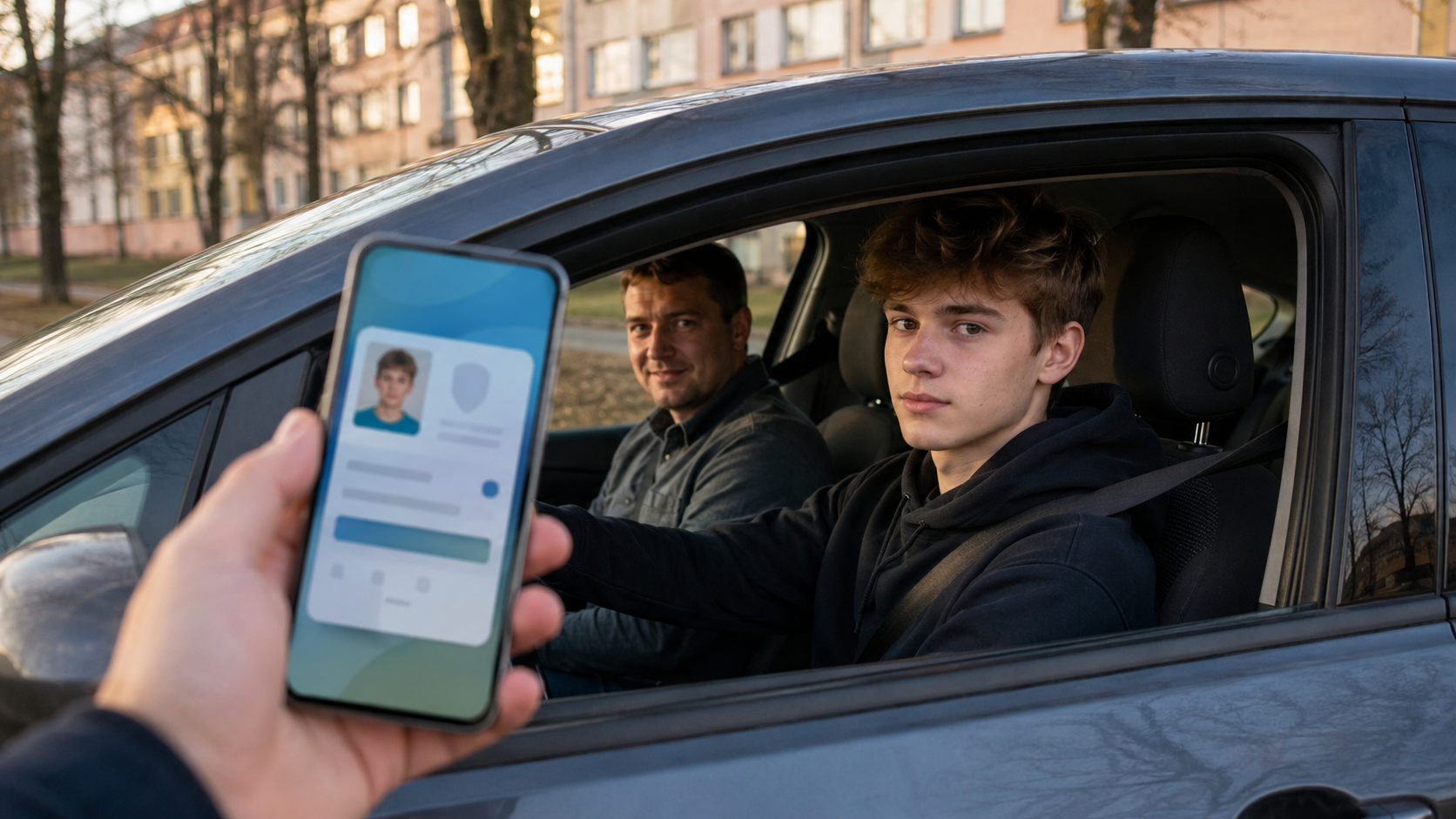
Information checked on 29 July 2026. The new EU Driving Licence Directive has entered into force legally, but most of its requirements do not yet apply in Latvia. Category B driving rights in Latvia can still currently be obtained from age 18. Member States must apply the accompanied-driving system from age 17 starting on 26 November 2028, while most other provisions must be applied from 26 November 2029. Latvia’s national conditions may still be clarified through implementing legislation.
The headline sounds very simple: the European Union will allow people to drive a car from age 17, and the driving licence will eventually be stored on a phone.
However, that short headline hides several different changes with different implementation dates.
A 17-year-old will not simply be able to pass the test and drive alone. Until reaching age 18, the young driver will have to be accompanied by a person who meets the legal requirements. The digital driving licence will not become the only available document because drivers will retain the right to receive a physical card as well.
The fact that the EU directive is already in force also does not mean that all the new rights can automatically be used in Latvia in 2026. The directive must first be implemented in Latvian legislation, while CSDD systems, examinations, registers and document-issuance procedures must be adapted.


The short conclusion: nothing changes automatically in Latvia in 2026. From November 2028, it should become possible to receive a category B licence at age 17 and drive with an accompanying person until adulthood. Most provisions concerning the digital licence, probationary periods, health requirements and examinations will apply from November 2029 or later, depending on the technical implementation schedule.
The most important points in one table
| Question | Situation in Latvia in 2026 | New EU rules |
|---|---|---|
| Minimum age for category B | 18 years | From age 17 with a mandatory accompanying driver until age 18 |
| Starting driver training | A category B learner’s permit can be obtained from age 16 | The directive does not prevent Member States from retaining an earlier training age |
| Driving independently at age 17 | Not permitted with category B rights | Not permitted — a qualifying accompanying driver is required |
| Probationary period | Several stricter rules already apply during the first two years of driving experience | A mandatory probationary period of at least two years throughout the EU |
| Driving licence on a phone | A unified EU mobile licence is not yet generally available | A mobile licence stored in the European Digital Identity Wallet and recognised throughout the EU |
| Physical card | The main licence format | Will remain available at the driver’s request |
| Category B licence validity | Usually 10 years | EU basic rule — 15 years, with the possibility of using 10 years when the licence is also used as an identity document |
| Driving ban for a serious offence abroad | Does not always apply automatically throughout the EU | Certain serious bans will also have to be implemented by the licence-issuing country |
When will each change take effect?
The new directive was published on 5 November 2025 and entered into force on 25 November 2025.
However, “the directive is in force” and “drivers can already use the new rights” are two different things.
| Date | What is scheduled? |
|---|---|
| 25 November 2025 | The directive legally entered into force at EU level |
| By 26 November 2026 | The European Commission must adopt detailed technical and security rules for the mobile licence |
| 26 November 2027 | Certain rights to drive heavier alternatively powered vehicles with category B and BE must be applied |
| 26 November 2028 | The accompanied-driving system for 17-year-old category B drivers must be applied |
| 26 November 2028 | Member States must have adopted and published most implementing legislation |
| 26 November 2029 | Most other provisions of the directive must begin to apply |
| Later technical date | The mobile licence will become the default format 54 months after adoption of the first necessary Commission implementing act |
A 17-year-old in Latvia therefore cannot rely solely on the EU directive in 2026 and demand a category B driving licence. Latvia’s current rules remain in force until the new system’s application date.
What will obtaining a driving licence from age 17 mean?
The new model is not simply ordinary learner driving with a parent sitting beside the driver.
To receive a category B licence at age 17, the young person will have to meet the same basic qualification requirements: complete training, pass the theory test and driving test and satisfy the medical requirements.
After passing the examinations, the person will receive a genuine driving licence containing EU code 98.02. This code will indicate that the driver may operate a vehicle only under the accompanied-driving system until reaching age 18.
| Current learner’s permit in Latvia | Future licence at age 17 |
|---|---|
| Confirms the right to learn to drive | Confirms acquired category B driving rights with an age restriction |
| The final category B driving examination has not yet been passed | The theory and driving examinations will already have been passed |
| Driving is part of the training process | Driving provides practical experience after obtaining the licence |
| A private instructor may qualify under Latvia’s current national requirements | The accompanying driver must satisfy the new EU minimum requirements and any additional Latvian rules |
| Independent driving is not permitted | Independent driving will also not be permitted before age 18 |
What requirements will apply to the accompanying driver?
The directive establishes basic requirements that a Member State may not weaken.
• the accompanying driver must be at least 24 years old;
• the person must sit in the front passenger seat;
• the person must be capable of providing guidance to the young driver;
• the relevant category of EU driving licence must have been issued more than five years earlier;
• the person must not have been subject to a driving ban in the licence-issuing country during the previous five years;
• the accompanying driver must comply with rules concerning alcohol and narcotic substances.
Latvia will also be allowed to impose additional conditions.
For example, the country could require advance registration of accompanying drivers, limit the number of registered accompanying persons, require a special identification sign on the vehicle or introduce other proportionate safety measures.
As of July 2026, there is no basis for claiming that Latvia will definitely allow only two accompanying drivers, require a specific number of kilometres or mandate a particular vehicle sign. These details will become known after Latvia adopts its implementing rules.
Example
A young person passes the examination at the age of 17 years and three months.
The person receives a category B licence containing code 98.02.
Until the 18th birthday, the driver may operate a vehicle only with a qualifying accompanying person in the front passenger seat.
The accompanying-driver requirement ends after the person turns 18.
However, the novice-driver probationary period continues until the nationally determined period has ended, and that period may not be shorter than two years.
Will a 17-year-old Latvian driver be allowed to drive abroad?
The category B accompanied-driving scheme is designed as an EU-wide system.
This means that a properly issued category B licence containing code 98.02 should, in principle, be recognised by other Member States when accompanied-driving requirements are followed.
However, before travelling, it will also be necessary to check:
• additional conditions in the destination country;
• whether the specific accompanying driver meets that country’s requirements;
• the vehicle’s insurance conditions;
• restrictions in a rental or leasing agreement;
• travel through a non-EU country;
• whether a physical driving licence must be carried when a third country does not recognise the digital document.
Insurance will be particularly important. The fact that the young person is legally entitled to drive does not automatically mean that a comprehensive-insurance policy will cover losses caused by a 17-year-old driver without additional conditions.
A probationary period of at least two years for every novice driver
For the first time, the new directive establishes an EU-wide principle: after passing the examination, a driver must be treated as a novice or inexperienced driver for at least two years.
The licence-issuing country determines the exact duration of the probationary period, but it may not be shorter than two years.
During the probationary period, the country must introduce stricter rules, sanctions or both regarding alcohol use. Measures must also be taken to reduce:
• driving under the influence of narcotic substances;
• failure to wear seat belts;
• failure to use child-restraint systems.
Several of these principles already operate in Latvia.
A driver whose experience operating motor vehicles does not exceed two years may not drive when the blood-alcohol concentration exceeds 0.2 per mille. Novice drivers also face a lower penalty-point threshold for suspension of driving rights than experienced drivers.
| Area | Current situation in Latvia | What does the new EU principle require? |
|---|---|---|
| Probationary period | Many requirements are already linked to the first two years of driving experience | At least two years in every Member State |
| Alcohol | The limit is 0.2 per mille for drivers with no more than two years of experience | Novice drivers must face a stricter regime than other drivers |
| Penalty points | The suspension threshold is 10 points for novice drivers and 16 for other drivers | The directive does not set a single number of points but permits stricter national measures |
Introducing the probationary period may therefore require less radical change in Latvia than in countries that have not previously applied a special regime to novice drivers.
Will the probationary period restart after obtaining another category?
The basic principle provides that a driver who already holds another vehicle category will normally serve only the remaining part of the previous probationary period for the new category.
However, there are several exceptions.
When the person previously held only category AM, obtaining another category creates a new probationary period in every case. Member States may also introduce an additional probationary period for other categories when justified by different risks and skill requirements.
Illustrative example: a young person receives category AM at age 16 and category B under accompanied driving at age 17. Experience with category AM does not automatically remove the new probationary period for category B.
How will the digital driving licence work?
The mobile driving licence will be a standardised EU digital document intended to be stored in the European Digital Identity Wallet.
It will not simply be a photograph of the physical card stored on a phone.
The digital licence will contain:
• standardised driving-rights data;
• secure authenticity verification;
• information about categories and restrictions;
• compatibility with Member States’ inspection systems;
• the same administrative validity and driving rights as the physical licence;
• limited transfer of personal information during inspection.
Unless EU or national law permits otherwise, the person conducting the inspection will not be allowed to retain personal data used to verify the licence after the check has been completed.
The directive also does not create a centralised EU biometric database for driving licences.
Will the physical driving licence disappear?
No.
When the mobile licence becomes the main or default format, drivers will still have the right to:
• receive only the digital licence;
• request only the physical licence;
• request both formats at the same time;
• request the other format later, even before the licence expires.
When a person already has a digital licence and requests a physical card, the physical document should normally be issued without undue delay and within approximately three weeks.
The physical licence will be particularly important for people without smartphones and for travel to non-EU countries where the digital document may not be recognised.
A discharged phone battery must not remove a person’s driving rights, but practical complications may arise during an inspection when no accessible document is available. Many drivers will therefore probably choose both formats.
When will the digital licence become the main format?
The directive does not specify one simple fixed date on which every European driver’s physical card will suddenly be replaced by a phone.
The European Commission must first adopt technical implementing rules covering:
• the visual appearance of the digital licence;
• interoperability between countries;
• security requirements;
• updating of information;
• lists of trusted issuers;
• connections with national systems.
The mobile licence must become the default format 54 months after the first necessary Commission implementing act has been adopted.
A Member State may begin issuing mobile licences earlier, but full mutual recognition throughout the EU depends on the common technical standard becoming operational.
Will driving licences be valid for 15 years?
The new EU basic rule provides for 15 years of administrative validity for categories AM, A1, A2, A, B1, B and BE.
A Member State may use a 10-year validity period when its legal system permits the driving licence to be used as an identity document.
A basic five-year validity period remains for lorry and bus categories.
| Categories | Directive’s basic validity period |
|---|---|
| AM, A1, A2, A, B1, B and BE | 15 years |
| C1, C1E, C, CE, D1, D1E, D and DE | 5 years |
| Light-category licence also used for identification | The Member State may use 10 years |
Light-category driving licences in Latvia are currently generally valid for 10 years.
Whether Latvia will move to 15 years after implementation or use a shorter period permitted by the directive will depend on national legislation.
A 15-year licence period also does not mean that a person will never need a medical examination during those 15 years. Administrative validity and medical-certification validity are related but legally separate issues.
What will change in medical checks?
The directive requires a more systematic assessment of a driver’s physical and mental fitness.
When a licence is issued for the first time, the Member State must ensure a health assessment. For light-vehicle categories, the country may in specified circumstances use the following instead of a full medical examination:
• a health self-assessment questionnaire;
• a national system that responds to significant changes in a driver’s health;
• a combination of both solutions.
When the self-assessment or other information raises concerns about a medical condition, the person must undergo a medical examination.
Medical examinations remain mandatory for heavy-vehicle and bus categories.
The directive does not require Latvia to abandon its existing medical examinations. It gives the country flexibility for light categories when an equivalent level of fitness monitoring is ensured.
What additional knowledge will be required in theory and driving tests?
The new EU rules require driver training to be modernised so that examinations reflect real traffic conditions and modern vehicle technology more accurately.
Training and examinations will have to place greater emphasis on:
| Topic | Why is it important? |
|---|---|
| Blind spots | To reduce collisions involving cyclists, motorcyclists and pedestrians |
| Distraction caused by telephone use | Even a brief glance at a screen substantially increases reaction distance |
| Opening vehicle doors safely | To avoid striking a passing cyclist or e-scooter rider |
| Pedestrians, children and micromobility | Vulnerable road users face a higher risk of serious injury |
| Driver-assistance systems | Drivers must understand system benefits, limitations and the duty to take control |
| Driving in snow and on slippery roads | To prepare drivers for changes in braking distance and grip |
| Economical driving | To reduce fuel or electricity use, emissions and tyre wear |
This does not mean that none of these subjects are currently taught in Latvia. The directive establishes a common minimum level for every Member State and requires examination programmes to be updated regularly as technology changes.
Heavier electric and other alternatively powered vehicles with category B
Batteries and other alternative-powertrain systems may increase a vehicle’s mass without increasing its load space.
The new rules therefore expand the possibility of driving certain alternatively powered vehicles with category B or BE when their maximum authorised mass exceeds the traditional 3,500-kilogram limit but does not exceed 4,250 kilograms.
At least two years of category B experience will generally be required, and the construction and use conditions established by the directive must be satisfied.
A similar right already exists in Latvia for certain electric goods vehicles weighing up to 4,250 kilograms when the additional weight results solely from the electric drivetrain and the driver has held category B for at least two years.
This does not mean that an ordinary category B licence will permit driving any vehicle weighing 4.25 tonnes. The vehicle type, drivetrain, use, driving experience and codes shown on the licence will remain decisive.
Will category B allow a heavier motorhome?
The directive provides the possibility of driving a motor caravan with category B after special training, an examination or both when its maximum authorised mass exceeds 3,500 kilograms but does not exceed 4,250 kilograms.
When combined with a trailer, the total permitted mass may reach 5,000 kilograms in certain circumstances.
However, this right will not automatically be included with every category B licence. The required training or examination must be completed, and the appropriate EU code must appear on the driving licence.
| Vehicle | Will an ordinary category B licence be sufficient without additional action? |
|---|---|
| Ordinary passenger car up to 3,500 kg | Yes |
| Any goods vehicle up to 4,250 kg | No |
| Qualifying alternatively powered vehicle up to 4,250 kg | Possibly, after meeting experience and other conditions |
| Motorhome weighing between 3,500 and 4,250 kg | The required training, examination or both and an appropriate licence endorsement will be necessary |
Professional lorry and bus drivers at a younger age
To reduce the shortage of professional drivers, the new rules allow professional categories to be obtained earlier under certain conditions.
| Category | Possible minimum age with a professional-competence certificate | Without the relevant certificate |
|---|---|---|
| C and CE | 18 years | 21 years |
| D and DE | 21 years | 24 years |
In certain cases, a country may also establish accompanied driving for 17-year-old candidates seeking professional lorry categories. Unlike the category B system, this professional scheme does not have to be introduced identically by every country.
A driving ban imposed abroad will no longer remain limited so easily to one country
The new driving-licence system is accompanied by a separate EU directive concerning mutual implementation of certain driving bans.
At present, a person may be banned from driving in the country where a serious offence was committed while the licence-issuing country does not automatically suspend the person’s rights.
The new system provides for information to be sent to the licence-issuing country following serious offences such as:
• driving under the influence of alcohol;
• driving under the influence of narcotic substances;
• extremely serious speeding, including at least 50 km/h above the permitted limit in specified circumstances;
• an offence resulting in death or serious physical injury.
The system will primarily cover bans imposed for at least three months when more than one month remains at the time of notification.
This does not mean that every foreign parking fine or minor speeding offence will automatically result in loss of driving rights in Latvia.
Will seniors face mandatory new annual tests?
No. The new directive does not require every senior driver throughout the EU to take a driving test every year after reaching a particular age.
Member States may reduce the administrative validity period for people aged 65 and over in order to carry out more frequent:
• medical examinations;
• health self-assessments;
• other proportionate measures, including refresher training.
However, each country continues to determine the specific system. Age alone does not automatically result in loss of driving rights.
Will the examination be available in the country of citizenship?
A driving licence is normally obtained in the country where the person has normal residence.
The new rules establish a limited exception for obtaining a first category B licence.
When the country of residence does not offer translation or interpretation of the theory or practical process into an EU language understood by the person, it may be possible under specified conditions to obtain the licence in the Member State of citizenship.
This does not create a free right to choose any EU country based on the easiest examination or lowest cost.
What will the new rules mean for driving schools?
Driving schools and CSDD will have to adapt the training and examination process.
Possible practical tasks in Latvia include:
• changing the minimum-age rules for issuing category B licences;
• introducing code 98.02 and monitoring accompanying drivers;
• establishing additional requirements for accompanying drivers;
• adapting theory-test questions;
• expanding training concerning ADAS systems and vulnerable road users;
• adapting medical-examination and self-assessment procedures;
• creating infrastructure for issuing and checking mobile licences;
• ensuring data exchange with authorities in other Member States.
During the transition, some new rules may already have been adopted while individual technical systems are still being introduced gradually.
Will obtaining a driving licence become more expensive?
The directive itself does not set the prices charged by driving schools, examination authorities or document-issuing bodies.
The possible effects may operate in opposite directions.
| Change | Possible effect on costs |
|---|---|
| Digital document | May reduce the need to manufacture and deliver a physical card |
| Right to request both formats | The country may charge a proportionate fee for the additional physical document |
| Expanded training programme | May increase driving-school costs when additional lessons are required |
| Accompanied driving after the examination | A family may obtain more practical experience without paying an instructor |
| Better initial experience | May reduce long-term accident, insurance and repair risks |
The greatest practical benefit may not be a cheaper licence but the opportunity to build several months of real driving experience under the supervision of an experienced adult after passing the examination.
Insurance for a 17-year-old driver
Compulsory motor insurance covers the civil liability of the owner or authorised user according to law, but policy pricing and the insurer’s risk assessment may depend on the drivers’ profiles.
Comprehensive-insurance policies may contain:
• a minimum driver-age condition;
• an increased excess for a young driver;
• a requirement to identify regular drivers;
• exclusions for commercial or training use;
• a duty to report changes in risk circumstances.
Before a 17-year-old begins using the family vehicle, it will be important to obtain written confirmation from the insurer that the intended use complies with the policy conditions.
What can families do now?
1. Do not plan on obtaining a licence at age 17 until Latvia’s new rules are applicable.
2. Start category B training under the current system, which allows a learner’s permit from age 16.
3. Follow announcements from CSDD and the Ministry of Transport concerning implementation of the directive.
4. Do not purchase a vehicle solely on the assumption that the young person will definitely be allowed to drive alone at age 17.
5. Check which family members may qualify as accompanying drivers in the future.
6. Check compulsory insurance, comprehensive insurance and leasing conditions before using the system.
7. Retain a physical driving licence when planning to drive abroad.
Common myths about the new rules
| Myth | Reality |
|---|---|
| Category B can already be obtained at age 17 in Latvia | Latvia’s rules in force in 2026 still provide for category B to be obtained from age 18 |
| A 17-year-old driver will be allowed to drive alone | A qualifying accompanying driver will be mandatory until age 18 |
| Any adult with a driving licence may act as the accompanying driver | The person must be at least 24, have held the relevant category for more than five years and have no recent driving ban |
| Driving from age 17 is ordinary learner driving | The young person will have passed the examinations and received a category B licence containing code 98.02 |
| Physical licences will disappear | Drivers will retain the right to request a physical card or both formats |
| A photograph of the licence on a phone will be sufficient | The official mobile licence will be a secure, verifiable digital document rather than an image file |
| Every senior will have to pass a driving test each year | The directive establishes no such uniform requirement; specific health measures remain a national decision |
| Category B will permit driving any vehicle up to 4,250 kg | The expansion applies only to specified vehicles and with additional conditions |
| A driving ban imposed abroad will always remain limited to that country | Certain serious bans will also have to be implemented by the licence-issuing country |
Mini test: have you understood the new rules correctly?
Answer yes or no:
1. Does the directive entering into force mean that every change already applies in Latvia?
2. Can a category B learner’s permit currently be obtained from age 16 in Latvia?
3. Will a 17-year-old driver have to pass the category B examinations?
4. Will the person be allowed to drive without an accompanying driver before age 18?
5. Must the accompanying driver be at least 24 years old?
6. Will it remain possible to request a physical licence after the mobile licence is introduced?
7. Will a screenshot be equivalent to the official mobile licence?
8. May the novice-driver probationary period be shorter than two years?
9. Will an ordinary category B licence automatically permit driving any 4.25-tonne vehicle?
10. Should insurance conditions be checked before a 17-year-old is allowed to use the family vehicle?
Correct answers: 1 — no; 2 — yes; 3 — yes; 4 — no; 5 — yes; 6 — yes; 7 — no; 8 — no; 9 — no; 10 — yes.
Can a category B licence already be obtained at age 17 in Latvia?
No. As of July 2026, Latvia’s current rules provide that category B driving rights may be obtained from age 18. A category B learner’s permit may be obtained from age 16.
When must Latvia introduce accompanied driving from age 17?
Member States must apply the directive’s accompanied-driving provisions from 26 November 2028. Latvia must adopt the necessary national rules and adapt its systems before that date.
Will a 17-year-old driver be allowed to drive alone?
No. Until reaching age 18, the young driver must be accompanied by a qualifying person sitting in the front passenger seat.
Will a parent automatically qualify as an accompanying driver?
Only when the parent meets every requirement: being at least 24 years old, having held the relevant EU licence category for more than five years and having no driving ban during the previous five years. Latvia may also establish additional conditions.
Will the digital driving licence be mandatory?
The mobile licence will eventually become the default format, but drivers will retain the right to request a physical card or both formats.
Will the digital licence work without internet access?
The precise offline-verification and technical-operating conditions will be established through Commission implementing acts and the technical solution used by the digital identity wallet. It should not be assumed that any screenshot or previously saved image will be valid.
Will the digital licence be valid outside the EU?
Not necessarily. The digital licence will be mutually recognised within the EU system, but non-EU countries may not accept it. For travel outside the EU, it will be safer to carry the physical licence and, when necessary, an international driving permit.
Will every novice driver in the EU face a zero-alcohol limit?
The directive requires stricter rules or sanctions for novice drivers than for experienced drivers, but it does not establish one identical blood-alcohol limit for every Member State. Latvia already applies a limit of 0.2 per mille to drivers with no more than two years of experience.
Will a Latvian driving licence definitely be valid for 15 years?
The directive’s basic period for light-category licences is 15 years, but countries may use a shorter period in specified circumstances. Latvia’s exact solution will become known after national legislation is adopted.
Will a driving ban imposed abroad automatically apply in Latvia?
After the new system is implemented, certain serious bans of sufficient duration must be reported to the licence-issuing country and enforced more widely throughout the EU. Minor offences and short bans will not necessarily fall within the system.
What should be remembered about the transition period?
An existing driving licence will not become invalid merely because a new EU directive has entered into force.
Physical licences will continue to be used until their expiry, exchange, renewal or another time specified by legislation.
A driver holding a Latvian licence valid for ten years in 2026 does not need to rush to replace it with a digital document when the unified system is not yet fully operational.
In 2026: follow Latvia’s current rules.
In 2027: pay attention to changes concerning heavier alternatively powered vehicles.
In 2028: follow Latvia’s rules for accompanied driving.
In 2029 and later: most of the new system is expected to enter practical operation.
Conclusion: the greatest change is not the licence on a phone but safer experience-building
The digital driving licence is the most visible and technologically interesting part of the new rules. It may make issuing, renewing, exchanging and checking documents easier.
From a road-safety perspective, however, the more important change may be the opportunity to obtain category B rights at age 17 and build several months of everyday driving experience with an experienced adult.
When implemented carefully, the system should allow a novice driver to encounter not only driving-school routes before driving independently, but also darkness, rain, winter conditions, congestion, motorways, unfamiliar roads and everyday traffic decisions.
At the same time, the accompanying driver may not be a random adult passenger. The EU establishes minimum age, experience and recent driving-ban requirements, while Latvia may add further safety conditions.
Latvian drivers and families do not currently need to change their plans based solely on a dramatic headline. Category B licences in Latvia are still obtained from age 18 in 2026.
The most important step will be to follow Latvia’s implementing rules in 2027 and 2028 because they will clarify registration of accompanying drivers, vehicle identification, insurance, licence codes and other practical details.
The driver’s final takeaway: the EU rules do not allow a 17-year-old simply to take the family car and drive alone. They create a controlled transition from driving school to independent traffic — with completed examinations, an experienced accompanying driver, a probationary period and a modern licence that may eventually be kept both in a wallet and on a phone.