
 LV
 EN
 RU
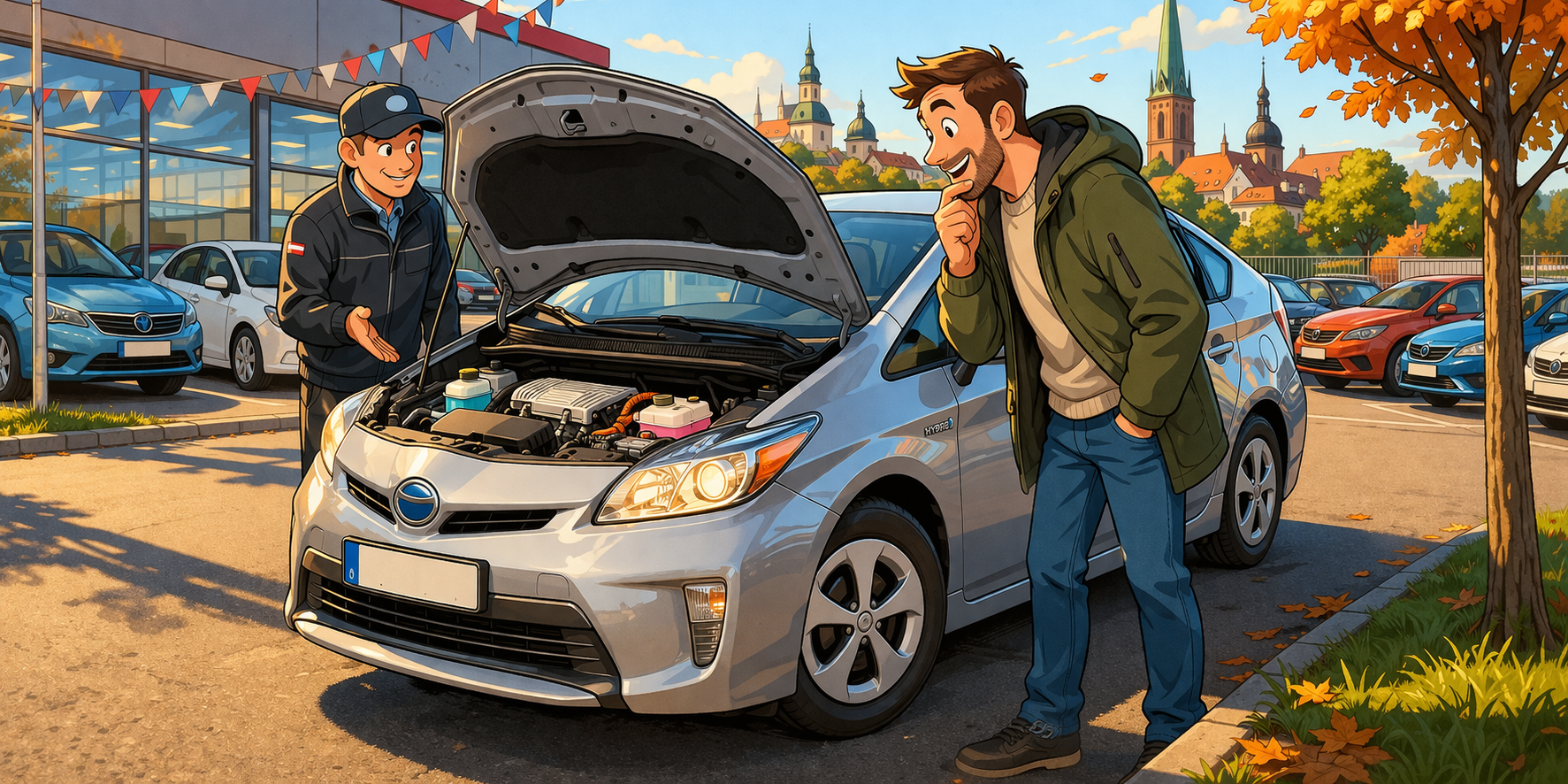
There are car-buying questions where people are not chasing a dream — they are chasing relief. Relief from high fuel bills. Relief from constant frustration at the pump. Relief from the feeling that every short trip somehow costs more than it should. And this is exactly where one very specific question starts appearing more and more often: is it worth buying a used hybrid in Latvia if your main goal is to spend less on fuel?
This is not a theoretical question. It comes from very practical people. People who don’t want — or can’t afford — a brand-new car. People who feel that petrol cars in city traffic are starting to become annoying to live with. People who don’t want to deal with diesel limitations in short-distance driving. And in that moment, a used hybrid starts to look almost perfect — like a smart compromise between old and new. Not too exotic. Not too expensive. Not too risky. And most importantly, promising lower fuel consumption in everyday life.
But this is also where people can go wrong. Because a used hybrid is not just “lower fuel consumption.” It is also a question of battery condition, previous usage, maintenance history, model choice, mileage, and expectations. In other words, a used hybrid can be a very smart purchase — but it can also be a purchase where someone falls in love with the idea of a hybrid, not the actual car.
That’s why this article is not here to hype or scare you. It’s here to give you a clear picture: when a used hybrid really makes sense in Latvia, where the real risks are, and why some drivers say “best decision I’ve made in years,” while others later admit that the idea was better than the actual experience.
Why are used hybrids so attractive in the first place?
Because they promise something very human: lower costs without changing your entire lifestyle. Electric cars still feel too expensive or impractical for many. Diesel comes with conditions and limitations. Petrol is simple, but often inefficient in city driving. A hybrid sits right in the middle — it looks like a balanced, logical choice.
And that appeal is not fake. Hybrids really do perform well in certain environments — especially in city driving. Stop-and-go traffic, short trips, traffic lights, congestion — this is where traditional cars often become inefficient, while hybrids feel much more natural.
That’s why for many drivers, a hybrid doesn’t feel like a “technology.” It feels like a solution. But this is also where the risk begins — because what works very well in one type of driving may not be universal.
A common forum insight: “At first I looked at hybrids as something modern. Later I realized it just fits city driving better.”
The short answer: yes — but only if you buy smart
If we simplify it, the answer is yes — a used hybrid in Latvia in 2026 can absolutely be a smart choice if your goal is to reduce fuel costs. Especially in urban environments. But only if you don’t buy the idea of a hybrid — you buy a good, well-maintained car with a clear history.
That’s where most of the story really begins. Because in the used hybrid world, the difference between a great purchase and a disappointing one is not the model — it’s the condition and history of the specific car.
People often want a simple yes or no. But the smarter answer is: it depends on how you drive, what you buy, and how carefully you choose.
The biggest advantage: hybrids thrive in the city
If your daily life is mostly city driving, this is where hybrids really shine. It’s not just about fuel savings — it’s about how naturally the car fits the environment. Frequent stops, slow movement, short distances — this is where hybrids operate efficiently.
Many drivers notice something unexpected after switching: driving becomes calmer. Less frustration in traffic. Less irritation about wasted fuel. Less feeling that your car is “fighting” your environment.
And this is an important point — the value of a hybrid is not just in liters per 100 km. Sometimes it’s in how well it fits your daily rhythm.
As one driver put it: “I bought it for fuel savings, but stayed because it just feels right in the city.”
But what about highway driving?
This is where balance matters. Hybrids are not bad on highways — but their biggest advantage is less noticeable there. Long, steady driving does not benefit as much from hybrid systems as city traffic does.
This is where some buyers feel slightly disappointed. They expected universal savings. But in reality, no car is universally optimal. If your driving is mostly long-distance and highway-based, a hybrid may still be a good choice — but not necessarily the best one for your specific use.
The key takeaway: hybrids are strongest where driving is dynamic, not constant.
The biggest fear: the battery
If there is one thing that makes buyers nervous, it’s the battery. And that fear is understandable. The word itself sounds expensive. It triggers worst-case scenarios in people’s minds.
But the mistake is thinking in extremes. Some people ignore it completely. Others fear it too much. The smart approach is in the middle. Yes, battery condition matters. But no — it doesn’t mean every used hybrid is a ticking time bomb.
What matters is how the car was used, maintained, and inspected. A well-kept hybrid with proper checks is a completely different story from a neglected one. The key is not fear — it’s informed buying.
A very real comment: “I feared the battery the most. Then I realized the real risk is buying blindly.”
Common mistakes when buying a used hybrid
The biggest mistake is simple: buying the concept, not the car. People see “hybrid,” imagine savings, and stop evaluating critically.
The second mistake is focusing only on fuel consumption. In reality, the condition of the car matters far more in the used market.
The third mistake is unrealistic expectations. A hybrid is not magic. It’s a smart tool — but only when used in the right context.
Hybrid vs petrol: what are you really choosing?
Most people are not choosing between technologies — they are choosing between lifestyles. Petrol is simpler and familiar. Hybrid is more efficient but slightly more complex.
One prioritizes simplicity. The other prioritizes efficiency. Neither is wrong. The right choice depends on your priorities.
Who should seriously consider a used hybrid?
Drivers who spend a lot of time in the city. Those who want to reduce fuel costs without switching to electric. Those who are willing to choose carefully, not impulsively.
For them, a used hybrid can be one of the smartest choices available today.
A great summary from drivers: “It’s not magic — but if it fits your life, it’s hard to go back.”
Conclusion
Yes — buying a used hybrid in Latvia can absolutely be worth it if your goal is to reduce fuel costs. But only if you approach it correctly. You are not buying “a hybrid.” You are buying a specific car that must fit your real driving life.
When everything aligns — city driving, proper condition, realistic expectations — a used hybrid can be one of the most practical and satisfying choices. But when expectations don’t match reality, even a good idea can feel disappointing.
If you want to compare how different fuel and driving scenarios affect your real costs, use the calculator below.