
 LV
 EN
 RU
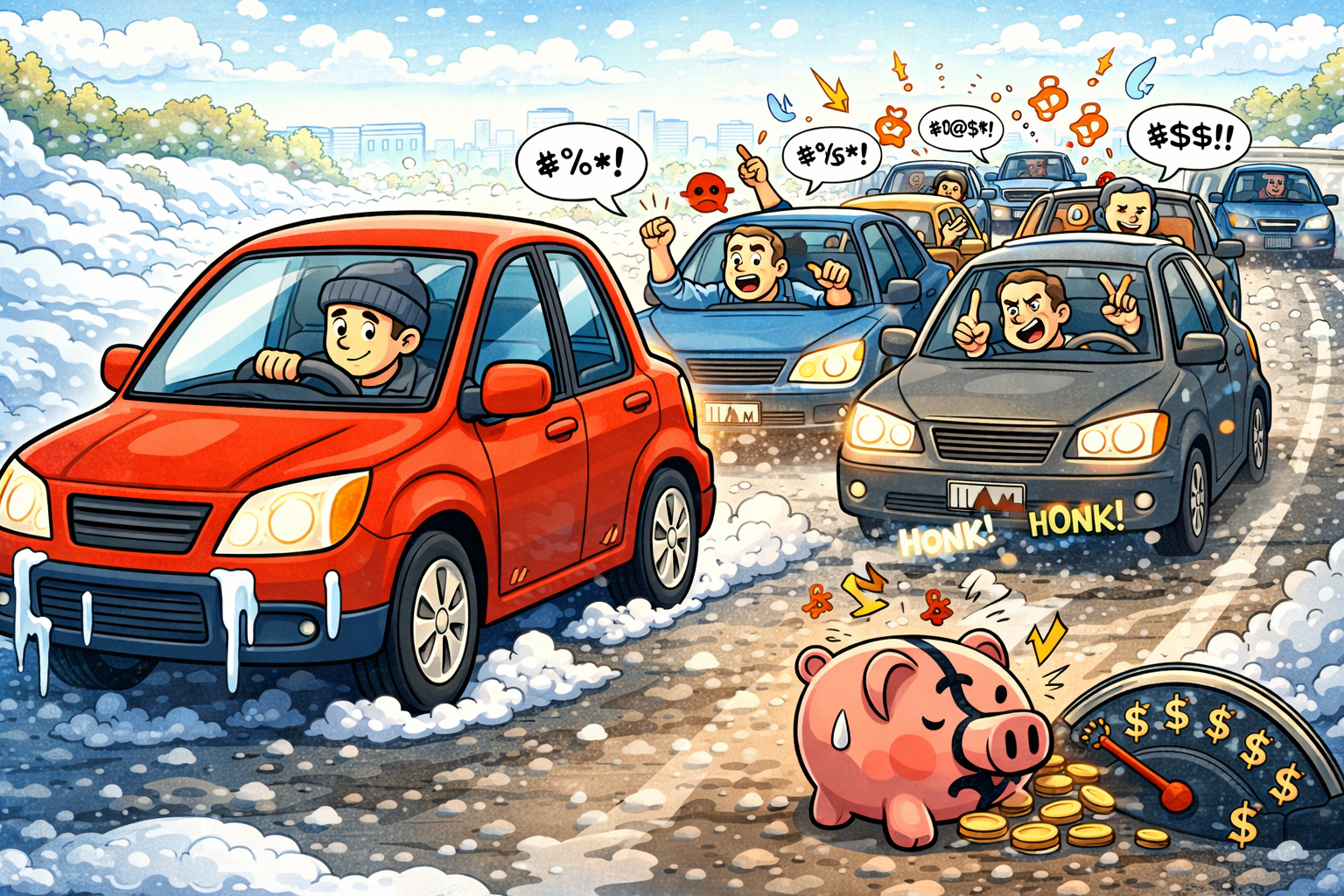
At first glance, short trips seem harmless. A quick drive to the store. Taking a child to school. A short commute of just a few kilometers. Nothing special. It even feels like the shorter the trip, the less fuel is used and the lower the cost. Logical, right?
But in reality, short trips are one of the most expensive ways to use a car. And this is one of those paradoxes that most drivers only understand when they start analyzing their costs more seriously. Because a short trip is not just a short distance. It is often full of inefficiency.
In this article, we will look at why short trips increase car costs so significantly, what mechanisms are behind it, and why sometimes a 3-kilometer drive can cost more than a 10-kilometer drive under different conditions.
Cold engine = higher consumption
One of the main reasons is very simple — the engine. A car operates most efficiently when it has reached its operating temperature. But during short trips, it often never gets there.
A cold engine consumes more fuel. The fuel mixture is richer, systems operate differently, and efficiency is lower. As a result, the first kilometers are always the most expensive.
And if your trip is only 2–5 kilometers, it means that almost the entire journey happens in this inefficient mode.
Driver comment: “I didn’t understand why my city consumption was so high until I realized — I almost never drive with a warm engine.”
Every start costs more than you think
Another factor — every trip starts with a start. And a start is one of the most “expensive” moments in terms of fuel consumption.
When a car begins to move, it uses more energy than when driving at a steady speed. If you drive a long distance, this start is “spread out” across the trip. But if the trip is very short, the start becomes a large part of the total consumption.
This means that five short trips per day often cost more than one longer trip with the same total number of kilometers.
Oil, condensation and engine wear
This is where things get more serious — and where many people don’t even think. Short trips affect not only fuel consumption but also the engine itself.
In cold operation, condensation forms. The oil does not reach optimal temperature and cannot perform its job perfectly. This means that over time, the engine wears out faster.
And now it is no longer just about fuel. It is about repairs. It is about the lifespan of the car.
“At the service, they told me — if you only drive short distances, you will pay later with repairs.”
The battery and electronics suffer more
Short trips also affect the battery. Every start consumes energy. But if the trip is too short, the battery does not have time to fully recharge.
As a result, over time it wears out faster. And this is another hidden cost that people rarely associate with their daily driving.
This effect becomes especially noticeable in winter.
A real-life scenario
Let’s imagine two people. One drives 3 km to work and 3 km back every day. The other drives 15 km in one direction.
The first person theoretically drives less. But their car operates almost all the time in a cold state. Every trip starts from zero. Every kilometer is an “expensive kilometer.”
For the second person, the engine warms up, the trip becomes more efficient, and overall consumption per kilometer is often lower.
Why do people underestimate this?
Because short trips feel cheap. You don’t spend much fuel in one go. You don’t see a big number.
But the problem is repetition. You repeat this inefficient scenario every day. And it is the repetition that makes it expensive.
Small cost + frequent repetition = big cost.
When are short trips especially inefficient?
- in winter
- with older cars
- with diesel engines
- when trips are under 5 km
In these cases, the effect becomes even more pronounced.
What can you do about it?
Sometimes the solutions are surprisingly simple:
- combine multiple trips into one
- walk some short routes
- choose routes with fewer stops
It is not always possible, but even small changes can reduce costs.
Conclusion
Short trips are not as cheap as they seem. They are often the most expensive kilometers you drive.
Because they combine all inefficiencies in one place — a cold engine, frequent starts, higher wear, and hidden costs.
And perhaps the most important thing — a short trip itself is not the problem. The problem begins when it becomes a daily habit you never think about.