
 LV
 EN
 RU
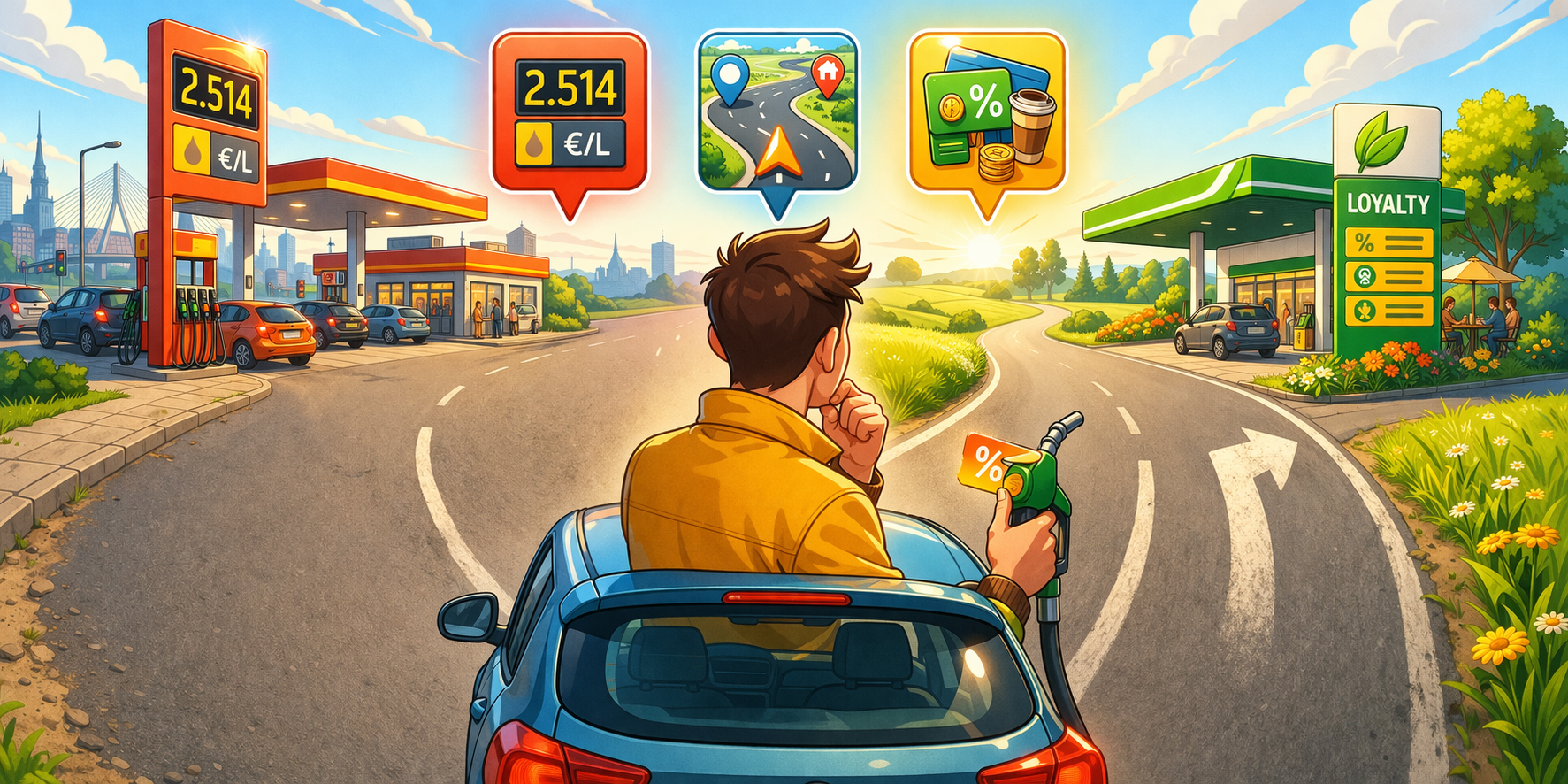
At first glance, choosing a fuel station seems almost ridiculously simple. You pull in, look at the price board, compare the numbers, and choose the cheapest one. That should be the end of it. But in real life, the decision is far more complicated than it looks. Because a driver is not choosing only a price per litre. They are actually choosing a whole small model of everyday economics — how far they need to drive to get there, how much time that costs, whether the “saving” gets burned away on the way, whether the loyalty discount is genuinely worth anything, and whether convenience is sometimes smarter than chasing a few cents on a board.
That is exactly why the question “which fuel station should I choose?” is much more interesting than it first appears. Some people live by one strict rule: always fill up wherever it is cheapest. Others go to the opposite extreme: they always use the same station and never think about price or alternatives at all. And then there is a third group that tries to be clever but often falls into the classic trap — they drive specifically to get “cheaper” fuel, while spending part or even all of that saving on the way there. In the end, the driver feels smart, but financially wins far less than expected.
This article is about exactly that — how to choose a fuel station more wisely, not just more instinctively. We will look at when price really is the main factor, when location matters much more than drivers think, what loyalty programs actually give you, and where drivers create an illusion of saving for themselves. Because in this topic, the winner is usually not the person who spots the lowest number, but the one who understands the full picture.
The first mistake: thinking the lowest price always means the smartest choice
It is a very understandable instinct. A driver sees one station with a lower price and immediately feels as if they have found the correct answer. And yes, sometimes that really is the correct answer. But not always. Because price on its own is only one layer of the whole decision. If the station with the lowest price is not on your route, if it requires a detour, if it means a longer queue, if you need to enter inconvenient traffic, or drive to an area you would not normally go to, then the “cheapest fuel” may stop being the cheapest solution.
Very often, drivers focus sharply on a few cents per litre but barely think about the road that leads to those cents. And that is interesting, because psychologically people feel the victory at the pump very strongly, while feeling the loss on the way much less. What stays in their mind is: I filled up cheaper. What does not stay as clearly is: I drove extra distance, spent extra time, and used fuel to reach that cheaper price.
That is why the first smart idea here is very simple — choosing a station is not only about comparing prices. It is about comparing prices together with the route.
A classic forum-style observation: “After a while I realised I wasn’t really saving on fuel — I was driving around to feel like I was saving.”
When is the lowest price really the most important factor?
It would be wrong to swing to the other extreme and say price does not matter. Of course it does. And for some drivers, it matters a lot. If a person drives a great deal, fills up regularly, often uses a full tank, travels between cities, or builds up high mileage for work, then even a small difference in price per litre can become very noticeable over a year. For that kind of driver, it is perfectly logical to monitor prices and be more disciplined about where they fill up.
But even here, it is important to be smart. The lowest price really starts to matter only when it fits your route, or at least does not require extra effort to reach. If you are already driving past it, if you can fill up without a real detour and without wasting time, then yes — the cheaper price becomes a strong argument. That is where real savings begin, not just a theoretical victory on a signboard.
In other words, the lowest price is a great criterion only when it does not turn into a separate mission. The moment the search for the cheapest fuel requires a dedicated trip, the whole situation becomes much more complicated.
When is the nearest station actually the smartest choice?
There are many situations where the nearest station, or the one already on your route, is not the “lazy” choice but the smarter one. Especially when the price difference is small. If the difference between two stations is minor, but one fits perfectly into your daily route, then practical convenience often beats theoretical savings. And that is not weakness. It is realism.
Drivers sometimes think that being smart means always chasing the lowest number. But being smart often means knowing when that chase starts costing too much. Time, traffic, extra kilometres, queues, and simple end-of-day fatigue are also resources. Not everything should be measured only in cents per litre.
A very typical example looks like this: a person is driving home after work, the tank is nearly empty, one station is directly on the way, another promises a slightly lower price but lies in a different direction. If getting that lower price means extending the journey, entering less convenient traffic, and spending more time on the entire “saving operation,” then the closer station is often the better choice, even if the number on its board is a little higher.
Drivers often phrase it very simply: “Cheaper isn’t where the number is lower — cheaper is where the total cost to my day is lower.”
The big illusion: people often fail to count the trip to the station
This is one of the most common mistakes in the whole subject. People calculate the discount very precisely, but calculate the trip very vaguely. They can tell you that one place is three or four cents per litre cheaper, but they cannot tell you exactly how much extra distance they drove to reach it. And even fewer try to turn that extra movement into money.
This is where the smart choice starts with a simple question: would I use this station naturally in my route anyway, or am I specifically driving to get a cheaper number? If it is part of your route — excellent. If it requires a separate trip — then the maths becomes much more serious. Sometimes a person saves on the fuel price but loses on their own logistics.
There is another important detail here: the smaller the tank, or the smaller the amount you are filling, the less reason there is to chase a minor price difference. If you are only putting in a small amount, even a noticeable per-litre gap may translate into a surprisingly small total saving. That is exactly the moment when many drivers should stop asking “where is it cheaper?” and start asking “is this saving even large enough to justify changing my route?”
Loyalty programs: a pleasant bonus or a real benefit?
Loyalty programs in the fuel world are fascinating because they play directly on human psychology. A discount, points, coffee, a special price, cashback, a bonus — all of this creates the feeling that you are being a clever customer rather than simply a person spending money on fuel. And to be fair, sometimes a loyalty program really is useful. But not always in the way people imagine.
Loyalty programs work smartest when they fit your natural habits. You already use that station. It is already on your route. You already fill up regularly at the same network. Then yes — discounts and rewards become a pleasant and real gain. They do not ask anything extra of you. They simply improve something you were already doing.
But a loyalty program becomes suspicious the moment you start adjusting your life to it more than it adjusts to you. If you start driving specifically to one network only for the points, buying things you would not otherwise buy, or feeling like you “saved” even though your overall spending logic has not improved, then the program is working more on your emotions than on your actual financial benefit.
A very sharp comment from drivers: “A discount is great only as long as it doesn’t require you to reorganise your whole behaviour around it.”
What do loyalty programs actually give the most of?
In truth, their biggest benefit is not always the cents on fuel itself. Sometimes the biggest benefit is stability. If a person knows that in a certain station network they will usually get understandable conditions, a small discount, some extra perk, or simply predictability, that creates convenience. And convenience in daily life is often worth much more than the theoretical chance of occasionally finding a lower price elsewhere.
Still, a smart driver knows how to separate a bonus from a reason. A loyalty program can be a good extra, but it should not be the only reason for choosing a station. If the price is weak, the location is inconvenient, and the whole station logic does not fit your routine, then points and discounts on paper do not magically make it a smart choice.
When does one “favourite station” become a trap?
There are plenty of drivers who always fill up in the same place. And sometimes that is completely sensible. If the station is on the route, the price is reasonable, the environment is familiar, and daily life does not suffer from it, then there is no issue. But sometimes this loyalty becomes blind. A person stops looking around, stops noticing alternatives, stops following price differences, and simply lives on autopilot: I always fill up here.
The trap here is not emotional. It is financial. Routine can become expensive precisely because nobody checks whether it still makes sense. A driver becomes used to their system and stops asking whether it is still working in their favour. This does not mean you have to obsessively search for alternatives every day. It just means it is healthy from time to time to check whether your habit is still helping you.
So a favourite station is a good thing only for as long as it remains a genuinely good choice, not just an old routine.
The smartest choice depends on the kind of driver you are
This is where the whole topic becomes real. There is no single correct model for everyone. A driver who travels a lot and regularly fills a full tank will care far more about price differences than someone who refuels less often and in smaller amounts. A city driver may care much more about whether the station is naturally on the way and does not require extra movement. Someone who spends a lot of time on highways or in business travel may benefit most from a combination where price and route happen to match within one particular network.
Time is a resource here too. For one person, ten extra minutes mean nothing. For another, ten minutes after work are expensive. One person values speed and familiarity. Another enjoys the almost sport-like task of finding the best price. So the smartest station choice does not begin with “where does everyone fill up?” It begins with “what kind of driver am I?”
On forums, people often put it very simply: “What counts as a saving for one person is just inconvenient hassle for another.”
How do you choose more wisely in practice, not just in theory?
It helps to answer three honest questions. Is this station actually on my route? Is the price difference really large enough to change my journey? And does the loyalty program give real value in my life, rather than just a pleasant feeling? Once those three answers are clear, a lot becomes much simpler.
The second important thing is not to judge everything by one fill-up. The smartest choice is usually not the one that gives the lowest price once. The smartest choice is the one that over time fits your route, habits, and cost logic best. One small victory on a board does not mean your whole system is good. But a good habit over months gives much more than one “successful” fill-up.
And one more thing: smart drivers occasionally test their own routine. Not obsessively, not every day, but enough to make sure that a habit does not quietly turn into blind routine. That balance between discipline and normal life is exactly where everyday wisdom starts to show.
Conclusion
Choosing a fuel station more wisely is not only about finding a board that is a few cents lower. It is about the full picture — price, location, route, time, the amount you are filling, and whether a loyalty program is genuinely working in your favour. Sometimes the cheapest station really is the smartest choice. Sometimes the nearest station is financially more sensible. And sometimes a loyalty program is a pleasant bonus, but not the main argument.
The most important thing is not to confuse the lowest price with the lowest total cost. Those are not the same. A driver does not spend only fuel — they also spend time, route, and daily energy. And the smartest decision is usually the one that takes all of those things into account together, not just one number on a board.
If you want to understand how fuel price and fuel consumption affect your real costs, use the calculator below.