
 LV
 EN
 RU
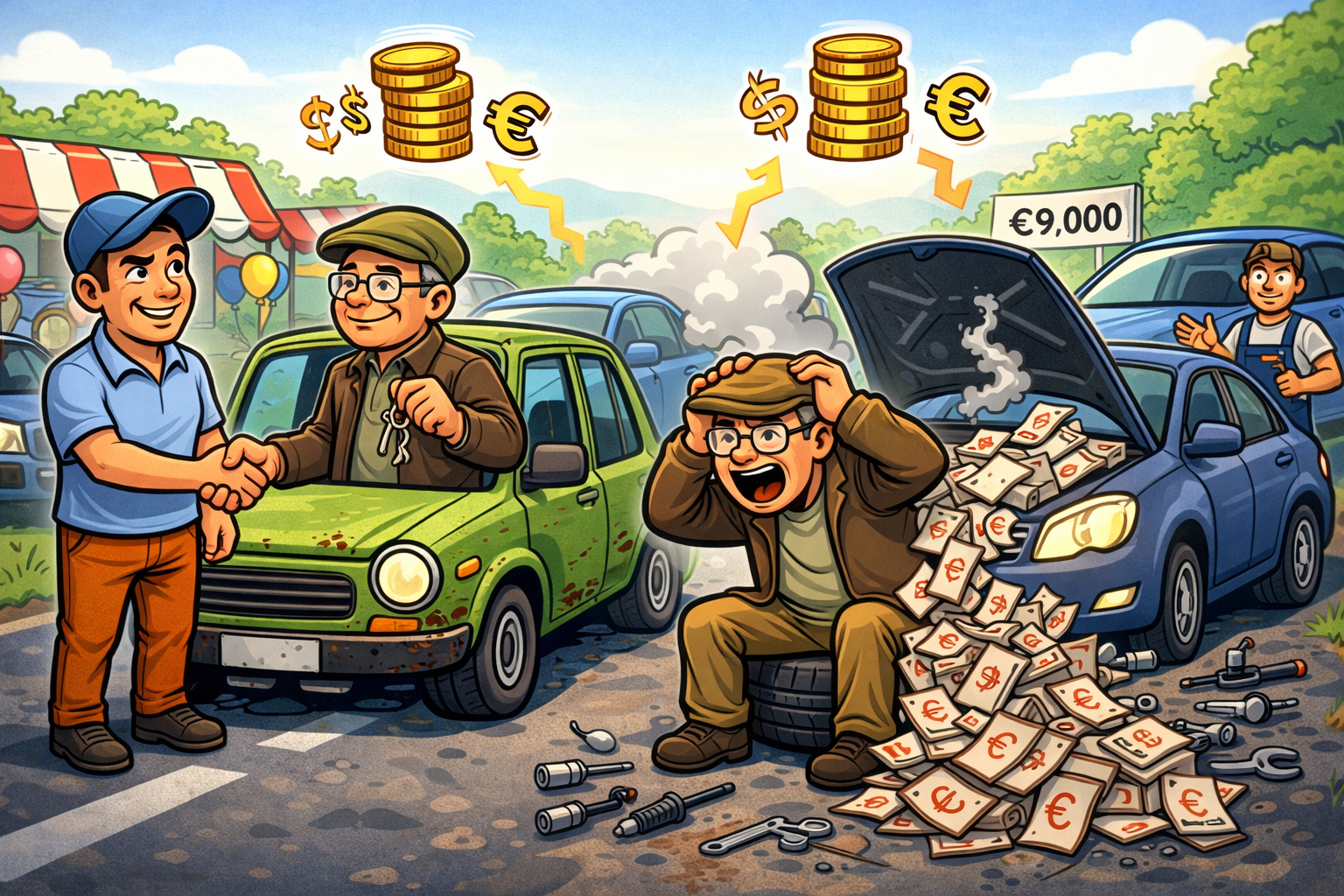
There is a very common way of thinking that appears almost every time someone buys a car: “I’ll take something cheaper — at least I’ll spend less.” And on one hand, it sounds logical. If the car costs less, then the overall expenses should also be lower. But in reality, this is one of the most dangerous assumptions in the car world.
Because a “cheap car” very often means only one thing — a lower purchase price. And that is just the beginning. The rest of the story often starts exactly after the keys are already in your pocket.
In this article, we will look at why a cheap car can become an expensive mistake, what hidden mechanisms are behind it, and why sometimes it is better to pay more upfront than to keep paying continuously afterward.
A low price often means a postponed problem
Cars are rarely sold cheaply without a reason. Of course, there are exceptions. But in most cases, a low price means that something has been “postponed.” A repair that hasn’t been done. A part that will soon need replacement. A problem that is not yet critical but is getting closer.
And this is the moment where buyers often make a mistake. They see the price, but they don’t see the future. They think: “For now, everything works.” But the question is not about today. The question is about the coming months.
Driver experience: “I bought a cheap car because it seemed like a good deal. In the first 3 months, I invested as much as the car itself cost.”
Repairs don’t come one by one — they come in waves
Another reality — if a car is worn out, problems usually don’t come one at a time. They come together.
You fix one thing — another appears. You replace one part — another turns out to be on the edge. And this creates the feeling that you are constantly repairing something.
And this is where financial fatigue begins. Because it is no longer one large payment. It is many smaller ones, but frequent. And together they often exceed the initial “savings.”
Fuel consumption is often higher
Cheap cars are often older. And older cars are almost always less efficient.
This means higher fuel consumption. And this is one of those costs that a person feels every week.
If you overpay just a few euros every week on fuel, it turns into hundreds over a year. And suddenly that “cheap car” no longer looks so cheap.
Reliability = also a cost
There is another thing people often don’t include in calculations — reliability.
If a car breaks down frequently, it costs not only in repairs. It costs in time. In stress. In unexpected situations.
For example — you are late for work because the car won’t start. You need a tow truck. You have to change plans. And all of this is a “cost” that does not appear in any calculator.
“The cheapest car I’ve owned was also the most expensive in terms of stress.”
A cheap purchase often means a more expensive sale
When it comes time to sell the car, reality shows up again. A cheap car often means lower demand and a lower price in the future.
And if you have invested in repairs during that time, you will almost never get that money back.
As a result, the overall financial outcome is often worse than if you had chosen a higher-quality car from the beginning.
A real comparison
Two people. One buys a car for €3000. The other — for €6000.
The first saves money upfront. But within a year:
- repairs: +€1500
- fuel: +€300 more
- unexpected expenses
The second pays more initially but drives more calmly, repairs less often, and the total cost may actually be lower.
And this is where the main conclusion lies — car costs do not start with the price, but with what happens after the purchase.
When is a cheap car actually okay?
Of course, there are situations where a cheap car is a logical choice:
- if you drive rarely
- if you can repair it yourself
- if it is a temporary solution
But for daily use, it is often not the most optimal option.
Conclusion
A cheap car is not cheap when you look at the bigger picture. It may only be cheap at the beginning.
The real costs are hidden in time — in repairs, fuel, wear, and reliability.
And perhaps the most important thing — a good decision when choosing a car is not about the lowest price. It is about the smartest long-term choice.