
 LV
 EN
 RU
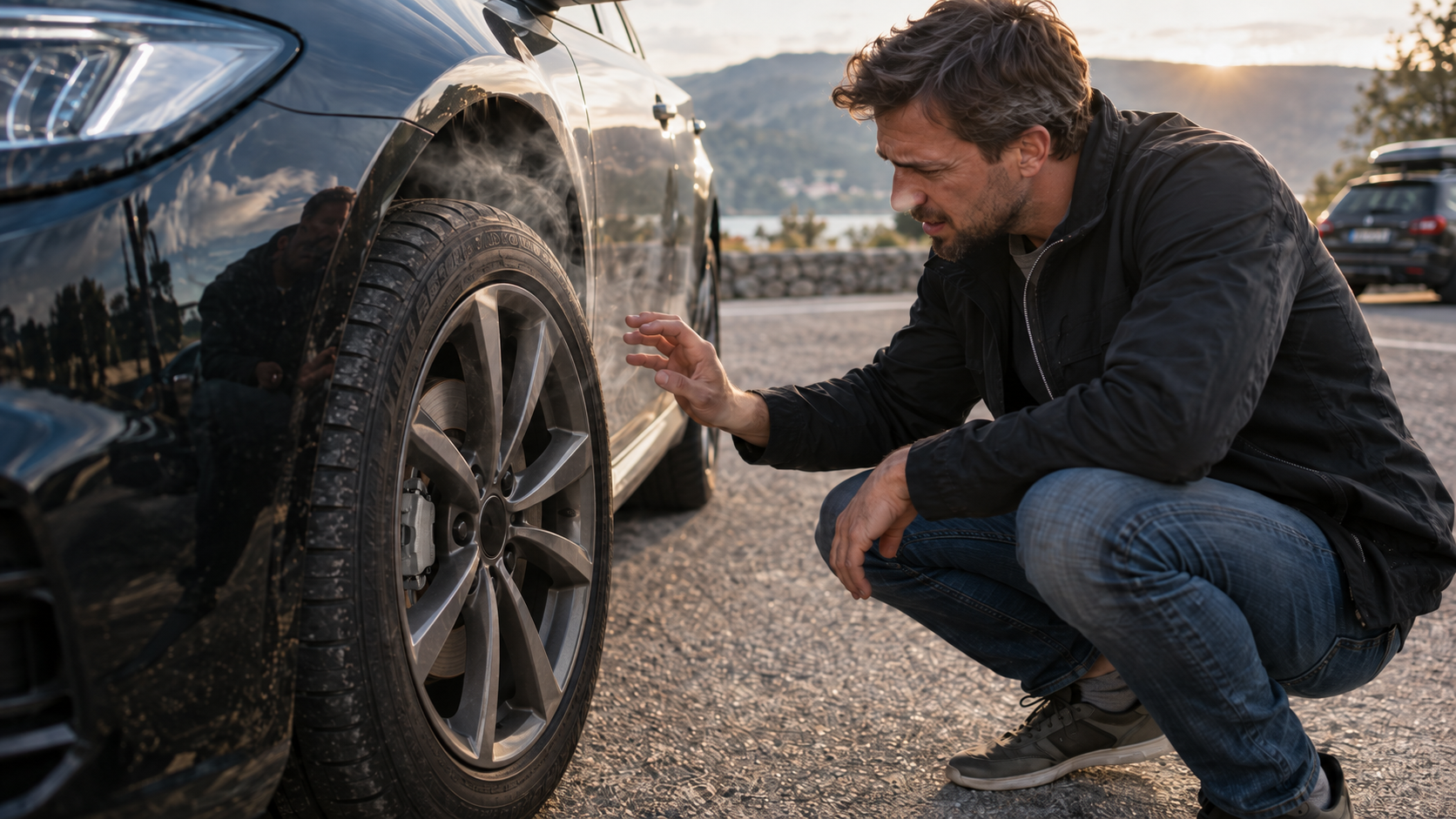
You drive twenty kilometres through town. No emergency stops, no long mountain descent and no aggressive driving. You park outside the house, get out and after a few steps notice an unusual smell. It is not exhaust fumes and it does not smell like a normally hot engine. It is closer to heated metal, scorched dust or something between overheated brakes and burning rubber.
You walk around the car and the smell becomes unmistakably stronger near one wheel. Bring your hand close to the wheel without touching it and you can feel heat radiating from it. The wheel on the opposite side does not feel the same.
The first question is usually: has the brake calliper seized?
Very possibly. But the word “calliper” is not yet a diagnosis. The calliper piston may fail to retract. The guide pins may be corroded or sticking. A brake pad may be jammed in its carrier. Hydraulic pressure may fail to release after the pedal is released because of a damaged brake hose. At the rear, the parking-brake cable, the mechanism inside the calliper or an electronic parking brake may fail to release completely.
And sometimes the source of the heat is not the brake calliper at all. A severely worn wheel bearing can generate significant friction and heat. Drum brakes can suffer from sticking shoes or parking-brake components. After incorrect brake work, pads can sit so tightly in their carrier that they cannot move away from the disc properly after braking.
This symptom should not be ignored because dragging brakes can enter a self-reinforcing cycle. The pad rubs against the disc, heat builds, components expand, friction can increase further, the friction material overheats, the disc leaves its intended operating range and heat spreads into the calliper and brake fluid.
At first the driver may notice nothing more than a smell. Later the car may stop rolling as freely, begin pulling to one side, use more fuel or develop vibration. In a more severe situation, braking performance can deteriorate precisely when it is needed most.
That is why one unusually hot wheel is not simply an interesting temperature difference. It is a symptom whose cause should be found before the next long journey.
Quick answer
If one wheel is significantly hotter than the opposite wheel on the same axle after ordinary driving and there is a noticeable burning-brake smell, a brake that is not releasing fully is a strong possibility. Common causes include a sticking calliper piston, seized calliper guide pins, a brake pad binding in its carrier, a damaged or internally restricted brake hose and a parking brake that is not releasing. At the rear, an electronic parking brake or drum-brake mechanism can also be responsible. If there is visible smoke, the wheel is extremely hot, the car pulls strongly, the pedal feels different or a warning light appears, do not continue driving. Allow the assembly to cool naturally and have the vehicle taken to a workshop without further brake loading — by recovery truck in more serious cases.
The important point is not whether brakes become warm after driving. Brakes are supposed to generate heat. What is concerning is a large temperature difference between similarly loaded wheels after normal driving, especially when accompanied by a burning smell, increased rolling resistance or the car pulling to one side.
Is a brake disc supposed to get hot?
Yes. The job of the braking system is to convert the vehicle's kinetic energy mainly into heat. Every time you slow down, the pads are pressed against the disc, friction is created and the brake assembly becomes hotter.
After city driving, all four brake discs may be warm or hot. After heavy braking they can become extremely hot. After a long downhill section, temperatures can be higher still.
So you cannot diagnose a fault simply because “the disc was hot”.
The comparison is much more useful. If the left-front wheel is merely warm after gentle driving but strong heat and a burning smell are coming from the right-front wheel, that difference has real diagnostic value.
The front and rear brakes will not necessarily run at the same temperature either. On many cars, the front axle performs a larger share of the work during normal braking. It is therefore more useful to compare the left and right wheels on the same axle than to expect all four corners to have identical temperatures.
Never test an overheated brake disc with your finger
This sounds obvious, yet people do it surprisingly often. A brake disc can easily be hot enough to cause a serious burn while looking completely ordinary.
Do not touch the disc, calliper or even the central part of the wheel until you know how hot the assembly is. If you want to compare temperatures, a safer approach is to use an infrared thermometer from a distance and measure the same location on both wheels of the same axle.
Even then, do not turn one temperature reading into a universal diagnosis. Brake temperature depends heavily on the most recent braking events, vehicle weight, disc size, weather and the exact point being measured. Different surface finishes can also affect infrared measurements.
The abnormal difference under comparable conditions is usually more useful than one supposedly “correct” temperature.
What can the symptom tell you before anything is dismantled?
| What you notice | What it suggests checking |
|---|---|
| One front wheel is much hotter after normal driving | Calliper piston, guide pins, free pad movement, brake hose |
| One rear wheel becomes hot after using the parking brake | Parking-brake cable, parking-brake mechanism in the calliper, EPB, drum/shoe mechanism |
| The car does not roll freely and there is a sharp burning smell after stopping | Persistent brake drag — a pad is not releasing from the disc properly |
| One pad is much more worn than the other in the same calliper | Calliper guide pins, piston or a pad binding in its carrier |
| Disc has blue/dark discolouration or pads have become shiny/glazed | Previous thermal overload — the reason for the overheating must be identified |
| Heat accompanied by humming, but little typical brake smell | A wheel-bearing problem should also be ruled out |
| Problem began immediately after replacing pads or discs | Installation, free pad movement, guide pins, piston retraction, parking-brake adjustment |
1. Seized brake-calliper piston
This is one of the classic causes. When you press the brake pedal, hydraulic pressure moves the calliper piston outward and pushes the pad against the disc. When the pedal is released, hydraulic pressure falls and the assembly must release sufficiently so the pad is no longer being forced hard against the disc.
If corrosion, contamination, a damaged dust boot or another fault prevents the piston from moving freely, it may remain too far extended after braking.
The result is continuous friction.
HELLA specifically lists a sticking calliper piston among the causes of brake-pad thermal overload and excessive wear. The consequences can include overheating, uneven wear, noise and poorer braking performance.
For the driver, this can appear as a hot wheel, a burning smell and the impression that the car no longer rolls as freely as it used to. Sometimes the vehicle begins pulling to one side, although the direction of the pull alone is not enough to identify the failed component.
If the piston has been sticking for a long time, the pads may not be the only damaged parts. The disc may have suffered thermal overload, while the calliper seals and brake fluid may have been exposed to far more heat than intended.
2. Corroded or seized calliper guide pins
Many passenger cars use floating brake callipers. These have one or more pistons on one side, while the calliper body itself slides on guide pins so the pad on the opposite side of the disc can also be applied.
In such a system, free movement of the guide pins is not a minor detail — it is part of the basic operation of the calliper.
HELLA explains that contaminated, stiff or seized guide pins can cause uneven pad wear, one-sided braking, increased heat build-up, brake-disc overheating and noise even when the brake pedal is not being pressed.
A very typical workshop finding is one pad in a calliper being worn almost down to the backing plate while the other still has a large amount of friction material remaining.
That is not simply “a strange set of brake pads”. It is a clue that force and movement inside the calliper have not been distributed correctly.
The guide pins need to be properly cleaned, their protective boots must be intact and the lubricant must be suitable for the particular braking system. HELLA also warns that unsuitable lubricant can damage rubber components and create additional faults.
3. A brake pad is stuck in its carrier
The calliper piston can be perfect. The guide pins can move freely. And yet the brake can still fail to release.
Why? Because the brake pad itself must be able to move correctly within its carrier.
Corrosion can build up underneath stainless-steel pad guide plates. This lifts the plate and reduces the available clearance. If the carrier has not been cleaned correctly or the pad does not fit properly, the pad can become clamped in place.
HELLA describes this exact situation: corrosion and dirt underneath the guide plate can lift it, causing the pad to bind so there is insufficient clearance after the brake is released. The result can be thermal overload, premature wear and noise.
This is also why the statement “I have just fitted new pads and now the wheel gets hot” should not automatically be dismissed as normal bedding-in.
If a pad is mechanically jammed, additional driving will not cure it. It will only continue creating heat.
4. A brake hose is preventing hydraulic pressure from releasing properly
This is a particularly interesting cause because the hose may not look dramatically damaged from the outside.
The flexible brake hose connects the fixed hydraulic line on the body to the moving brake assembly at the wheel. It must withstand hydraulic pressure, steering movement, suspension travel, temperature changes, road salt and ageing.
HELLA's brake inspection guidance recommends checking hoses not only for leaks, porosity and rubbing damage but also for changes in their internal diameter or swelling.
If the hose is damaged internally or restricted, a situation can develop where the high hydraulic pressure created by pressing the pedal is sufficient to apply the brake, but after the pedal is released the pressure at that wheel cannot return as freely as it should.
The calliper may then be incorrectly blamed even though part of the real problem is located a few tens of centimetres away inside the hose.
A workshop can distinguish this by checking whether hydraulic pressure remains trapped at the wheel and whether the brake releases when that pressure is removed in a controlled diagnostic procedure. This is not something to experiment with at the roadside — the hydraulic braking system is safety-critical.
5. Parking-brake cable or mechanism is not releasing a rear wheel
If one rear wheel is overheating, especially after the parking brake has been used, do not focus only on the hydraulic calliper piston.
On many cars, a mechanical parking brake uses cables to apply the rear brakes. The cable must not only pull the brake on — it must also return freely when the lever or pedal is released.
If the outer protective casing is damaged, water and dirt can enter. Corrosion may develop and the cable can begin sticking. In cold weather, trapped moisture can also freeze.
HELLA describes a practical parking-brake repair example in which contamination and corrosion inside a Bowden cable restricted its movement. After the parking brake is released, the rear wheels must again be able to rotate freely.
That means the symptom “the parking brake felt unusually stiff this morning and later one rear wheel began to smell” carries very different diagnostic information from simply saying “the calliper is hot”.
6. Electronic parking brake or rear-calliper mechanism
Many modern vehicles use an electronic parking brake, or EPB, instead of a traditional mechanical handbrake lever. Depending on system design, an electric actuator can operate directly on the rear calliper or through another mechanism.
On such a vehicle, saying “the handbrake cable has seized” may not apply at all because there may be no cable.
Instead, there can be problems with the actuator, the mechanism inside the calliper, wiring, position control or an incorrectly performed service procedure.
This becomes particularly important after rear-pad replacement. Many EPB systems require a specific service mode before work begins and a defined reset, initialisation or return-to-operating-position procedure afterwards.
Even on conventional rear callipers with an integrated mechanical parking-brake mechanism, the piston often cannot simply be forced straight back into the housing. HELLA notes that certain designs require the piston to be pressed and rotated simultaneously using the appropriate tool. An incorrect procedure can damage the mechanism.
7. Drum brakes or separate parking-brake shoes remain applied
Not every rear wheel uses a simple disc-and-calliper arrangement.
Some vehicles still use rear drum brakes. Others use a normal rear brake disc for the service brake but have small separate parking-brake shoes inside the central “hat” section of the disc.
In these mechanisms, brake shoes, return springs, the adjuster or parking-brake actuation system can stick. The result for the driver is exactly the same — the wheel rotates against constant resistance and begins to overheat.
The context of recent repairs or long storage becomes particularly useful here. After months without driving, corrosion may be involved. After brake work, adjustment may be incorrect. After using the parking brake in freezing weather, a cable or mechanism may remain partly applied.
That is why an overheating rear wheel should not automatically be diagnosed as “the calliper piston” before anyone has even established what type of braking system is fitted to the vehicle.
8. The wheel bearing, not the brake, is overheating
This is a less common but important alternative.
A wheel bearing is designed to allow the wheel to rotate with very little resistance. If it becomes severely worn, damaged, incorrectly installed or loses proper lubrication, friction can increase.
Usually a wheel bearing will produce other symptoms before severe overheating develops: humming, growling, vibration or noticeable play. The sound changes with vehicle speed and sometimes with cornering load.
If the wheel is hot but the pads and disc do not show the usual signs of brake overheating, while the wheel has already been humming for some time, the bearing should not be forgotten.
At the same time, remember that brake heat transfers very easily into the hub and bearing. A warm hub does not prove a bearing fault by itself — the actual source of the heat still has to be identified.
9. The problem began after brake work — and it is not simply “normal until it beds in”
If one wheel began overheating immediately after pads, discs, a calliper or the parking brake were repaired, that fact is very important information for the workshop.
New pads do need to bed against the disc surface, and their friction behaviour can differ during the first kilometres. But one wheel becoming extremely hot and producing a strong burning smell after gentle driving is not something that should automatically be labelled normal bedding-in.
The technician should check whether the pads move freely in the carrier, whether the guide pins are sticking, whether the piston was retracted correctly, whether the correct parts and fasteners were used, whether the rear parking brake was correctly adjusted and whether a flexible brake hose was twisted during the work.
HELLA's professional brake-service guidance emphasises that calliper guides must move freely and pads must be fitted correctly, while contaminated or stiff guides and restricted pad movement can lead to overheating.
The timing alone does not prove a workshop made an error. But it is far too useful diagnostically to leave out of the discussion.
Why does a dragging brake heat up so quickly?
Even relatively light continuous friction can generate an enormous amount of heat when it continues for several kilometres.
During normal braking, friction happens for a limited period. You press the pedal, the brakes absorb energy, then you release the pedal and the system begins cooling.
With a dragging brake, that cooling phase barely arrives. The pad continues sliding against the disc through hundreds and thousands of wheel revolutions.
Even if the driver cannot feel a huge amount of resistance, the heat accumulated after 10–20 kilometres can already be substantial.
HELLA identifies thermal overload, premature wear and deterioration in braking characteristics as possible consequences of sticking pistons, guide pins and pads.
What does overheating do to the pads and disc?
An overheated brake pad does not necessarily just look “more worn”. Its friction material can glaze, become brittle, crack or lose the friction characteristics for which it was designed.
The disc can develop local thermal changes, discolouration or an uneven surface condition. If a thermally damaged disc is left in place and only new pads are installed, the problem may continue in another form.
That is why repairing a seriously dragging brake does not always end with “we freed the piston”. The technician also needs to assess what prolonged heat has already done to the surrounding components.
What happens to the brake fluid?
This is where a hot wheel turns from a purely mechanical issue into a hydraulic safety concern.
The calliper sits directly next to the heated disc and pads. Part of that heat is transferred through the piston and into the brake fluid.
If brake fluid reaches its boiling point, vapour bubbles can form. Unlike liquid, gas can be compressed. The driver may experience this as a longer, softer or “spongier” brake pedal.
Old brake fluid with increased moisture content can have a lower boiling point than fresh fluid. That is why prolonged overheating at one wheel is not merely a question of how long the pads will survive.
For more on brake-fluid ageing, moisture and boiling points, see “How Often Should You Change Brake Fluid? Why Does It Absorb Moisture and What Do DOT 3, DOT 4, DOT 5 and DOT 5.1 Really Mean?”.
Why can the car pull to one side?
If one wheel is being lightly braked all the time, the vehicle experiences additional resistance on one side. The driver may notice that the car does not roll freely on a level surface or tends to pull sideways.
But even here, an overly simple rule is not reliable.
While driving without braking, the pull can be caused directly by brake drag. But after severe overheating, the affected brake may begin performing poorly during actual braking because the pad or disc has been thermally damaged. The vehicle's behaviour can then change.
So the direction of the pull alone is not enough to say “this is definitely the hot wheel”. The brakes need to be measured and inspected.
Why can the parking brake fail to release after a car wash or freezing night?
Moisture can enter mechanical parking-brake cables and components. If their protective coverings are already damaged, the problem becomes more likely.
In winter, water can freeze and prevent the cable from moving freely. After a car wash or very wet journey, the symptom may appear the following morning.
The driver releases the lever and everything appears normal inside the cabin, yet the mechanism at the wheel does not return fully.
After just a few kilometres, the result can be a hot rear wheel and a strong brake smell.
HELLA notes that moisture and frost can cause parking-brake cables to freeze, while corrosion and contamination can restrict their normal movement.
Should you pour cold water over overheated brakes to cool them faster?
No — deliberately pouring cold water over a severely overheated brake disc is not a good idea.
A very rapid temperature change creates thermal shock. Water hitting extremely hot components can also turn to steam immediately and create a burn hazard.
If the brakes have overheated, park the vehicle safely, switch off the engine if appropriate and allow the assembly to cool naturally.
If the car is on a slope and you suspect the parking brake itself is causing the fault, do not leave the vehicle unsecured. In that situation, safely securing the vehicle and obtaining professional assistance are more important than experimenting with the brake mechanism.
Does a strong brake smell always mean a seized calliper?
No.
After very hard braking, a long downhill section or controlled bedding-in of new brakes, a noticeable smell can appear even when the braking system is working correctly.
Once again, context is the key.
If you have just completed a long mountain descent and all four brakes are hot, the smell alone does not prove a fault.
If you have driven ten kilometres gently on a flat road with one light stop before arriving home and one wheel is dramatically hotter than the opposite wheel and smells strongly, that is a completely different situation.
What can you safely check yourself in five minutes?
- Remember the driving conditions. Had you just driven down a hill and used the brakes heavily, or was it a gentle journey?
- Identify where the smell is strongest. Do not touch the brake disc or calliper.
- Compare the two wheels on the same axle. If you have an infrared thermometer, measure the same location on both sides.
- Look at the disc through the wheel. Strong blue or dark discolouration can indicate thermal overload.
- Watch for smoke. Smoke from the wheel area is much more serious than ordinary warmth.
- Think about how the car rolls. Has it recently felt “heavier” and begun losing speed more quickly when coasting?
- Think about the parking brake. Did the problem begin after using it, especially in freezing weather or after washing the vehicle?
- Do not crawl underneath a vehicle supported only by a jack. Wheel-drag, calliper and hydraulic checks are safer on a proper lift or secure axle stands.
Can you jack up the wheel and check whether it spins freely?
In a workshop, this is one logical part of the diagnostic process. If a brake is not releasing, a raised wheel may be much more difficult to turn than the opposite wheel.
But the result has to be interpreted correctly. Driven wheels can also have resistance from the differential and transmission. A small amount of pad contact with the disc is normal on many cars. Electronic parking-brake systems have their own designs and procedures.
And a car supported only by its emergency jack is not a safe place to put your hands around the wheel and brake assembly.
So comparing wheel rotation is useful in a workshop, but at home safety matters more than proving the diagnosis yourself.
How does a workshop distinguish a sticking piston from guide pins or a brake hose?
This is where real diagnosis begins.
First, the technician confirms which wheel is braking itself. Then the pad-wear pattern, calliper movement, guide pins, protective boots and piston are inspected.
If the brake is mechanically binding, the technician needs to establish whether the problem lies in the piston, guide pins or a pad jammed in the carrier.
If trapped hydraulic pressure is suspected, the hose and the rest of the hydraulic circuit need to be checked. A technician can determine diagnostically whether the brake releases once the trapped pressure is removed.
At the rear, the mechanical parking-brake cable or EPB system also needs separate consideration.
And after the cause has been found, the consequences must be assessed: pad condition, disc heat damage, seals and, where appropriate, the condition of the brake fluid.
A “hot calliper” does not automatically mean “buy a new calliper”. First establish whether the brake is being held on by the piston, guide pins, a jammed pad, the parking brake or trapped hydraulic pressure.
Can you simply free up the calliper and keep driving?
Sometimes an old calliper can be moved mechanically and the wheel appears to rotate normally again for a while. That does not mean the fault has been repaired.
If a corroded piston has already seized once, its surface, seal or dust boot may be damaged. If a guide pin has been dry and rusty, simply forcing it to move without proper cleaning and servicing may produce only a temporary improvement.
And if the real cause is a restricted brake hose, “freeing the piston” does nothing to solve the underlying problem.
A temporary result is not sufficient in a braking system. The important question is whether the assembly can operate correctly and repeatedly after the repair.
Should the pads and discs be replaced on both sides?
If the brakes at one wheel have suffered severe overheating, the workshop needs to assess both the affected components and the opposite side of the same axle.
Brake pads and discs are generally replaced in axle pairs so braking characteristics remain as similar as possible on the left and right sides.
HELLA's professional brake-repair guidance recommends replacing brake discs in axle pairs and fitting new pads with them.
This does not mean every minor guide-pin fault automatically requires replacement of the entire braking system. But after serious overheating, the components should be assessed according to the damage they have actually suffered, not merely by how much pad thickness remains.
Can you drive to a workshop with one hot wheel?
This is one of those situations where it is important to resist giving a universal answer such as “yes, just drive slowly”.
If one wheel has become significantly overheated after gentle driving and there is a burning smell, the braking system is already not operating normally. Every additional kilometre may continue generating more heat.
The driver also has no way of knowing how close the system is to the next stage — damaged pad material, disc thermal overload, boiling brake fluid or a more complete seizure of the mechanism.
If the heat difference is small, there is no smell, smoke, pulling or change in braking performance and the difference was noticed only through measurement, professional inspection is still appropriate, but the situation may not be an immediate emergency.
If the wheel is clearly overheating and smells strongly, the safer choice is not to continue until the cause is understood.
Vehicle recovery is particularly appropriate if:
- smoke is coming from the wheel area;
- the burning smell is very strong and the wheel is radiating intense heat;
- the vehicle pulls strongly to one side;
- the brake pedal has become softer, longer or otherwise unusual;
- significant vibration has appeared during braking or braking has become noticeably uneven;
- the red brake-system warning light or another serious warning has illuminated;
- the wheel becomes extremely hot again very quickly after a short drive;
- it is unclear whether the fault is in the brake, wheel bearing or another safety-critical wheel component.
For more on other dangerous brake symptoms, see “Brakes Squeaking, Vibrating or the Pedal Feels Soft: When Can You Drive and When Must You Stop Immediately?”.
Mini test: what is most likely keeping the brake applied?
The right-front wheel smells and is much hotter after 15 km in town. The inner pad is almost worn out while the outer pad still has plenty of material.
The calliper needs to be checked — piston, guide pins and free pad movement. The wear pattern helps narrow the diagnosis, but simply replacing the pads is not enough until the cause has been identified.
After braking, one front wheel remains partially applied, but the calliper does not appear badly corroded mechanically.
Trapped hydraulic pressure needs to be ruled out. One possible local cause is a damaged or internally restricted flexible brake hose.
After a freezing night, you release the parking brake, but three kilometres later one rear wheel begins to smell.
The parking-brake cable or mechanism becomes a very logical suspect. Moisture, corrosion and freezing can prevent the mechanism from returning completely.
The wheel began overheating immediately after new brake pads were installed, and there was no problem before the repair.
Check whether the pads move freely in the carrier, corrosion beneath the guide plates, calliper guide pins, piston retraction and the overall installation. Serious one-sided overheating should not simply be dismissed as bedding-in.
The wheel has been humming for several weeks. Now the hub is becoming unusually warm as well, but there is little obvious brake smell.
A wheel-bearing fault should be ruled out. The workshop should still establish whether the heat is genuinely being generated inside the bearing rather than originating from the brake and spreading into the hub.
After a mountain road, all four wheels are hot and there is a brake smell.
This can result from heavy but otherwise normal thermal loading after prolonged braking. However, if the pedal begins feeling soft or braking performance falls, stop safely and allow the brakes to cool. On future descents, use an appropriate gear and engine or regenerative braking rather than holding the brake pedal continuously.
Myths and facts
| Claim | Myth or fact? | Explanation |
|---|---|---|
| One extremely hot wheel after gentle driving can indicate a brake that is not releasing. | Fact | Especially when the temperature differs significantly from the opposite wheel and there is a burning smell. |
| If one wheel is hot, the complete calliper always needs replacing. | Myth | The cause can be the piston, guide pins, pad, hose, parking brake or another component. |
| Corroded calliper guide pins can cause overheating. | Fact | If a floating calliper cannot move correctly, pad release can become uneven and heat can build up. |
| A brake hose cannot cause brake drag if it is not leaking externally. | Myth | Internal damage or restriction can interfere with normal release of hydraulic pressure. |
| One very hot wheel after fitting new pads is always normal bedding-in. | Myth | Some smell can occur under certain conditions, but pronounced one-sided overheating needs diagnosis. |
| An overheated calliper can affect brake fluid as well. | Fact | Heat transfers into the hydraulic system; excessive temperatures can compromise braking performance. |
| The best way to cool an overheated disc is to pour cold water over it. | Myth | Allow the brakes to cool naturally; rapid temperature change and steam create unnecessary risks. |
Frequently asked questions
Why is one wheel much hotter than the others?
After normal driving, one significantly hotter wheel often suggests checking whether that brake is releasing completely. Possible causes include a sticking calliper piston, seized guide pins or pad, a hydraulic hose problem or the parking-brake mechanism. A wheel-bearing fault should also be ruled out.
How can you tell whether a brake calliper is seized?
Typical clues include one hot wheel, a burning smell, uneven pad wear, increased rolling resistance and sometimes the vehicle pulling to one side. However, the exact part of the calliper must be identified, and trapped hydraulic pressure or a parking-brake problem also needs to be ruled out.
Can you drive with a seized brake calliper?
If the wheel is clearly overheating or there is a strong burning smell, continuing a normal journey is not recommended. Continued friction can damage the pads and disc and overheat the brake fluid. If there is smoke, strong pulling or a change in pedal feel, the vehicle is better transported to a workshop.
Can a seized calliper increase fuel consumption?
Yes. A wheel that is constantly being lightly braked creates additional rolling resistance that the engine or electric motor must continuously overcome. Fuel or energy consumption can increase, although that is secondary to the overheating and braking-safety risks.
Why does a wheel get hot after new brake pads have been fitted?
Check that the pads are installed correctly and move freely in their carrier, that the calliper guide pins are not corroded and that the piston was retracted correctly. Significant one-sided overheating after brake work should not automatically be treated as normal bedding-in.
Can the brake hose be responsible even if the calliper itself is good?
Yes. An old or internally damaged flexible brake hose can restrict fluid movement. The brake can still be applied by high hydraulic pressure, but pressure at the wheel may not release normally afterwards.
Why is only one rear wheel getting hot?
In addition to the rear calliper, inspect the parking-brake system. Depending on the vehicle, this may be a mechanical cable, a mechanism built into the rear calliper, an electronic EPB system or separate parking-brake shoes inside a drum.
Should brake fluid be changed after repairing a seized calliper?
Not automatically after every mild case, but after significant overheating the condition and service history of the fluid should be evaluated. If the fluid has been exposed to substantial heat or its replacement interval has already been exceeded, the workshop may reasonably recommend replacement according to the requirements of the specific vehicle.
Conclusion
One very hot wheel is one of those vehicle symptoms that can look surprisingly harmless at first.
The car still drives. There may be no warning lights on the dashboard. The brake pedal can still feel normal. There may be no visibly broken component.
Just the smell and the heat.
But that is exactly what makes the fault important: one brake may be partly applied continuously even though the driver does not experience it as a separate braking event.
Every kilometre means more friction. More heat. More thermal loading of the pad and disc.
A sticking brake calliper is indeed one of the first suspects, but the diagnosis does not end with the word “calliper”.
The piston can seize. A floating calliper can have corroded guide pins. A pad can become mechanically trapped in its carrier because of corrosion. A hose can prevent hydraulic pressure from releasing. At the rear, a parking-brake cable, electronic parking brake or separate drum mechanism may remain applied.
And sometimes the brakes are blamed incorrectly — the heat and noise may be coming from the wheel bearing.
That is why the most useful first observation is not simply “the calliper is hot”. It is much more precise: which wheel is hot, after what kind of driving, and how different is it from the opposite wheel on the same axle?
The second useful detail is timing. Did the problem appear after using the parking brake? After freezing weather? After a car wash? Immediately after new pads were installed? After calliper work?
The third is the group of accompanying symptoms. Burning smell. Smoke. Increased rolling resistance. Pulling to one side. A changed brake pedal. One pad wearing significantly faster than the other.
Those details turn the vague statement “one wheel gets hot” into a much more focused diagnostic direction.
It is also important to understand that prolonged overheating does not stop at the component that originally began sticking. It can damage pads and discs, thermally stress calliper seals and raise brake-fluid temperature. A relatively small initial fault can therefore turn into a much larger repair if it is ignored for long enough.
That is exactly why you should not try to “drive through” the problem. If a brake is binding because of corrosion, incorrect assembly or a hydraulic fault, additional kilometres will not repair it.
There is also no benefit in pouring cold water over an overheated disc or touching it by hand to find out “how hot it really is”.
Stop somewhere safe. Allow the components to cool. Remember which wheel was hot and what happened before the symptom appeared. And if there is a strong burning smell, smoke, pulling, changed pedal feel or rapid repeated overheating, do not turn the next journey into another diagnostic experiment.
A braking system should not be reliable only on the day of a vehicle inspection. It needs to behave predictably every single time you press the pedal.
Driver's short takeaway: if one wheel is much hotter than the opposite wheel on the same axle after normal driving and there is a burning smell, first suspect a brake that is not releasing fully. The cause may be a sticking calliper piston, seized guide pins, a brake pad trapped in its carrier, an internally damaged brake hose or the parking-brake mechanism. At the rear, do not forget EPB systems and drum/parking-brake shoes, while humming also means a wheel bearing should be ruled out. Do not touch a hot disc and do not pour cold water over it. Serious one-sided overheating after new pads have been fitted should not simply be dismissed as bedding-in. If the wheel smells strongly, smokes, the car pulls, the pedal feels different or the overheating quickly returns, stop driving — brake drag can rapidly damage the pads and disc and thermally overload the brake fluid as well.
Sources and technical note
The technical information in this article was checked against HELLA TechWorld material covering diagnosis of brake-pad and brake-disc thermal overload, sticking calliper pistons, floating-calliper guide pins, corrosion around brake-pad guide plates, inspection of brake hoses and lines, mechanical and electronic parking-brake systems and rear-calliper service procedures. HELLA technical information identifies sticking pistons, restricted guide-pin movement and brake pads binding in their carriers as possible causes of overheating and uneven wear, while corrosion, contamination, moisture and frost can restrict the movement of parking-brake cables. The exact calliper design, minimum brake-component dimensions, EPB service procedure, fastener torque, lubricant and brake-fluid specification must always be taken from the technical documentation for the specific vehicle.